
View Our Recent Work:

Yacht automation is defined as the integration of marine-grade electronic, mechanical, and software subsystems to control navigation, safety, power, and comfort features from a single interface. This automating yacht systems guide covers everything from choosing the right components to programming your first automation rules and keeping the whole system running reliably in Florida’s salt-air environment. The industry backbone for this integration is NMEA 2000, a standardized protocol that lets your engine, sensors, and navigation instruments share data across one network. When done right, automation reduces crew workload, catches problems before they become failures, and turns a complex vessel into something genuinely enjoyable to operate. This guide follows ABYC E-11 safety standards throughout, because convenience should never come at the cost of seamless manual control.
What yacht systems can be automated and how they integrate
Modern yacht automation brings propulsion, power management, navigation, and climate systems into a single control interface. That consolidation simplifies monitoring and raises operational efficiency across the whole vessel. Here are the major subsystems you can automate:
- Propulsion and engine management: Throttle control, trim tabs, and engine monitoring with real-time alerts for oil pressure, temperature, and RPM.
- Navigation: Autopilot, chartplotter integration, AIS transponders, and radar with collision-avoidance alerts.
- Power management: Shore power switching, battery monitoring, inverter control, and generator auto-start when battery voltage drops.
- HVAC and climate: Zone-based air conditioning, ventilation fans, and humidity sensors that adjust output based on cabin occupancy.
- Lighting: Scheduled or sensor-triggered lighting for navigation lights at sunset, cabin mood lighting, and underwater lights.
- Security: Motion sensors, camera feeds, bilge alarms, and fire suppression system alerts.
- Entertainment: Multi-zone audio, satellite TV, and Wi-Fi distribution managed from the same touchscreen as your navigation.
All of these systems communicate through a CAN-bus or NMEA 2000 network. NMEA 2000 enables context-aware automation such as auto-adjusting engine speed during a bilge alarm or activating navigation lights precisely at sunset. Centralized control typically lives on a helm touchscreen, a tablet, or a mobile app, with role-based access so the owner, captain, and guests each see only the controls relevant to them.
What do you need before starting a yacht automation installation?
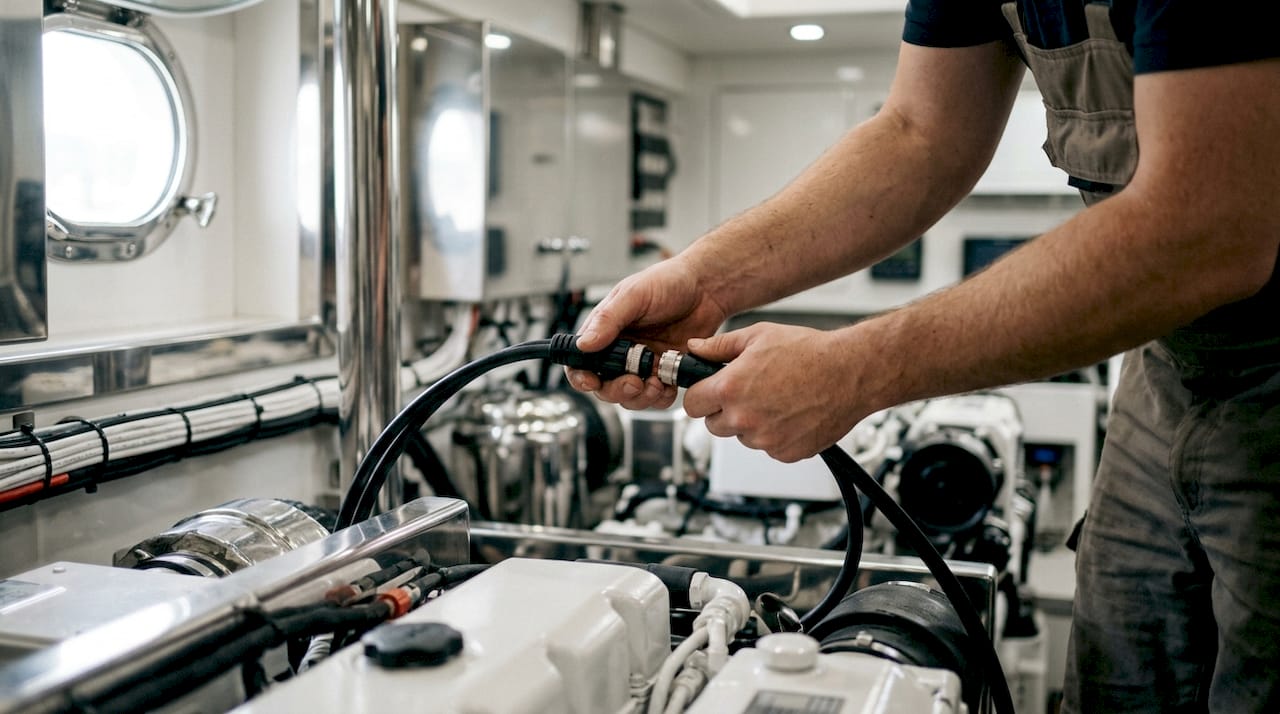
Preparation separates a reliable system from an expensive headache. Marine-grade hardware is non-negotiable. Components designed for salt air, vibration, and power fluctuations reduce failure points and make diagnostics far simpler. Mixing consumer-grade electronics into a marine network causes instability that is genuinely difficult to trace.
| System category | Hardware requirement | Protocol | Safety standard |
|---|---|---|---|
| Navigation | Marine-certified chartplotter, GPS antenna | NMEA 2000 | ABYC E-11 bypass |
| Power management | Marine battery monitors, shore power relay | CAN-bus | Manual override switch |
| Lighting | Waterproof LED drivers, sealed keypads | NMEA 2000 or proprietary bus | Physical dimmer bypass |
| HVAC | Marine-rated control boards, sealed sensors | CAN-bus | Manual thermostat fallback |
| Security/bilge | Bilge pump float switches, sealed cameras | Standalone or networked | Independent float switch |
Critical circuits require manual bypass controls to comply with ABYC E-11. That means navigation lights, bilge pumps, and fire suppression systems must operate independently if the automation layer fails entirely. Cybersecurity is equally serious. Reliable marine IT infrastructure requires careful network design because metal hulls cause interference, multi-deck layouts create dead zones, and satellite hand-offs introduce vulnerabilities. Use a dedicated VLAN for automation traffic, separate from guest Wi-Fi.
Pro Tip: Design your system in modules from day one. A modular automation design lets you add new components without rewiring the whole vessel, and it prevents lock-in to a single proprietary platform.
How do you implement and program yacht automation step by step?
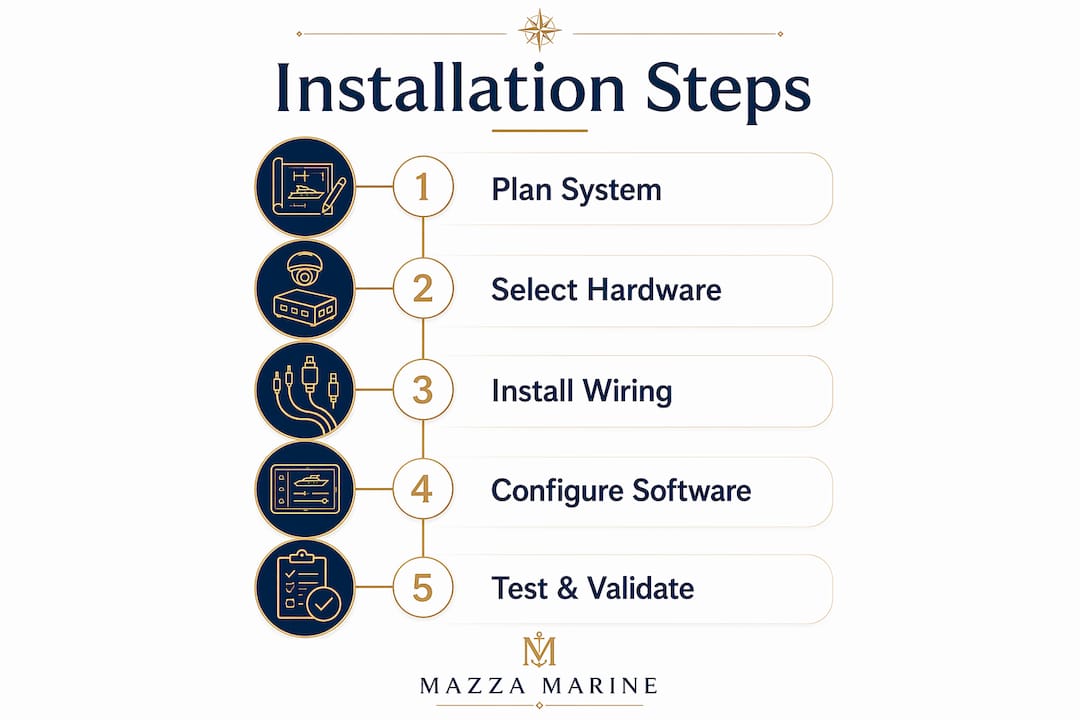
Execution follows a clear sequence. Skipping steps, especially testing, is where most installations go wrong.
- Define your goals. List exactly which systems you want automated and what triggers each action. “Navigation lights on at sunset” is a goal. “Make the boat smarter” is not.
- Audit existing wiring. Map every circuit before touching anything. Older vessels often have undocumented wiring that conflicts with new network nodes.
- Install the network backbone. Run your NMEA 2000 or CAN-bus trunk cable, then add drop cables to each device. Keep runs short and use proper T-connectors with termination resistors at both ends.
- Mount and wire hardware. Install sensors, keypads, relays, and control panels in marine-rated enclosures. Seal every penetration against moisture.
- Program automation rules. Use the control system’s software to define triggers and actions. Start with simple rules: lights on at sunset, bilge pump alert at high water, generator start at 50% battery.
- Test each rule independently. Simulate the trigger condition and confirm the correct response. Do not test multiple rules simultaneously during commissioning.
- Conduct a full crew walkthrough. Every person who operates the vessel needs to know how to use the interface and, critically, how to override any automated function manually.
- Document everything. Create a wiring diagram and a rule log. Future technicians, including Mazzamarine’s Florida network, will thank you.
Legacy hardware upgrades require replacing linked modules in unison because older bus architectures are often incompatible with new processors. If you are retrofitting an existing vessel, plan for a phased replacement rather than mixing old keypads with new control heads.
Pro Tip: Program a “night mode” scene that dims all interior lights, activates navigation lights, and silences non-critical alerts with a single button press. Crew fatigue drops noticeably on overnight passages when the helm environment is calm and controlled.
How do you maintain and troubleshoot automated yacht systems?
Automated systems in a marine environment need regular attention. Salt air, vibration, and UV exposure degrade connectors and seals faster than most owners expect. A quarterly inspection schedule catches problems before they cascade.
- Inspect all connectors and cable runs for corrosion, chafing, and loose terminations. Pay particular attention to any penetration through a bulkhead.
- Test every manual bypass at least twice a year. A bypass that has not been exercised may seize or corrode without anyone noticing until it is urgently needed.
- Update firmware and software on a regular schedule. Remote monitoring and software updates enable early fault detection and allow some issues to be resolved without hauling the vessel.
- Review cybersecurity settings after every software update. Change default passwords, audit connected devices, and confirm your VLAN segmentation is intact.
- Log all faults and alerts. A pattern of repeated bilge pump activations or voltage dips tells a story. Read it before it becomes an emergency.
- Check power quality. Voltage spikes from shore power or generator switching are a leading cause of control board failures. A marine-grade surge protector on the main panel is inexpensive insurance.
For vessels operating in hurricane-prone waters, system reliability under extreme weather depends on more than good hardware. Fuel delivery continuity, generator readiness, and battery backup capacity all feed into whether your automation holds up when conditions deteriorate fast. Pair your technical maintenance with a solid weather-preparedness plan. You can also find detailed guidance on maintaining marine mechanical systems to keep the mechanical side of your automated vessel in top condition.
What are the future trends in yacht automation upgrades?
The next wave of yacht automation builds on what you already have rather than replacing it. The key is choosing systems today that can absorb tomorrow’s technology without a full rebuild.
AI-assisted automation is moving from commercial shipping into the recreational market. These systems analyze historical data from your vessel, such as fuel consumption patterns, engine load cycles, and route history, and suggest adjustments that a human operator would rarely notice. IoT sensors are shrinking in cost and size, making it practical to monitor bilge temperature, hull stress, and refrigeration performance on vessels that previously had no instrumentation at all.
Satellite connectivity has improved dramatically. Low-latency broadband via constellations like Starlink means remote diagnostics and over-the-air updates are now realistic for vessels far offshore, not just marina-bound yachts.
| Upgrade category | Near-term benefit | Future-proofing value |
|---|---|---|
| AI-assisted engine management | Fuel savings, predictive maintenance alerts | High |
| IoT environmental sensors | Real-time bilge, temperature, and humidity data | High |
| Satellite broadband | Remote monitoring, firmware updates offshore | High |
| Renewable energy integration | Solar and wind feeding smart power management | Medium-High |
| Cybersecurity management platform | Threat detection, automated VLAN updates | Medium |
Renewable energy integration is particularly relevant for Florida yacht owners who spend extended time at anchor. Solar panels feeding a smart battery management system can run HVAC, lighting, and monitoring indefinitely without generator noise. Customizing your yacht for performance often starts with exactly this kind of power architecture upgrade. The modular approach pays off here: adding a solar array to an existing automation network is a one-afternoon job if the infrastructure was designed for it from the start.
Key takeaways
Yacht automation succeeds when marine-grade hardware, NMEA 2000 integration, ABYC E-11 compliant manual bypasses, and a modular design philosophy are combined from the planning stage onward.
| Point | Details |
|---|---|
| Start with NMEA 2000 | This protocol connects engine, navigation, and sensor data across one reliable network. |
| Require manual bypasses | ABYC E-11 mandates physical overrides on navigation lights, bilge pumps, and safety circuits. |
| Use marine-grade hardware only | Consumer electronics fail in salt air; marine-certified components reduce failure points significantly. |
| Design modularly | A modular system adds new components without rewiring and avoids proprietary lock-in. |
| Maintain on a schedule | Quarterly connector checks, firmware updates, and bypass tests prevent cascading failures. |
What I have learned from years of watching yacht automation go right and wrong
The most common mistake I see is owners who automate everything at once and then cannot diagnose anything when a fault appears. Automation layers complexity on top of complexity. When something goes wrong at 2:00 AM offshore, you need to know which layer failed. That knowledge only comes from building the system incrementally and genuinely understanding each piece before adding the next.
The second mistake is underestimating the marine environment. I have watched beautifully programmed systems fail within a season because the installer used connectors rated for indoor use. Salt air is relentless. It finds every gap, every unsealed terminal, every connector that was “probably fine.” Marine-grade is not a marketing term. It is the difference between a system that works and one that corrodes into an expensive puzzle.
Appropriate trust in automation is the phrase I keep coming back to. Automation supports human decision-making. It does not replace it. The best-automated yachts I have been aboard all share one quality: the captain knows exactly how to run the vessel without any of it. The automation makes their job easier. It does not make their judgment irrelevant.
My practical advice is to start small and expand modularly. Automate your power management and lighting first. Learn the system. Then add navigation integration, then climate, then security. Each phase teaches you something that makes the next phase better. Owners who try to do it all at once almost always end up with a system they do not fully trust, which defeats the entire purpose.
— Jason
Mazzamarine’s network is ready to help with your automation build
Mazzamarine connects Florida yacht owners with a trusted network of marine electrical specialists, electronics integrators, and refit professionals who understand the specific demands of South Florida’s salt-water environment.

Whether you are starting a fresh automation build on a new vessel or retrofitting an older sportfish with modern yacht control systems, Mazzamarine’s partners handle everything from NMEA 2000 network installation to full electrical refit. The team also supports ongoing maintenance, firmware management, and troubleshooting for existing automated systems. Start with the marine mechanical systems guide to understand what your vessel needs, then reach out to Mazzamarine directly. Mino and Luigi built this network specifically for owners who want expert guidance and lasting relationships, not just a one-time repair call.
FAQ
What is yacht automation?
Yacht automation is the integration of marine-grade electronic and software systems to control navigation, power, climate, lighting, and safety features from a centralized interface, typically using the NMEA 2000 protocol as the data backbone.
What does ABYC E-11 require for automated systems?
ABYC E-11 requires physical manual bypass controls on critical circuits including navigation lights and bilge pumps, so the vessel remains operable if the automation layer fails.
How much does it cost to automate a yacht?
Costs vary widely based on vessel size and system scope. Entry-level power management and lighting automation starts in the low thousands, while full multi-system integration on a large yacht can reach six figures. No publicly listed industry average applies to all vessel types.
Can I add automation to an older yacht?
Yes, but older vessels often use legacy bus architectures that are incompatible with modern control systems. Replacing processors requires upgrading associated modules and keypads in unison to avoid integration failures.
How do I keep an automated yacht system secure from cyber threats?
Use a dedicated VLAN for automation traffic, separate from guest Wi-Fi, change all default passwords after installation, and apply firmware updates on a regular schedule to close known vulnerabilities.
Recommended
Text or Call 954-330-9653 Schedule Appointment
Mazza Marine Yacht Services & Refit

Fiberglass Upgrades and Damage Repair

Premium Yacht Paint/ Faux Teak

Fishing: Custom Rods, Reels,Tackle

Electrical, Electronics and Navigation

Paint, Hull and Gelcoat

Teak Decks, Wood Cabinets, Carpentry

Canvas, Enclosures and Upholstery

Mechanical, Repower and Running Gear

Plumbing, Bilge and Thru-Hulls

Welding and Custom Fabrication

Interior Refit And Past Work
Get your yacht value Estimate
"*" indicates required fields