
View Our Recent Work:

Most boat owners think skipping scheduled service saves money. It does not. The real benefits of full maintenance packages become clear the moment a neglected through-hull fitting fails offshore, or a deferred impeller replacement turns into a blown heat exchanger. Proactive, structured care is what separates vessels that hold their value and perform season after season from those that spend more time on the hard than on the water. This guide breaks down exactly what full maintenance packages cover, why they pay for themselves, and how to choose the right plan for your vessel in 2026.
Table of Contents
- Key takeaways
- Benefits of full maintenance packages explained
- Why full maintenance packages save you more than they cost
- Common concerns and myths about maintenance packages
- How to choose the right maintenance package
- My take on why documented packages change everything
- Let Mazzamarine handle your vessel’s full care
- FAQ
Key takeaways
| Point | Details |
|---|---|
| Preventive care saves real money | Owners enrolled in maintenance programs save 20-30% on total repair costs versus reactive approaches. |
| Deferred maintenance multiplies costs | Skipping routine service can increase ownership costs by up to 75% over five years. |
| Packages protect resale value | A documented maintenance history gives buyers confidence and helps you retain more of your vessel’s original value. |
| Fine print determines real value | Labor caps, exclusions, and emergency priority terms define whether a package truly delivers on its promises. |
| Choose based on your boat’s profile | Age, usage frequency, and operating environment should drive which tier and service scope fits your vessel. |
Benefits of full maintenance packages explained
Understanding what is actually inside a full maintenance package removes the guesswork and helps you evaluate what you are paying for. At the marine level, these packages are structured around the same principle that governs any high-performance asset: scheduled intervention beats emergency reaction every time.
A well-designed package covers the following service categories:
- Engine and mechanical systems. Oil and fluid changes, impeller replacements, belt and hose inspections, zinc anodes, and fuel filter service. Most providers recommend annual service intervals or service tied to engine hours, typically every 100 hours for diesel inboards.
- Hull and running gear. Bottom paint inspection and application, propeller checks, shaft seal condition, and through-hull inspection. Florida’s warm waters accelerate biofouling, making hull care non-negotiable.
- Electrical and electronics. Battery bank testing, bilge pump function, navigation light inspection, and wiring integrity checks.
- Safety and compliance. Fire extinguisher dating, flare kit validity, EPIRB registration, and life raft service windows. A lapsed safety item can ground your vessel or void your insurance.
- Interior and plumbing. Holding tank inspections, raw water strainer cleaning, and AC seacock condition.
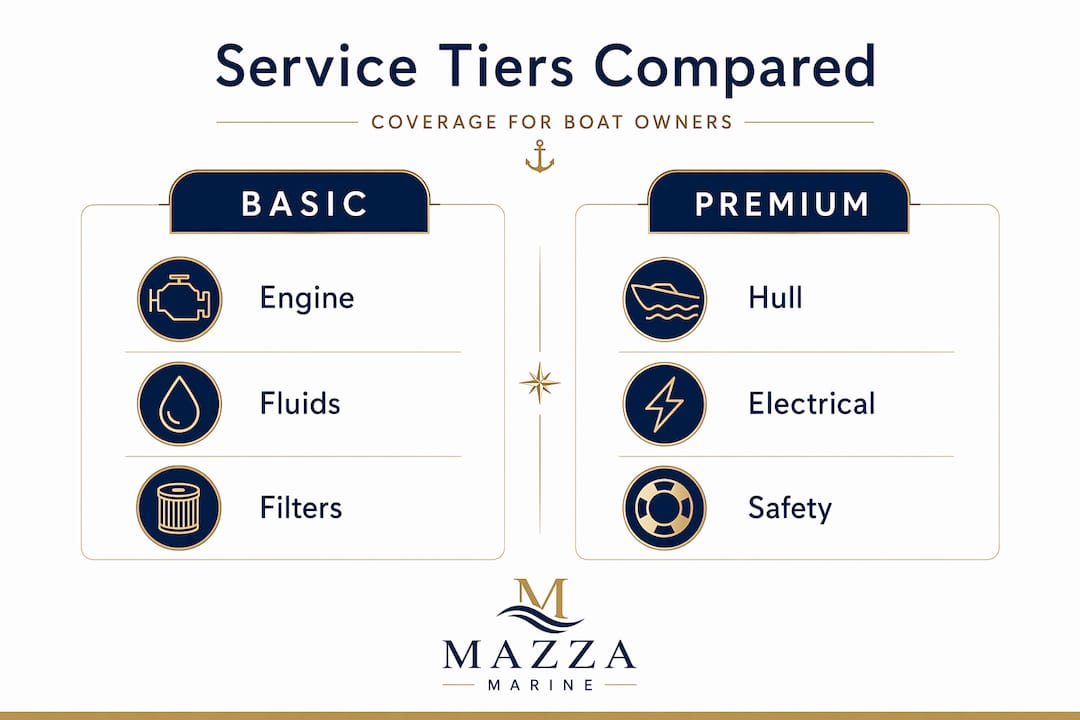
Service tiers vary by provider. Entry-level packages typically cover engine and fluid service. Mid-tier adds hull and electrical. Premium packages bundle all of the above with priority scheduling, loaner equipment, and documented service records. That documentation matters beyond peace of mind. A complete maintenance history from a reputable provider boosts resale value by giving prospective buyers verifiable proof of a vessel’s condition, something sporadic repair receipts cannot provide.
| Service tier | Typical coverage | Best for |
|---|---|---|
| Basic | Engine, fluids, filters | Lightly used vessels under 10 years old |
| Mid-level | Engine, hull, electrical | Regular use, coastal cruisers |
| Premium | All systems, priority service | Heavy use, offshore, liveaboards |
Why full maintenance packages save you more than they cost
Here is where the math becomes impossible to ignore. Skipping routine maintenance can increase total ownership costs by up to 75% over five years and strip 15-20% from fuel efficiency. A diesel engine running on degraded oil works harder, burns more fuel, and wears faster. That inefficiency compounds quietly until something fails catastrophically.
The specific financial case for comprehensive maintenance advantages breaks down across four areas:
-
Direct repair cost reduction. Owners enrolled in structured maintenance programs save 20-30% on total repair costs compared to those who address problems only after they surface. A $400 impeller swap scheduled annually costs a fraction of the $8,000 to $15,000 heat exchanger replacement that follows impeller failure.
-
Fuel and energy efficiency. Clean fuel systems, properly torqued props, and healthy engine mounts reduce parasitic drag and combustion inefficiency. Preventive maintenance improves fuel efficiency by 15-20%, which adds up meaningfully across a Florida boating season.
-
Extended vessel lifespan. Structured preventive maintenance shifts owners from reactive firefighting to proactive asset management. Vessels that receive consistent care run reliably for decades. Those that do not age in dog years.
-
Avoided catastrophic failure costs. Minor deferred issues do not stay minor. Failing seals or hoses can escalate into engine or transmission damage costing 10 to 50 times the original repair. A $60 raw water hose left unchecked can sink a boat.
Pro Tip: Track your engine hours carefully. Most marine engine manufacturers recommend service at 100-hour intervals rather than calendar months. A boat used heavily for chartering may need two full service cycles in a single season, while a weekend vessel might only need one.
Common concerns and myths about maintenance packages
The biggest misconception about full maintenance packages is that they are an upsell dressed up as a service benefit. Some skepticism is healthy. But most of it dissolves when you read the fine print carefully and compare the real coverage to the alternative.
Here is what actually deserves scrutiny before you sign:
- Labor rate caps. Some packages cap labor hours per visit. If a complex repair runs long, you absorb the difference. Know this threshold before committing.
- Wear and tear exclusions. Packages typically exclude cosmetic deterioration and normal wear items like upholstery or canvas. They are not refits; they are maintenance programs.
- Emergency priority service. This is one of the most underrated full maintenance service perks. Priority service during peak seasons means your boat moves to the front of a crowded service queue when a holiday weekend is three days away and every marina in South Florida is booked out.
- Coverage geography. Some packages only apply at the issuing marina. If you cruise from Miami to the Bahamas, confirm whether the coverage travels with you or stays on the dock.
The most honest way to frame the maintenance package value proposition is this: think of it as operational insurance. Maintenance plans protect vessel value, compliance standing, and reliability rather than functioning as a simple line-item expense. Self-managed maintenance can work for mechanically inclined owners with the time to track every service interval. For most boat owners, the coordination overhead alone makes a package worth the cost.
Pro Tip: Ask any prospective service provider to show you a sample service report from an actual package client. A provider who documents thoroughly and transparently will hand it over without hesitation. One who hedges probably does not track the details you need.
How to choose the right maintenance package
Picking the right plan is not about choosing the most expensive tier. It is about matching the package scope to your specific vessel profile. Here is how to work through that evaluation methodically.
-
Assess your boat’s age and mechanical condition. Vessels over 12 years old accumulate compounding vulnerabilities. Older through-hulls, aging wiring looms, and tired raw water pumps benefit most from a premium-tier plan that covers all systems. Newer vessels may be well served by a mid-level package focused on engine and hull care. Check the engine maintenance specifics for your make and model before selecting a tier.
-
Calculate your actual usage pattern. A sportfisher running offshore 40 weekends a year accumulates engine hours fast. A trawler used for two seasonal cruises sees lower mechanical stress but higher corrosion exposure from sitting. Your service frequency should match your hours, not just your calendar.
-
Map your operating environment. South Florida’s salt water, heat, and humidity accelerate corrosion, growth, and UV degradation faster than temperate climates. A package that includes bottom paint, zinc service, and AC system checks is not a luxury here. It is a necessity.
-
Negotiate key terms before signing. Ask specifically about labor rate caps, what happens if a covered service reveals a larger underlying issue, and whether emergency callouts are included or billed separately. A good provider welcomes these questions.
-
Verify documented service history is included. Preventive maintenance is the most effective way to reduce downtime and avoid breakdowns, but only if it is recorded. Documentation protects your warranty, supports insurance claims, and strengthens your position when you sell. A service program that does not provide written records is not a full package. It is just a series of appointments.
Understanding which yacht mechanical systems your vessel relies on most heavily will help you prioritize coverage tiers and identify gaps before they become expensive surprises.
My take on why documented packages change everything
I have seen both sides of this. Owners who treat their vessels with the same discipline they apply to their businesses, scheduling service, keeping records, working with providers they trust. And owners who handle things as they come up, calling for help after something fails, spending three times the money, and missing the best weekends of the season while the boat sits in a service yard.
The difference is not mechanical knowledge. It is philosophy. A full maintenance package forces a structured relationship between you and your vessel. It builds a paper trail that tells the story of how the boat was cared for. When I have watched owners sell well-maintained vessels, the complete service history consistently commands a premium that dwarfs what the packages cost over the years. Buyers trust documented care in a way they simply cannot trust verbal reassurances.
What I find most underestimated is the domino effect of deferred maintenance. A small water intrusion around a portlight seal gets ignored for a season. By the next year it has wicked into the surrounding fiberglass, started delaminating a section of the cabin wall, and introduced mold behind the headliner. A $150 reseal becomes a $4,000 interior repair. I have watched that exact sequence play out more than once. A proactive package catches the portlight. The domino never falls.
My honest recommendation: do not wait until something breaks to think about maintenance strategy. Choose a provider with a real track record, read the fine print carefully, and treat the package as part of what it costs to own a serious vessel.
— Jason
Let Mazzamarine handle your vessel’s full care
If the framework above resonates with you, the next step is finding a service partner who actually delivers on it rather than just promises it. Mazzamarine connects Florida yacht owners with a trusted network of marine specialists covering everything from engine and mechanical long-term care to hull protection, electrical systems, and interior refits.

Whether you are trying to identify repair warning signs before they escalate or you are ready to enroll in a complete maintenance program, Mazzamarine has the expertise and the Florida connections to make it happen. Brothers Mino and Luigi built this operation on a genuine passion for the sea and a commitment to relationships that outlast any single service call. You get quality craftsmanship, priority scheduling, and a single point of contact for every aspect of your vessel’s care. Reach out today and start building a maintenance plan your boat actually deserves.
FAQ
What do full maintenance packages typically include?
Full maintenance packages generally cover engine service, fluid changes, hull inspection, electrical checks, safety equipment review, and plumbing condition assessments. Premium tiers add priority scheduling and documented service records.
How much can I save with a maintenance package?
Owners enrolled in structured maintenance programs save 20-30% on repair costs compared to reactive repair approaches. Fuel efficiency improvements of 15-20% add further savings over a full boating season.
Are maintenance packages worth it for newer boats?
Yes. Even new vessels benefit from documented service history, which protects warranty coverage and retains resale value more effectively than sporadic maintenance records. Entry-level packages work well for vessels under five years old.
What should I watch for in a maintenance package contract?
Scrutinize labor rate caps, exclusions, and emergency service priority terms carefully. These details determine whether the package delivers real value or leaves you absorbing costs you assumed were covered.
How often should a boat receive full service?
Most marine professionals recommend service annually or every 100 engine hours, whichever comes first. Heavy-use vessels like charter boats or offshore sportfishers may require two service cycles per year.
Recommended
Text or Call 954-330-9653 Schedule Appointment
Mazza Marine Yacht Services & Refit

Fiberglass Upgrades and Damage Repair

Premium Yacht Paint/ Faux Teak

Fishing: Custom Rods, Reels,Tackle

Electrical, Electronics and Navigation

Paint, Hull and Gelcoat

Teak Decks, Wood Cabinets, Carpentry

Canvas, Enclosures and Upholstery

Mechanical, Repower and Running Gear

Plumbing, Bilge and Thru-Hulls

Welding and Custom Fabrication

Interior Refit And Past Work
Get your yacht value Estimate
"*" indicates required fields