
View Our Recent Work:

Most bilge pump replacements run between $200 and $1,700 total, with the typical mid-size boat job landing at $350 to $800 once parts, labor, and wiring are accounted for. A basic cartridge swap on an accessible pump can cost far less. Full re-mounts with new wiring, hose, and a float switch push toward the top of that range. If your pump is struggling, sputtering, or silent, replace it now rather than wait, and hire a marine tech for anything beyond a like-for-like cartridge swap.
TL;DR:
- Replacing a bilge pump typically costs between $350 and $800 for mid-size boats, with simpler cartridge swaps on accessible units costing less.
- Labor costs are the primary variable, ranging from 2 to 6 hours at $75 to $150 per hour, depending on access, wiring, and installation complexity.
- Higher costs arise from larger voltage systems, long discharge runs, corroded fittings, or relocating switches, which can significantly extend installation time.
- Upgrading to higher-capacity pumps or adding redundancy increases parts costs by $50 to $150 and may require extra wiring and full installation efforts.
- Proper maintenance, including monthly strainer checks and annual inspection, can extend pump life beyond 3 to 7 years and prevent costly emergencies.
Table of Contents
- What Does a Bilge Pump Replacement Cost Break Down To?
- What Makes One Bilge Pump Installation Cost More Than Another?
- Should You Replace the Bilge Pump Yourself or Hire a Pro?
- How Long Does a Bilge Pump Actually Last?
- How Do You Get Comparable Bilge Pump Quotes?
- Routine Bilge Pump Maintenance and Quick Troubleshooting
- What Does It Cost to Dispose of an Old Bilge Pump?
- How Does Warranty Coverage Affect Bilge Pump Replacement Cost?
- Does Upgrading Pump Capacity During Replacement Cost More?
- Field Notes: What Surprises Owners Most About Bilge Pump Costs
- Get a Straight Answer on Your Bilge Pump Before It Fails at Sea
- Where to Verify These Numbers Yourself
- Sources
- FAQ
What Does a Bilge Pump Replacement Cost Break Down To?
That $350 to $800 midpoint isn’t one number, it’s a stack of smaller line items, and knowing each one is how you catch a padded invoice before you sign it.
Pump unit cost by capacity and voltage:
- Small 12V pumps rated 500 to 800 GPH: roughly $20 to $60
- Mid-range 12V pumps rated 1,000 to 1,500 GPH: roughly $60 to $150
- High-capacity or 24V pumps rated 2,000+ GPH: roughly $150 to $350
- Combo units with an integrated automatic switch: add $30 to $80 over a manual-switch equivalent
Float switches sold separately run $15 to $60 depending on whether it’s a simple mechanical float or a solid-state sensor switch. Wiring, marine-grade heat-shrink connectors, and an inline fuse holder typically add $20 to $50 in materials. Discharge hose, hose clamps (always stainless, always doubled at each connection), fittings, and marine sealant usually run another $25 to $75, more if the old hose run needs full replacement rather than a splice.
Labor is where estimates diverge most. Installation time typically runs 2 to 6 hours for a common job, and shop rates in most markets fall between $75 and $150 an hour. That single variable, hours times rate, explains most of the spread between a $350 quote and an $800 one.
By the numbers: A basic cartridge swap (parts $40, 1.5 hours labor at $100/hour) lands around $190. A mid-tier job with a new float switch and hose section (parts $150, 3 hours labor) lands near $450. A premium install with a high-capacity 24V pump, full re-wire, and hard-to-reach mounting (parts $300, 5.5 hours labor at $130/hour) climbs to roughly $1,015.
Here’s how those three scenarios stack up side by side:
Regional labor and marina density can swing final numbers 10% to 25% off these averages, with coastal urban yards, think Miami, Fort Lauderdale, and the Keys, running toward the higher end.
What Makes One Bilge Pump Installation Cost More Than Another?
Two boats with the “same” pump swap can land on wildly different invoices, and it almost never comes down to the pump itself.
- GPH rating and voltage. A 24V system on a larger vessel demands heavier gauge wire and often a different fuse panel connection, which adds labor minutes a 12V swap never needs.
- Float switch type and placement. A surface-mount mechanical float bolted where the old one lived is quick. A solid-state switch relocated to solve a chronic false-trigger problem means new drilling, new sealant, and more bench time.
- Bilge access. A pump sitting in an open engine bay takes fifteen minutes to reach. A pump buried under a fuel tank baffle or behind a genset mount can add an hour before a tech even touches a wrench.
- Discharge hose diameter and run length. Longer runs and tighter bends increase head pressure, which sometimes means upsizing the pump itself, not just running more hose.
- Hull penetrations and corrosion. A through-hull fitting that’s corroded or a hose clamp fused in place from years of saltwater exposure turns a swap into a small fabrication job.
Installing a pump with an integrated automatic switch cuts a step out of the process compared to wiring a separate float, but the discharge hose and through-hull height still need to clear roughly 8 inches above the heeled waterline, and that geometry check is non-negotiable regardless of switch type.
Pro Tip: Ask your tech to photograph the old mounting point before removal. If the new pump’s footprint doesn’t match, you’ll want proof of what was there when comparing the final invoice to the original quote.
Should You Replace the Bilge Pump Yourself or Hire a Pro?
A cartridge-style pump that clips into an existing strainer basket is genuinely one of the more approachable DIY jobs on a boat, provided the replacement is like-for-like. Swap the cartridge, reconnect the existing wiring, test it, done. Cross-model replacements are a different story: different footprints often mean new mounting screws, a different hose barb size, and sometimes a longer or shorter wire run than what’s already in place.
Here’s a rough framework for deciding:
- Same brand, same model, accessible mount: DIY is reasonable if you’re comfortable with basic marine wiring and have the right hose clamps on hand.
- Different model, different footprint, or tight access: Hire a tech. The labor savings rarely offset the risk of a bad hose seal.
- Any 24V system or long wire run: Hire a tech. Proper gauge sizing, fusing, and heat-shrink connections matter more here, and a mistake can cook a wire run inside a bulkhead you can’t see.
- Anything touching a through-hull or requiring new sealant at a hull penetration: Hire a tech, full stop. This is a below-waterline safety component.
Expect 2 to 6 hours of shop labor for a typical install, billed at $75 to $150 an hour depending on region. Beyond the dollars, a professional install often preserves your insurance standing and warranty coverage on adjacent systems, since a botched DIY wiring job near a fuel line or battery bank can complicate a claim later.
How Long Does a Bilge Pump Actually Last?
Most bilge pumps hold up for 3 to 7 years, with heavy bilge water, frequent debris, and constant cycling on the low end and light-use, well-maintained systems on the high end. ABYC-informed guidance points many surveyors toward inspecting, and often replacing, pumps every 3 to 5 years depending on use and condition.
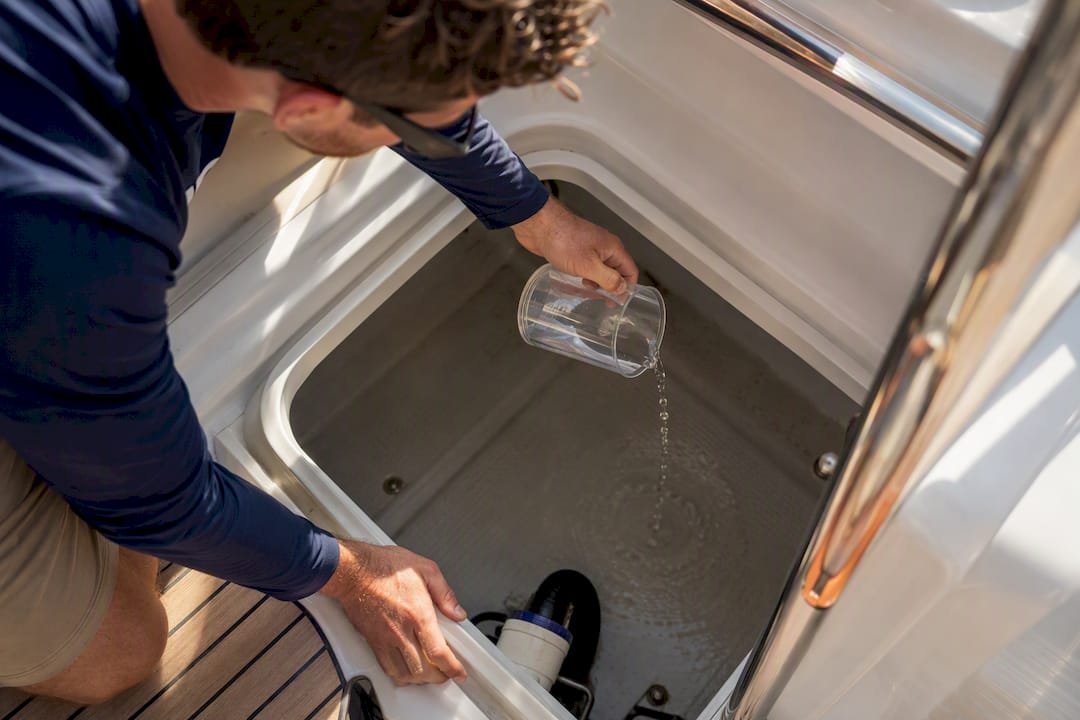
Watch for reduced output, frequent clogging even after cleaning the strainer, or intermittent electrical faults, chattering, tripping fuses, running only when tapped. Any of those three is a replace-now signal, not a monitor-and-wait one. A quick monthly test, pour water into the bilge and confirm strong overboard discharge, catches most failures before they become emergencies.
How Do You Get Comparable Bilge Pump Quotes?
Vague quotes hide vague work. Send the yard clear photos of the current pump, its label (GPH and voltage are usually printed right on it), and a short video of the bilge access point. That single step lets most shops pre-quote with real accuracy instead of guessing over the phone.
Every itemized estimate you receive should separate:
- Pump and float switch cost
- Wiring, connectors, and fuse materials
- Hose, clamps, and sealant
- Labor hours and the hourly rate
- Testing and disposal fees
Before you sign anything, ask these questions:
- Are your techs familiar with ABYC wiring and fuse-sizing standards?
- Will the new pump be tested under load before I leave the dock?
- What’s the parts warranty, and does it cover labor if the pump fails early?
- Is disposal of the old pump included, or billed separately?
A quote with a single flat “bilge pump service” line and no hour breakdown is the biggest red flag. Ask for the split before you approve anything.
Routine Bilge Pump Maintenance and Quick Troubleshooting
A pump that dies without warning usually gave signals for weeks first. Clear the strainer basket monthly, debris buildup is the number one cause of reduced flow, and rinse the impeller cartridge if your model uses one.
To test on the spot: pour a few gallons of water into the bilge and confirm strong, steady discharge overboard. Weak flow or a pump that runs but moves little water points to a clogged strainer or a failing impeller, not necessarily a dead pump.
Temporary fixes have limits. Re-seating a loose wire connector or replacing a cracked hose clamp is fine as a stopgap. Never patch a corroded through-hull fitting or a cracked discharge hose and call it done, that’s a haul-out or professional repair item.
- Spare hose clamps (stainless, at least two sizes)
- A spare fuse matching your pump’s rating
- Dielectric grease for connectors
- A backup float switch
Pro Tip: Practical Sailor recommends running two pumps, a primary and a backup, rather than relying on a single high-capacity unit. Redundancy beats raw GPH when the bilge is filling fast.
What Does It Cost to Dispose of an Old Bilge Pump?
Disposal is rarely its own line item, and when it is, it’s small: most marine techs fold it into the labor cost or charge a flat $5 to $15 handling fee. The pump itself is mostly plastic housing and a small electric motor, no different from disposing of a household appliance motor, so most marinas and repair shops simply toss it with routine shop waste or send it to a local electronics recycler.
Ask specifically whether disposal is included when you request an itemized quote. Some independent techs will hand the old pump back to you if you ask, which matters if you want to keep it as a spare for a smaller secondary bilge or a backup on a tender. If your old pump used a wet-cell battery connection or had any fuel exposure, mention that to your tech. Fuel-contaminated components sometimes need to go through a hazardous waste stream rather than standard recycling, and a reputable shop will already know the local disposal rules for that.
The bottom line: disposal cost is a rounding error compared to parts and labor, but it’s worth confirming upfront so it doesn’t show up as a surprise add-on line after the work is done.
How Does Warranty Coverage Affect Bilge Pump Replacement Cost?
A pump’s warranty length often tells you more about expected lifespan than the price tag does. Budget pumps frequently carry a 1-year warranty, mid-range units 2 to 3 years, and premium models sometimes stretch to 5 years or more. Paying a bit more upfront for a longer warranty period usually costs less over a boat’s ownership than replacing a cheaper pump twice in the same span.
Labor warranty is a separate question entirely, and it’s the one owners forget to ask about. A shop’s workmanship warranty, covering the install itself, wiring, hose connections, sealant work, matters just as much as the manufacturer’s part warranty. If a connector fails six weeks after install, you want that covered under labor warranty, not treated as a brand-new service call.
When comparing quotes, ask directly: does the estimate cover parts warranty only, or labor too, and for how long? A shop that stands behind its wiring and mounting work for a full season is worth a slightly higher upfront price over one that treats the install as a one-time transaction. Warranty terms rarely show up unprompted on a written estimate, so this is a question you need to ask out loud before work begins, not something to assume is standard.
Does Upgrading Pump Capacity During Replacement Cost More?
Replacing a failed pump is the natural moment to reconsider whether the old capacity was ever right for your boat. Moving from a 1,000 GPH unit to a 1,500 or 2,000 GPH model typically adds $50 to $150 to the parts cost, and it may require a heavier gauge wire run and a higher-rated fuse, both of which add modest labor time rather than major expense.
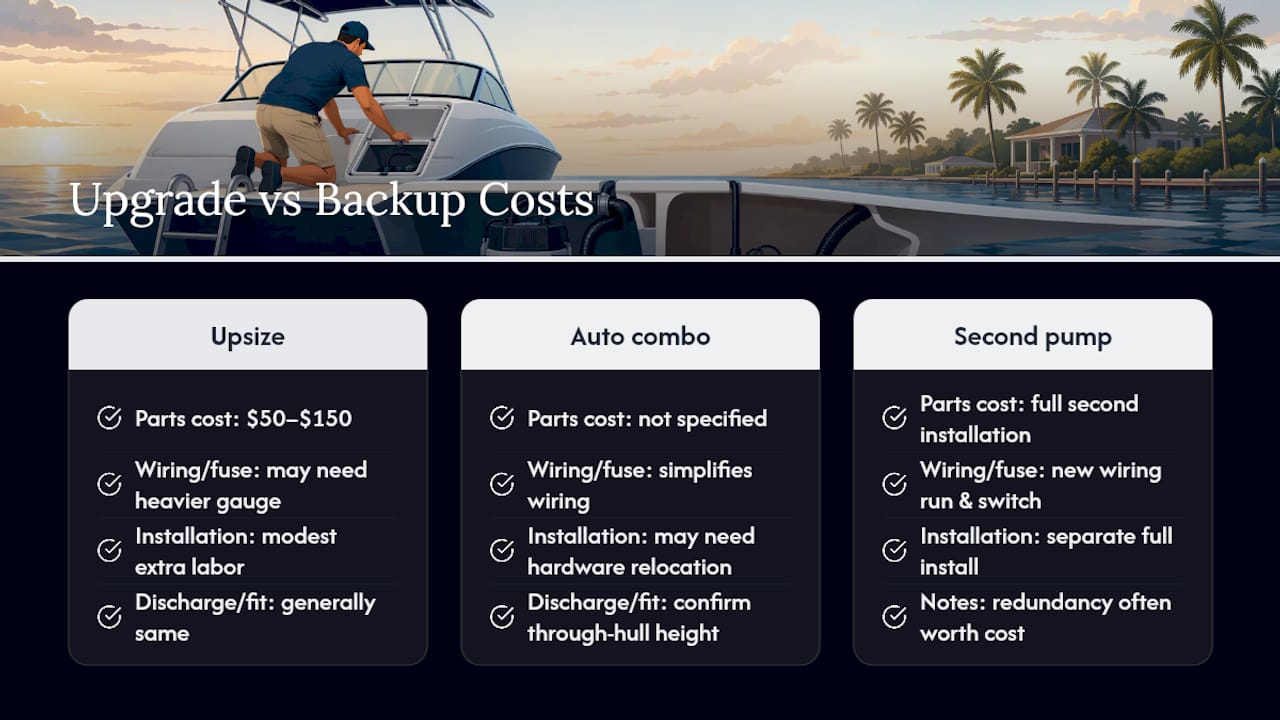
Switching from a single manual-switch pump to a combo unit with an integrated automatic switch simplifies the wiring on one hand but requires confirming the discharge hose and through-hull height still clear the boat’s heeled waterline, a detail that occasionally means relocating hardware rather than a straight swap.
The bigger cost jump comes from adding a second pump as a backup rather than upsizing the primary. That’s effectively a second full installation, new wiring run, new discharge point or shared manifold, new switch, so budget it as a separate line item rather than an add-on to the existing quote. Given how often a single-pump failure turns into an emergency, many owners find the redundancy worth the added cost, particularly on boats that spend extended time away from the dock.
Field Notes: What Surprises Owners Most About Bilge Pump Costs
The surprises are rarely the pump itself. It’s the wiring rework nobody budgeted for, a fuse holder corroded solid, a hose clamp that snaps the second you touch it, or a mounting bracket buried behind a fuel tank that adds an hour before any real work starts.
Yards price access time honestly when they can see it, which is why sending clear photos before a quote matters more than owners expect. It is important to document the bilge, the pump label, and the symptoms before calling for service. Doing so shortens the quote process and helps keep the final invoice close to the estimate, which is the whole point of asking for one in writing.
— Jason
Get a Straight Answer on Your Bilge Pump Before It Fails at Sea
You’ve seen the ranges, the labor math, and the questions worth asking any yard. A key benefit is receiving one itemized quote covering parts, labor, wiring, and testing from a team that also handles the mechanical, electrical, and thru-hull work a bilge system often touches, avoiding the need to coordinate among multiple specialists.

Send us photos of your pump label and bilge access, and describe what you’re seeing, weak flow, silence, chattering, and we’ll build a real estimate before anyone steps aboard. For expert help with dockside service coordination and cleanup, consider contacting SSF Detail’s marine detailing services. Some service providers include workmanship warranty and post-service testing under load, helping owners know whether the fix was successful. If your bilge system needs more than a pump swap, our marine repair and maintenance guide covers how we scope larger mechanical work, and if you’re dealing with active flooding or an urgent failure right now, our emergency repair line gets a tech moving today. Reach out and get your quote started.
Where to Verify These Numbers Yourself
The U.S. Coast Guard’s dewatering device guidance and ABYC-informed inspection standards form the backbone of safe replacement practice. For installation specifics, Boating Magazine’s automatic pump guide and Practical Sailor’s maintenance tips walk through wiring and upkeep in more technical detail than fits here.
Sources
- Go2Marine — Bilge pump buying guide (ABYC referenced)
- Boating Magazine — Installing an automatic bilge pump
- Currentcost
- Practical Sailor — Bilge pump installation and maintenance tips
FAQ
Is a Bilge Pump Easy to Replace?
A like-for-like cartridge swap on an accessible pump is one of the easier DIY jobs on a boat. Cross-model replacements, 24V systems, or hard-to-reach mounts are better left to a marine tech.
What Is the Average Life Expectancy of a Bilge Pump?
Most bilge pumps last 3 to 7 years, with heavy use and debris exposure shortening that range and light, well-maintained use extending it toward the higher end.
How Often Should Bilge Pumps Be Replaced?
ABYC-informed guidance points many surveyors toward inspecting and often replacing bilge pumps every 3 to 5 years depending on how hard the boat is used.
Can You Run a Boat Without a Bilge Pump?
You shouldn’t. The U.S. Coast Guard strongly recommends having a reliable dewatering device aboard at all times, and operating without one is a significant safety risk regardless of boat size.
What’s a Reasonable Total Budget for Bilge Pump Replacement?
Plan for $350 to $800 for a typical mid-size boat install, with basic swaps running lower and complex, high-capacity, or hard-access jobs climbing toward $1,000 or more.
Recommended
Text or Call 954-330-9653 Schedule Appointment
Mazza Marine Yacht Services & Refit

Fiberglass Upgrades and Damage Repair

Premium Yacht Paint/ Faux Teak

Fishing: Custom Rods, Reels,Tackle

Electrical, Electronics and Navigation

Paint, Hull and Gelcoat

Teak Decks, Wood Cabinets, Carpentry

Canvas, Enclosures and Upholstery

Mechanical, Repower and Running Gear

Plumbing, Bilge and Thru-Hulls

Welding and Custom Fabrication

Interior Refit And Past Work
Get your yacht value Estimate
"*" indicates required fields