
View Our Recent Work:

Quick Overview
- Florida yacht owners benefit from understanding core terminology for safety and efficient communication.
- Proper knowledge of propulsion, bilge, and electrical systems prevents costly repairs and safety hazards.
- Maintaining familiarity with advanced regional terms enhances vessel management and docking capabilities.
Most Florida yacht owners can name their boat’s color and engine brand. Far fewer can tell a marine contractor exactly where the limber holes are, or explain the difference between bonding and grounding to their insurance adjuster. That gap in vocabulary is not just an inconvenience. It can delay emergency repairs, inflate service bills, and create real safety risks on the water. Boating terminology basics covers the core terms every owner needs, from bow to bilge. This guide goes further, connecting each term to real Florida conditions, practical maintenance tasks, and the kind of confident communication that separates reactive owners from proactive ones.
Table of Contents
- Essential structural and directional terms every owner must know
- Propulsion and drive systems: Understanding engines, drives, and their jargon
- Bilge systems decoded: Pumps, switches, and critical maintenance
- Electrical system essentials: From battery banks to corrosion defense
- Advanced and Florida-specific terminology: What separates serious owners
- What most Florida owners miss about yacht terminology
- Maintain your edge: Next steps for top-tier yacht care
- Frequently asked questions
Key Takeaways
| Point | Details |
|---|---|
| Directional basics matter | Understanding port, starboard, bow, and stern prevents mistakes and improves safety during docking and maintenance. |
| Choose the right propulsion | Knowing drive types helps you select, maintain, and troubleshoot engines suited to Florida’s unique conditions. |
| Bilge system knowledge prevents disasters | Learning bilge terms minimizes risks from leaks, flooding, and Florida’s extreme weather. |
| Electrics and corrosion go hand in hand | Familiarity with electrical jargon and regular checks fight salt-related damage and outages. |
| Advanced terms save money | Mastering further terminology like anode and antifouling leads to better performance, lower costs, and safer boating in Florida. |
Essential structural and directional terms every owner must know
Before you can manage a yacht well, you need to speak its language. Misusing directional terms during a tight docking maneuver in a crowded Miami marina is more than embarrassing. It can mean a scraped hull, a damaged slip, or worse. The boating terminology basics every owner should master include: Bow (the front of the vessel), Stern (the rear), Port (left side when facing the bow), Starboard (right side when facing the bow), Beam (the widest point of the hull), Hull (the main structural body), Deck (the walkable surface above), Bilge (the lowest interior space where water collects), and Cabin (the enclosed living or working space below deck).
Here is a quick reference table to keep these straight:
| Term | Meaning | Practical example |
|---|---|---|
| Bow | Front of the vessel | “Tie the bow line first” |
| Stern | Rear of the vessel | “Back the stern into the slip” |
| Port | Left when facing forward | “Fender on the port side” |
| Starboard | Right when facing forward | “Dock light on starboard” |
| Beam | Widest point | “Check beam clearance at the lift” |
| Hull | Main body structure | “Hull inspection after grounding” |
| Bilge | Lowest interior space | “Bilge pump running overnight” |
In Florida, these terms carry extra weight. Hurricane prep means securing lines at both bow and stern while protecting the port and starboard sides from surge. Tight ICW (Intracoastal Waterway) passages require precise directional calls. A good Florida yacht management guide will reference these terms constantly, and so will every contractor, captain, and marina staff member you work with.
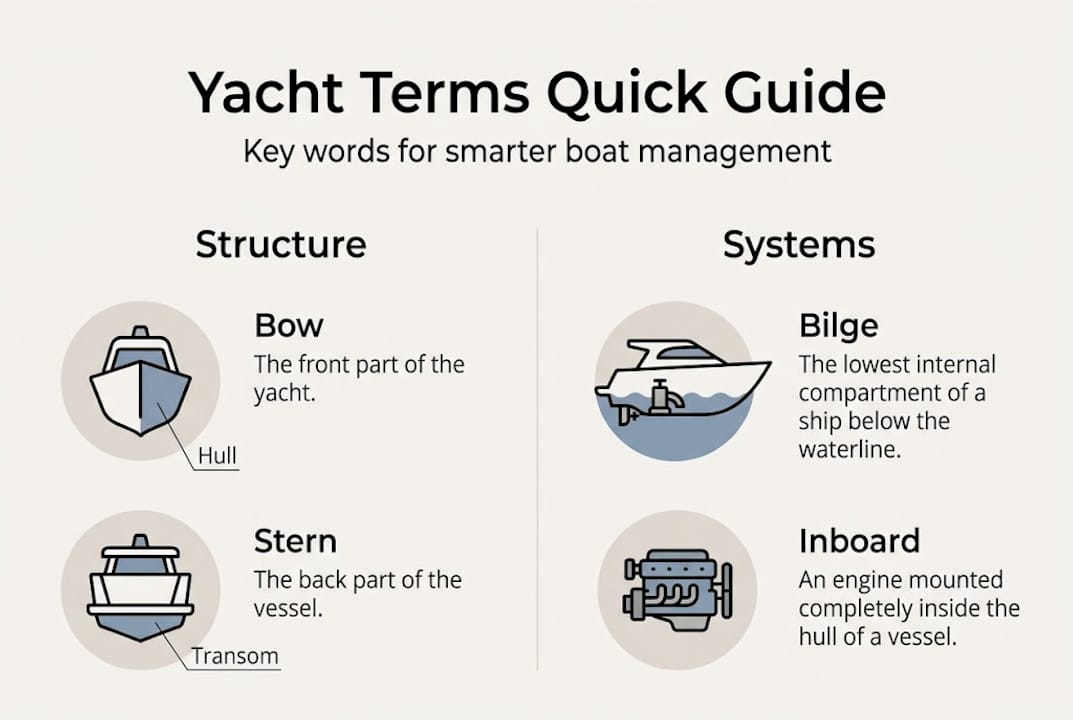
For a deeper reference, the comprehensive yachting glossary from Boat International covers hundreds of additional terms as your knowledge grows.
Pro Tip: Use a label maker or colored tape to mark port (red) and starboard (green) on key interior surfaces near the helm. Guests and new crew will orient faster, and you will avoid costly miscommunications during docking.
Propulsion and drive systems: Understanding engines, drives, and their jargon
Once you have the basics down, it is essential to understand propulsion terms and what they mean for your vessel. The propulsion system terminology breaks down as follows: an Inboard Engine sits inside the hull with a fixed drive shaft, a Stern Drive (also called an I/O) uses an inboard engine paired with an external drive unit, Pod Drives are steerable units mounted under the hull for superior maneuverability, an Outboard is a self-contained engine mounted on the transom, a Propeller is the rotating blade assembly that pushes water, and an Impeller is an internal pump rotor used for engine cooling or jet thrust.
Here is how these systems compare for Florida boating:
| Drive type | Best for | Maintenance focus | Florida concern |
|---|---|---|---|
| Inboard | Larger cruisers, offshore | Shaft seals, transmission | Corrosion on shaft and strut |
| Stern drive | Mid-size boats | Bellows, gimbal bearing | Saltwater intrusion in bellows |
| Pod drive | Luxury yachts, tight docking | Software, seals | Hull modification costs |
| Outboard | Sportfish, center consoles | Impeller, lower unit | Sand and silt in lower unit |
For routine checks, follow this sequence:
- Check engine oil before every trip and change per manufacturer intervals.
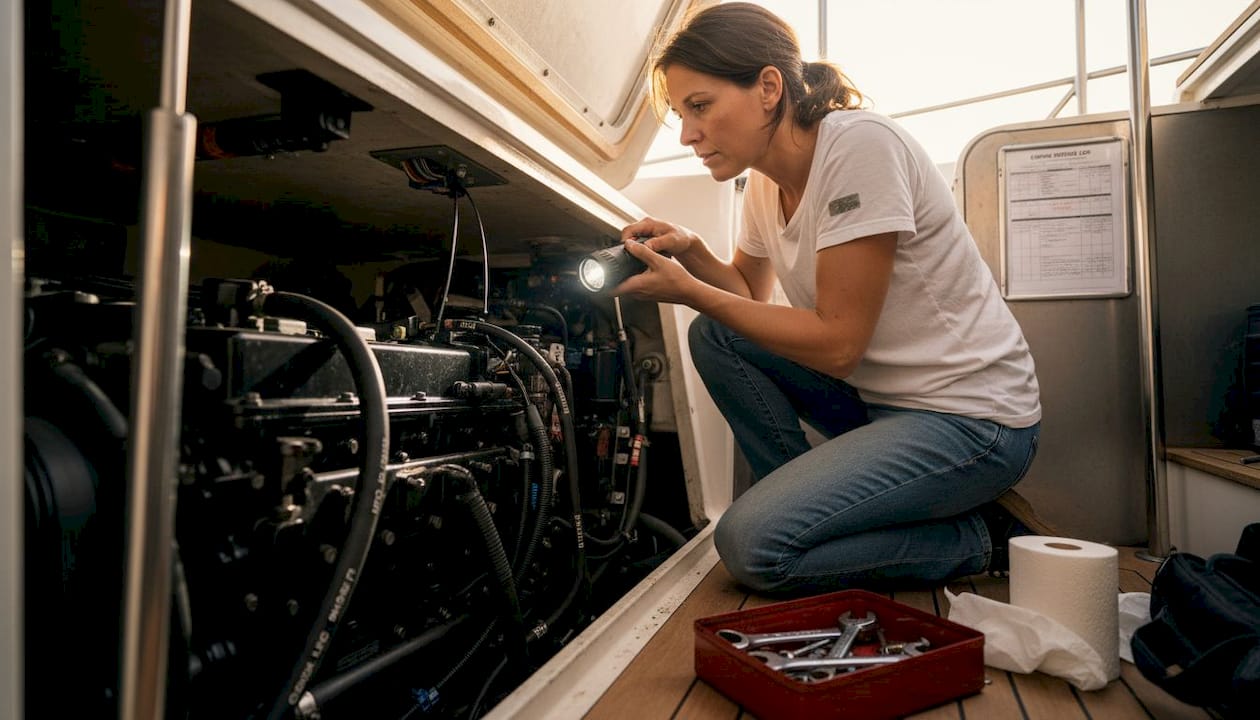
- Inspect the impeller annually. A failed impeller means no cooling water, which means a seized engine.
- Inspect drive seals and bellows on stern drives every season. Florida saltwater is relentless.
- Check propeller for dings, bent blades, or fishing line wrapped around the shaft.
- Flush with fresh water after every saltwater outing, especially outboards.
Outboards average 1,500 to 4,000 hours of lifespan, while diesel inboards can double that with proper care. That difference in longevity comes down almost entirely to maintenance discipline. Review Florida engine maintenance tips to build a schedule that matches your usage, and bookmark the engine troubleshooting guide for when something sounds off.
For a visual breakdown of engine components, the boat engine parts overview from Sea Tow is a reliable reference.
Pro Tip: A slight vibration at cruising speed often signals a bent propeller blade, not an engine problem. Check the prop before assuming the worst. In Florida’s shallow waters, prop strikes are common and easy to miss at first.
Bilge systems decoded: Pumps, switches, and critical maintenance
With propulsion covered, let us move to a system whose failure can turn inconvenient into catastrophic: the bilge. The bilge system components include the Bilge Pump (which removes accumulated water), the Float Switch (which activates the pump automatically when water rises), the Strainer (which filters debris before it reaches the pump), and Limber Holes (small openings in structural members that allow water to flow toward the pump). Well-designed systems layer a primary electric pump, a high-capacity emergency pump, and a manual backup.
Florida’s climate makes bilge maintenance non-negotiable. Heavy afternoon rain, high humidity, and constant saltwater exposure create conditions where a neglected bilge becomes a breeding ground for mold, corrosion, and electrical shorts. Moisture sitting in the bilge attacks wiring, corrodes through-hulls, and weakens structural bonding.
Standard bilge pumps leave 1 to 2 inches of water behind after cycling. Advanced systems like Arid Bilge technology can achieve a completely dry bilge, dramatically reducing corrosion risk.
Watch for these warning signs that your bilge system needs attention:
- Pump cycling more frequently than usual, especially without rain
- Musty or sulfur smell coming from below deck
- Visible standing water after the pump has run
- Debris or oil sheen on the bilge water surface
- Corrosion or discoloration around the pump housing or wiring
The Florida spring maintenance checklist includes bilge inspections as a priority item, and the yacht mechanical maintenance guide covers system upgrades in detail. For new owners, yacht maintenance tips from Coastal Air Systems offer a solid starting point.
Pro Tip: Replace float switches every year in Florida. They are inexpensive, and a stuck or failed switch is one of the most common causes of unexpected flooding. Do not wait for it to fail during a storm.
Electrical system essentials: From battery banks to corrosion defense
Every reliable yacht also leans on its electrical system, which faces unique challenges in Florida. Core terms include Battery Banks (separate banks for engine starting and house loads like lights and electronics), the Alternator (which recharges batteries while the engine runs), Bonding and Grounding (a system that connects metal components to prevent stray current corrosion and reduce shock risk), and the ECU (Electronic Control Unit, the brain managing engine functions on modern vessels).
The essential yacht electrical system maintenance guide from North Pacific Yachts emphasizes that Florida saltwater accelerates corrosion on every electrical connection aboard. A properly bonded and grounded system is not optional here. It is the difference between a vessel that holds its value and one that develops expensive gremlins every season.
A fully charged 12V battery reads 12.6 volts at rest. Anything below 12.4V suggests the bank needs attention before your next trip.
Electrical red flags to watch for aboard your Florida yacht:
- Green or white powder forming on battery terminals or cable ends
- Navigation lights flickering or dimming at anchor
- Electronics resetting randomly or losing memory
- Unusual warmth near wiring runs or junction boxes
- Bilge pump running on battery power more than expected
For hands-on help with your vessel’s wiring, Florida marine electrical work covers the services available through Mazza Marine’s expert network. The helpful maintenance tips resource also covers basic electrical checks you can perform yourself between professional inspections.
Advanced and Florida-specific terminology: What separates serious owners
If you want to go beyond the basics and operate like a pro, here are advanced and uniquely Florida terms every serious owner should know. The advanced yacht terminology glossary highlights several that are especially relevant: A-60 Bulkhead refers to a fire-rated structural divider that meets international safety standards, Air Draft is the total height of your vessel from the waterline to the highest fixed point (critical for clearing ICW bridges), Bow Thruster is a lateral propulsion unit in the bow that makes tight docking dramatically easier, Antifouling refers to specialized bottom paint that inhibits marine growth on the hull, and Anode (often called a zinc) is a sacrificial metal piece that corrodes in place of your hull, drive, and through-hulls.
Florida adds its own layer of regional priorities. Dehumidification systems protect interiors from mold during hot, wet months. Zinc anodes need inspection every 6 to 12 months because Florida’s warm, conductive saltwater burns through them faster than cooler northern waters. Hull fouling from barnacles and algae is aggressive here, making antifouling paint selection a real performance decision, not just a cosmetic one.
Pod drives enhance maneuverability but require hull modifications during installation, and hybrid propulsion systems offer quieter, more eco-friendly operation. Both technologies demand that owners understand the terminology before committing to upgrades.
Here is your annual advanced maintenance checklist:
- Inspect and replace zinc anodes every 6 to 12 months
- Apply fresh antifouling paint before each season
- Confirm air draft measurements before any ICW transit
- Test bow thruster operation at the start of each season
- Check A-60 bulkhead integrity during any interior refit
For heavy equipment and structural work, the heavy yacht machinery guide from Mazza Marine is an excellent resource.
What most Florida owners miss about yacht terminology
Here is an honest truth we have seen play out in Florida marinas more times than we can count: owners who do not know their vessel’s terminology almost always pay more over time. Not because they are careless, but because communication breaks down at the worst moments.
When a contractor asks about the location of a through-hull and the owner is not sure what that means, the job takes longer. When an insurance adjuster asks about the bonding system after an electrical fire, vague answers delay claims. These are not hypothetical scenarios. They are regular occurrences in Florida’s busy boating world.
The contrarian view worth sharing is this: you do not need to memorize a maritime dictionary. But a focused list of 30 to 40 terms tied to your specific vessel can transform how you manage it. Keep a running list in your phone or posted near the helm. Update it every time a new issue surfaces or a contractor uses a term you had to look up. That living document is worth more than any single repair.
Your complete boat management guide should be built on this foundation of clear, shared vocabulary between you, your crew, and your service partners.
Pro Tip: After every service visit, ask your technician to name the parts they worked on. Write them down. Over one season, you will build a vocabulary that is perfectly tailored to your vessel.
Maintain your edge: Next steps for top-tier yacht care
Learning the right terminology is the foundation. What you build on it is where the real value appears. Owners who understand their vessels communicate clearly with contractors, catch problems earlier, and spend less on reactive repairs over the life of their boat.
At Mazza Marine, we have built a network of Florida’s finest yacht experts covering everything from urgent repairs to full refits. Whether you need to review the signs you need yacht repairs in Florida, explore paint and hull maintenance options, or sharpen your vessel’s performance with engine performance tips, we are here to help. Mino and Luigi built this company on a passion for the sea and a commitment to every owner they work with. Reach out today and let us be your long-term partners on the water.
Frequently asked questions
Why do Florida boat owners need to understand bilge system terms?
Florida’s heavy rain and humidity make reliable bilge operation essential to prevent corrosion, flooding, and costly repairs. Knowing terms like float switch and strainer helps you describe problems accurately and get faster service.
What’s the difference between inboard, outboard, and pod drives?
Inboards are mounted inside the hull, outboards attach to the transom, and pod drives combine engine and drive units beneath the hull for superior maneuverability. Each system has distinct maintenance needs and performance characteristics.
How can I spot corrosion in my yacht’s electrical system?
Look for green or white powder on terminals, flickering electronics, and random resets. Florida saltwater accelerates corrosion on connections, so check terminals and wiring monthly.
Which advanced terms matter most for Florida boat owners?
Prioritize anode, antifouling, air draft, and bow thruster. These four terms cover bridge safety, hull protection, and tight docking, which are the most common challenges Florida owners face day to day.
Recommended
- Boat management in Florida: complete yacht owner’s guide
- Marine mechanical systems: Yacht maintenance made simple
- Yacht Heavy Machinery: 30-50% Fewer Breakdowns Guide
- Yacht navigation upgrades: Safety, efficiency, control
- Sloep Terminologie Uitgelegd: Luxe, Elektrisch en Design – Dobber Boats
- Master marine radio protocols for safe UK boating in 2026
Text or Call 954-330-9653 Schedule Appointment
Mazza Marine Yacht Services & Refit

Fiberglass Upgrades and Damage Repair

Premium Yacht Paint/ Faux Teak

Fishing: Custom Rods, Reels,Tackle

Electrical, Electronics and Navigation

Paint, Hull and Gelcoat

Teak Decks, Wood Cabinets, Carpentry

Canvas, Enclosures and Upholstery

Mechanical, Repower and Running Gear

Plumbing, Bilge and Thru-Hulls

Welding and Custom Fabrication

Interior Refit And Past Work
Get your yacht value Estimate
"*" indicates required fields