
View Our Recent Work:

What do boat slip costs in Florida actually look like?
Overview: Florida boat slip costs vary widely by region and slip type, with rental slips charged by the foot monthly and deeded slip prices ranging from lower amounts in the Panhandle to much higher prices for large slips in Fort Lauderdale. Where you dock, how long you commit, and whether you rent or own all move the number dramatically.
Location shapes pricing more than almost any other factor. South Florida’s constrained waterfront supply pushes monthly rental rates toward the top of the range, while Tampa Bay and the Panhandle offer more breathing room. A 40-foot slip in Miami runs considerably more than the same footprint in Pensacola. The Keys occupy their own tier entirely, where scarcity and prestige combine to keep prices elevated year-round.
Key price benchmarks by region for deeded slips show wide variation: Fort Lauderdale large slips sell for $150,000–$600,000, Tampa Bay slips cost $80,000–$200,000, and Panhandle slips range from $30,000–$120,000, with rental income from $800–$6,000/month depending on size and location.

Rental rates at Miami-area public marinas illustrate the range well. Annual contract rates run from $11.10 to $32.10 per boat foot per month, while monthly transient rates climb from $16.43 to $43.50 per foot. Daily transient docking costs $1.00 to $2.50 per foot per day. South Florida’s permitting delays limit new dock construction, which keeps supply tight and protects values over time.
Marinas bill based on slip minimum length or certified vessel length, whichever is greater. A 38-foot boat assigned to a 40-foot minimum slip pays for 40 feet regardless.
Ownership types and what they mean for your wallet
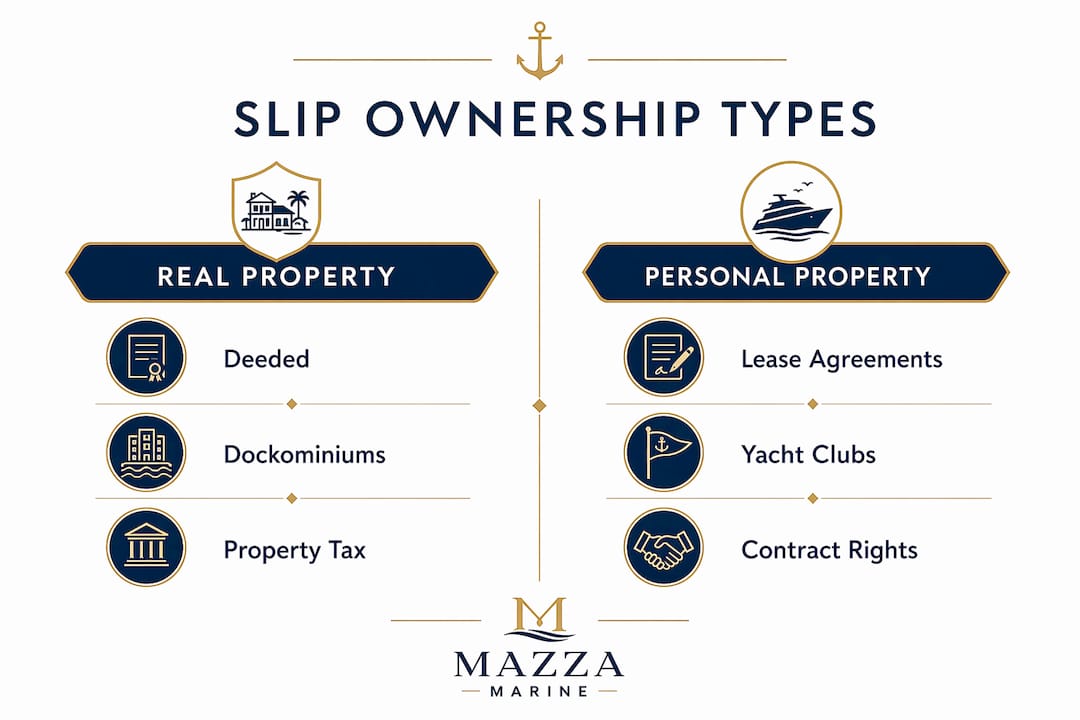
Florida law draws a clear line between two categories: real property slips and personal property slips. That distinction controls your taxes, financing options, and what happens when you want to sell.
Deeded slips and dockominiums are real property. They carry recorded deeds, generate separate property tax bills, and can be financed with a traditional mortgage. The closing process mirrors a home purchase, including a title search and title insurance. Association fees cover shared infrastructure maintenance, reserve funds, and insurance on common structures.
Lease agreements and yacht club memberships are personal property. Your rights live in the contract, not in public records. Lenders who finance these interests file a security interest under Article 9 of the Uniform Commercial Code rather than recording a mortgage. When the lease expires, so does your right to the slip.
Ownership of deeded slips carries physical maintenance obligations: seawall upkeep, electrical system upgrades, and periodic dredging. These costs arrive unpredictably and can be substantial. Docking fees typically represent 8–15% of total annual boat operating costs, and that baseline grows when you add liveaboard fees, metered electricity, and hurricane preparation charges.
Common additional fees to budget for:
- Liveaboard surcharges (where permitted by marina rules)
- Electricity: 30-amp service runs $3–$8/day; 50-amp runs $10–$16/day at Miami public marinas
- Hurricane prep fees charged seasonally by many private facilities
- Association fees for dockominium owners covering shared maintenance
Pro Tip: Before purchasing any slip, pull the recorded deed or lease document and verify the ownership classification with a Florida real estate attorney. Legal experts emphasize that taxes, financing options, and transfer rules all hinge on whether the slip is real or personal property, and errors here are expensive to unwind.
Seasonal vs. yearly rental: how contract terms affect your rate
Committing to an annual contract almost always costs less per month than renting on a transient basis. Miami public marina data shows the gap clearly: annual contract holders pay $11.10–$32.10 per foot per month, while monthly transient renters pay $16.43–$43.50 per foot. That spread can represent hundreds of dollars monthly on a 50-foot slip.
Seasonal rentals, typically covering the winter months when snowbird demand peaks, often price closer to transient rates than annual ones. Florida’s busiest boating season runs October through April, and marinas in South Florida and the Keys price accordingly. Locking in an annual contract before peak season starts is the most reliable way to secure both a slip and a better rate. Annual contracts at many facilities also require a security deposit equal to two months’ dockage.
Private marinas vs. public docks: where your money goes
Public marinas operated by city or county governments generally offer lower base rates than private facilities, but the gap in amenities is real. Miami-Dade’s Bill Bird Marina, for example, provides 152 wet slips with electricity, water, laundry, and fuel at government-set rates. Private marinas often bundle concierge services, pump-out stations, and on-site repair access into higher monthly fees.
The tradeoff is predictability versus service. Public dock rates are set by municipal fee schedules and change slowly. Private marina pricing responds to market demand, which means rates in high-demand areas like Fort Lauderdale and Miami Beach can shift year to year. For boat management in Florida, knowing which type of facility fits your vessel’s service needs matters as much as the base rate.
Insurance requirements and what they cost
Most Florida marinas require proof of liability insurance before you can occupy a slip, whether you rent or own. Private facilities typically require a minimum of $300,000 in liability coverage, and some larger marinas set the floor at $500,000. Dockominium associations carry their own master policy on shared structures, but that coverage does not extend to your vessel or your individual slip improvements.
Boat owners should carry a separate marine policy covering hull damage, liability, and pollution liability. Liveaboard policies carry additional premiums. Annual marine insurance costs vary by vessel size, age, and coverage limits, so getting multiple quotes from marine-specialist insurers is standard practice.
Permit and regulatory fees for Florida slip owners
Florida boat dock permits involve both state and local agencies, and the process is rarely quick. The Florida Department of Environmental Protection and the Army Corps of Engineers both review new dock construction on sovereign submerged lands. Permit fees vary by project scope, but the timeline is the bigger cost: multi-year permitting delays are common in South Florida, which is precisely why existing permitted slips command premium prices.
For renters, the permit burden falls on the marina operator. For buyers of deeded slips, confirming that all existing permits are current and transferable is a non-negotiable step in due diligence. Annual boat ramp permits at Miami-area county facilities run $165–$265. Slip owners in dockominium structures should also verify that the master lease on any sovereign submerged land has sufficient remaining term, as Florida law requires a minimum unexpired lease term for condominium submission to be valid.
Key Takeaways
Florida boat slip costs span a wide range, with deeded slip prices ranging from $30,000–$120,000 in the Panhandle, $80,000–$200,000 in Tampa Bay, and $150,000–$600,000 in Fort Lauderdale; monthly rentals run $11.10–$43.50 per foot depending on contract type and location.
| Point | Details |
|---|---|
| Location drives price | Fort Lauderdale large slips sell for $150,000–$600,000; Panhandle slips range from $30,000–$120,000. |
| Annual contracts save money | Annual rates ($11.10–$32.10/foot/month) beat monthly transient rates ($16.43–$43.50/foot/month). |
| Ownership type changes everything | Deeded slips are real property with mortgages and taxes; leased slips are personal property with contract-based rights. |
| Budget beyond the base rate | Docking fees represent 8–15% of annual boat operating costs before surcharges like electricity and hurricane prep. |
| Permits protect slip value | South Florida’s permitting constraints limit new supply, supporting long-term appreciation of 8–12% in prime markets. |
Mazzamarine knows what Florida slip ownership really costs

Slip costs are only one piece of the ownership picture. Mazzamarine’s network of Florida yacht experts helps owners manage the full scope, from marine repair services and maintenance packages to refit work and mechanical upgrades. Mino and Luigi built Mazzamarine on the belief that every owner deserves a trusted partner, not just a vendor. Reach out today and put that expertise to work for your vessel.
Recommended
Text or Call 954-330-9653 Schedule Appointment
Mazza Marine Yacht Services & Refit

Fiberglass Upgrades and Damage Repair

Premium Yacht Paint/ Faux Teak

Fishing: Custom Rods, Reels,Tackle

Electrical, Electronics and Navigation

Paint, Hull and Gelcoat

Teak Decks, Wood Cabinets, Carpentry

Canvas, Enclosures and Upholstery

Mechanical, Repower and Running Gear

Plumbing, Bilge and Thru-Hulls

Welding and Custom Fabrication

Interior Refit And Past Work
Get your yacht value Estimate
"*" indicates required fields