
View Our Recent Work:

Overview: the right bottom paint option comes down to three things — how your boat lives in the water, what your hull is made of, and what the local fouling pressure demands.
- Trailer boats (launched and retrieved regularly): hard modified-epoxy or thin-film ablative; no buildup risk.
- Liveaboards and full-season in-water boats: multi-season ablative or high-copper hard paint for sustained protection.
- High-speed offshore vessels: hard contact-leaching paint; ablatives can erode too fast at planing speeds.
- Aluminum hulls: copper-free formulations only — cuprous oxide causes galvanic corrosion on bare aluminum.
- Eco-focused owners or regulated waters: biocide-free silicone foul-release or a tralopyril-based copper-free formula.
- Florida saltwater boats with heavy fouling pressure: high-copper ablative or hybrid; the warm, nutrient-rich water demands it.
The Washington Department of Ecology and the EPA have both signaled tightening standards on copper leach rates, so understanding your biocide options is no longer just a performance question — it’s a compliance one too.
Key Takeaways
Matching your bottom paint to your boat’s actual usage pattern, hull material, and local water conditions is the decision that determines whether your coating lasts a season or three.
| Point | Details |
|---|---|
| Match paint class to usage | Trailered boats need ablatives; full-season in-water boats benefit from hard or multi-season SPC coatings. |
| Never put copper on aluminum | Cuprous oxide causes galvanic corrosion on bare aluminum; use copper-free epoxy primer and copper-free topcoat. |
| Foul-release needs prep and speed | Silicone systems offer lower ecological impact but require professional application and consistent vessel speed to shed growth. |
| Check regulations before you buy | The EPA’s 9.5 µg/cm²/day copper leach-rate cap applies federally; state restrictions vary and are actively evolving. |
| Mazzamarine handles the full cycle | From haul-out coordination and surface prep through paint application and splash-back, Mazzamarine’s Florida network covers every step. |
Table of Contents
- What are the main bottom paint options for your boat?
- How do biocides work, and what does U.S. regulation say?
- How do you choose the right paint for your boat and waters?
- Solvent-based vs. water-based: what changes at the application stage?
- How long does bottom paint last, and what does it cost?
- Which brands make these paints, and what do they emphasize?
- When does professional application make more sense than DIY?
- U.S. regulations and safe practices for hull painting
- What experience actually teaches about picking bottom paint
- Mazzamarine handles your bottom paint from haul-out to splash
- Sources
What are the main bottom paint options for your boat?
Antifouling bottom paint falls into four broad classes. Each prevents fouling through a different mechanism, and that mechanism determines everything from how long the coating lasts to whether it survives a haul-out.
Hard (contact-leaching) paints
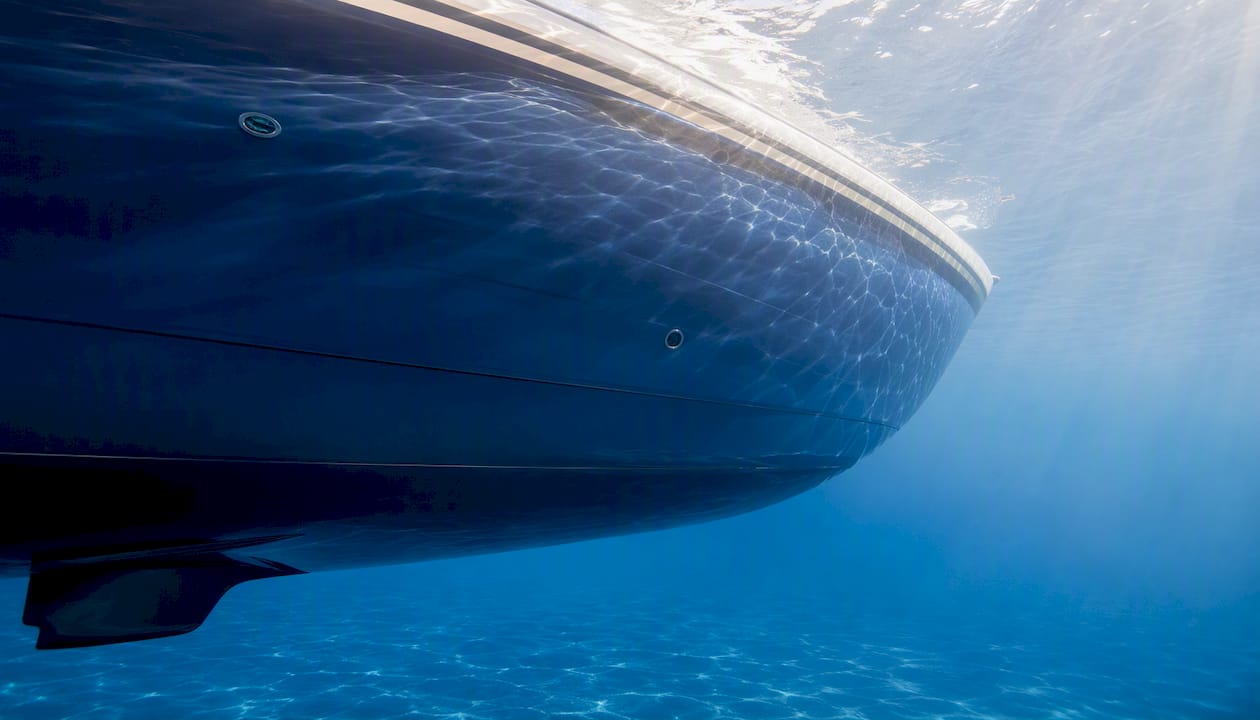
Hard paints cure to a rigid, insoluble matrix. Biocides — usually cuprous oxide — leach through pores in the film as water passes over the hull. The paint itself does not wear away. That durability makes hard paint excellent for boats that sit in one place for long seasons, but it creates a real problem for trailered boats: the dry-out and re-wet cycle can cause the film to crack and delaminate. Hard paints also build up with each recoat, eventually requiring a full strip.
Ablative (self-polishing) paints
Ablatives are designed to wear. As the hull moves through water, the outer binder layer slowly erodes, exposing fresh biocide continuously. Self-polishing copolymer (SPC) technology takes this further: the binder reacts chemically with seawater, releasing biocide at a controlled rate and leaving a smoother surface over time. The practical payoff is that ablatives stay effective even after a haul-out, because the next season simply picks up where the erosion left off. They suit seasonal boaters well and work particularly well for northern owners who pull the boat for winter.
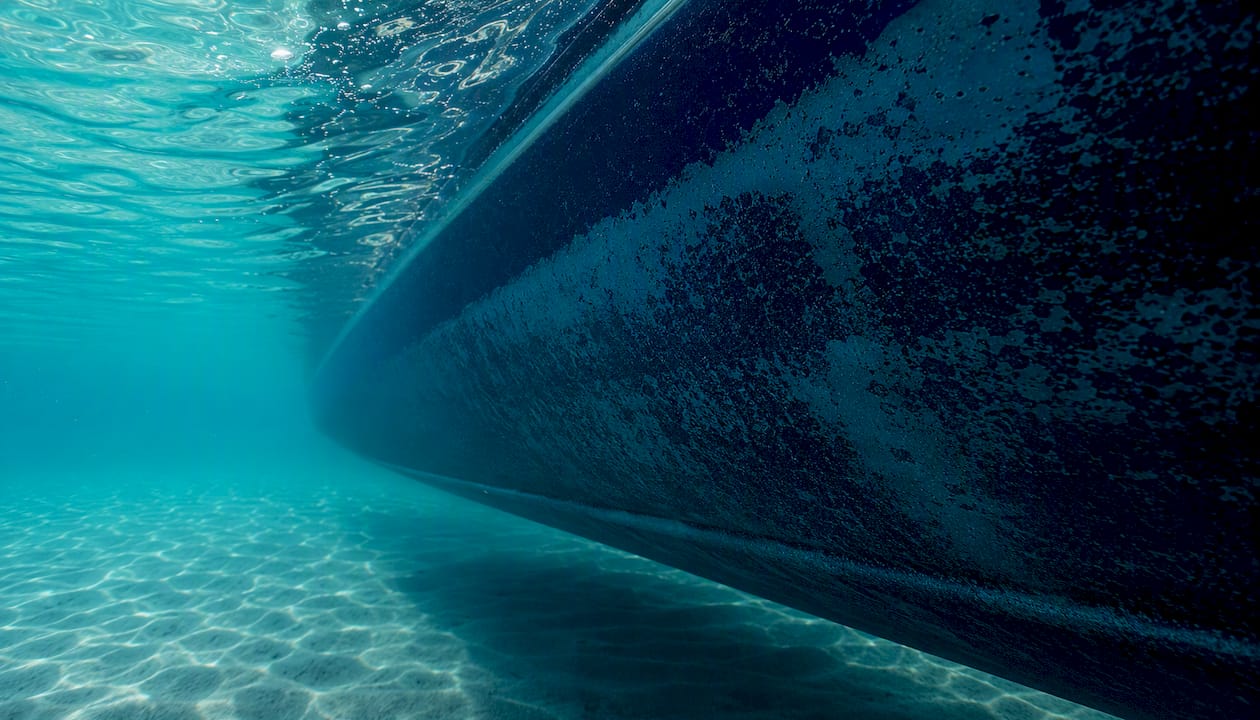
Hybrid ablatives
Hybrid formulas blend a harder binder with controlled-erosion chemistry. The goal is durability closer to a hard paint with the self-renewing biocide delivery of an ablative. They tend to suit boats that spend most of the season in the water but get hauled once or twice a year.
Foul-release (silicone/PTFE) coatings
Foul-release coatings contain no biocide at all. Instead, they use ultra-low surface energy — silicone or PTFE chemistry — so fouling organisms cannot grip the hull firmly. At speeds above roughly 15 knots, organisms simply shed. Below that speed, periodic light scrubbing keeps the surface clean. These coatings demand careful surface prep, often a dedicated primer system, and professional application for best results.
| Paint class | Best for | Biocide type | Recoat interval | Hull compatibility | Application |
|---|---|---|---|---|---|
| Hard contact-leaching | Full-season in-water, stationary boats | Copper-based | Annual or as needed | Fiberglass, wood (not bare aluminum) | DIY or pro; primer often needed |
| Ablative / SPC | Seasonal, trailered, moderate use | Copper or copper-free | 1–3 seasons depending on erosion | Fiberglass, wood, some aluminum (copper-free only) | DIY-friendly |
| Hybrid ablative | Mixed-use, moderate fouling | Copper or copper-free | 1–2 seasons | Fiberglass, wood | DIY or pro |
| Foul-release silicone | High-speed, eco-sensitive, commercial | Biocide-free | 3–5 years (with maintenance) | Fiberglass, aluminum (check primer) | Professional recommended |
How do biocides work, and what does U.S. regulation say?
The biocide is the active ingredient that kills or repels fouling organisms. Choosing the right one is as much about environmental compliance as it is about performance.
Copper-based biocides
Cuprous oxide is the workhorse of the antifouling industry. It releases copper ions that are toxic to barnacles, algae, and tube worms. Cuprous thiocyanate (sometimes called “white copper”) offers a lighter-colored alternative with similar chemistry. Copper works reliably across a wide range of water temperatures and fouling pressures, which is why it still dominates the U.S. market.
The regulatory picture is shifting, though. The EPA established a maximum allowable copper leach rate of 9.5 µg/cm²/day for registered antifouling paints. Washington State’s 2020 legislation set a framework that could restrict many copper-based paints beginning January 1, 2026 if safer, effective alternatives are confirmed — a signal that other coastal states may follow.
Copper-free biocides
Econea (tralopyril), zinc pyrithione, and DCOIT are the main copper-free active ingredients. Econea at relatively low concentrations can match the antifouling efficacy of much higher copper loadings in certain formulations, and it degrades faster in marine environments. Zinc pyrithione is often used as a booster alongside other actives. DCOIT (Sea-Nine) is a broad-spectrum biocide effective at low concentrations.
A word of caution: “copper-free” does not automatically mean environmentally benign. Field and lab assessments from Chalmers University found that some copper-free formulations showed concerning toxicity profiles in environmental assays, even when their fouling performance was strong. Always read the active ingredient list and the manufacturer’s technical data sheet (TDS) before assuming a copper-free label equals low impact.
Biocide-free foul-release coatings
A comparative assessment of biocidal and biocide-free antifouling coatings found that biocide-free systems show lower ecological impacts and can deliver long-term fuel savings when matched to the right vessel operation. The tradeoff is operational: foul-release coatings need speed to shed growth, require more active cleaning when the boat sits idle, and demand a compatible primer system. A recent multi-site field comparison found that a silicone-based biocide-free coating performed best against fouling in certain coastal tests, but required special primers and careful application — reinforcing that these systems reward preparation.
Regulatory callout: The EPA’s 9.5 µg/cm²/day copper leach-rate cap applies to all FIFRA-registered antifouling paints sold in the U.S. State-level restrictions vary and are evolving; check your state environmental agency before purchasing, especially in California, Washington, and other coastal states with active review programs.
Pro Tip: Before buying any antifouling paint, download the manufacturer’s TDS. The TDS lists the active ingredient percentage, the registered leach rate (where disclosed), recommended hull substrates, and recoat windows — information that the label alone rarely provides in full.
How do you choose the right paint for your boat and waters?
Matching biocide release rate and paint type to vessel usage is the single most important selection principle — not price, not copper percentage alone. Here is a step-by-step decision checklist.
Step 1: How does your boat live?
- Trailered regularly → ablative or thin-film; avoid hard paints that crack on dry-out.
- In the water full season → hard or multi-season ablative; fouling pressure is constant.
- Liveaboard or commercial vessel → high-copper hard paint or premium SPC ablative.
Step 2: What hull material do you have?
- Fiberglass → most paint classes work; check primer compatibility.
- Aluminum → copper-free only; cuprous oxide causes galvanic corrosion on bare metal.
- Wood → hard or ablative with appropriate primer; check for compatibility with existing coatings.
- Inflatable (Hypalon/PVC) → specialized inflatable-safe formulas only; most standard antifoulings will damage the fabric.
Step 3: What are your local water conditions?
- Warm, nutrient-rich saltwater (Florida, Gulf Coast) → heavy fouling pressure; choose high-biocide-load paint or premium SPC.
- Cooler northern waters → moderate fouling; ablatives and lower-copper formulas often suffice.
- Freshwater → fouling pressure is lower; some owners use thin-film or PTFE options; check local regulations on biocide use in freshwater.
- Brackish estuaries → mixed fouling communities; consult your local boatyard for what works in that specific body of water.
Step 4: How fast and how often do you run?
- High-speed planing hull (above 25 knots regularly) → hard paint; ablatives erode faster at speed.
- Displacement or slow-cruising hull → ablative or foul-release; both suit lower speeds.
- Occasional weekend use → ablative; the self-renewing surface handles irregular schedules well.
Step 5: What is your maintenance tolerance?
- Willing to scrub monthly and haul annually → most options work.
- Prefer low-touch maintenance → foul-release (if you run fast enough) or premium multi-season SPC.
- Budget-driven → ablative DIY is typically the most cost-effective entry point.
Common mistakes to avoid:
- Choosing paint by price alone, ignoring local fouling pressure.
- Applying a copper-bearing paint directly to bare aluminum.
- Painting hard over soft without stripping — incompatible binders cause delamination.
- Skipping the primer when switching paint systems or hull materials.
Local boatyards are genuinely one of the best resources here. Field performance is highly site-specific, and a yard that hauls dozens of boats in your marina every season knows which products hold up in that exact water.
Solvent-based vs. water-based: what changes at the application stage?
The chemistry inside the can matters, but so does what happens when you open it.
Solvent-based antifouling paints carry higher VOC content, stronger odor, and require solvent-based cleanup (typically xylene or acetone). They tend to dry faster in humid conditions, which matters in Florida’s climate, and they generally offer better adhesion on older, contaminated surfaces. The tradeoff is worker exposure and stricter disposal requirements for waste solvent.
Water-based formulations have improved significantly. They clean up with water, produce lower VOC emissions, and are easier to handle for DIY owners. Drying time can be longer in high-humidity environments, and some water-based paints are more sensitive to surface moisture at application. For a well-prepped, dry hull, the performance gap between solvent and water-based has narrowed considerably.
Primer compatibility and the rules that matter most
Never apply a copper-bearing antifouling paint directly to bare aluminum. The galvanic reaction between copper ions and aluminum causes rapid, aggressive corrosion beneath the coating. Use a copper-free epoxy barrier primer rated for aluminum, then apply a copper-free topcoat.
Do not apply a hard antifouling over an existing soft or ablative coating without stripping first. The rigid hard paint cannot flex with the eroding layer beneath it and will delaminate. When switching paint systems entirely, a full strip to bare substrate and a fresh primer system is the safest path.
Application methods
Brush and roller application suits most DIY owners and most antifouling paints. Rolling applies a thicker, more uniform film than brushing alone; tipping with a brush after rolling smooths the surface. Spray application delivers the most uniform film thickness and is standard for professional foul-release application, but it requires containment to prevent overspray and is rarely practical for DIY in a marina setting.
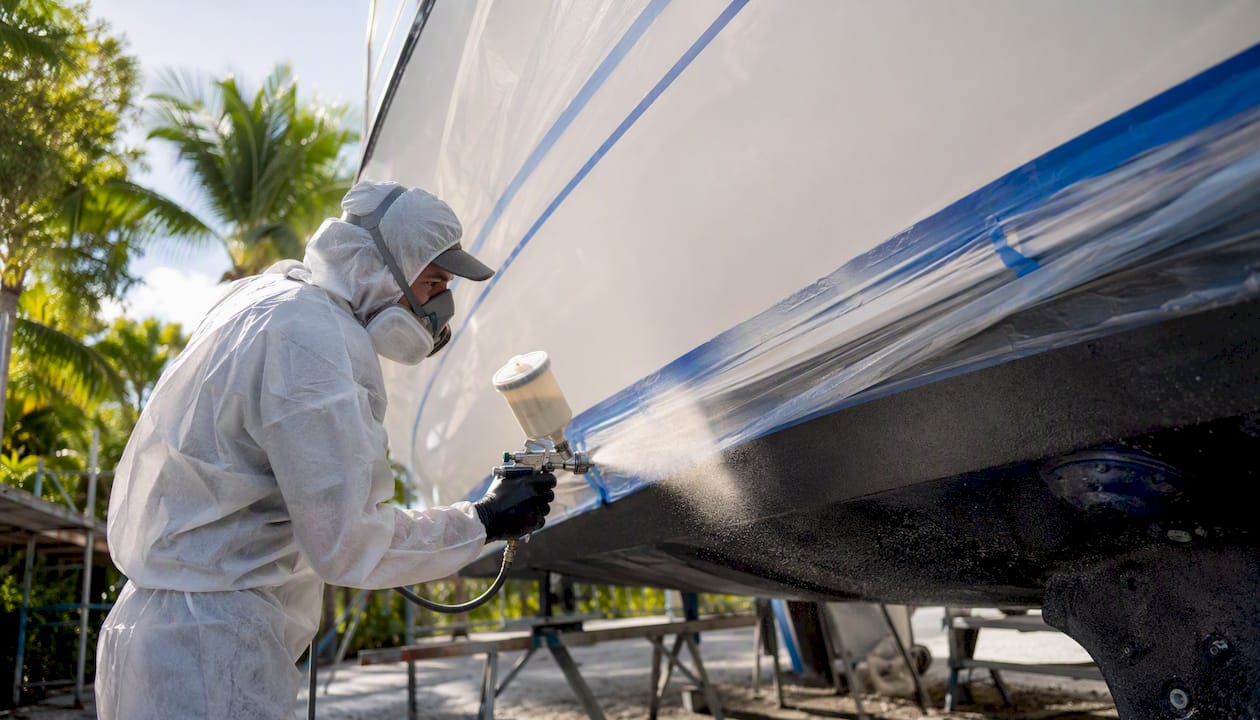
Pro Tip: Foul-release silicone systems almost always require professional spray application. The primer and topcoat must be applied within specific recoat windows — often measured in hours — and the surface must be completely free of contamination. A single fingerprint on an uncured silicone surface can cause adhesion failure. This is one application where DIY rarely pays off.
How long does bottom paint last, and what does it cost?
Realistic expectations prevent expensive surprises at haul-out time.
Single-season vs. multi-season paints: Most ablative and hard paints are rated for one season (roughly 12 months in the water). Multi-season SPC ablatives can last two to three seasons under moderate fouling pressure, making them cost-effective for owners who don’t want annual haulouts. In Florida’s warm, biologically active water, even multi-season paints often need a fresh coat every 12–18 months to maintain effective protection.
Maintenance schedule:
| Task | Typical interval |
|---|---|
| Visual hull inspection (in water) | Monthly |
| Light scrubbing / growth removal | Every 2–3 months (more in summer) |
| Underwater inspection by diver | Every 3 months |
| Haul-out and full repaint | Every 1–3 seasons depending on paint type and fouling |
| Full strip and barrier coat | Every 5 years or when buildup exceeds manufacturer limits |
Cost ranges: Antifouling paint typically runs from roughly $50–$80 per gallon for entry-level ablatives to $150–$300 or more per gallon for premium SPC or foul-release systems. Coverage varies by product — most manufacturers list 300–400 square feet per gallon for a single coat on a smooth hull, but rough or porous surfaces absorb more. A typical 30-foot sailboat may need two gallons for two coats; a 50-foot sportfish can easily require four to six gallons. For South Florida cost benchmarks specific to the local market, labor and haul-out fees add significantly to the material cost.
Professional application in Florida typically adds $15–$30 per linear foot for labor, plus haul-out, pressure washing, and disposal fees. A full professional repaint on a 40-foot vessel, including prep and two coats, commonly runs into the low-to-mid thousands of dollars depending on the yard and paint system chosen.
Pro Tip: Pay extra attention to high-wear areas — the bow, keel, and rudder — where water turbulence accelerates ablation. Apply an additional coat to these zones, and note it in your maintenance log. The manufacturer’s TDS will list coverage per coat; use that figure, not the label’s marketing claim, when estimating how much paint to buy.
Which brands make these paints, and what do they emphasize?
The brands below represent the most widely available product lines in the U.S. market. This is an illustrative overview, not a ranked list — no single brand is universally superior across all conditions.
- TotalBoat: Offers a range of ablative and hard antifouling paints at accessible price points, with both copper-based and copper-free options. Popular with DIY owners for clear labeling and direct-to-consumer availability.
- Interlux: A long-established marine coatings brand with a broad portfolio spanning hard, SPC ablative, and foul-release systems. Their Micron series is widely used by cruisers and liveaboards in U.S. waters.
- Pettit: Known for both hard and ablative formulas, including copper-free options. Their Trinidad and Hydrocoat lines are frequently recommended by boatyards along the East Coast and Gulf.
- Sea Hawk: A Florida-based manufacturer with formulations specifically developed for warm, high-fouling-pressure waters. Their products are a common sight in South Florida boatyards and are worth asking about locally.
- Intersleek: Produced by International Paint, Intersleek is a professional-grade foul-release system used primarily on commercial vessels and performance yachts. It requires professional application and is not a DIY product.
How to read a manufacturer’s TDS
The TDS is where the real information lives. If a paint claims “multi-season” protection, the TDS will usually specify the conditions under which that claim applies — water temperature, vessel speed, and fouling zone. Marketing copy on the label is a starting point; the TDS is the document you make decisions from.
When does professional application make more sense than DIY?
Some bottom paint jobs are genuinely within reach of a careful DIY owner. Others are not, and the cost of getting it wrong — delamination, galvanic corrosion, failed foul-release adhesion — far exceeds the savings on labor.
Situations where professional application is the smart call:
- Foul-release silicone systems (Intersleek and similar): spray application, tight recoat windows, zero contamination tolerance.
- Aluminum hulls: primer selection and application sequence are critical; a mistake causes structural corrosion.
- Multi-coat commercial systems on large vessels: film thickness control and QA require professional equipment.
- Major surface prep (grinding, blasting, or full strip): containment, disposal, and worker safety require professional setup.
- Any boat where the existing coating history is unknown: a pro can test for compatibility before committing to a new system.
What a professional service includes:
- Haul-out coordination and pressure washing.
- Surface assessment and compatibility testing.
- Masking of waterline, running gear, and through-hulls.
- Primer application (barrier coat, tie coat, or aluminum-safe primer as needed).
- Antifouling application to specified film thickness, with extra coats on high-wear zones.
- Proper containment and disposal of wash water and paint residue per local regulations.
- Documentation of paint system used (for future compatibility reference).
In Florida, haul-out lead times at busy yards can run two to four weeks during peak season (spring and early summer). Booking your haulout in winter gives you more scheduling flexibility and often better yard rates. Mazzamarine’s network of Florida hauling partners and full maintenance packages covers the entire cycle — from haul-out scheduling through surface prep, paint application, and splash-back — so you’re not coordinating multiple vendors yourself.
U.S. regulations and safe practices for hull painting
Antifouling paint is a pesticide under FIFRA (Federal Insecticide, Fungicide, and Rodenticide Act), which means every product sold in the U.S. must be EPA-registered. The EPA’s copper leach-rate cap of 9.5 µg/cm²/day is the federal ceiling; state-level restrictions can be more stringent.
Regulatory note: Washington State’s 2020 legislation established a framework that could restrict many copper-based antifouling paints beginning January 1, 2026, pending confirmation that safer alternatives are available. Other coastal states, including California, have active review programs. Check your state environmental agency’s current guidance before purchasing — regulations in this area are actively evolving.
Safe practices for DIY painters:
- Wear a NIOSH-approved respirator rated for organic vapors and particulates; antifouling dust is toxic.
- Use chemical-resistant gloves and eye protection throughout sanding and application.
- Sand only with wet-sanding methods or vacuum-shrouded sanders to contain copper dust.
- Never sand or apply antifouling paint directly over open water; use a tarp or containment system to capture all residue.
- Dispose of paint waste, rags, and wash water through your marina’s designated waste program — never rinse into the water.
- Check with your marina whether any biocides are prohibited in that specific anchorage or slip area.
For professional yards:
- Closed-loop pressure washing systems capture wash water for proper treatment and disposal.
- Paint stripping residue must be collected and disposed of as hazardous waste per EPA and state guidelines.
- Confirm that the paint product is currently registered in your state before applying it commercially.
Pro Tip: Before purchasing any antifouling paint, verify that the product is currently EPA-registered and check the manufacturer’s TDS for the active ingredient’s regulatory status in your state. A product legal in one state may be under restriction in another — and the label alone does not always reflect the most current regulatory status.
What experience actually teaches about picking bottom paint
There’s a pattern that shows up again and again with Florida yacht owners: they choose a paint based on what worked on their last boat, in a different marina, in different water. A 40-foot sportfish owner who ran a high-copper hard paint successfully in the Chesapeake arrives in Miami and finds it failing by midsummer because South Florida’s warm, nutrient-dense water is a fundamentally different fouling environment.
The honest answer is that no single formula wins everywhere. What Mazzamarine’s network of Florida yards has found, time and again, is that the boats with the cleanest bottoms after a full season are the ones where the paint selection started with a conversation about actual usage — how many hours per week, what speed range, whether the boat sits in a slip or on a mooring. Foul-release systems are genuinely impressive when applied correctly on a boat that runs regularly; on a boat that sits idle for weeks at a time, they become a maintenance burden. High-copper ablatives are workhorses in Florida waters, but they’re not the answer for an aluminum-hulled center console.
The other thing worth saying plainly: the TDS is your friend. Most paint failures trace back to someone skipping the primer, applying outside the recoat window, or putting a new system over an incompatible old one. The data sheet tells you exactly what not to do. Read it before you open the can.
Mazzamarine handles your bottom paint from haul-out to splash
Choosing the right antifouling system is one decision. Getting it applied correctly — on a properly prepped hull, with the right primer, within the manufacturer’s recoat windows — is another. Mazzamarine’s Florida network covers both. Whether you need a straightforward ablative repaint, a professional foul-release installation on a performance yacht, or a complete maintenance package that handles haul-out scheduling, surface prep, application, and splash-back coordination, the team manages every step so you don’t have to chase multiple vendors.
What Mazzamarine brings to a bottom paint project:
- Surface prep to TDS specification, including barrier coat and aluminum-safe primer where needed.
- Professional spray or roller application with film thickness verification on high-wear zones.
- Haul-out and splash coordination through established Florida yard partners.
Florida’s peak hauling season fills up fast. To get your bottom paint project scheduled before the rush, reach out to Mazzamarine through the marine repair service guide and get a quote from the team directly.
Sources
These resources are worth consulting before committing to a paint system, especially if you’re switching classes or operating in regulated waters.
- Draft Antifouling Paints in Washington State: Third Report to the Legislature
- Field and environmental assessment of antifouling coatings (Chalmers University)
- Comparative assessment of biocidal and biocide-free antifouling coatings
- Copper high rivals silicone in fouling test
- How to choose bottom paint for your boat
Ask your local boatyard which products they see holding up in your specific marina. Lab data and field tests from Sweden or Washington State are useful context, but the yard that hauls boats in your bay every spring has the most relevant data point of all.
Recommended
Text or Call 954-330-9653 Schedule Appointment
Mazza Marine Yacht Services & Refit

Fiberglass Upgrades and Damage Repair

Premium Yacht Paint/ Faux Teak

Fishing: Custom Rods, Reels,Tackle

Electrical, Electronics and Navigation

Paint, Hull and Gelcoat

Teak Decks, Wood Cabinets, Carpentry

Canvas, Enclosures and Upholstery

Mechanical, Repower and Running Gear

Plumbing, Bilge and Thru-Hulls

Welding and Custom Fabrication

Interior Refit And Past Work
Get your yacht value Estimate
"*" indicates required fields