
View Our Recent Work:

Most boat owners spend serious money on their vessel and then gamble on its longevity by underestimating how much choosing maintenance packages actually matters. The right package keeps your engine running clean, your hull protected from Florida’s relentless saltwater, and your time on the water free from unexpected breakdowns. The wrong one leaves you overpaying for services you don’t need or, worse, missing critical work that shortens your boat’s life. This guide breaks down what is a maintenance package, how to compare your options, and how to match the right plan to your specific vessel and usage patterns.
Table of Contents
- Key Takeaways
- Choosing maintenance packages: understanding what they cover
- Comparing service levels, pricing, and benefits
- Matching your package to boat type and usage
- How to evaluate and apply your maintenance plan
- What I’ve learned about maintenance plans after years on the water
- How Mazzamarine supports Florida yacht owners
- FAQ
Key Takeaways
| Point | Details |
|---|---|
| Know what’s included | Maintenance packages vary widely in scope; always verify exactly which services are bundled before signing. |
| Match package to vessel type | Saltwater yachts, sportfish boats, and outboards each require different service frequencies and coverage. |
| Timing affects cost | Scheduling maintenance outside peak season reduces wait times and can lower your overall service costs. |
| Document everything | A written service log protects your warranty and strengthens resale value significantly. |
| Condition-based beats fixed schedules | Adjusting service intervals to actual usage and environment saves money and prevents hidden damage. |
Choosing maintenance packages: understanding what they cover
A maintenance package is a bundled agreement between a boat owner and a service provider that covers a defined set of recurring tasks performed at scheduled intervals. Think of it as a curated service plan designed to address everything from routine fluid changes to seasonal systems checks, all under one agreement rather than booking individual jobs piecemeal.
Most packages fall into three broad categories:
- Basic packages cover oil and filter changes, spark plug replacement, fuel filter swaps, and a general safety inspection. These suit owners with newer boats, low annual hours, or freshwater use where wear is less aggressive.
- Comprehensive packages add engine servicing, cooling system flushes, impeller replacement, fuel system treatment, battery checks, bilge pump testing, and basic hull cleaning. For most Florida yacht owners running year-round in saltwater, this tier is the minimum worth considering.
- Premium or platinum packages include everything in comprehensive tiers plus electronics diagnostics, bottom paint application, full detailing, canvas and enclosure inspection, winterization or de-winterization services, and priority scheduling for urgent repairs.
Package scope shifts considerably based on vessel size and operating environment. A 28-foot center console running inshore saltwater trips needs a different maintenance focus than a 55-foot sportfish yacht making offshore runs in heavy seas. Professional spring commissioning for a 25-foot boat runs between $200 and $600 for a standard scope, while full detailing alone can reach $15 to $50 per linear foot. Understanding those baseline costs helps you evaluate whether a bundled package actually represents value or simply packages things you could schedule separately.
Comparing service levels, pricing, and benefits
Price is the first thing most boat owners look at when comparing maintenance services, but it’s rarely the most telling number. What matters more is what that price actually buys you relative to what your boat needs.
| Package tier | Typical annual cost range | Core inclusions | Best suited for |
|---|---|---|---|
| Basic | $300 to $700 | Oil/filter, spark plugs, inspection | Freshwater use, low hours, new engines |
| Comprehensive | $800 to $1,800 | Engine service, cooling, fuel system, hull clean | Year-round saltwater, moderate use |
| Premium/Platinum | $2,000 to $5,000+ | Full systems, detailing, electronics, priority service | Offshore yachts, heavy use, charter vessels |
The most overlooked benefit of bundled packages is scheduling priority. Bundled maintenance clients receive priority status at service shops, which matters enormously during Florida’s peak spring and summer season when quality mechanics have waiting lists stretching weeks. That priority alone can mean the difference between a working boat and one sitting at the dock when you want to be offshore.
That said, bundled plans have real drawbacks worth examining. Some packages include services your boat genuinely doesn’t need, inflating the price without adding real protection. Long-term maintenance agreements with dealer shops may limit your flexibility to use independent specialists for specific work, such as electronics upgrades or custom hull and gelcoat repairs that require niche expertise.
Pro Tip: Before committing to any package, request an itemized list of every service included and verify which are performed at every visit versus annually. Some packages bury infrequent services in the headline list to make the tier sound more complete than it is.
Matching your package to boat type and usage
No two boats have the same maintenance demands, and this is exactly where most generic package advice falls apart. Your vessel type and how you actually use it should drive every decision when selecting maintenance package options.
Here’s how usage patterns shape package requirements:
- Saltwater versus freshwater: Saltwater accelerates corrosion on every metal surface, clogs raw-water cooling systems faster, and degrades bottom paint at a higher rate. Severe-duty conditions like saltwater use shorten recommended maintenance intervals significantly, meaning manufacturer schedules are often the minimum rather than the standard.
- Outboard engines: These benefit heavily from lower unit gear oil checks, impeller replacements, and fuel stabilization services. Checking gear oil in the fall rather than spring, for instance, catches water intrusion from seal failure early, allowing repairs before the spring rush locks up every mechanic in the marina.
- Inboard and sportfish yachts: These demand more attention to raw-water cooling systems, heat exchangers, transmission fluid, and shaft seal integrity. Owners running offshore in the Gulf Stream need packages that explicitly include these checks at least annually.
- Pontoon and freshwater boats: Basic to mid-level packages are usually sufficient, with the focus on engine health, bilge, and electrical systems rather than heavy corrosion protection.
- Sailing yachts: Rigging inspection, standing and running rigging checks, and mast wiring should be non-negotiable package elements. These are easy to skip but catastrophically expensive when they fail offshore.
Year-round Florida boaters also face a particular challenge. Vessels that never see storage tend to accumulate wear faster on cooling system components because there’s no off-season for parts to rest or get a thorough inspection. If you’re running your boat more than 150 hours a year in saltwater, a comprehensive or premium package is not a luxury. It’s the cost of reliability.
Pro Tip: Ask your service provider whether their package pricing adjusts for your specific engine hours rather than calendar time. A boat running 200 hours a year ages far faster than one doing 50 hours, and your package should reflect that.
How to evaluate and apply your maintenance plan
Finding the right package on paper is only half the work. Applying it well is what actually protects your boat. Use this practical checklist when vetting service providers and managing your plan:
- Verify the provider’s reputation. Look for reviews from boat owners with similar vessel types. A shop that excels at outboard service may not have deep experience with twin-diesel inboards or heavy marine machinery.
- Confirm coverage clarity. Get every included service in writing. Verbal agreements about what’s “covered” have a way of becoming disputes when a specific repair comes up.
- Assess flexibility. The best affordable maintenance packages allow you to add or remove services as your needs change rather than locking you into rigid tiers for multi-year terms.
- Build and maintain a service log. A written log of engine specs, oil capacities, and filter numbers turns maintenance from guesswork into a repeatable, efficient process. It also supports warranty claims and meaningfully increases resale value.
- Consider condition-based intervals. Predictive, condition-based maintenance tailored to actual vessel condition outperforms fixed-time schedules, especially for boats operating in severe environments. Rather than servicing by the calendar, use engine hour meters, oil analysis, and visual inspection to trigger service when it’s actually needed.
- Time your services strategically. Scheduling major work in the fall or late winter means shorter wait times, better mechanic availability, and often lower shop rates compared to April and May. Checking lower unit oil in fall rather than waiting for spring is a small habit that prevents major delays.
- Blend DIY and professional services. Not everything requires a technician. Regular rinsing, basic fluid checks, and interior cleaning can be handled by the owner, reserving professional services for tasks that genuinely require expertise and specialized equipment.
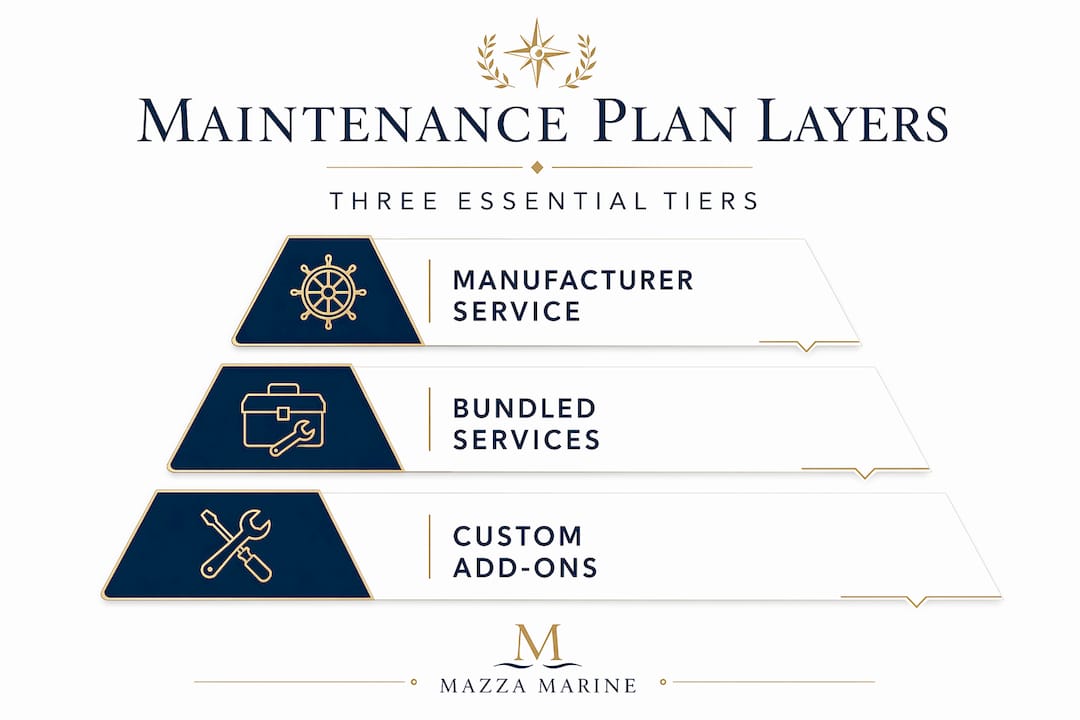
One framework worth adopting: divide your package into three layers. The first covers fixed, non-negotiable manufacturer intervals. The second covers condition-triggered tasks based on hours, visual cues, or test results. The third covers seasonal and situational work tied to your boating calendar. A provider offering smarter yacht maintenance structured around this approach will serve you far better than one applying the same cookie-cutter schedule to every boat in their yard.
What I’ve learned about maintenance plans after years on the water
I’ve watched boat owners make the same expensive mistake over and over. They look at a healthy-running engine and decide to push the service interval another season. That logic feels sound until the day it isn’t. Skipping manufacturer-recommended intervals is genuinely the costliest error in boating, not because the engine explodes the next day, but because the damage accumulates silently until it’s a five-figure repair instead of a routine service call.
What I’ve come to believe, after seeing how different boats hold up over time, is that predictive and condition-based maintenance beats rigid schedules in almost every real-world scenario. Fixed schedules are designed for average conditions. Your boat doesn’t live in average conditions.
I’ve also learned to be skeptical of premium-tier packages that load in services you’ll never use. A freshwater lake boat does not need the same anti-corrosion protocol as a Miami sportfish running the Gulf Stream every weekend. One-size-fits-all packages are often priced for the worst-case vessel, not yours. The best maintenance agreements I’ve seen are the ones where the provider actually asks about your usage patterns before quoting anything.
Keep the log. I can’t say this enough. The owners who maintain detailed, written service records sell their boats faster and for more money. It’s not just about warranties. It’s about proving that the boat was cared for by someone who paid attention.
— Jason
How Mazzamarine supports Florida yacht owners
Whether you’re trying to make sense of your current coverage or starting fresh with a new vessel, Mazzamarine has helped countless Florida yacht owners sort through their options and build plans that actually fit the way they boat.

Mino and Luigi’s team offers access to a deep network of Florida yacht specialists covering everything from engine troubleshooting and mechanical systems to hull care, interior refits, sportfish upgrades, and custom welding. Whether you need a single service or a long-term maintenance agreement tailored to your vessel and usage patterns, Mazzamarine connects you with the right experts and stays with you through every season. Reach out today for a personalized consultation and find the package that keeps your boat at its best.
FAQ
What is a maintenance package for a boat?
A boat maintenance package is a bundled service agreement covering a set of recurring tasks such as engine servicing, fluid changes, hull cleaning, and systems inspections performed at defined intervals by a professional provider.
How do I compare maintenance package options?
Request itemized service lists from each provider, verify the frequency of each service, and confirm whether the pricing adjusts for your boat’s size, engine hours, and operating environment before comparing total value.
What should I look for in a maintenance provider?
Look for a provider with experience on your specific vessel type, clear written contracts, flexible coverage options, and a reputation backed by reviews from owners with similar boats and usage patterns.
Are long-term maintenance agreements worth it?
Long-term agreements can deliver cost savings and priority scheduling, but review the terms carefully to confirm flexibility for adding services or switching providers if your needs change.
How often should a saltwater boat be serviced?
Saltwater boats in heavy use should be serviced more frequently than manufacturer base intervals suggest, since severe conditions accelerate wear on cooling systems, anodes, seals, and bottom paint throughout the season.
Recommended
Text or Call 954-330-9653 Schedule Appointment
Mazza Marine Yacht Services & Refit

Fiberglass Upgrades and Damage Repair

Premium Yacht Paint/ Faux Teak

Fishing: Custom Rods, Reels,Tackle

Electrical, Electronics and Navigation

Paint, Hull and Gelcoat

Teak Decks, Wood Cabinets, Carpentry

Canvas, Enclosures and Upholstery

Mechanical, Repower and Running Gear

Plumbing, Bilge and Thru-Hulls

Welding and Custom Fabrication

Interior Refit And Past Work
Get your yacht value Estimate
"*" indicates required fields