
View Our Recent Work:

Boat ownership in Florida means constant battles with saltwater, UV exposure, and the relentless wear that comes with life on the water. Off-the-shelf parts rarely fit perfectly, and when they fail, the consequences range from costly downtime to genuine safety risks. The custom welding advantages available today give boat owners and operators a real edge, from bespoke hull reinforcements to precision-fabricated outriggers that simply cannot be replicated with catalog parts. This guide breaks down exactly why custom welding is the gold standard for serious marine vessel owners who demand durability, perfect fit, and long-lasting performance.
Table of Contents
- Key Takeaways
- 1. Custom welding advantages start with precision fit
- 2. Durability and corrosion resistance that outlasts stock parts
- 3. Long-term cost savings that justify the investment
- 4. The versatility of personalized welding solutions for boats
- 5. How to choose the right custom welding service for your boat
- 6. Custom welding efficiency reduces vessel downtime
- My take on custom welding and vessel longevity
- How Mazzamarine can help with your custom welding needs
- FAQ
Key Takeaways
| Point | Details |
|---|---|
| Perfect fit every time | Custom welding matches your exact vessel geometry, eliminating the compromises of mass-produced parts. |
| Stronger joints, less corrosion | Welded joints exceed base metal strength and create sealed connections that resist marine corrosion. |
| Long-term savings | Higher upfront costs are offset by fewer replacements, less maintenance, and reduced downtime over time. |
| Mobile service is a game changer | On-site marine welding avoids transport risks and delivers precision fitting directly at the dock. |
| Choose certified professionals | AWS-certified welders with marine experience deliver measurably better outcomes and fewer costly reworks. |
1. Custom welding advantages start with precision fit
When you order a bracket, a fitting, or a structural component off a shelf, you are accepting a compromise. The part was designed for the average boat, not yours. Custom welding changes that entirely.
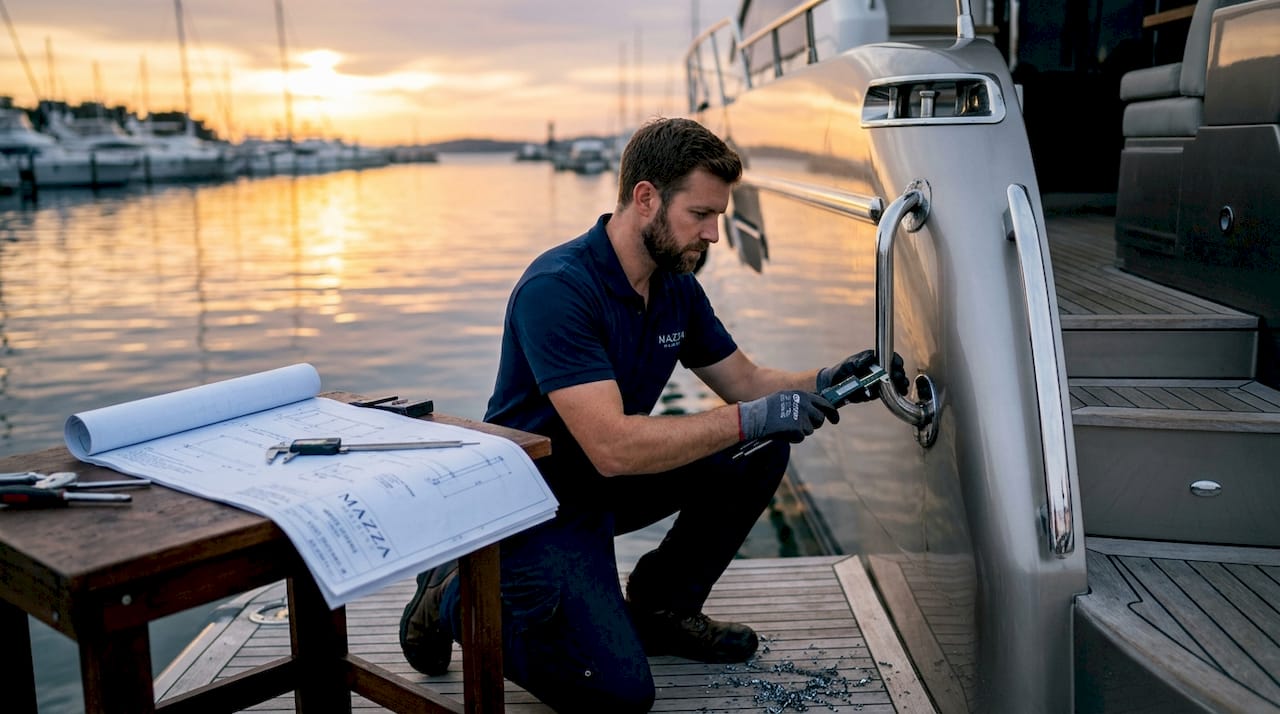
Skilled fabricators work from your vessel’s actual geometry, whether you are dealing with a wide-body sportfish, a long-range cruiser, or a center console with a custom tower already in place. They can accommodate unusual curves, non-standard angles, and tight clearances that no factory part will ever address. Techniques like CNC plasma cutting and in-house CAD design allow fabricators to translate your requirements into precise, repeatable cuts and assemblies before a single arc is struck.
One of the underappreciated advantages of bespoke welding is the ability to work from damaged originals. Fabricators use reverse engineering to recreate parts from broken samples, which is far more accurate than relying on hand measurements and hand-drawn sketches.
- Match complex hull geometries no catalog part can fit
- Accommodate unusual tower, arch, or outrigger configurations
- Replicate discontinued or one-off OEM parts from damaged samples
- Use CAD-supported design for repeatable accuracy
Pro Tip: When bringing a damaged part for replication, always bring the mating component as well. Fabricators can fit both pieces together to capture tolerances that drawings often miss.
2. Durability and corrosion resistance that outlasts stock parts
Saltwater is relentless. It finds every crevice, every imperfect seal, and every threaded fastener that was not quite tight enough. Bolted assemblies give corrosion a roadmap. Welded joints do not.
Welding eliminates holes and stress risers that bolted connections create, which matters enormously in a marine environment where vibration and salt exposure are daily realities. A properly executed weld is often stronger than the surrounding base metal, creating a connection that flexes with the vessel rather than working loose over time.
“Welded joints often outperform base metals in strength and durability, critical for marine applications where vibration and corrosion are prevalent.” — Toledo Fab
AWS-certified welders know how to select filler materials compatible with marine-grade aluminum and stainless steel, and they understand how heat input affects corrosion resistance in saltwater-exposed alloys. This is not something a general welder can reliably replicate. You can see real-world examples of how tailored welding services address corrosion in high-wear marine zones across a range of vessel types.
- Seamless joints prevent salt intrusion at connection points
- Eliminated bolt holes remove initiation sites for crevice corrosion
- Proper filler selection maintains corrosion resistance in marine alloys
- Reinforced high-wear areas like chine rails, swim platforms, and anchor rollers last significantly longer
3. Long-term cost savings that justify the investment
The upfront cost of custom welding services gives some boat owners pause. That hesitation fades quickly once you calculate what repeated stock-part failures actually cost. Custom welding reduces long-term expenses by minimizing maintenance cycles and preventing the kind of catastrophic failures that turn a weekend on the water into a six-week haul-out.
Consider these real scenarios boat owners face:
- A swim platform bracket fabricated from off-the-shelf aluminum angle stock corrodes at the fastener holes within three seasons. A custom-welded stainless bracket lasts the life of the boat.
- A stock tower base plate that does not quite fit the hardtop footprint develops stress cracks from flex. A custom plate welded to exact tolerances distributes load properly and eliminates the issue.
- A mass-produced thru-hull fitting that requires annual re-bedding because it was never quite the right diameter. A custom fabricated fitting seats perfectly and requires no annual attention.
Custom fabrication pricing varies widely based on material, complexity, and finishing, but the math usually favors custom work within two to three replacement cycles of stock parts.
Pro Tip: Ask your fabricator to document the materials and alloy grades used in your custom parts. That information is priceless if you need repairs or additions years later, especially with exotic marine alloys.
4. The versatility of personalized welding solutions for boats
Custom welding is not a single service. It is a category that covers everything from emergency structural repairs performed at the dock to elaborate performance upgrades fabricated in a fully equipped shop. The range of custom welding applications available to Florida boat owners is genuinely impressive.
Mobile welding services are particularly valuable for marine work. Transporting a large vessel to a shop is expensive, logistically complex, and carries its own risk of damage in transit. A qualified mobile welder can come directly to your slip or marina and perform high-quality work in place, including precise fitting that benefits from having the actual vessel present.
| Service type | Best for | Typical materials |
|---|---|---|
| Mobile structural repair | Cracked frames, hull reinforcement | Marine aluminum, 316 stainless |
| Custom tower fabrication | Sport fish, center consoles, express cruisers | Aluminum alloy tube and plate |
| Outrigger base fabrication | Tournament fishing setups | Marine-grade aluminum |
| Thru-hull and sea cock work | All vessel types | Bronze, 316 stainless |
| Swim platform extension | Cruisers, motor yachts | Marine aluminum, teak-capped |
Beyond structural work, custom welding enables performance modifications that genuinely change how a boat handles and fishes. Reinforced outrigger bases, custom tower configurations with integrated rod holders and electronics arches, and bespoke hardtop frames with precision-fit canvas tracks all come from skilled custom fabrication, not a parts catalog.
5. How to choose the right custom welding service for your boat
Not every welder who can run a bead on carbon steel is qualified to work on your marine vessel. The stakes are high, and the selection criteria matter.
Start with certification. AWS-certified welders have demonstrated competence to an objective standard, and that certification matters even more when they have documented marine project experience. 70% of successful fabrication projects involve experienced fabricators from the start, which significantly cuts errors and rework on complex marine jobs.
- Verify AWS certification and ask specifically about marine alloy experience
- Request examples of similar marine projects, particularly with aluminum and stainless
- Ask whether in-house CAD design and reverse engineering are available
- Confirm they can provide a line-item quote covering materials, labor, and finishing
- Clarify whether mobile service is available and what the mobilization cost covers
Most reputable shops provide detailed quotes within 24 hours, with line-item breakdowns that show exactly what you are paying for. If a shop cannot tell you the alloy grade of the material going into your boat, walk away. Transparency here is not optional.
Look for fabricators who welcome design collaboration. The best results come when designers and skilled welders work together from the start, minimizing distortion and maximizing strength, particularly when exotic alloys are involved. A shop that asks detailed questions about how your boat is used, where it operates, and what loads the component will bear is a shop that takes the work seriously.
You can also review Mazzamarine’s overview of marine welding for yachts to understand what questions to bring to any consultation.
6. Custom welding efficiency reduces vessel downtime
Time off the water costs money, whether you are a charter operator or a weekend sportfisherman who has planned a tournament months in advance. One of the most underappreciated custom welding advantages is how dramatically it reduces vessel downtime compared to the cycle of ordering, waiting, receiving, and discovering that an off-the-shelf part does not fit correctly.
Custom welding and custom fabrication compresses that cycle. A skilled shop with CAD support and experienced welders can produce a part to specification in days rather than the weeks it takes to source, ship, and fit a catalog component that may still require modification. Mobile service compresses it further by eliminating the need to haul the vessel at all.
For charter operators and commercial boat owners, that efficiency translates directly to revenue. For private owners, it means keeping your season intact rather than watching it disappear into a repair backlog. The custom welding efficiency argument is simple: the right part, made to fit your boat, delivered faster than waiting for a stock part that does not quite work.
My take on custom welding and vessel longevity
I have worked alongside boat owners for years, and the pattern is consistent. The vessels that hold their value, stay out of haul-out facilities, and keep their owners smiling season after season are almost always the ones where quality custom work was done early.
What surprises people is not the corrosion itself. It is how fast it moves when it gets started behind a poorly fitted fitting or inside a bolt hole that was never sealed properly. I have seen a single compromised connection on a swim platform bracket create enough stress cracking to require a full platform replacement in under two seasons. The original “savings” from using a stock part evaporated completely.
What I tell every boat owner is this: find a certified welder who asks more questions than you expect. The ones who want to know how you use the boat, where you run, and what loads the part will carry are the ones who will deliver something that lasts. The ones who quote you immediately without asking a single question about your vessel are the ones you will call again in eighteen months to fix what they built.
Investing in yacht heavy machinery maintenance and custom fabrication together is the combination that keeps vessels performing without the revolving door of repairs that makes ownership exhausting. I have seen that approach cut a boat owner’s annual repair spend by more than half, and it almost always starts with getting the welding right the first time.
— Jason
How Mazzamarine can help with your custom welding needs
At Mazzamarine, custom welding and precision fabrication are part of a broader commitment to keeping Florida boats in exceptional condition. Mino and Luigi built this network around the belief that yacht ownership should feel like a pleasure, not a project management exercise.

Mazzamarine connects you with AWS-certified marine welders who specialize in aluminum, stainless, and exotic marine alloys. Mobile service is available throughout Florida, meaning the work comes to your dock, not the other way around. Whether you need a structural repair, a bespoke tower fabrication, or a full set of custom outrigger bases, the network is equipped to deliver. If you are unsure whether your vessel needs attention, the Florida 2026 yacht repair guide is a practical starting point. For owners looking to take performance further, explore the full range of sportfish tower upgrades Mazzamarine facilitates across the state. Contact the team today for a consultation and a detailed quote.
FAQ
What are the main custom welding advantages for boat owners?
Custom welding provides a precise fit to your vessel’s exact geometry, creates corrosion-resistant sealed joints stronger than bolted connections, and reduces long-term maintenance costs compared to repeatedly replacing stock parts that never fit perfectly.
Is custom welding more expensive than standard repairs?
Custom welding typically costs more upfront, but upfront costs are offset by fewer replacements and less maintenance over time, making it the more economical choice across the life of a vessel.
Can a welder come to my marina instead of me hauling the boat?
Yes. Mobile welding services are specifically suited for marine work, eliminating transport risks and allowing precise on-site fitting directly at your slip or marina.
What certifications should I look for in a marine welder?
AWS certification is the standard benchmark, combined with documented experience working with marine-grade aluminum and 316 stainless steel. Always ask for examples of comparable marine projects before committing.
How long does a custom fabricated marine part typically last?
With proper materials and a certified welder, custom marine parts routinely outlast stock alternatives by several seasons, and many last the life of the vessel when installed in non-impact-critical locations.
Recommended
Text or Call 954-330-9653 Schedule Appointment
Mazza Marine Yacht Services & Refit

Fiberglass Upgrades and Damage Repair

Premium Yacht Paint/ Faux Teak

Fishing: Custom Rods, Reels,Tackle

Electrical, Electronics and Navigation

Paint, Hull and Gelcoat

Teak Decks, Wood Cabinets, Carpentry

Canvas, Enclosures and Upholstery

Mechanical, Repower and Running Gear

Plumbing, Bilge and Thru-Hulls

Welding and Custom Fabrication

Interior Refit And Past Work
Get your yacht value Estimate
"*" indicates required fields