
View Our Recent Work:

Overview: A marine diesel repower for small-to-mid-range inboard diesels generally incurs substantial costs once labor, yard fees, and rigging are included, with larger vessels typically costing even more. Repower is generally justified over rebuild when your engine has recurring systemic failures, your annual fuel bill is high enough to generate meaningful savings, or emissions compliance is becoming a real concern.
Three immediate next steps before you commit to anything:
- Commission a pre-repower survey to document hull access, foundation condition, exhaust routing, and electrical baseline.
- Pull 12–24 months of fuel and maintenance records so you can run a realistic payback calculation.
- Request line-item quotes from at least two installers — engine part number, labor hours, crane/drydock, alignment, sea trials, and disposal must all appear as separate line items.
Key Takeaways
A full-system marine diesel repower generally has significant installed costs including labor, yard fees, and peripheral systems, and the engine itself is rarely the largest line item once labor, yard fees, alignment, and peripheral systems are included.
| Point | Details |
|---|---|
| Installed cost range | Small-to-mid diesel inboards run $20,000–$45,000 installed; larger vessels reach $45,000–$70,000 or more. |
| Rebuild vs. repower | Rebuilds cost roughly 25–50% of replacement upfront but offer no warranty and no efficiency gain. |
| ROI horizon | EPA analysis shows payback typically runs 10–20 years, potentially 7 years for high fuel-use vessels. |
| Quote comparability | Every quote must itemize engine part number, labor by phase, crane/drydock, alignment, sea trials, and disposal separately. |
| Mazzamarine | Mazzamarine manages the full Florida repower process from pre-repower survey through warranty handover as a single turnkey project. |
Table of Contents
- How does diesel repower cost compare to a rebuild?
- What does a full repower invoice actually include?
- How do you choose the right engine and installer?
- What does a repower project timeline look like?
- What do sample budgets look like by boat size?
- How do you calculate ROI and handle EPA emissions requirements?
- How do you get quotes that are actually comparable?
- How Mazza Marine handles a diesel repower in Florida
- What owners usually get wrong about diesel repowers
- Mazzamarine handles the full repower process in Florida
- Sources
How does diesel repower cost compare to a rebuild?
This is the question that trips up more boat owners than any other, and the answer depends on more than just the upfront invoice. A rebuild vs. repower analysis from SB Marine Mechanic notes that Rebuilds can often cost substantially less than full replacement in straightforward cases — but peripheral system failures, hidden corrosion, or a worn gearbox can push that total uncomfortably close to what a new engine would cost anyway.
Marine Power Systems frames it well: a professional rebuild often costs substantially less upfront, but a Repower delivers modern diagnostics, improved fuel economy, and a manufacturer warranty that a rebuilt engine typically cannot match. That warranty gap matters more than most owners realize, especially on a vessel that logs serious hours each season.
Neptunus Power draws a useful distinction between repair, overhaul, rebuild, and repower — they are not interchangeable terms. A repower is a capital investment, and it makes sense when the vessel has significant remaining service life and heavy operational demand to justify that expense.
When a rebuild makes sense
- The engine block is structurally sound with no cracks, no coolant contamination, and no history of overheating damage.
- The vessel is lightly used (under 200 hours per year) with no regulatory pressure to upgrade emissions.
- Your budget ceiling is firm and the rebuild quote is genuinely 50% or less of a new-engine-installed price.
- The gearbox, mounts, shaft, and exhaust are all in serviceable condition — no peripheral surprises lurking.
When repower is the better lifecycle investment
- Recurring systemic failures: coolant in the oil, chronic overheating, or repeated injector failures that a rebuild may not fully resolve.
- High annual fuel use where a more efficient modern engine generates real savings over a 5–10 year horizon.
- Emissions or regulatory triggers — particularly relevant for commercial operators under EPA oversight.
- The vessel has 15 or more years of working life ahead and the owner plans to keep or sell it at a premium.
| Factor | Rebuild | Repower |
|---|---|---|
| Upfront cost | Lower (often 25–50% of replacement) | Higher (installed costs vary widely) |
| Downtime | 2–6 weeks typical | 4–12 weeks depending on scope |
| Warranty | Typically limited or none | Manufacturer warranty on new engine |
| Fuel efficiency | Unchanged from original spec | Often meaningfully improved |
| Diagnostics/tech | Legacy systems | Modern engine management |
| Resale impact | Modest | Positive, especially with documentation |
What does a full repower invoice actually include?
This is where owners get surprised. The engine itself is only one line item, and often not the largest one once the full scope is written out. S.H. Continental Marine reports installed cost ranges for small-to-mid diesel inboards and larger configurations vary widely with many additional costs beyond the engine list price. — and notes that add-ons beyond the engine list price routinely push totals higher. The G Force blog on diesel conversions makes the same point plainly: parts-only swap figures are almost always misleading once labor and yard services enter the equation.
Here is what a complete repower quote should itemize:
- Engine (with part number and warranty terms): The largest single line item. Pricing varies by brand, HP rating, and whether the engine is a direct-fit replacement or requires custom adaptation.
- Gearbox/transmission: Often replaced alongside the engine, especially if the original unit is worn or incompatible with the new power rating.
- Engine mounts and stringers: Older vessels frequently need new mounts or stringer reinforcement, which can add fabrication cost.
- Shaft and propeller work: A new engine with different torque characteristics almost always requires propeller re-pitching or replacement. Shaft alignment is non-negotiable.
- Exhaust system: Wet exhaust systems corrode over time. A repower is the right moment to replace hoses, risers, and mufflers — skipping this is a common source of post-installation problems.
- Heat exchanger and cooling system: Inspect and often replace the heat exchanger, raw-water pump, and associated hoses.
- Fuel system: Tanks, fuel lines, and filters should be inspected; older aluminum tanks in particular may need replacement.
- Controls and throttle/shift cables: New engines often use updated control interfaces that require cable replacement or electronic control upgrades.
- Wiring and harnesses: Engine wiring looms rarely transfer cleanly from old to new. Budget for new harnesses and panel work.
- Electronics and instrumentation: Tachometers, temperature gauges, and alarm systems tied to the old engine typically need replacement or reconfiguration. For a full picture of what this scope involves, Mazzamarine’s electrical and electronics services cover the instrumentation side in detail.
- Drydock, crane, and yard fees: Hauling, blocking, and crane time are billed separately by most yards. In Florida, expect these to add meaningfully to the total.
- Fabrication: Custom brackets, exhaust modifications, or foundation work that does not come off the shelf.
- Alignment: A precision process that must be done after installation and before sea trials. Never let it be skipped or bundled vaguely into “installation.”
- Sea trials and commissioning: Load testing, throttle response checks, and documentation of operating parameters.
- Removal and disposal of the old engine: Rarely free. Confirm this is included in the quote.
Pro Tip: The line item owners most often miss is hull access modification. On older vessels with tight engine rooms, cutting new access panels or reinforcing the engine bed can add $2,000–$8,000 to a project that looked straightforward on paper. A pre-repower survey catches this before the yard does.
How do you choose the right engine and installer?
Engine selection is not just about matching horsepower. The right choice depends on duty cycle, the vessel’s weight and hull form, and the emissions compliance requirements that apply to your operation.
Sizing and spec criteria
- Duty cycle: A vessel that runs at continuous load (charter, commercial, liveaboard) needs an engine rated for continuous operation, not just intermittent peak output. Oversizing for intermittent use wastes fuel and accelerates wear through wet-stacking.
- BHP vs. shaft HP: Brake horsepower is the engine’s rated output; shaft horsepower is what actually reaches the propeller after gearbox and shaft losses. Size for shaft HP, not BHP.
- Power-to-weight: Heavier engines affect trim, especially on smaller vessels. Confirm the new engine’s weight against the original before ordering.
- Emissions compliance: Commercial operators and vessels operating in regulated areas must meet EPA 40 CFR §1042 standards for marine diesel engines. Confirm the engine’s certification tier before purchase.
- Fuel type compatibility: Confirm compatibility with the fuel types your operation uses. Diesel fuel type differences can affect injector wear and long-term maintenance costs.
Undersizing is just as costly as oversizing.
Installer selection checklist
Choosing the right yard or mechanic is as consequential as choosing the right engine. Bring these questions to every installer you consider:
- What is your experience with this hull type and engine brand?
- Can you provide references or documented examples of comparable repowers?
- Who handles warranty claims if the engine develops a fault post-installation?
- Is alignment performed in-house or subcontracted?
- What is your process for scope changes discovered mid-project?
- Are sea trials included, and what parameters do you document?
- What does your quote exclude? (This question alone separates thorough installers from vague ones.)
What does a repower project timeline look like?
A realistic timeline prevents the single most common owner frustration: expecting a four-week project and getting a twelve-week one. Here is the typical critical path:
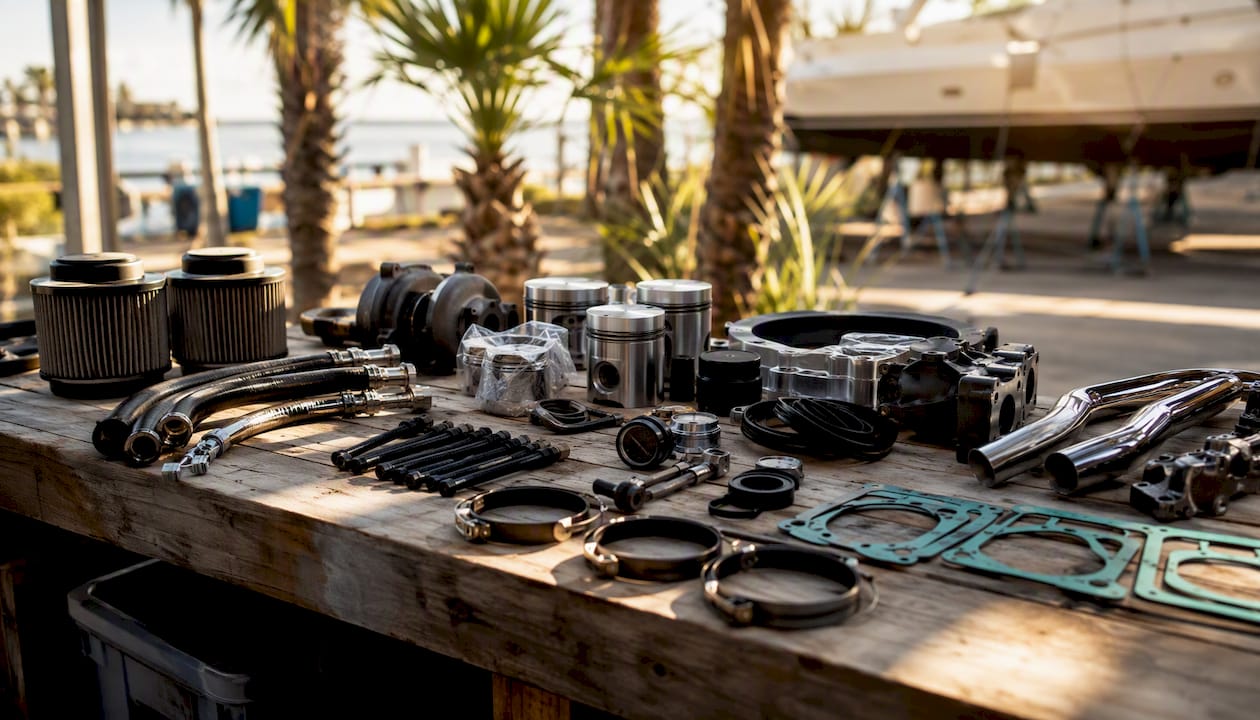
Planning and procurement (2–6 weeks): Engine selection, quote finalization, and parts ordering. Lead times on some diesel engines and gearboxes can stretch to 8–12 weeks for non-stock configurations — start this phase before you need the boat.
Haul-out and removal (3–7 days): Yard scheduling, crane time, old engine removal, and initial inspection of foundations and systems.
Installation and fabrication (1–4 weeks): Varies enormously by vessel size, access, and how much custom fabrication the new engine requires. Older vessels with corroded stringers or non-standard engine beds add time here.
Alignment and commissioning (3–7 days): Shaft alignment, controls setup, and systems checks before water.
Sea trials (1–2 days): Load testing, documentation, and sign-off.
For a small inboard diesel (20–60 HP), total yard time typically runs 3–5 weeks. Mid-range repowers (80–300 HP) commonly take 5–8 weeks. Large repowers on 300+ HP vessels, especially twin-engine configurations, can run 10–14 weeks or more.
Common causes of schedule creep:
- Parts lead times that were not confirmed at quote stage.
- Discovery of corroded or damaged stringers and engine beds during removal.
- Electrical system deficiencies that surface once the old engine is out.
- Drydock scheduling conflicts at busy Florida yards, particularly in spring and fall.
- Regulatory inspections required for commercial vessels.
A pre-repower survey that documents foundation condition, exhaust routing, and electrical baseline is the most reliable way to compress the discovery phase and keep the schedule honest.
What do sample budgets look like by boat size?
These ranges reflect installed costs — engine, labor, yard fees, alignment, and standard peripheral work — based on industry-reported figures. They are planning benchmarks, not quotes. Your actual cost depends on vessel age, access, hull condition, and the scope of peripheral systems that need attention.
A few line items that move the needle most:
- Hull age and access: Vessels over 25 years old frequently need stringer work, new fuel tanks, and exhaust system replacement that newer hulls do not.
- Gearbox condition: If the transmission is original and the engine is being replaced, replacing the gearbox at the same time avoids a second haul-out within a few years.
- Controls and electronics: A full controls upgrade on a larger vessel can add $5,000–$15,000 to the base engine-and-labor cost.
- Drydock and crane: Florida yard rates vary, but haul-out, blocking, and crane time for a mid-size vessel commonly add $2,000–$6,000 to a project.
For owners considering a full-service refit alongside the repower, bundling work into a single yard period almost always reduces total cost compared to separate haul-outs.
How do you calculate ROI and handle EPA emissions requirements?
Repowers do not always pay back quickly, and owners deserve an honest calculation rather than an optimistic one. According to the EPA’s Marine Repower Guide, repower analyses commonly show ROI in the 10–20 year range, with payback potentially as short as 7 years for high fuel-use applications. The EPA also provides the Diesel Emissions Quantifier, a free tool for estimating emissions reductions and cost-effectiveness — useful for both personal analysis and grant applications.
A worked payback example
- Monthly fuel cost before repower: $1,600
- Monthly savings at 15% efficiency gain: $240
- Annual savings: $2,880
- Repower cost (installed): $50,000
- Simple payback: approximately 17 years
At higher fuel use or a larger efficiency gain, the math improves. Diesel price fluctuations also affect this calculation meaningfully — rising fuel costs shorten payback; falling costs extend it.
The EPA figure of 22.2 lbs of CO2 per gallon of diesel burned lets you translate fuel savings directly into emissions reductions for grant applications or compliance reporting.
EPA compliance and grant opportunities
- EPA 40 CFR §1042 governs emissions standards for marine diesel engines. Commercial operators replacing older, higher-emission engines with certified modern units may qualify for grant funding through EPA’s Diesel Emissions Reduction Act (DERA) program.
- State-level programs: Several coastal states, including Florida, have administered DERA sub-grants and clean air programs that offset repower costs for commercial vessels. Check with the Florida Department of Environmental Protection for current availability.
- ROI horizon as a grant filter: Grant programs typically prioritize projects with a payback horizon under approximately 7 years. If your calculation lands in that range, a grant application is worth the effort before you commit to a full out-of-pocket project.
How do you get quotes that are actually comparable?
Most owners collect two or three quotes and discover they cannot compare them because each one is scoped differently. The fix is simple: tell every installer exactly what line items you expect to see, and reject any quote that omits them.
Must-have line items on every quote
- Engine make, model, and part number with warranty terms (duration, what is covered, who handles claims)
- Labor hours broken out by phase: removal, installation, alignment, commissioning
- Crane and drydock fees (confirm whether these are estimated or fixed)
- Gearbox: replacement or inspection/service, clearly stated
- Shaft alignment (confirm this is a separate line, not buried in “installation”)
- Sea trials: included or billed separately, and what is documented
- Removal and disposal of the old engine
- Exhaust system: replacement or inspection scope
- Controls and wiring: what is included and what is excluded
- Parts lead times: when is the engine expected to arrive?
Red flags that justify pushing back or re-scoping
- Labor quoted as a single lump sum with no phase breakdown.
- No warranty detail beyond “manufacturer warranty applies.”
- Alignment listed as “included” with no separate line or hour estimate.
- No mention of removal/disposal costs.
- Quote excludes “any fabrication required” without a cap or estimate.
- No stated policy for scope changes discovered mid-project.
Pro Tip: Ask each installer to walk you through their quote line by line before you sign. The questions that come up in that conversation reveal more about their process than the document itself.
How Mazza Marine handles a diesel repower in Florida
Mazzamarine approaches a repower as a full-system project, not just an engine swap. The scope typically begins well before the yard period and extends through commissioning and warranty handover — which is exactly what prevents the budget surprises that plague owners who treat a repower as a simple parts-and-labor job.
The standard process Mazzamarine follows:
- Pre-repower survey: A technical inspection of hull access, engine foundations, exhaust routing, fuel system, and electrical baseline. This is the document that drives the quote and prevents mid-project discoveries.
- Planning and drawings: Confirmation of engine selection, gearbox compatibility, mount specifications, and exhaust routing before any parts are ordered.
- Procurement: Engine, gearbox, mounts, and peripheral components sourced with confirmed lead times so the yard period is not held up waiting for parts.
- Fabrication: Custom brackets, stringer reinforcement, exhaust modifications, and any hull access work completed before the new engine arrives.
- Installation: Engine set, shaft aligned, controls connected, wiring completed, and cooling system commissioned.
- Sea trials and commissioning: Load testing, throttle and shift response, temperature and pressure checks, and full documentation of operating parameters.
- Warranty handover: Engine warranty registered, service intervals documented, and owner briefed on the new maintenance schedule.
Mazzamarine’s mechanical, repower, and running gear capability covers the full scope of what appears on a repower invoice, from foundation work and fabrication through propeller and shaft service. For owners who want to understand the full repower vs. rebuild decision before committing, the South Florida repower guide is a useful starting point.
To request a pre-repower assessment, reach out directly through Mazzamarine’s service team. The survey is the single most valuable step you can take before signing any repower contract.
What owners usually get wrong about diesel repowers
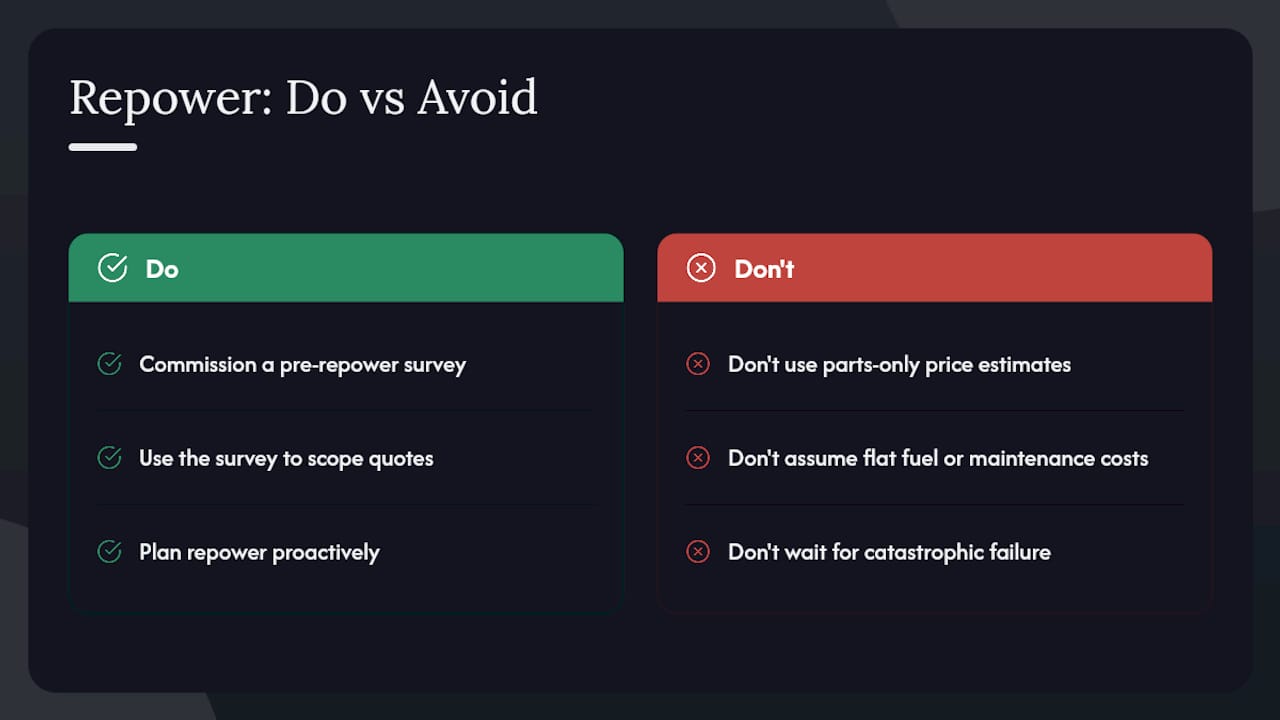
That advice is not wrong, exactly, but it misses the more important point. The quote comparison is only useful if the quotes are actually comparable — and in most cases, they are not.
What Mazzamarine sees most often is owners who arrive at the yard with a parts-only figure in their head, usually something they found on a forum or a manufacturer’s website, and then experience genuine shock when the installed total comes in two or three times higher. That gap is not a markup or a surprise. It is the cost of alignment, crane time, exhaust replacement, wiring, and the fabrication work that the engine listing never mentioned.
The single most useful thing an owner can do before the first installer conversation is commission a pre-repower survey. Not a quote. A survey. The survey tells you what the project actually involves — which foundations need reinforcement, whether the exhaust system is serviceable, what the electrical baseline looks like. With that document in hand, every quote you receive is scoped against the same reality, and the comparison becomes genuinely useful.
There is also a tendency to treat the ROI calculation as a reason to delay. “The payback is 15 years, so maybe I’ll wait.” But that calculation assumes fuel prices stay flat, maintenance costs stay predictable, and the old engine keeps running without a catastrophic failure. None of those assumptions are reliable on a vessel with 8,000 hours on the original power plant. The real question is not whether the repower pays back in year 7 or year 17. It is whether the vessel is worth protecting, and whether you want to be the owner who planned ahead or the one who got forced into an emergency yard period at the worst possible time.
Mazzamarine handles the full repower process in Florida
If you want a turnkey, warranty-backed diesel repower in Florida without managing a dozen vendors yourself, Mazzamarine is built for exactly that. Mino and Luigi’s team coordinates the pre-repower survey, engine procurement, fabrication, installation, alignment, and sea trials as a single managed project — so you are not chasing a yard, an engine supplier, and an electrician simultaneously.
What a standard Mazzamarine repower package includes: pre-repower technical survey, full engine and gearbox procurement with confirmed lead times, in-house fabrication for mounts and exhaust, shaft alignment, controls and wiring, sea trials with documented commissioning data, and warranty handover. The team’s mechanical refit expertise means the scope extends naturally to running gear, electrical systems, and any peripheral work the survey identifies.
For Florida yacht owners who want a realistic, line-item estimate before committing, the right first step is a pre-repower assessment. Contact Mazzamarine’s team to schedule an on-site survey and get a quote built on what your vessel actually needs.
Sources
These are the tools and references worth bookmarking before you start collecting quotes or running your own payback calculation.
- Repower vs Rebuild | Marine Power Systems
- Marine Engine Replacement: Inboard & Sterndrive Repower Costs – S.H Continental Marine
- Marine engine repair vs overhaul vs rebuild vs repower explained | Neptunus Power
- Diesel Cummins Conversion or Cummins Swap | G Force
- Repower vs Rebuild Marine Diesel Engine
Recommended
Text or Call 954-330-9653 Schedule Appointment
Mazza Marine Yacht Services & Refit

Fiberglass Upgrades and Damage Repair

Premium Yacht Paint/ Faux Teak

Fishing: Custom Rods, Reels,Tackle

Electrical, Electronics and Navigation

Paint, Hull and Gelcoat

Teak Decks, Wood Cabinets, Carpentry

Canvas, Enclosures and Upholstery

Mechanical, Repower and Running Gear

Plumbing, Bilge and Thru-Hulls

Welding and Custom Fabrication

Interior Refit And Past Work
Get your yacht value Estimate
"*" indicates required fields