
View Our Recent Work:

Florida boat dock permits are legal authorizations required from local, state, and federal authorities before you build, expand, or substantially modify a dock on Florida waterways. Three agencies govern this process: your local county or municipal government, the Florida Department of Environmental Protection (FDEP), and the U.S. Army Corps of Engineers (USACE). Each agency protects a different interest, from zoning compliance to seagrass beds to navigable water safety. Getting all three approvals right the first time is what separates a smooth build from a costly, drawn-out ordeal.
What permits are required for Florida boat dock construction?
Florida dock construction permits fall into three distinct layers, and every layer matters. Missing even one can stop your project cold, regardless of how far along the others are.
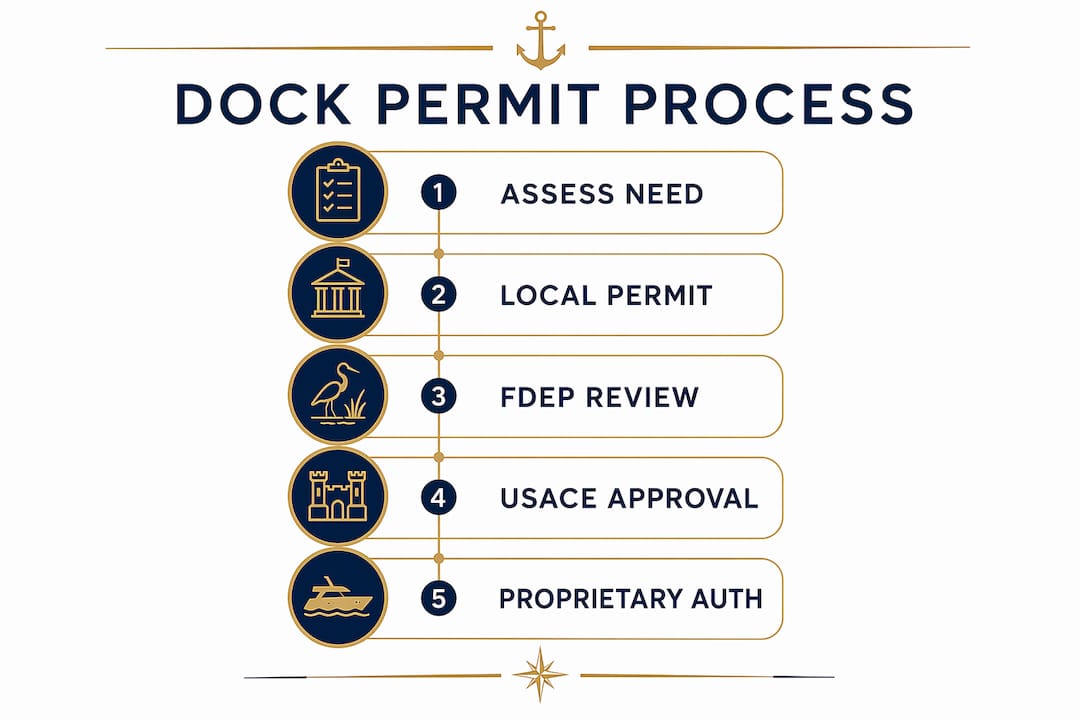
Local building permits are typically the first step. Your county or municipality reviews zoning compliance, setbacks from property lines and neighboring docks, and construction codes. Local approval alone does not substitute for state or federal permits. Think of it as the foundation of a three-story structure: necessary, but not sufficient on its own.
FDEP permits cover environmental impact on Florida’s waterways. FDEP offers three tiers:
- Exemptions: Available for small, low-impact residential docks that meet strict size and location criteria.
- General permits: Apply to moderate projects with limited environmental impact, processed faster than individual permits.
- Individual permits: Required for larger or more complex projects, especially those affecting sensitive habitats like seagrass, mangroves, or wetlands.
USACE permits address federal jurisdiction over navigable waters. The USACE issues Nationwide Permits for common, low-impact activities, Regional General Permits for projects within specific geographic areas, and Individual Permits for projects with significant environmental or navigational impact.
Beyond these regulatory permits, Florida adds a fourth requirement that surprises many boat owners: proprietary authorization. Most submerged lands in Florida are state-owned public trust lands, meaning your property deed almost certainly does not grant you the right to build over them. You need a separate lease or easement from the state before construction begins. Regulatory permits authorize the construction itself. Proprietary authorizations grant legal use of the underwater land beneath your dock. Both are essential for full compliance.
Processing times range from 30 days for straightforward general permits to 180 or more days for complex individual permits. Fees run from $100 to over $4,000 depending on project scope.
How do you know if your dock qualifies for an exemption?
Exemptions exist, but they come with firm boundaries. Dock permit exemptions apply to small, low-impact residential structures typically under 500 to 1,000 square feet of over-water coverage. Cross that threshold, or disturb a sensitive habitat, and you move into general or individual permit territory.
| Permit category | Typical size limit | Key triggers |
|---|---|---|
| Exemption | Under 500–1,000 sq. ft. | No habitat impact, residential use only |
| General permit | Moderate size | Limited environmental impact, standard construction |
| Individual permit | No fixed limit | Dredging, filling, seagrass or mangrove impact |
| USACE Nationwide | Low-impact activities | Minimal navigational or environmental effect |
| USACE Individual | Complex projects | Significant habitat or navigational impact |
Environmental criteria carry as much weight as size. The presence of seagrass beds, mangroves, or wetlands on or near your site can push a project from an exemption straight into an individual permit, regardless of square footage. Dredging or filling of any kind almost always triggers the individual permit process.
The FDEP also caps how far a dock can extend into the water. Dock extensions are limited to no more than 500 feet waterward or 20% of the waterbody width, whichever is less. This rule protects both navigation lanes and ecological habitats.
Pro Tip: Commission a professional site survey before you draw a single plan. A licensed marine surveyor can identify seagrass, wetland boundaries, and submerged land ownership issues that would otherwise blindside you mid-application.
How to apply for Florida boat dock permits step by step
A clear application sequence saves weeks of back-and-forth with agencies. Professional engineers’ sealed plans and licensed marine contractors significantly increase approval success rates. Here is the practical roadmap:
-
Conduct a pre-application site survey. Hire a licensed marine contractor or environmental consultant to assess habitat conditions, water depth, and submerged land ownership. This step defines which permit tier you need.
-
Prepare detailed site plans and engineering drawings. For most projects beyond simple exemptions, you need stamped drawings from a licensed Professional Engineer (PE). Plans must show dock dimensions, materials, setbacks, water depths, and proximity to sensitive habitats.
-
Submit your local building permit application. File with your county or municipal building department. Include site plans, property surveys, and any required zoning variance requests.
-
File your FDEP application. Submit through the FDEP’s online portal. Include environmental assessments, engineering plans, and any mitigation proposals if your project affects regulated habitats.
-
Submit to the USACE. For projects in navigable waters, file a permit application with the appropriate USACE district. Nationwide Permit eligibility can be self-verified for minor projects, but individual permits require a full application package.
-
Apply for proprietary authorization. Contact the Florida Department of Environmental Protection’s Submerged Lands and Environmental Resources program to obtain your lease or easement for state-owned submerged lands.
-
Respond to agency requests for additional information (RAI). Agencies routinely request clarifications. Respond promptly and completely to avoid losing your place in the review queue.
-
Complete the public notice period. Individual permits trigger a public comment window. Neighbors and environmental groups can submit objections during this time.
-
Receive approvals and begin construction. Post all permits on site as required and follow approved plans exactly. Any deviation may require a permit modification.
Pro Tip: Submit your local, FDEP, and USACE applications as close together as possible. Parallel processing cuts months off your total timeline compared to waiting for one approval before starting the next.
For a broader view of Florida marine compliance, understanding how these permit workflows fit into overall boat ownership is worth your time.
Common mistakes that derail Florida dock permit applications
The permit process has well-worn failure points. Knowing them in advance is the difference between a dock built on schedule and one that sits as a pile of lumber while agencies sort out your paperwork.
- Assuming local approval is enough. Local building permits do not cover environmental and federal navigable water regulations. Independent state and federal approvals are legally required, full stop.
- Submitting incomplete engineering plans. Non-compliant or unsigned plans are the most common cause of application rejection. Always use a PE-stamped set for anything beyond a basic exemption project.
- Ignoring proprietary authorization. Property deeds rarely grant ownership of underwater lands. State submerged lands are public trust property, and skipping the lease or easement step leads directly to stop-work orders and fines.
- Underestimating public comment delays. Neighbor objections during the public notice period can trigger additional agency review and add months to your timeline.
- Skipping the professional site survey. Building without identifying sensitive habitats on your site is a gamble that rarely pays off. Discovering seagrass after you have submitted plans means starting over.
- Starting construction before all approvals are in hand. Unauthorized construction results in stop-work orders, mandatory removal at your expense, and potential civil penalties.
“Regulatory permits authorize construction, but proprietary authorizations grant legal use of state-owned submerged lands. Both are essential for compliance. Treating them as optional or sequential rather than parallel requirements is the single most expensive mistake a dock owner can make.”
How does the layered permit process affect your project timeline?
Florida dock permitting does not run on a single clock. Three agencies review your project on their own schedules, and understanding how those schedules interact is the key to realistic project planning.
| Agency | Permit type | Typical processing time |
|---|---|---|
| Local government | Building permit | 2–8 weeks |
| FDEP | General permit | 60–120 days |
| FDEP | Individual permit | 4–6 months or more |
| USACE | Nationwide permit | 30–60 days |
| USACE | Individual permit | 6–18 months |
Environmental permit timelines run 60 to 120 days for general projects. Federal individual permits can stretch 6 to 18 months. The good news is that local, FDEP, and USACE reviews can run in parallel, not in sequence, when you submit applications simultaneously.
Public comment periods add unpredictability. Early informal engagement with neighbors before you file reduces the chance of formal objections that trigger extended agency review. A 15-minute conversation with the neighbor whose view your dock might affect is worth far more than the legal fees you would spend fighting a formal objection. For owners managing multiple compliance obligations, the Florida yacht safety checklist offers a useful parallel framework for staying organized.
Key Takeaways
Florida boat dock permits require coordinated approvals from local government, FDEP, and USACE, plus a separate proprietary authorization for state-owned submerged lands, before any construction begins.
| Point | Details |
|---|---|
| Three-agency requirement | Local, FDEP, and USACE permits are each legally required and cannot substitute for one another. |
| Proprietary authorization | A state lease or easement for submerged lands is mandatory and separate from environmental permits. |
| Exemption size limits | Residential docks under 500–1,000 sq. ft. with no habitat impact may qualify for exemptions. |
| Parallel submissions | Filing with all agencies simultaneously cuts months off the total approval timeline. |
| Professional plans matter | PE-stamped engineering drawings and licensed marine contractors significantly improve approval rates. |
What I have learned about Florida dock permitting the hard way
The biggest misconception I see among boat owners is that the local building permit is the finish line. It is not even the halfway point. Florida’s waterways are governed by a genuinely layered system, and each layer exists for a real reason. The FDEP protects seagrass beds that took decades to recover. The USACE protects navigation channels that commercial and recreational traffic depends on. The submerged lands program protects public access to waters that belong to every Floridian, not just waterfront property owners.
My honest advice: treat the permit process as a project in itself, not a formality before the real project begins. Budget time and money for a professional site survey before you commit to any design. The survey will either confirm your plans are viable or save you from an expensive redesign after submission. Either outcome is worth the cost.
I have also seen owners skip the neighbor conversation and pay for it dearly. A formal objection during the public comment period can add months to an already long timeline. Most neighbors are not opposed to a dock. They are opposed to being surprised by one. A quick conversation, showing them your plans and asking for feedback, resolves most concerns before they become formal complaints.
The proprietary authorization step is the one that catches even experienced applicants off guard. Your deed says you own the waterfront lot. It almost certainly does not say you own the lake bed or bay bottom beneath where your dock will sit. That land belongs to the state, and you need permission to use it. Skipping this step and then receiving a stop-work order after construction has started is a painful and expensive lesson.
— Jason
Mazzamarine and the Florida marine ownership experience
Building a dock is one chapter of Florida boat ownership. Keeping your vessel in top condition while that dock is in use is the ongoing story.

Mazzamarine connects Florida yacht owners with a trusted network of marine experts covering urgent repairs, complete maintenance packages, engine and mechanical work, custom welding, and more. Whether you are managing a new dock build or keeping a sportfish ready for the next offshore run, Mazzamarine’s team brings the kind of hands-on knowledge that only comes from genuine passion for the sea. Explore the marine repair service guide to see how professional maintenance fits into the full picture of responsible boat ownership in Florida. When your dock is ready, your vessel should be too.
FAQ
Do I need a permit for a small residential dock in Florida?
Most residential docks require at least a local building permit and a review by FDEP. Small structures under 500 to 1,000 square feet with no habitat impact may qualify for an FDEP exemption, but local and proprietary authorizations are still typically required.
What is proprietary authorization for a Florida dock?
Proprietary authorization is a state-issued lease or easement granting legal use of state-owned submerged lands beneath your dock. It is separate from environmental permits and required because most Florida waterway bottoms are public trust land, not private property.
How long does it take to get Florida dock construction permits?
Timelines range from 30 days for simple Nationwide USACE permits to 18 months or more for complex federal individual permits. Filing with local, FDEP, and USACE agencies simultaneously is the most effective way to reduce total wait time.
What happens if I build a dock without permits in Florida?
Unauthorized dock construction triggers stop-work orders, civil fines, and mandatory removal of the structure at the owner’s expense. Penalties apply regardless of whether the dock causes visible environmental damage.
Can I extend my dock as far as I want into the water?
No. FDEP limits dock extensions to no more than 500 feet waterward or 20% of the waterbody width, whichever measurement is smaller. This rule protects navigation lanes and sensitive aquatic habitats.
Recommended
Text or Call 954-330-9653 Schedule Appointment
Mazza Marine Yacht Services & Refit

Fiberglass Upgrades and Damage Repair

Premium Yacht Paint/ Faux Teak

Fishing: Custom Rods, Reels,Tackle

Electrical, Electronics and Navigation

Paint, Hull and Gelcoat

Teak Decks, Wood Cabinets, Carpentry

Canvas, Enclosures and Upholstery

Mechanical, Repower and Running Gear

Plumbing, Bilge and Thru-Hulls

Welding and Custom Fabrication

Interior Refit And Past Work
Get your yacht value Estimate
"*" indicates required fields