
View Our Recent Work:

Florida boat financing is defined as a secured loan product where the vessel serves as collateral, allowing buyers to spread the purchase cost over time rather than paying in full upfront. Whether you’re buying your first center console or refinancing a sport yacht, the Florida marine financing market offers competitive products from banks, credit unions, and specialized marine lenders like Boatzon, Seacoast Bank, and A Plus Mortgage. Loan terms, rates, and down payment requirements vary widely based on your credit profile, vessel age, and loan size. Knowing what to expect before you walk into a lender’s office puts you in a far stronger position.
What are the typical Florida boat financing options and loan terms?
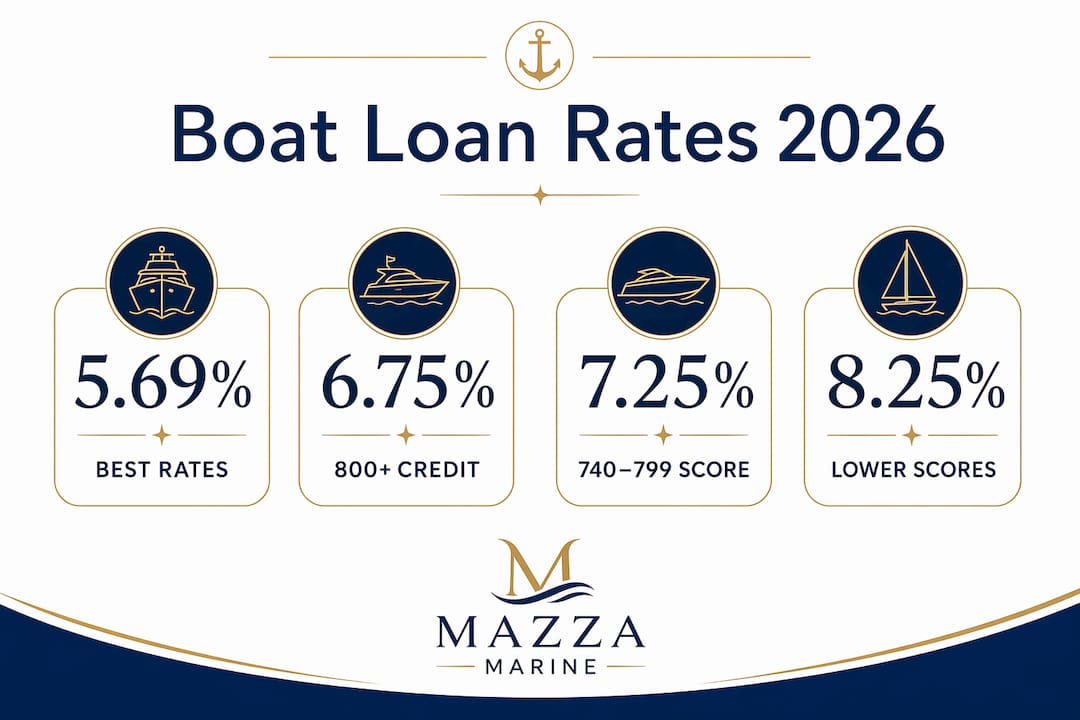
Boat loan rates in Florida currently range from approximately 5.69% to 8.25%, depending on your credit score. Borrowers with scores above 800 can expect rates near 6.75%, while those in the 680–699 range typically face rates closer to 8.25%. That gap translates to hundreds of dollars per month on larger loans, so your credit score is the single most powerful lever you control before applying.
Loan terms in Florida typically run from 5 to 20 years. Newer, higher-value vessels qualify for the longer end of that range, while older or smaller boats usually get shorter terms. A longer term lowers your monthly payment but increases the total interest you pay over the life of the loan. Run both scenarios with a loan calculator before committing.
| Credit Score Range | Approximate Rate |
|---|---|
| 800+ | ~6.75% |
| 740–799 | ~7.25% |
| 700–739 | ~7.75% |
| 680–699 | ~8.25% |
| Below 680 | Varies, often higher |
Down payments for Florida boat loans typically fall between 10% and 20%. Used boats in older or rougher condition can require up to 30% down, since lenders factor in depreciation risk when setting terms. A larger down payment not only reduces your monthly obligation but often unlocks a lower interest rate.

Pro Tip: Put down at least 20% if your budget allows. It signals financial stability to lenders and frequently moves you into a better rate bracket, saving real money over a 15-year term.
Which financing options suit first-time buyers, self-employed applicants, and credit-challenged borrowers?
First-time buyers in Florida face the same basic requirements as any borrower, but they often underestimate how much documentation lenders want. Stable income proof, a solid credit history, and a 10–20% down payment are the baseline. Starting with a pre-qualification through a platform like Boatzon, which uses soft credit checks that do not affect your score, lets you compare multiple offers before committing to a hard inquiry.
Self-employed borrowers carry a heavier documentation burden. Florida lenders require at least two years of tax returns and bank statements to verify income stability. Lenders like A Plus Mortgage specialize in self-employed applicants and offer products designed around the reality that net income on a tax return often looks lower than actual cash flow. Organizing your financial records early is not optional. It is the difference between approval and a frustrating back-and-forth.
Credit-challenged buyers are not shut out of the market. Some programs accept scores as low as 550, though they come with higher down payment requirements and elevated rates. Here is what every buyer profile should prepare before applying:
- Credit score: Pull your report from all three bureaus and dispute any errors before applying.
- Income documentation: W-2 employees need recent pay stubs and two years of tax returns. Self-employed borrowers need two years of returns plus bank statements.
- Down payment funds: Have funds verified and ready. Lenders want to see the money, not just hear about it.
- Vessel details: Year, make, model, hull identification number, and a recent survey for used boats.
- Insurance quotes: Florida lenders require proof of coverage before closing. Get quotes early.
Shopping for loans online gives every buyer profile access to Florida’s competitive marine lending market without driving to multiple bank branches. Comparing three to five offers takes an afternoon and can save thousands over the loan term.
Pro Tip: Organize your financial documents into a single digital folder before you start applying. Lenders who get clean, complete packages move faster and sometimes offer better terms to borrowers who make their job easy.
How do Florida-specific factors affect your boat loan?
Florida’s boating environment creates financing conditions you will not encounter in most other states. Lenders here have learned from experience, and their requirements reflect the real risks of keeping a vessel in South Florida waters year-round.
Lenders prefer boats manufactured within the last 15–20 years. Older vessels depreciate faster and are harder to value accurately, which increases lender risk. A 1998 sportfish may be a beautiful boat, but financing it at favorable terms is genuinely harder than financing a 2015 model. If you are set on an older vessel, budget for a larger down payment and a shorter loan term.
Florida also imposes a documentary stamp tax of $0.35 per $100 on promissory notes executed within the state. On a $150,000 loan, that adds $525 to your closing costs. Ask your lender upfront who covers that fee. Some lenders absorb it; others pass it directly to the buyer.
The biggest Florida-specific factor is hurricane insurance. Florida lenders require named-storm deductibles and mandatory hurricane haul-out coverage for boats kept at Florida marinas. These requirements protect both the lender’s collateral and your investment, but they add meaningfully to annual ownership costs. Factor these into your total budget before signing a loan agreement:
- Named-storm deductible: A separate, higher deductible that applies specifically to hurricane damage claims.
- Hurricane haul-out coverage: Pays for the cost of removing your boat from the water before a named storm.
- Agreed-value vs. actual cash value policies: Lenders often require agreed-value policies, which pay the full insured amount rather than depreciated value.
- Liveaboard restrictions: Some policies exclude or limit coverage if the vessel is used as a primary residence.
Knowing these requirements before you apply means you can get insurance quotes alongside loan quotes and build an accurate monthly ownership budget from day one. You can also review the yacht documentation guide for Florida owners to understand how title and registration paperwork intersects with loan requirements.
What are the options for refinancing or upgrading your existing boat loan in Florida?
Refinancing a boat loan in Florida works similarly to refinancing a mortgage. The goal is to replace your current loan with a new one at better terms, whether that means a lower rate, a shorter term, or reduced monthly payments. Refinancing can lower your monthly payments or adjust your loan term, but approval depends on your current credit standing and the vessel’s condition.
The most common reason Florida boat owners refinance is a credit score improvement since the original loan was taken out. If your score has climbed 50 or more points, you may qualify for a meaningfully lower rate. Even a one-point rate reduction on a $200,000 loan saves thousands over a 15-year term.
Here are the core steps to refinancing a Florida boat loan:
- Check your current loan terms. Know your remaining balance, current rate, and any prepayment penalties before shopping.
- Pull your credit report. Verify your score has improved and dispute any errors before applying.
- Get the vessel appraised or surveyed. Lenders need a current valuation, especially for boats more than five years old.
- Shop at least three lenders. Compare Boatzon, Seacoast Bank, and your current lender’s refinance offer side by side.
- Calculate the break-even point. Divide closing costs by your monthly savings to determine how many months until refinancing pays off.
- Submit a complete application. Include updated income documentation, insurance proof, and vessel details.
Upgrading to a newer or larger vessel often involves a combination of refinancing the existing loan and taking out additional financing for the new boat. Understanding how yacht resale value factors affect your trade-in position helps you negotiate from a stronger place when the time comes.
Key Takeaways
Florida boat financing rewards prepared borrowers: strong credit, a 20% down payment, and complete documentation consistently produce the best rates and fastest approvals.
| Point | Details |
|---|---|
| Rate range in 2026 | Rates run from 5.69% to 8.25%, with your credit score as the primary driver. |
| Down payment expectations | Plan for 10–20% on new boats and up to 30% on used or older vessels. |
| Florida-specific costs | Budget for the $0.35 per $100 documentary stamp tax and mandatory hurricane insurance. |
| Self-employed documentation | Prepare two years of tax returns and bank statements before applying. |
| Refinancing opportunity | A credit score improvement of 50+ points often justifies refinancing for a lower rate. |
What I have learned from watching Florida buyers navigate boat financing
After years of watching Florida boat owners go through the financing process, the pattern is clear. The buyers who get the best deals are not necessarily the wealthiest. They are the most prepared. They know their credit score before the lender does. They have their tax returns organized. They have already called an insurance broker and know what hurricane coverage will cost annually.
The buyers who struggle are the ones who fall in love with a boat first and figure out the financing second. Florida’s marine lending market is genuinely competitive, and lenders like Boatzon, A Plus Mortgage, and Seacoast Bank all want your business. But they want to see that you are a serious, organized borrower. Walking in with a complete package signals exactly that.
One thing most articles skip: the Florida-specific costs catch people off guard every single time. The documentary stamp tax feels small until you are at closing and the number is higher than expected. The hurricane haul-out insurance requirement feels bureaucratic until your marina calls you at midnight because a Category 3 is 48 hours out. These are not obstacles. They are part of responsible boat ownership in this state, and the buyers who plan for them from the start never feel blindsided.
My honest advice is to treat financing as the first act of ownership, not a hurdle before it. Get pre-qualified, compare at least three lenders, and build your full annual cost picture before you sign anything. Florida is one of the best places in the world to own a boat. The financing process, done right, is the foundation that makes the whole experience worth it.
— Jason
Mazzamarine: your partner after the loan closes
Once your financing is in place and you are holding the keys to your vessel, the real work of Florida boat ownership begins. Florida’s sun, salt air, and storm season are relentless on hulls, engines, and electronics. Protecting your investment means staying ahead of maintenance, not chasing repairs after something fails.

Mazzamarine connects Florida boat owners with a trusted network of yacht experts covering everything from urgent repairs in Miami to complete maintenance packages and interior refits. Brothers Mino and Luigi built Mazzamarine on decades of hands-on experience and deep Florida marine industry relationships. Whether your newly financed vessel needs a mechanical inspection, a canvas enclosure, or a full marine repair service, Mazzamarine’s network has you covered. Reach out today and start the ownership chapter with the right team behind you.
FAQ
What credit score do I need for a boat loan in Florida?
Most Florida lenders approve borrowers with scores of 680 and above, though some programs accept scores as low as 550 with a larger down payment. Scores above 800 qualify for the best available rates, currently near 6.75%.
How much do I need to put down on a boat in Florida?
Standard down payments run from 10% to 20% for new boats. Used or older vessels may require up to 30% down, depending on condition and vessel age.
Can self-employed borrowers get a boat loan in Florida?
Self-employed borrowers can qualify for Florida boat loans by providing two years of tax returns and bank statements. Lenders like A Plus Mortgage specialize in self-employed marine financing and offer products suited to variable income profiles.
What is Florida’s documentary stamp tax on boat loans?
Florida charges $0.35 per $100 on promissory notes executed within the state. On a $150,000 loan, that equals $525 in additional closing costs. Ask your lender upfront whether they absorb this fee or pass it to the buyer.
Is refinancing a boat loan in Florida worth it?
Refinancing makes financial sense when your credit score has improved significantly or when market rates have dropped since your original loan. Calculate the break-even point by dividing total closing costs by your monthly savings to confirm the timing is right.
Recommended
Text or Call 954-330-9653 Schedule Appointment
Mazza Marine Yacht Services & Refit

Fiberglass Upgrades and Damage Repair

Premium Yacht Paint/ Faux Teak

Fishing: Custom Rods, Reels,Tackle

Electrical, Electronics and Navigation

Paint, Hull and Gelcoat

Teak Decks, Wood Cabinets, Carpentry

Canvas, Enclosures and Upholstery

Mechanical, Repower and Running Gear

Plumbing, Bilge and Thru-Hulls

Welding and Custom Fabrication

Interior Refit And Past Work
Get your yacht value Estimate
"*" indicates required fields