
View Our Recent Work:

Florida charges a 6% sales and use tax on boats and yachts, but the total tax due, state rate plus any county surtax, can never exceed $18,000, no matter how much the yacht costs. Whether you actually owe that tax depends on where the vessel is delivered, registered, and used, not just where you signed the contract. Nonresidents who meet strict documentation rules can skip Florida tax entirely at closing.
TL;DR:
- The $18,000 tax cap covers the combined state and county surtax, with surtax only applying to the first $5,000 of the purchase price, making high-value yachts effectively pay less after the cap.
- Private sellers generally cannot deduct trade-ins unless specific documentation rules are followed, and the total taxable amount includes the vessel, motor, accessories, and add-ons unless itemized separately.
- Nonresident buyers can avoid Florida sales tax by providing proper documentation and filing paperwork within specified deadlines, but missing steps can trigger back taxes and penalties.
- The new 2024 rule treats a boat and trailer sold together as a single taxable item, limiting county surtax exposure to one $5,000 threshold instead of two.
- Most errors occur in paperwork handling, such as invoice itemization and decal documentation, which can lead to paying more in back taxes than the actual tax owed if not managed carefully.
Table of Contents
- Florida Yacht Sales Tax: What Counts as the Taxable Sales Price
- How the $18,000 Sales Tax Cap Actually Works
- Nonresident Exemption Rules, Decals, and Filing Deadlines
- Boat and Trailer as One Taxable Item: The 2024 Rule Change
- Worked Examples: What You’d Actually Owe
- Paying the Tax: Dealer Collection vs. Registration-Time Use Tax
- What Mazza Marine Sees at Closing
- Where to Verify These Rules Yourself
- Why the $18,000 Cap Gets Misunderstood More Than It Should
- Getting the Paperwork Right When You Close
- Sources
- FAQ
Florida Yacht Sales Tax: What Counts as the Taxable Sales Price
The taxable sales price on a yacht is broader than most buyers expect. Florida taxes the entire rig, boat, motor, and accessories, as one bundle unless the dealer separately itemizes each component on a sworn sales invoice. That distinction matters when a broker structures a deal with add-ons like electronics packages or tenders.
A few rules shape what actually gets taxed:
- Dealers can apply a trade-in allowance against the sales price, lowering the taxable amount.
- Private sellers generally cannot offer a trade-in deduction unless the transaction follows specific documentation rules under Florida law.
- If a private-sale invoice comes in below fair market value, the Florida Department of Revenue can assess tax based on reference valuation guides instead of the stated price.
- Use tax, not sales tax, applies when you buy out of state and bring the vessel into Florida within six months of purchase.
- Use tax also applies to a boat bought from a private seller and then delivered to or used in Florida, even without a dealer involved.
Every itemization decision on the invoice ripples through to what you owe later.
How the $18,000 Sales Tax Cap Actually Works
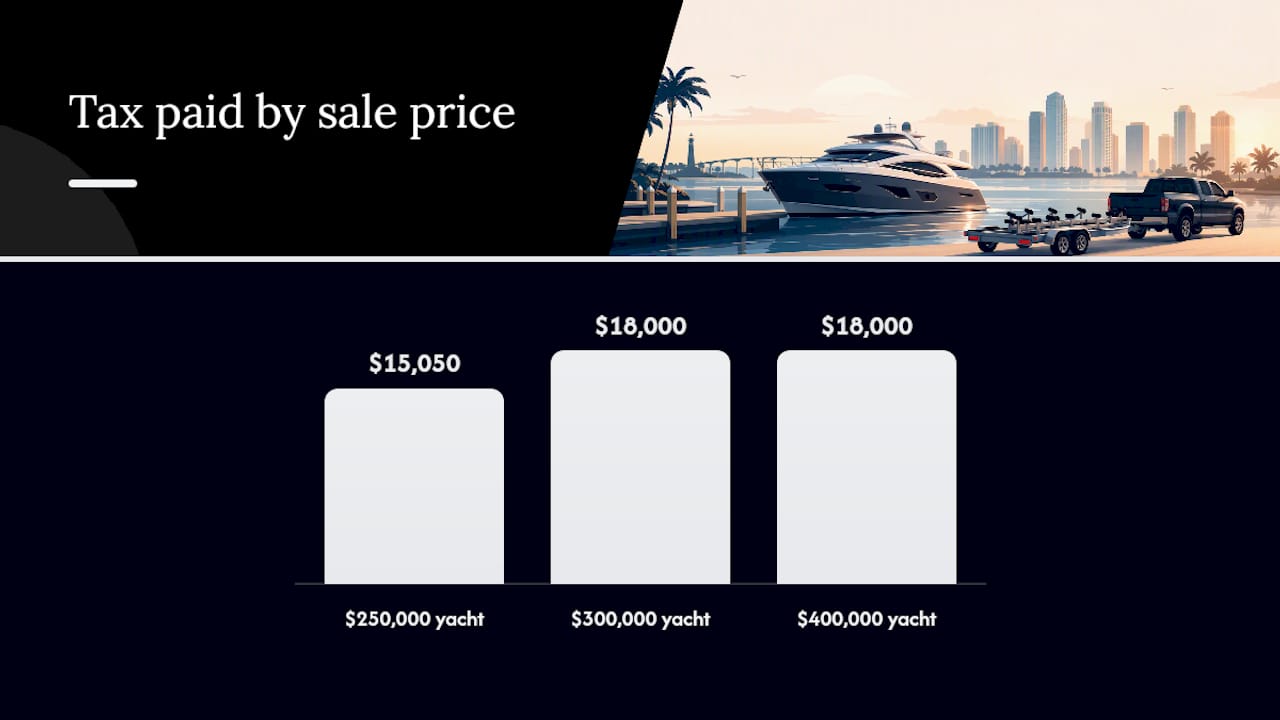
The $18,000 cap applies to your combined tax bill, not just the state’s 6% share. This is where most buyers get confused: the cap covers the 6% state rate plus any county discretionary surtax added on top, calculated together as one ceiling. That structure has been in place since July 1, 2010, when Florida capped the maximum tax on vessel sales at $18,000.
Discretionary surtax adds a wrinkle. Counties can add their own surtax rate, listed on Form DR-15DSS, but that surtax only applies to the first $5,000 of a single item’s sales price. Here’s how the math plays out on a real purchase:
- A $400,000 yacht sold in a county with a 1% surtax generates $24,000 in state tax (6% of $400,000) plus $50 in county surtax (1% of the $5,000 surtax cap).
- Combined, the tax amount exceeds the cap, so the buyer pays the maximum $18,000 total.
- On a $250,000 yacht, state tax alone comes to $15,000, plus county surtax based on the applicable rate, typically resulting in a total below the cap with no adjustment needed.
Statistic Callout: Florida’s 6% state rate combined with the $18,000 cap means any yacht priced above roughly $300,000 (before surtax) effectively pays a declining tax rate as the purchase price climbs.
Nonresident Exemption Rules, Decals, and Filing Deadlines
Florida’s nonresident purchaser exemption lets qualifying out-of-state buyers avoid Florida sales tax at closing, but it is a paperwork-driven process, not an automatic discount. Miss a step and the exemption evaporates.
To qualify and keep the exemption valid, a nonresident buyer typically needs to:
- Provide proof of residency outside Florida at the time of purchase.
- Sign an affidavit stating the vessel will be removed from Florida within the required window.
- Have the selling dealer file the required exemption paperwork within 30 days of the sale.
- Remove a vessel of 5 net tons or larger from Florida waters within 90 days, or purchase extension decals to extend that window to 180 days.
Pro Tip: Keep every receipt tied to the decal purchase and departure date. If the state later questions the exemption, that paper trail is what separates a quick resolution from a retroactive tax bill with penalties attached.
The compliance traps here are procedural, not conceptual. A missed 30-day filing, an undated affidavit, or a vessel that lingers in Florida waters past its decal window can trigger back taxes plus mandatory penalties, even when the buyer genuinely intended to comply.
Boat and Trailer as One Taxable Item: The 2024 Rule Change
An emergency administrative rule that took effect July 1, 2024, changed how Florida treats a boat sold with its trailer. Under Emergency Rule 12AER24-8, a boat and its corresponding trailer sold to the same buyer, at the same time, on the same invoice, are now taxed as a single item for discretionary surtax purposes.
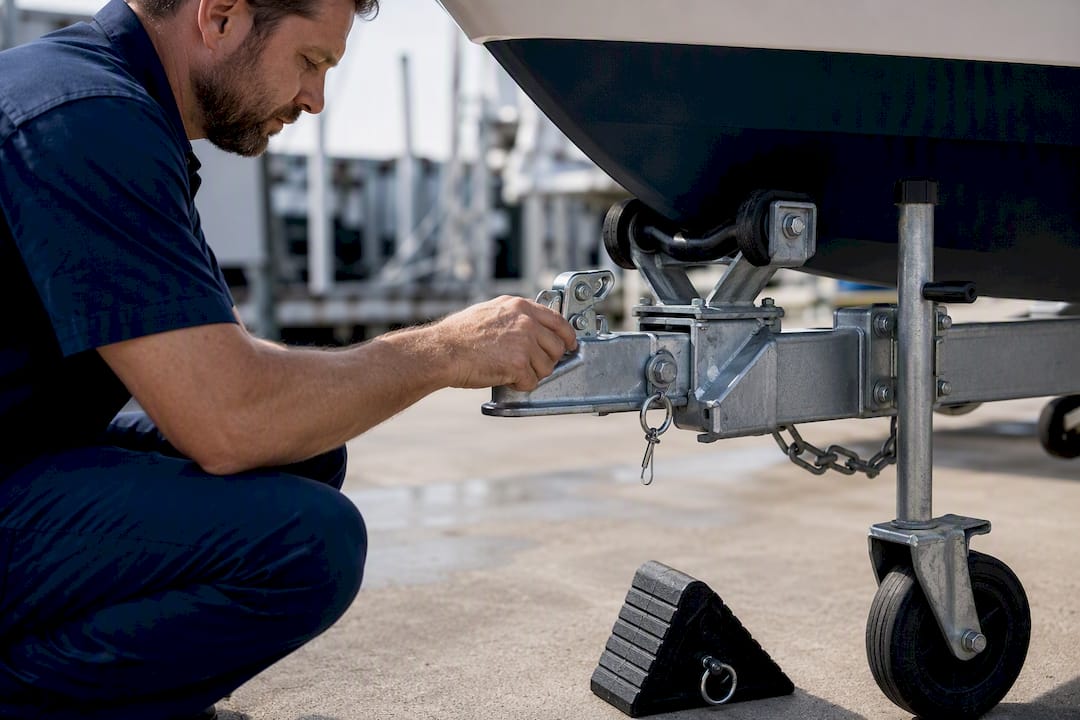
That single detail changes the surtax math meaningfully. Because the county surtax only applies to the first $5,000 of a single item, bundling the boat and trailer together caps the surtax exposure at one $5,000 threshold rather than two separate ones.
What this means for your invoice:
- Ask the dealer or seller to itemize the boat and trailer on one invoice if you want the single-item surtax treatment.
- Splitting the boat and trailer onto separate invoices could change your surtax liability, so confirm which structure your closing documents actually use.
- If you’re financing the trailer separately, flag that early so the paperwork lines up with how you actually want the sale taxed.
Careful invoicing here isn’t a technicality. It’s the difference between a clean closing and a surprise tax adjustment months later.
Worked Examples: What You’d Actually Owe
Numbers make this easier to trust than abstractions. Here are two scenarios that show how the cap and credit rules play out in practice.
- A $1.5 million yacht purchased in Florida. At 6%, state tax alone would be $90,000. Add a county surtax on the first $5,000 (say, 1%, or $50), and the total theoretical tax is $90,050. The $18,000 cap overrides that entirely, so the buyer pays exactly $18,000, full stop.
- A yacht bought in a state with a 4% sales tax rate, then registered in Florida. The buyer already paid 4% at the point of purchase. Florida allows a credit for that amount, so the buyer owes the difference, roughly 2 percentage points, up to whatever portion of the $18,000 cap that gap represents.
Statistic Callout: The credit for tax paid to another state only applies with documentation. Without an official receipt showing the amount and rate paid, Florida has no record to credit against.
The most common mistakes: assuming the cap excludes county surtax, failing to itemize the invoice properly, and missing the decal removal deadline for a nonresident exemption.
Paying the Tax: Dealer Collection vs. Registration-Time Use Tax
Most dealer sales are straightforward. The dealer collects Florida sales tax at the point of sale and remits it to the state, so you walk away with tax already handled.
Private sales work differently; if you need detailed information on vessel registration and numbering requirements, see the guide on Boat Registration Numbers to ensure you comply with U.S. legal standards. You pay use tax directly, either at your county tax collector’s office or through the Florida Department of Highway Safety and Motor Vehicles, when you title and register the vessel.
A few deadlines and documents matter here:
- Title and register the vessel within 30 days of purchase or within 30 days of entering Florida waters.
- Documented vessels from out of state get a 90-day window instead of 30.
- Bring the bill of sale, any out-of-state tax receipts, and proof of prior registration to the tax office.
- If you already paid tax in another state, bring that documentation to claim credit against what Florida would otherwise charge.
What Mazza Marine Sees at Closing
Working across so many yacht transfers, the pattern is consistent: buyers lose money not on the tax rate itself but on paperwork gaps that surface weeks after closing. A missing affidavit or a poorly itemized invoice costs far more in back taxes than it would have taken to get it right the first time.
Before you sign anything, verify:
- Every line item on the invoice, especially trailer, electronics, and trade-in entries
- The nonresident affidavit, if applicable, and its filing date
- Copies of all decal purchase receipts kept with your closing packet
Yacht service providers often coordinate this paperwork alongside brokerage and refit scheduling, and can point you toward a qualified tax professional when a purchase gets complicated. Contributed by Jason, a Florida yacht industry contributor focused on ownership transfer and compliance.
Where to Verify These Rules Yourself
Every figure in this guide traces back to primary sources. Florida’s official boat tax brochure, GT-800005, covers the cap, surtax, and exemption rules in full. The statutory authority sits in Florida Statutes Chapter 212, and the 2024 trailer rule lives in Emergency Rule 12AER24-8. Save your dealer affidavits and invoices, and loop in a tax professional for anything unusual.
Why the $18,000 Cap Gets Misunderstood More Than It Should
Most articles on this topic bury the cap under paragraphs of statutory language, then leave readers guessing whether it applies to their situation. It does, almost always, once your yacht crosses roughly $300,000 in value. That’s the detail that should shape your negotiating strategy, not the headline 6% rate.
Where conventional advice falls short is the assumption that dealers automatically get the invoicing right. They usually do, but the 2024 trailer rule caught plenty of experienced brokers off guard, and private sellers rarely know the itemization rules at all. If you’re buying privately or from a smaller dealer, read the invoice line by line before you sign.
The single biggest priority, ahead of researching rates or comparing counties, is documentation discipline. Nonresident exemptions, out-of-state tax credits, and even the trailer bundling rule all hinge on paperwork filed correctly and on time. The tax math is simple. The compliance process is where deals go wrong. Buyers who treat the closing packet with the same seriousness as the survey and sea trial come out ahead every time.
— Jason
Getting the Paperwork Right When You Close
Buying a yacht in Florida means the tax question is really a paperwork question, and that’s exactly where Mazza Marine steps in. As Florida’s one-stop yacht services network, Mazza Marine coordinates brokerage, invoice review, and ownership transfer logistics so buyers aren’t piecing together closing documents alone or hoping a dealer’s affidavit filing happens on schedule.

When you work with a professional yacht service on a purchase or transfer, expect a review of your invoice itemization, guidance on decal timing if you qualify for a nonresident exemption, and a referral to a tax professional when your situation needs one. Scheduling of any refit or repair work is coordinated around registration deadlines, so upgrades or engine service don’t collide with your title window. Visit Mazza Marine to start your closing checklist and get matched with the right team for your next yacht purchase or transfer.
This article is general information, not a substitute for advice from a qualified financial advisor. Consult a qualified financial professional about your own circumstances before acting on anything here.
Sources
- Florida Statutes, Chapter 212 (Sales/Use Tax) — relevant sections including §212.05
- Emergency Rule 12AER24-8 — Florida Administrative Rules (Department of Revenue)
FAQ
How Much Is Sales Tax on a Yacht in Florida?
The combined total is capped at $18,000, no matter how expensive the yacht is.
What State Has No Sales Tax on Boats?
Several states, including Oregon, Montana, and New Hampshire, do not charge sales tax on boat purchases. Florida buyers who purchase in a no-tax state and later register the vessel in Florida still owe Florida use tax unless they qualify for the nonresident exemption.
What Are the Tax Benefits of Owning a Yacht?
The main benefit for Florida buyers is the $18,000 tax cap itself, which keeps the tax burden proportionally lower on higher-priced yachts. Some owners also explore federal deductions tied to business use or financing, though those depend heavily on individual tax circumstances and are worth reviewing with a tax professional.
Which State Is Cheapest to Buy a Boat In?
States with no sales tax, like Montana or Oregon, technically charge nothing at purchase, but buyers who plan to register in Florida will still owe Florida’s use tax unless the nonresident exemption applies. For a straightforward purchase and registration in one place, Florida’s $18,000 cap often makes it more competitive than it first appears for higher-value yachts.
Does Mazza Marine Help With Yacht Tax Paperwork?
Mazza Marine coordinates invoice review, documentation, and referrals to tax professionals as part of its brokerage and ownership transfer services. Current service details and pricing are available directly on the Mazza Marine website.
Recommended
Text or Call 954-330-9653 Schedule Appointment
Mazza Marine Yacht Services & Refit

Fiberglass Upgrades and Damage Repair

Premium Yacht Paint/ Faux Teak

Fishing: Custom Rods, Reels,Tackle

Electrical, Electronics and Navigation

Paint, Hull and Gelcoat

Teak Decks, Wood Cabinets, Carpentry

Canvas, Enclosures and Upholstery

Mechanical, Repower and Running Gear

Plumbing, Bilge and Thru-Hulls

Welding and Custom Fabrication

Interior Refit And Past Work
Get your yacht value Estimate
"*" indicates required fields