
View Our Recent Work:

Yacht engine balancing is defined as the process of aligning, tuning, and verifying propulsion components to minimize vibration, reduce mechanical wear, and maintain fuel efficiency across all operating conditions. Knowing how to balance yacht engines correctly separates owners who enjoy smooth, reliable passages from those chasing expensive breakdowns. The industry term for this discipline is “propulsion system alignment and balance,” and it covers everything from engine mount adjustment to shaft alignment verification during sea trials. Get it right, and your engines run quieter, last longer, and burn less fuel. Get it wrong, and the damage hides inside your gearbox long before you feel anything unusual on deck.
What tools and preparations do you need before balancing yacht engines?
Good preparation is the difference between a successful balance job and one that creates new problems. Before touching a single mount bolt, you need the right instruments and a clean, documented starting point.
Essential tools for the job:
- Vibration analyzer: A handheld or portable unit that measures vibration frequency and amplitude at the engine, mounts, and shaftline. Objective vibration analysis replaces guesswork with data.
- Laser alignment device: Used to measure angular and parallel misalignment between the engine output flange and the shaft coupling. Far more accurate than a straightedge.
- Dial indicators: Mounted on the coupling to measure runout and offset during shaft alignment checks.
- Feeler gauges and torque wrench: For verifying mount compression and bolt torque to manufacturer specification.
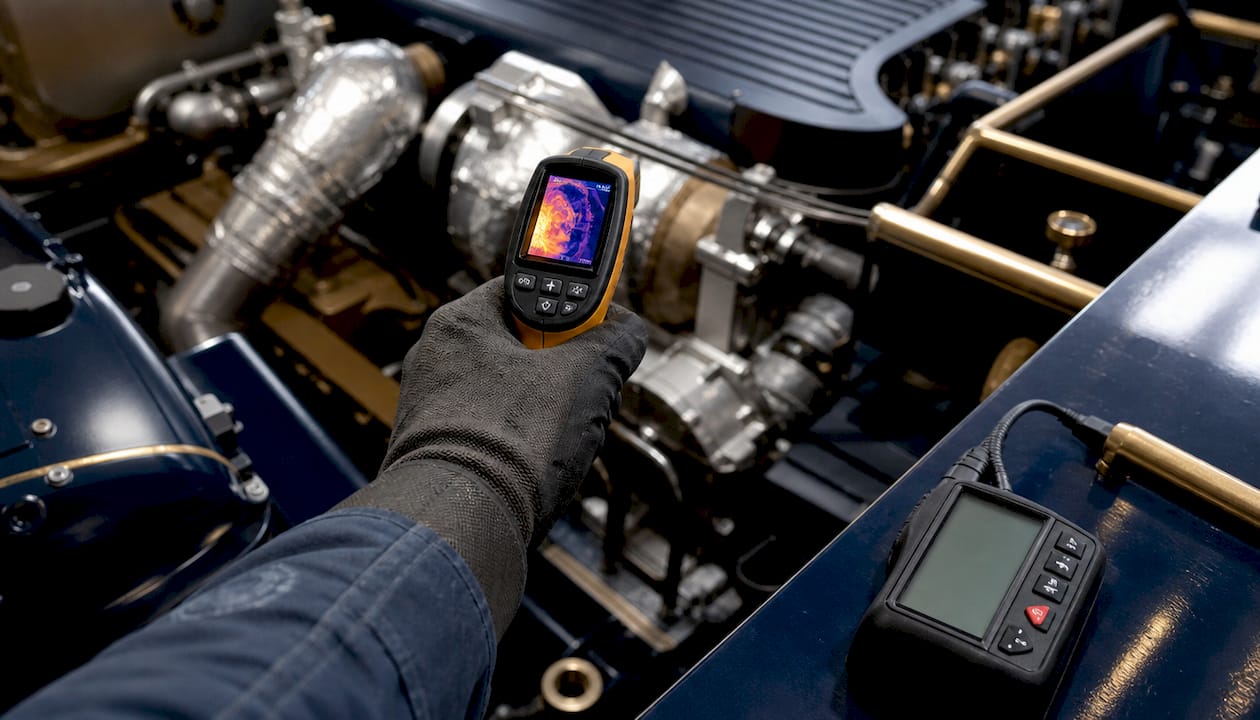
- Infrared thermometer: Checks bearing and coupling temperatures after a run, flagging hot spots that signal misalignment.
Before any measurement begins, the engine must be at operating temperature. Cold alignment readings do not reflect real running conditions because thermal growth changes the relative position of the engine and shaft. The bilge around the engine beds must be clean and dry so you can see any cracked stringers or soft mounts clearly. Document the current vibration readings, mount condition, and coupling clearances before you change anything. That baseline is your reference for every adjustment that follows.
Pro Tip: Photograph every mount, chock, and coupling before disassembly. If you need to return to the original configuration, those photos save hours.
| Preparation Step | Why It Matters |
|---|---|
| Warm engine to operating temp | Reflects real thermal growth in alignment readings |
| Clean and inspect engine beds | Reveals soft spots or cracks that invalidate alignment |
| Record baseline vibration data | Gives you a before-and-after comparison |
| Check mount condition | Worn or collapsed mounts cannot hold alignment |

How do you balance yacht engines and align shafts step by step?
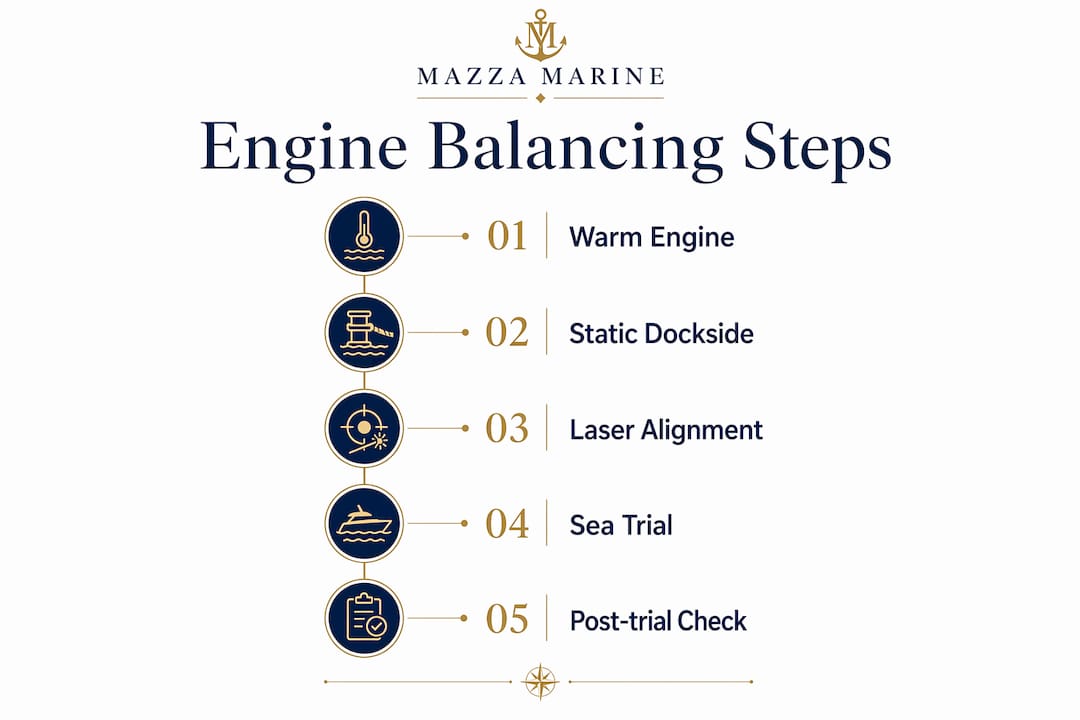
The standard process for balancing yacht motors follows a logical sequence. Skipping steps, especially the sea trial verification, is the most common cause of repeat alignment failures.
- Inspect and replace engine mounts. Soft, cracked, or oil-soaked mounts cannot hold alignment. Replace any that show compression set or cracking before proceeding.
- Set static alignment at the dock. Use your laser alignment device and dial indicators to bring the engine coupling into alignment with the shaft coupling. Engine mount positioning affects the entire propulsion train, including the gearbox and shaftline, so work methodically.
- Adjust chocks and shims. Metal chocks under the engine feet set the vertical position. Add or remove shims to achieve the target offset and angular values specified by the engine manufacturer.
- Torque all mount bolts to specification. Under-torqued mounts shift under load. Over-torqued mounts crush the rubber element and transmit vibration directly into the hull.
- Run the engine and take vibration readings. Record amplitude and frequency at idle, cruise, and wide-open throttle. Compare against your baseline.
- Conduct a sea trial. Alignment at dock can shift significantly underway due to hull flexing and thermal expansion. Take vibration readings at sea under load to confirm the balance holds.
- Re-check alignment after the sea trial. Hull deflection and thermal growth often move the engine slightly. A post-trial check catches any shift before it becomes wear.
Pro Tip: On twin-engine yachts, balance each engine independently before comparing port and starboard vibration signatures. Trying to tune both simultaneously creates confusion about which engine is causing which reading.
| Alignment Stage | Key Check |
|---|---|
| Static dockside | Laser alignment within manufacturer tolerance |
| Post-run at dock | Coupling temperature and vibration amplitude |
| Sea trial underway | Vibration at cruise RPM under load |
| Post-sea trial | Re-check coupling offset after hull flex |
Hull flex is a factor that surprises many owners. Lightweight yacht structures flex with load and temperature, shifting alignment conditions underwater and underway. A reading taken at the dock in the morning can look very different from one taken after two hours at sea in warm Florida water. That is why sea trial verification is not optional. It is the only way to confirm that your alignment holds in real operating conditions.
What are the most common mistakes in yacht engine balancing?
The single most dangerous mistake in yacht engine balancing is treating perceived smoothness as proof of mechanical health. Comfort tuning, which involves softening engine mounts or adding insulation to reduce vibration felt on deck, masks vibration symptoms without fixing the underlying cause. The yacht feels better. The gearbox and couplings wear faster.
Common errors that cost owners money:
- Relying on feel instead of measurement. Vibration perception varies between people and sea states. Objective data from a vibration analyzer does not.
- Skipping the sea trial verification. Dockside alignment is a starting point, not a finished result.
- Replacing mounts without checking alignment. New mounts change the engine’s resting position. Alignment must be re-checked after every mount replacement.
- Ignoring gearbox and coupling condition. A worn flexible coupling or a gearbox with backlash generates vibration that no amount of engine alignment will fix.
- Failing to log changes. Without records, you cannot identify trends or trace the source of new vibration.
“A competent yacht engineer prioritizes measuring vibration and alignment over perception and comfort tuning. Lack of objective measurement leads to trade-offs where perceived smoothness hides underlying accelerated damage in yacht engines. Comfort tuning increases guest perception of smoothness but often shifts mechanical stress into gearboxes and couplings, causing accelerated wear despite seeming improvement.”
The consequences of improper alignment are not subtle over time. Uneven bearing wear, gear tooth distress, and shaft seal failure all trace back to misalignment that was never measured correctly. A professional vibration assessment catches these issues before they become a haul-out and a large repair bill.
How does balancing yacht engines improve fuel efficiency and reduce costs?
A well-balanced propulsion system burns fuel more efficiently because the engine is not fighting internal friction caused by misalignment. Engine tuning and calibration can deliver fuel savings of up to 10% by optimizing parameters like air intake and fuel injection alongside mechanical balance. That figure matters when fuel represents up to 50% of a yacht’s annual operating budget.
Practical benefits of maintaining engine balance:
- Reduced bearing and seal wear extends engine life between overhauls.
- Lower vibration amplitude reduces fatigue on hull fittings, exhaust systems, and electrical connections.
- Consistent alignment keeps the propeller shaft running true, improving propulsive efficiency.
- Fewer unplanned breakdowns mean less time on the dock and more time on the water.
Hull maintenance works alongside engine balancing to maximize savings. Hull cleaning and antifouling reduce hydrodynamic resistance and can improve fuel efficiency by up to 20%. A perfectly balanced engine pushing through a fouled hull still burns excess fuel. Both sides of the equation matter.
Routine engine maintenance and tuning compound these savings over a season. Owners who treat engine balance as a one-time fix rather than an ongoing practice consistently spend more on repairs and fuel than those who schedule regular checks.
How do you keep yacht engines balanced over time?
Maintaining engine balance is not a single event. It is a monitoring practice built into your regular maintenance schedule.
Signs that balance has degraded:
- New or increased vibration at a specific RPM range
- Unusual noise from the gearbox or shaft coupling
- Elevated bearing temperatures after a run
- Visible movement in engine mounts under load
- Increased fuel consumption without a change in operating profile
Marine engines benefit from balance checks every 300–500 hours or after any major repair. That interval catches alignment drift before it causes component damage. Log every vibration reading with the date, engine hours, sea conditions, and load. A detailed maintenance log turns individual readings into a trend, and trends tell you when something is changing before it fails.
Onboard monitoring systems that track RPM, temperature, and vibration continuously give you early warning between scheduled checks. When a reading spikes outside its normal range, you investigate before the sea trial rather than during it.
Pro Tip: Set a baseline vibration reading at commissioning each season. Every subsequent reading has a clear reference point, making trend analysis straightforward.
Key Takeaways
Proper yacht engine balancing requires objective measurement, sea trial verification, and scheduled monitoring. Comfort tuning without measurement accelerates hidden mechanical damage regardless of how smooth the vessel feels.
| Point | Details |
|---|---|
| Measure before and after | Always record baseline vibration data before making any adjustment. |
| Sea trials are mandatory | Dockside alignment shifts underway due to hull flex and thermal growth. |
| Avoid comfort tuning traps | Softening mounts masks symptoms and accelerates gearbox and coupling wear. |
| Schedule checks every 300–500 hours | Regular intervals catch alignment drift before it causes component failure. |
| Pair engine balance with hull maintenance | Hull cleaning can improve efficiency by up to 20%, compounding engine-side gains. |
What I’ve learned from watching owners skip the sea trial
After years of working alongside Florida yacht engineers and watching propulsion systems get pulled apart, one pattern stands out clearly. Owners who skip the sea trial verification almost always come back with a gearbox problem within a season. They did the dockside alignment correctly. The numbers looked good at the dock. Then the hull flexed underway, the thermal growth shifted the coupling, and the misalignment ran for hundreds of hours before anyone noticed.
The other thing I’ve seen repeatedly is the comfort tuning trap. A guest complains about vibration. The quick fix is softer mounts or more insulation. The yacht feels better at the next charter. Six months later, the flexible coupling is destroyed. The engine mechanical systems were never actually fixed. They were just quieted.
Electronic vessel control systems are changing this. Modern EVC systems can monitor combustion parameters and flag imbalances that would have gone undetected with older analog gauges. Engine balancing is evolving from manual synchronization toward integrated electronic management that catches issues in real time. That technology is worth understanding and worth asking your engineer about.
My honest advice: treat every vibration reading as data, not a judgment call. If the numbers say something is wrong, believe the numbers. A sea trial costs a few hours of fuel. A gearbox replacement costs far more.
— Jason
Mazzamarine’s engine and mechanical services for Florida yacht owners
Florida’s heat, saltwater, and year-round operating season put propulsion systems under constant stress. Mazzamarine works with a trusted network of Florida yacht engineers who specialize in engine alignment, vibration analysis, and complete mechanical maintenance packages built around your vessel’s specific needs.
Whether you need a one-time alignment check after a repower or an ongoing maintenance program that includes scheduled vibration monitoring, Mazzamarine connects you with the right experts. Brothers Mino and Luigi built this network on the principle that every yacht owner deserves a long-term relationship with people who know their boat. Reach out to Mazzamarine today and schedule a professional engine assessment before your next season begins.
FAQ
What does balancing yacht engines actually involve?
Yacht engine balancing covers shaft alignment, engine mount adjustment, and vibration verification using instruments like laser alignment devices and vibration analyzers. The goal is to minimize mechanical stress across the entire propulsion train.
How often should yacht engine alignment be checked?
Balance checks every 300–500 hours or after any major repair keeps alignment within safe limits and prevents vibration-related wear.
Why is a sea trial necessary after engine alignment?
Hull flex and thermal growth shift alignment conditions underway, so dockside readings alone cannot confirm that the balance holds under real operating loads.
Can soft engine mounts fix a vibration problem?
Softer mounts reduce vibration felt on deck but do not correct misalignment. They mask symptoms while accelerating wear in gearboxes and couplings.
How much fuel can proper engine balancing save?
Engine tuning and calibration can reduce fuel consumption by up to 10%. Combined with clean hull maintenance, total efficiency gains can be substantial across a full season.
Recommended
Text or Call 954-330-9653 Schedule Appointment
Mazza Marine Yacht Services & Refit

Fiberglass Upgrades and Damage Repair

Premium Yacht Paint/ Faux Teak

Fishing: Custom Rods, Reels,Tackle

Electrical, Electronics and Navigation

Paint, Hull and Gelcoat

Teak Decks, Wood Cabinets, Carpentry

Canvas, Enclosures and Upholstery

Mechanical, Repower and Running Gear

Plumbing, Bilge and Thru-Hulls

Welding and Custom Fabrication

Interior Refit And Past Work
Get your yacht value Estimate
"*" indicates required fields