
View Our Recent Work:

Documenting past yacht work is the process of collecting, organizing, and verifying all maintenance and repair records to create a comprehensive, accessible history of your vessel’s upkeep. Whether you’re preparing for a flag state survey, planning a sale, or simply trying to understand what your engines have been through, a solid yacht work history is the difference between confident ownership and costly guesswork. The good news: you don’t need to have been meticulous from day one. With the right tools and a clear process, even a scattered collection of receipts, emails, and handwritten notes can become a professional maintenance record that buyers and surveyors trust.
How to document past yacht work: gathering records and choosing tools
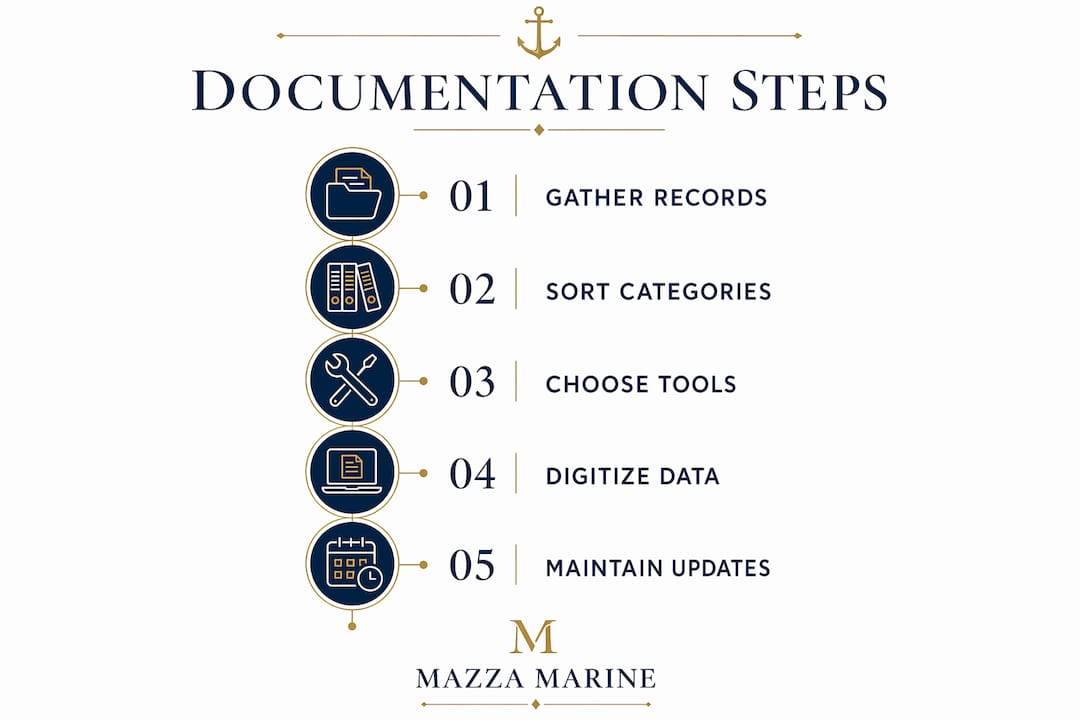
Before you can organize anything, you need to know what you already have. Start by pulling every document you can find: receipts from boatyards, invoices from mechanics, service reports from electronics technicians, and any handwritten notes left by previous owners. Check onboard storage, email archives, cloud folders, and even text message threads with contractors. If you purchased the vessel from a prior owner, request their records directly. Many sellers hold onto service files long after a sale and will share them when asked.
Once you have your raw materials, sort them into categories: engine and mechanical, hull and paint, electrical and electronics, safety systems, and interior. This rough grouping makes the next step, entering records into a system, far faster.

The tool you choose shapes how useful your records become over time. Here is a quick comparison of the three most common approaches:
| Tool | Best for | Limitations |
|---|---|---|
| Spreadsheets (Excel, Google Sheets) | Small vessels, simple histories | No timestamps, no accountability, 3-4 hours wasted monthly |
| Dedicated PMS software (YachtWyse, YachtLogicPro) | Professional fleets, survey-ready records | Setup time, subscription cost |
| Paper logbooks | Backup archive, legacy records | Not searchable, easily lost or damaged |
The yacht management software market is projected to reach USD 2.5 billion by 2030, growing at 9.5% annually. That growth reflects a real shift: owners and captains are moving away from paper and spreadsheets because the operational cost of disorganized records is simply too high.
Pro Tip: Don’t delete or discard old paper files once you digitize them. Store them in a labeled binder or waterproof box onboard as a physical archive. Surveyors occasionally ask to see original documents.
How to organize and digitize your yacht’s maintenance history
With your records gathered and your tool selected, the actual work of building a structured history begins. Follow these steps to move from chaos to clarity:
-
Create a master equipment inventory. List every major system onboard: main engines, generators, watermakers, HVAC, navigation electronics, safety gear, and hull systems. Assign each a unique identifier or tag. This becomes the backbone of your log.
-
Enter historical records chronologically. Work backward from the most recent service. For each entry, record the date, the work performed, the contractor or crew member who did it, the parts used, and the cost. Approximate dates are acceptable when exact dates are unknown. Note them as “circa” or “approx.” rather than leaving the field blank.
-
Digitize paper documents. Use a smartphone scanning app like Adobe Scan or Microsoft Lens to photograph receipts and reports. Attach these scans directly to the relevant log entry. A photo of the original invoice attached to a digital record creates the kind of timestamped audit trail that surveyors trust.
-
Establish service intervals from historical data. Once your history is entered, look for patterns. If your main engines received oil changes every 250 hours, set that as your recurring interval going forward. For engine maintenance specifically, track both engine hours and calendar dates to prevent degradation even when hour thresholds are not met.
-
Link photos and receipts to every entry. A log entry that reads “replaced raw water impeller” is useful. The same entry with a photo of the old impeller, the new part number, and the receipt attached is authoritative.
The implementation timeline for digital PMS typically runs two to four weeks, starting with inventory digitization. Don’t try to backfill every record from the past decade in week one. Focus first on current active schedules and equipment status. Legacy paper files can remain as archives while you build forward momentum.
Pro Tip: When dealing with incomplete records, a brief written note explaining the gap is more credible than silence. Something like “No records available for this period. Vessel was under prior ownership from 2018 to 2021” tells a surveyor or buyer exactly what they need to know.
A well-structured data table for each major system might look like this:
| System | Last service date | Service performed | Next due | Record attached |
|---|---|---|---|---|
| Port main engine | March 2025 | Oil change, impeller | Sept 2025 | Yes (invoice) |
| Generator | Jan 2025 | Full service | July 2025 | Yes (photo) |
| Watermaker | Oct 2024 | Membrane flush | April 2025 | No (approx.) |
What are common mistakes to avoid when recording yacht repairs?
The most damaging mistake in yacht work documentation is treating it as a one-time project rather than an ongoing practice. Owners who build a beautiful log for a sale and then abandon it after closing leave the next owner in the same position they started in.
Here are the pitfalls that consistently undermine otherwise solid documentation efforts:
- Relying on spreadsheets without version control. When multiple crew members edit the same file, entries get overwritten, deleted, or duplicated. A shared spreadsheet with no edit history is not a reliable record.
- Leaving entries vague. “Engine work done” tells nobody anything. Every entry needs a specific description, a performer name, and a date. Paper and spreadsheet systems lack verifiable timestamps, which is exactly what leads to survey deficiencies.
- Skipping safety system records. Fire suppression systems, life raft certifications, EPIRB registrations, and flare expiry dates are the records surveyors check first. These are also the records most likely to be missing.
- Treating approximate data as unreliable. An approximate record is always better than no record. Document what you know, note the uncertainty, and move on.
- Failing to review for gaps. Schedule a quarterly review of your log. Look for systems with no entries in the past 12 months and investigate whether service was performed but not recorded, or genuinely skipped.
“The chain of evidence matters as much as the record itself. A timestamped, attributed entry in a digital PMS carries far more weight than a handwritten note with no date and no signature.” — YachtWyse, Flag State Survey Prep
You can also review vessel documentation examples to understand what professional records look like before you build your own. Seeing the standard makes it easier to match it.
How does documented yacht work history improve resale value?
A thorough, organized maintenance history does more than satisfy surveyors. It changes how buyers perceive your vessel before they ever step aboard. Detailed maintenance logs increase resale appeal by proving care and reliability in a market where buyers are rightly skeptical of undocumented vessels.
Think of it this way: two comparable 60-foot sportfish yachts are listed at the same price. One comes with a binder of receipts and a digital log showing every service since launch. The other has a verbal assurance from the seller that “everything has been maintained.” The documented vessel commands more buyer confidence, faster negotiations, and often a stronger final price. Documented yacht resale value in Florida is directly tied to how well an owner can prove the vessel’s history.
Beyond resale, good records reduce operational downtime. When your captain knows exactly when the port engine last had its injectors serviced, they can plan the next haul-out around it rather than reacting to a failure at sea. Engine systems account for 30 to 40% of total maintenance budgets, which makes them the single most important category to track with precision.
For captains and crew, the benefits extend to professional credibility. Yachting recruiters advise quantifying work history with metrics rather than vague descriptions. A captain who can say “managed a 12-month refit program with full digital PMS records across 14 systems” is a more compelling hire than one who simply lists vessel names. Good documentation habits serve your career as much as your vessel.
A maritime documentation checklist is a practical starting point if you want to cross-reference your records against compliance standards before a survey or sale.
Key takeaways
Thorough yacht work documentation requires a structured system, digital tools with timestamped entries, and consistent upkeep across engine, safety, and hull records.
| Point | Details |
|---|---|
| Start with what you have | Gather receipts, invoices, and emails before choosing a tool or system. |
| Choose digital over paper | Platforms like YachtWyse and YachtLogicPro provide audit trails that spreadsheets cannot match. |
| Track engines by hours and dates | Hybrid tracking prevents degradation and aligns service intervals accurately. |
| Document gaps honestly | A noted gap with context is more credible than a blank field or a missing entry. |
| Records drive resale value | Detailed maintenance history increases buyer confidence and supports stronger asking prices. |
What I’ve learned from years of watching owners get this wrong
I’ve seen owners spend six figures on a refit and then hand over a vessel with a manila envelope of crumpled receipts as the “documentation package.” It’s one of the most avoidable ways to leave money on the table, and it happens constantly in Florida’s yacht market.
The shift that changed my thinking was realizing that documentation is not about the past. It’s about the present. When you maintain a living log of your vessel’s systems, you’re not just creating a record for the next buyer. You’re giving yourself a tool that makes every decision sharper, from scheduling a haul-out to negotiating with a contractor who claims work was never done.
My honest recommendation: don’t try to reconstruct five years of history in a weekend. Start with your current equipment inventory and the last 12 months of service records. Get those into a digital system with photos attached. Then work backward incrementally. The smarter approach to yacht maintenance is always incremental, not heroic.
Prioritize engine and safety system records above everything else. Those are the two categories that surveyors scrutinize hardest and buyers ask about first. If your log is strong in those areas, everything else is a bonus.
The owners I’ve seen get the best results are the ones who treat their log like a living document, not a filing cabinet. Update it within 48 hours of any service. Attach the receipt before you lose it. Note the contractor’s name and phone number. That level of discipline takes about 10 minutes per service event and pays back in full at the first survey or sale.
— Jason
How Mazzamarine can support your documentation and maintenance journey

Mazzamarine works with Florida yacht owners at every stage of ownership, from urgent repairs in Miami to long-term engine programs and full interior refits. When you’re building out your vessel’s work history, having a trusted service partner means your records are accurate, detailed, and tied to professional invoices from day one. Every job Mazzamarine completes comes with documentation you can drop straight into your maintenance log.
If you’re not sure where your vessel stands mechanically, start with the signs you need yacht repairs guide to identify what needs attention before your next survey or listing. Mino, Luigi, and the Mazzamarine team are ready to help you build a vessel history worth showing off. Reach out today and start your documentation on solid ground.
FAQ
What records should I collect first when documenting past yacht work?
Start with engine service records, safety system certifications, and hull work invoices. These are the categories surveyors and buyers examine first, and they carry the most weight in any resale or compliance review.
Is a spreadsheet good enough for tracking yacht services?
Spreadsheets work for simple histories but lack verifiable timestamps and accountability features. Dedicated platforms like YachtWyse or YachtLogicPro provide the audit trails that professional surveys and resale transactions require.
How do I handle missing or incomplete records?
Note the gap explicitly in your log with a brief explanation, such as prior ownership period or records unavailable. An honest, documented gap is more credible to surveyors and buyers than a blank field with no context.
How long does it take to set up a digital maintenance system?
Implementing a digital PMS typically takes two to four weeks, beginning with equipment inventory digitization. Focus on active schedules first and treat legacy paper files as a background archive rather than a backfill priority.
Does documented maintenance history actually affect resale price?
Detailed maintenance logs directly increase buyer confidence and resale appeal by proving consistent care and reliability. In Florida’s competitive yacht market, a well-documented vessel routinely attracts stronger offers and faster closings than comparable undocumented listings.
Recommended
Text or Call 954-330-9653 Schedule Appointment
Mazza Marine Yacht Services & Refit

Fiberglass Upgrades and Damage Repair

Premium Yacht Paint/ Faux Teak

Fishing: Custom Rods, Reels,Tackle

Electrical, Electronics and Navigation

Paint, Hull and Gelcoat

Teak Decks, Wood Cabinets, Carpentry

Canvas, Enclosures and Upholstery

Mechanical, Repower and Running Gear

Plumbing, Bilge and Thru-Hulls

Welding and Custom Fabrication

Interior Refit And Past Work
Get your yacht value Estimate
"*" indicates required fields