
View Our Recent Work:

Hiring the wrong crew member for your Florida yacht isn’t just inconvenient. It can mean safety failures at sea, miserable guest experiences, and thousands of dollars lost to re-hiring, retraining, or legal complications. Florida’s yachting culture moves fast, especially around Fort Lauderdale and Miami, and the pressure to fill berths quickly before a season opens leads many owners into rushed decisions they later regret. This guide walks you through every stage of building a reliable, professional crew, from defining exactly who you need to negotiating fair salaries and onboarding your team with confidence.
Table of Contents
- Define your yacht crew requirements
- Document and verify essential qualifications
- Step-by-step yacht crew recruitment workflow
- Reference, temperament, and background checks
- Florida yacht crew salary benchmarks and costs
- The real secret to long-term successful yacht crews
- Upgrade your yacht and your crew’s effectiveness
- Frequently asked questions
Key Takeaways
| Point | Details |
|---|---|
| Start with clear role definitions | Precisely outlining each crew member’s responsibilities ensures you hire the right fit for your yacht. |
| Always verify credentials and medicals | Check all certifications and do not skip medical screening to protect legal compliance and safety. |
| Follow a structured hiring workflow | Using a step-by-step process greatly increases the chance of a strong and lasting crew hire. |
| Prioritize reference and background checks | Contacting past employers and verifying temperament are as important as reviewing qualifications. |
| Budget with local salary benchmarks | Understand Florida’s 2026 pay ranges so your offers attract and retain top crew talent. |
Define your yacht crew requirements
Once you see the risks of a wrong hire, the first step is getting clear on exactly what you need for your yacht. Skipping this step is the single biggest reason Florida owners end up re-hiring within a season.
Start by answering these foundational questions before you post a single job listing:
- How large is your vessel, and what license level does your captain legally require?
- What are your typical itineraries: coastal day trips, offshore passages, or extended Caribbean runs?
- Will you charter the yacht, use it privately, or both?
- How many guests do you regularly host, and what level of service do they expect?
- What season windows matter most to you, and do you need full-time or rotational crew?
- Are there specialty skills you require, such as dive instruction, culinary training, or heavy machinery experience?
With those answers in hand, write out a clear role description for every position. A captain on a 90-foot sportfish running charters out of Miami has entirely different responsibilities than a captain managing a 150-foot motor yacht doing private Caribbean passages. Your engineer’s scope changes dramatically depending on whether your engines are inboard diesels or twin gas-powered setups. Interior crew and chef positions vary based on whether guests expect fine dining service or relaxed family hospitality.
As one well-regarded recruitment resource explains, when hiring yacht crew, start by defining the exact roles and requirements for your vessel, including captain license level, engineer certifications, interior service preferences, and deck experience, before you ever search for candidates.
Clear written descriptions also reduce confusion during interviews. Candidates self-screen better, and you spend less time on people who aren’t a real fit.
Pro Tip: Technical qualifications will get someone in the door, but personality and team compatibility are what keep them aboard. Build in a section of your role description that outlines your onboard culture, communication expectations, and tone. A calm, methodical owner who prefers quiet efficiency should hire differently than one who runs a high-energy charter program.
For broader context on Florida yacht management basics, it pays to understand how crew planning fits inside the bigger picture of vessel ownership.
Document and verify essential qualifications
After defining roles, the next step is making sure every candidate meets the basic legal and safety requirements before you invest any more time in them.

STCW stands for Standards of Training, Certification and Watchkeeping for Seafarers. It’s the international baseline for professional maritime safety training, covering firefighting, personal survival, first aid, and security awareness. ENG1 is the standard medical fitness certificate for seafarers. For most yacht positions, you should treat STCW and ENG1 medical certifications as baseline non-negotiables during your verification process.
Beyond those two, here’s a practical overview of what to look for by role:
| Role | Required | Recommended |
|---|---|---|
| Captain | STCW, USCG or MCA license, ENG1 | GMDSS radio, radar endorsement |
| Engineer | STCW, ENG1, relevant engineer license | OOW (engineering watch) cert |
| Deckhand | STCW basic safety, ENG1 | Powerboat or sailing endorsements |
| Interior/Stew | STCW basic safety, ENG1 | WSET wine cert, food handler card |
| Chef | STCW basic safety, ENG1 | Culinary credentials, HACCP training |
Never accept photocopies without seeing originals. Digital credential verification platforms exist, but nothing replaces holding the physical certificate and cross-referencing it with the issuing authority. Fraudulent credentials exist in the industry. It’s rare, but the consequences of putting someone with a falsified captain’s license behind the helm are severe.
Never make exceptions on safety credentials, regardless of how impressive a candidate looks on paper or how urgently you need to fill a position. One unqualified person in a critical role puts everyone aboard at risk.
Also confirm that certificates haven’t expired. STCW basic safety certificates typically require a refresher every five years. An ENG1 is valid for two years. An otherwise excellent candidate with lapsed credentials is not ready to sail until they’ve renewed them.
Understanding essential yacht safety gear and how it connects to your crew’s training requirements will make your verification conversations more meaningful.
Step-by-step yacht crew recruitment workflow
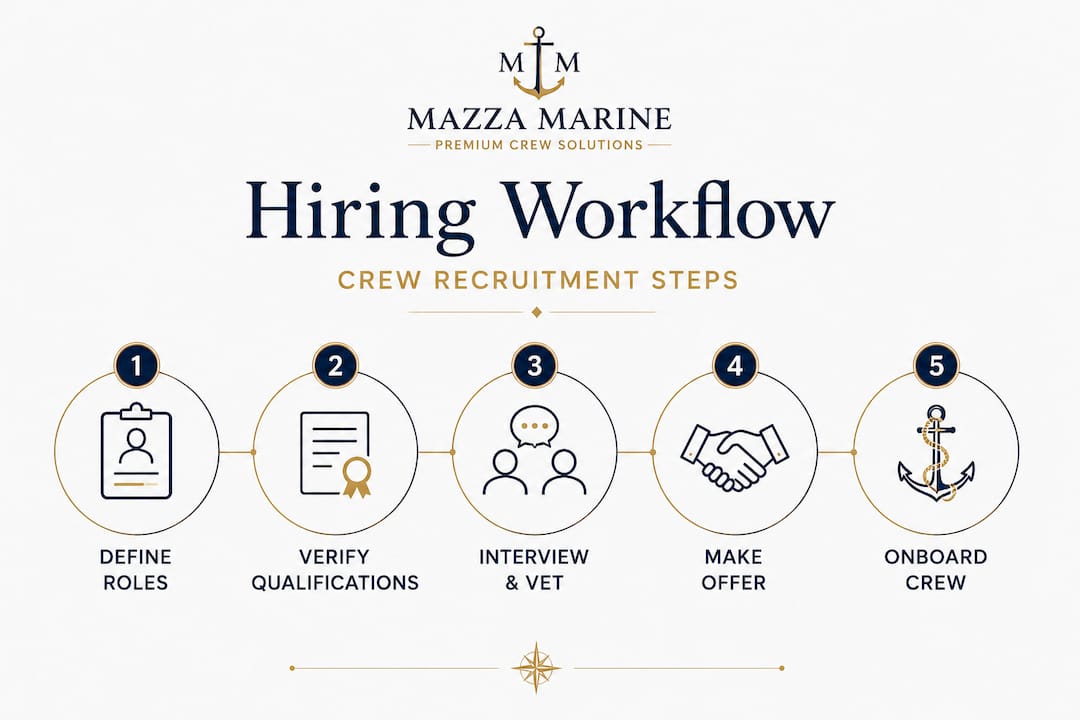
Once you know the requirements and non-negotiables, here’s how to move from posting a job to onboarding your new crew in a structured, reliable way.
A structured recruitment workflow for employers typically includes posting and engagement, credential verification, interviews, reference checks, and onboarding and rotation integration steps.
- Source candidates. Use job boards, crew agencies, referrals from trusted captains, and maritime schools. Fort Lauderdale’s crew placement community is tight-knit, and a strong referral from a respected captain carries real weight.
- Screen applications. Filter first by certification compliance and experience level. Discard anyone who doesn’t meet your stated minimums, even if they write a compelling cover letter.
- Conduct video and in-person interviews. Ask situational questions, not just background summaries. Ask how they handled a mechanical failure at sea, a difficult guest situation, or a conflict with another crew member.
- Make a conditional offer. Lay out the contract terms, rotation schedule, compensation, and key expectations. Conditional means the offer depends on verified references and a background check.
- Run reference and background checks. Call previous captains and owners directly. Do not rely on written letters alone.
- Complete onboarding. Walk new crew through your systems, safety briefings, guest protocols, and rotation schedule before the first voyage.
The hiring timeline in Florida averages two to four weeks for standard positions and can stretch to six to eight weeks for senior roles like captain or chief engineer. Plan accordingly, especially before peak season windows in November through April.
Do-it-yourself vs. agency hiring
| Factor | DIY hiring | Agency/management |
|---|---|---|
| Cost | Lower upfront | Agency fee or retainer |
| Time investment | High | Lower |
| Candidate pool | Dependent on your network | Larger pre-vetted pool |
| Background checks | Your responsibility | Often included |
| Compliance support | Your responsibility | Usually included |
| Speed for urgent hires | Slower | Faster via pre-vetted pools |
For hiring for technical reliability aboard your vessel, especially when filling engineer positions, the agency route often produces stronger results because vetted candidates arrive with verified mechanical experience. If you’re looking specifically at engineer recruitment advice, prioritize hands-on diesel experience and familiarity with your specific engine brand.
Pro Tip: If you’re approaching peak season and still don’t have your crew filled, tap into agency pre-vetted pools rather than accepting whoever is immediately available on a job board. A two-week wait for the right person beats a full season with the wrong one.
Smart owners who plan ahead for maintenance and crew hiring together rarely find themselves scrambling at the last minute.
Reference, temperament, and background checks
Candidate interviews aren’t enough. Thorough vetting closes the gap and minimizes risk aboard your vessel.
The most valuable reference you’ll ever get is a direct phone call to a previous captain or owner. Not a written letter. Not a LinkedIn endorsement. A real conversation where you ask open-ended questions and listen carefully to what they say, and what they avoid saying. As one industry source puts it, vetting should include direct reference checks with previous captains and owners, and rushing hires is more disruptive than temporary understaffing.
When you call a reference, listen for these signals:
- Strong reference: Specific examples, enthusiastic tone, willingness to re-hire, detailed descriptions of the candidate’s work under pressure.
- Weak reference: Vague language, pauses before answering, only confirming dates of employment, no real enthusiasm.
- Red flags: Hesitation about the person’s attitude toward authority, any mention of conflict with guests or fellow crew, reluctance to recommend.
Personality and temperament deserve as much attention as credentials on a yacht. Crew members live and work in close quarters for weeks or months. A technically skilled deckhand who creates social tension in the crew quarters can poison the entire vessel’s atmosphere and affect guest satisfaction directly.
If you’re working with a crew agency, ask specifically what screening they perform beyond certificate checks. Background checks and additional screening beyond certificates, such as criminal record checks, credit history, and compatibility testing, are what separate thorough agencies from basic job-matching services.
Pro Tip: Don’t rush to fill a position just because you have an upcoming trip. Running short-handed for a voyage or two is a manageable challenge. Living with a poor hire for a full season is not. Temporary discomfort buys you time to find the right person.
Understanding crew professionalism standards helps you recognize it when you see it during the interview and reference phase.
Florida yacht crew salary benchmarks and costs
With your shortlisted candidates in hand, here’s what to expect and plan for financially in the Florida crew market.
The Fort Lauderdale and Miami markets set some of the highest crew compensation benchmarks in the United States, driven by demand, cost of living, and the concentration of large private and charter vessels in the region. Florida crew salary ranges by role in 2026 reflect the competitive nature of the market.
| Role | Monthly salary range (Florida, 2026) | Notes |
|---|---|---|
| Captain (60-100 ft) | $7,000 – $12,000 | Charter use increases range |
| Captain (100+ ft) | $12,000 – $18,000+ | Depends on experience/vessel |
| Chief engineer | $6,500 – $11,000 | Mechanical complexity matters |
| First mate/officer | $4,500 – $7,500 | Varies with vessel size |
| Deckhand | $3,000 – $5,500 | Entry to experienced |
| Chief stewardess | $4,000 – $7,000 | Charter service adds premium |
| Chef/cook | $4,500 – $9,000 | Culinary level varies widely |
Several factors push salaries higher or lower within these ranges:
- Vessel size and complexity: Larger, more technically demanding yachts command higher pay across all positions.
- Charter vs. private use: Charter programs generate more workload and often come with tip income on top of base salary.
- Itinerary and offshore passages: Crew spending months away from home expect higher compensation than those on local day-use vessels.
- Experience and reputation: A captain with 20 years and a spotless record will command top-range pay, and rightly so.
When budgeting, remember that base salary is only part of the picture. Consider these additional costs:
- Health and medical insurance (often required and highly valued by crew)
- Return flights and travel allowances for rotational crew
- Professional development and training reimbursements
- Crew provisioning and onboard accommodations
- Payroll taxes and any applicable maritime employment regulations
Tying your crew budget into your broader Florida yacht management plan helps you see the full cost of ownership clearly, without surprises mid-season.
The real secret to long-term successful yacht crews
Here’s an opinion that doesn’t always appear in hiring guides: the most damaging crew mistakes Florida owners make aren’t about certifications. They’re about chemistry.
In our experience working with yacht owners across South Florida, the hires that fall apart fastest are the ones where the owner or captain prioritized an impressive resume over every other consideration. You can have a captain with flawless credentials who communicates poorly, dismisses junior crew feedback, or quietly resents the owner’s involvement. That person creates dysfunction that trickles through the whole vessel.
The owners who build genuinely great crews do something slightly different. They treat the interview process as a two-way compatibility assessment, not just a credential review. They ask how the candidate has handled being wrong. They ask how they’ve navigated a tense moment with a guest who was out of line. They pay attention to how that person speaks about their previous employer, because that tells you exactly how they’ll speak about you in two years.
One Florida owner we know rebuilt his entire 90-foot sportfish crew after a season of technical excellence but persistent tension between the captain and the interior team. Every certificate was in order. The boat ran perfectly. But the guests felt the friction and stopped booking. He re-hired with a deliberate focus on personality alignment and reported that the following season felt like a different vessel entirely.
The honest truth is that technical skills are the floor, not the ceiling. They get someone past the credential check. What determines whether they stay, whether your guests come back, and whether your captain and engineer work as a unit rather than two strangers sharing a boat is fit. The synergy between a well-matched crew and a well-maintained yacht creates a yachting experience that’s genuinely hard to replicate.
Build relationships, not just contracts. The best crew members stay with owners who invest in them, communicate clearly, and treat the yacht as a shared passion rather than just a managed asset.
Upgrade your yacht and your crew’s effectiveness
A skilled crew can only perform as well as the vessel beneath them allows. Reliable engines, well-maintained systems, and a thoughtfully upgraded interior give your team the tools to deliver a seamless onboard experience every voyage.

At Mazza Marine, we work alongside Florida yacht owners to ensure that when you bring exceptional crew aboard, they’re stepping onto a vessel that matches their professionalism. From minimizing machinery breakdowns to keeping your engines performing at peak reliability, our Florida network covers every technical need. We also offer complete paint, hull, and gelcoat solutions to keep your yacht presenting beautifully. Reach out to Mino and Luigi today and let’s make sure your vessel and your crew are both ready for the season ahead.
Frequently asked questions
What are the must-have qualifications for Florida yacht crew?
STCW safety training and an ENG1 (or equivalent) medical certificate are baseline non-negotiables for all primary yacht crew roles, regardless of vessel size or itinerary.
How long does it typically take to hire a qualified yacht crew?
Most crew hires in Florida take 2 to 4 weeks, but more senior or specialized roles may require 6 to 8 weeks or more due to availability and lead time.
Should I use a yacht crew agency or hire directly?
Agencies can save significant time and offer pre-vetted candidates, but always verify they conduct full background checks and compatibility screening beyond basic certificate review.
What are typical salary ranges for crew in Fort Lauderdale and Miami?
Captain salaries typically range from $7,000 to $18,000 per month depending on vessel size and usage, while other roles vary widely based on experience and the complexity of the yacht, as detailed in current Florida crew salary benchmarks.
Recommended
Text or Call 954-330-9653 Schedule Appointment
Mazza Marine Yacht Services & Refit

Fiberglass Upgrades and Damage Repair

Premium Yacht Paint/ Faux Teak

Fishing: Custom Rods, Reels,Tackle

Electrical, Electronics and Navigation

Paint, Hull and Gelcoat

Teak Decks, Wood Cabinets, Carpentry

Canvas, Enclosures and Upholstery

Mechanical, Repower and Running Gear

Plumbing, Bilge and Thru-Hulls

Welding and Custom Fabrication

Interior Refit And Past Work
Get your yacht value Estimate
"*" indicates required fields