
View Our Recent Work:

Yacht ventilation is defined as the controlled movement of fresh air through a vessel’s interior to remove heat, moisture, and fumes. Knowing how to improve yacht ventilation is one of the most practical investments you can make as a yacht owner. Poor airflow breeds mold, concentrates engine fumes, and turns a beautiful cabin into a sweat box. The good news is that fixing it does not require a full refit. A combination of well-placed passive vents and powered marine fans solves most problems, and the principles behind the fix are simpler than most owners expect.
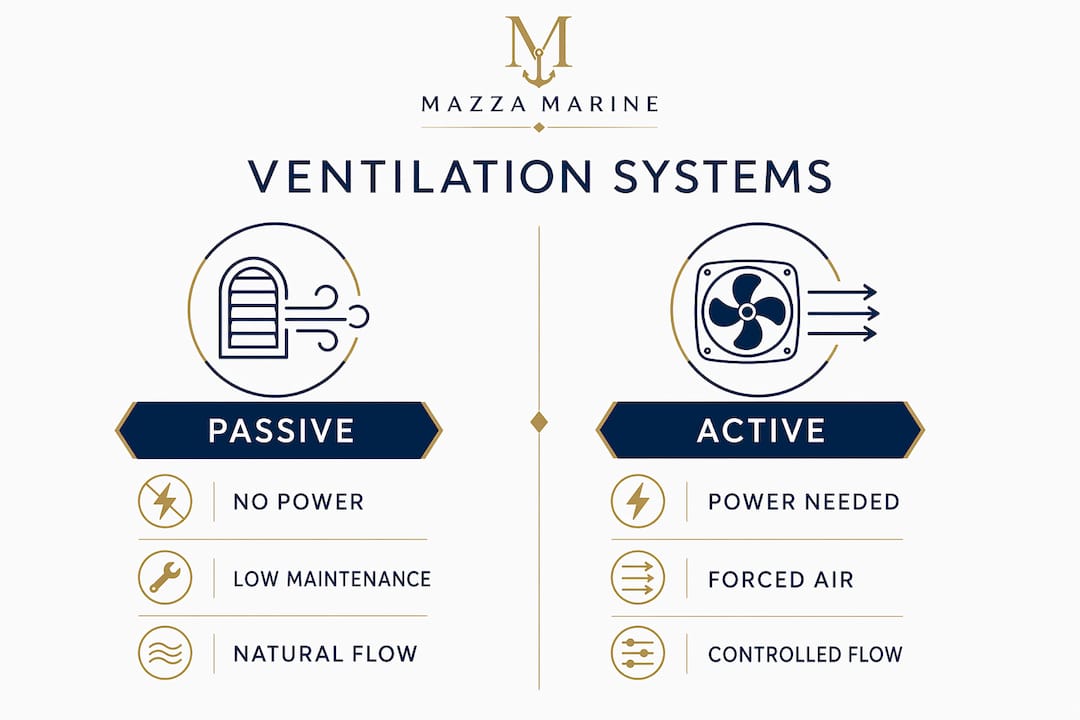
How to improve yacht ventilation: passive and active systems explained
Effective yacht ventilation relies on two systems working together: passive and active. Passive ventilation uses no electricity. It moves air through physical placement and natural pressure differences. Active ventilation adds powered fans and blowers to force air where natural convection cannot reach.
Passive ventilation components
Passive components include deck vents, dorade boxes, and mushroom vents. Dorade boxes are particularly clever. They allow air to pass through while blocking water, making them ideal for offshore passages. Mushroom vents work well on hatches and cabin tops where low-profile airflow is needed. These components form the backbone of any good yacht ventilation system workflow.
Balancing low intake vents and high exhaust vents enhances natural convection through what engineers call the chimney effect. Warm air rises and exits through high exhaust vents, pulling cooler air in through low intake vents. No power required.
Active ventilation components
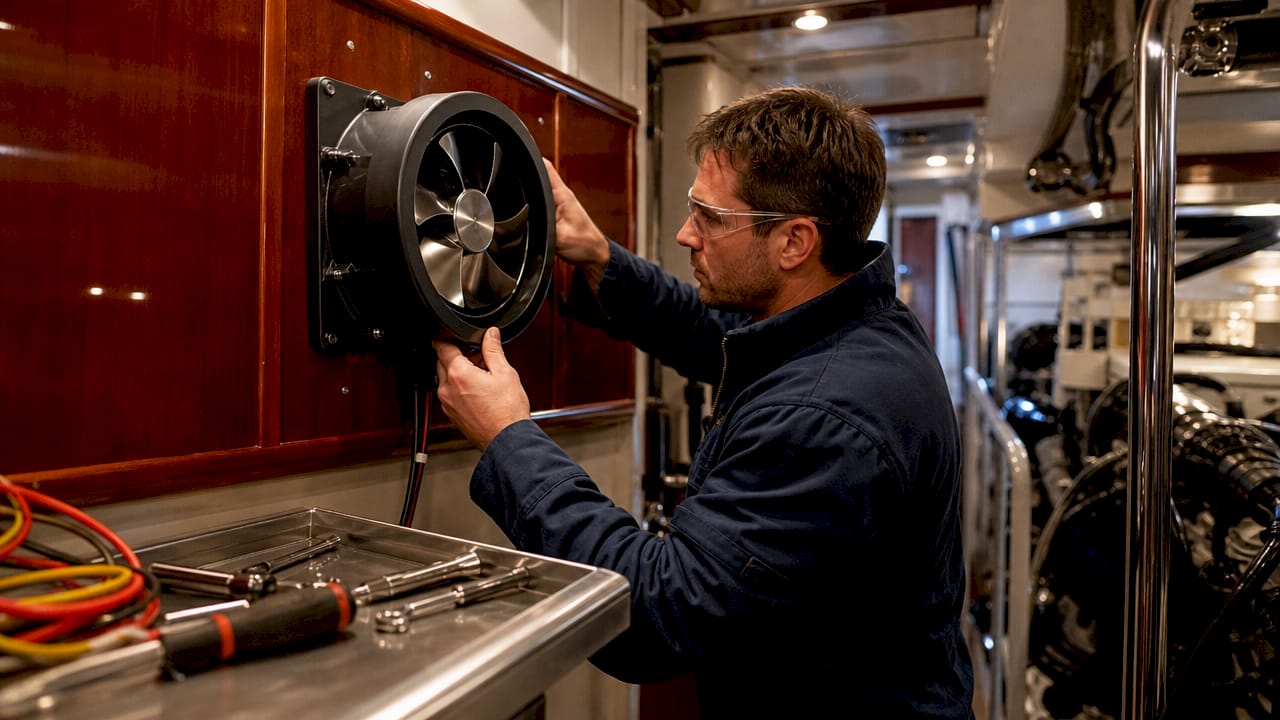
Active systems use electric blowers and intake fans to force air movement. These are non-negotiable in engine rooms, bilges, and enclosed cabins where natural convection stalls. Modern marine electric fans consume only a few amps per hour and can safely run overnight to maintain cabin comfort. Many newer models include reversible airflow, built-in timers, and temperature sensors.
The table below compares passive and active ventilation across the features that matter most to yacht owners.
| Feature | Passive ventilation | Active ventilation |
|---|---|---|
| Power required | None | Yes, low amp draw |
| Best application | Cabins, hatches, cockpits | Engine rooms, bilges, enclosed spaces |
| Airflow control | Limited | High, adjustable |
| Installation cost | Low | Moderate |
| Maintenance | Minimal | Periodic cleaning required |
How to calculate and size ventilation openings and fans for your yacht
Sizing is where most owners get it wrong. Too small a vent and the airflow is choked. Too large and you lose structural integrity or invite water ingress.
The standard formula for engine room ventilation starts with horsepower. Divide engine room horsepower by 3.3 to calculate the minimum passive vent area in square inches. That gives you the baseline. Then add 20% to that figure to compensate for airflow resistance from screens, louvers, and duct bends. That 20% buffer is what separates a system that works on paper from one that works on the water.
Here is a practical example. A twin-engine yacht with 600 combined horsepower needs a minimum vent area of roughly 182 square inches before the resistance margin. After adding the 20% resistance margin, the target rises to approximately 218 square inches. Spread that across multiple vents for redundancy.
| Engine horsepower | Base vent area (sq in) | With 20% margin (sq in) |
|---|---|---|
| 300 | 91 | 109 |
| 600 | 182 | 218 |
| 900 | 273 | 328 |
For powered blowers, size the exhaust blower slightly larger than the intake. Creating negative pressure by running a more powerful exhaust blower than intake blower pulls fresh air through the yacht and expels hot air effectively. It also prevents odor backflow from the engine room into living spaces.
Pro Tip: Run your engine room blowers for at least 4–5 minutes before engine start to expel any accumulated fumes. Some systems use timers that keep blowers running up to 15 minutes after shutdown for the same reason. This is a safety practice, not just a comfort one.
What are the best installation practices for vents and fans to optimize airflow?
Placement determines whether your system breathes or suffocates. Even correctly sized vents fail when installed in the wrong location.
The chimney effect only works when intake and exhaust vents are separated vertically. Place intake vents as low as practical and exhaust vents as high as possible. The greater the vertical distance, the stronger the natural draft. On a motor yacht, this often means intake vents near the waterline or lower hull sides and exhaust vents at the cabin top or flybridge level.
Horizontal separation matters just as much. Intake and exhaust points placed too close together cause short-circuit airflow. Fresh air enters, immediately gets pulled back out through the nearby exhaust, and the interior never actually refreshes. A minimum separation of several feet between intake and exhaust points prevents this.
Screen selection also affects real-world airflow more than most owners realize. No-see-um insect screens block nearly all breeze, while standard mesh screens allow significantly better air penetration. The fix is simple: use standard mesh in areas with low bug pressure and switch to no-see-um screens only when anchored in bug-heavy anchorages. Removable and adjustable screens give you that flexibility without permanent compromise.
Installation do’s and don’ts:
- Do place intake vents on the windward side of the vessel when possible
- Do use marine enclosures with adjustable screens to balance airflow and bug protection
- Do seal gaps around duct penetrations to prevent short-circuit airflow
- Don’t install intake and exhaust vents on the same side of the cabin at the same height
- Don’t use no-see-um screens as your default in all conditions
- Don’t block vents with stored gear, canvas covers, or equipment
Pro Tip: Planning airflow paths with clear entry and exit points prevents stagnant air and moisture buildup. Sketch your airflow path on a simple diagram before drilling any holes. It takes 20 minutes and saves costly mistakes.
How to maintain and troubleshoot yacht ventilation systems for sustained performance?
A ventilation system that worked perfectly at installation will degrade without maintenance. The culprits are salt, oil mist, and dust. They coat fan blades, clog vent screens, and quietly strangle your airflow over months.
Fans degrade in airflow capacity over time due to salt, dust, and oil buildup on the blades. Regular cleaning restores performance and prevents owners from misdiagnosing a dirty fan as a failed motor. Ventilation fans designed for marine environments feature corrosion resistance to withstand saltwater exposure, but that resistance does not eliminate the need for cleaning.
Signs your ventilation system needs attention include musty odors in the cabin, condensation on interior surfaces, visible mold near vent openings, and a noticeable rise in cabin temperature at anchor. Any one of these signals reduced airflow. All four together signal a system that has been neglected.
Troubleshooting steps:
- Remove and inspect all vent screens for blockage. Clean with fresh water and a soft brush.
- Check fan blades for oil film, salt crust, or debris. Wipe blades clean and test amperage draw against the manufacturer’s specification.
- Inspect duct runs for kinks, collapsed sections, or disconnected joints that restrict airflow.
- Verify blower direction. Reversible fans are sometimes switched accidentally during maintenance.
- Test the negative pressure balance. Hold a tissue near the intake vent with the exhaust blower running. The tissue should draw inward. If it does not, your exhaust blower is undersized or blocked.
- Check for engine room ventilation issues that may indicate a broader mechanical problem beyond the ventilation system itself.
A quarterly inspection covers most yachts used regularly. Yachts stored in humid climates or used in Florida summers benefit from monthly checks during peak season.
Key takeaways
The most effective approach to yacht ventilation combines correctly sized passive vents with powered exhaust blowers, installed at maximum vertical and horizontal separation, and maintained on a regular cleaning schedule.
| Point | Details |
|---|---|
| Use the horsepower formula | Divide engine horsepower by 3.3, then add 20% for resistance to size vents correctly. |
| Create negative pressure | Size exhaust blowers slightly larger than intake blowers to pull fresh air through the vessel. |
| Separate intake and exhaust | Place intake vents low and exhaust vents high, with maximum distance between them. |
| Choose screens wisely | Standard mesh screens allow far better airflow than no-see-um screens in low-bug conditions. |
| Clean fans regularly | Salt and oil buildup on blades causes gradual performance loss that mimics motor failure. |
What I’ve learned about balancing passive and powered ventilation
Yacht owners often ask me whether they should go all-passive or all-powered. The honest answer is that neither extreme works well. Passive-only systems fail in engine rooms and enclosed bilges where natural convection cannot generate enough draft. Powered-only systems waste energy and create noise in spaces where a well-placed dorade box would do the job quietly and for free.
The real skill is matching the solution to the space. On a 45-foot motor yacht, the engine room demands powered exhaust blowers sized to the horsepower formula. The forward cabin, by contrast, often needs nothing more than a properly positioned dorade and a hatch vent. Spending money on powered fans in a forward cabin that already has good natural airflow is a waste. Skipping powered blowers in the engine room is a safety risk.
Climate matters too. Florida owners deal with heat and humidity that passive systems alone cannot handle in summer. A reversible cabin fan running overnight on a timer costs almost nothing in electricity and makes the difference between a comfortable morning and a damp, stuffy one. I have seen owners spend thousands on interior refits while ignoring a $150 fan upgrade that would have solved 80% of their comfort complaints.
The other thing I always tell owners: do not wait for a problem to appear. Ventilation failures are slow and invisible until they are not. Mold behind a bulkhead, corroded wiring from chronic condensation, or a fume buildup that trips a CO alarm at 2 a.m. are all preventable with a quarterly inspection and a cleaning schedule you actually follow.
— Jason
Mazzamarine’s ventilation and maintenance expertise for Florida yacht owners
Ventilation problems rarely exist in isolation. A blocked engine room vent often signals a broader maintenance gap, and a musty cabin can point to plumbing or bilge issues underneath. Mazzamarine’s network of Florida yacht specialists handles the full picture.

Whether you need a ventilation system inspection, a fan upgrade, or a complete yacht mechanical systems review, Mazzamarine connects you with the right expert for your vessel. Mino and Luigi’s team has built relationships with Florida’s best marine technicians, so you get honest advice and skilled hands, not guesswork. If your yacht is showing signs of poor airflow, check the signs your yacht needs repair before a small fix becomes a costly one. Reach out to Mazzamarine today and get a straight answer from people who love boats as much as you do.
FAQ
What is the basic formula for sizing engine room vents?
Divide total engine horsepower by 3.3 to get the minimum vent area in square inches, then add 20% to account for resistance from screens and ducting.
How long should blowers run before starting the engine?
Run engine room blowers for at least 4–5 minutes before ignition to clear any accumulated fumes. Some systems use timers that extend operation up to 15 minutes after shutdown.
Do insect screens affect yacht ventilation significantly?
Yes. No-see-um screens block nearly all airflow, while standard mesh screens allow much better air penetration. Switch screen types based on local bug conditions rather than using one type year-round.
How often should marine ventilation fans be cleaned?
Clean fan blades quarterly for regularly used yachts. Yachts stored or used in humid, salty environments like Florida benefit from monthly inspections during peak summer months.
What is negative pressure and why does it matter for boat ventilation?
Negative pressure occurs when the exhaust blower is slightly more powerful than the intake blower, creating a vacuum that pulls fresh air through the vessel and prevents fumes or odors from flowing back into living spaces.
Recommended
Text or Call 954-330-9653 Schedule Appointment
Mazza Marine Yacht Services & Refit

Fiberglass Upgrades and Damage Repair

Premium Yacht Paint/ Faux Teak

Fishing: Custom Rods, Reels,Tackle

Electrical, Electronics and Navigation

Paint, Hull and Gelcoat

Teak Decks, Wood Cabinets, Carpentry

Canvas, Enclosures and Upholstery

Mechanical, Repower and Running Gear

Plumbing, Bilge and Thru-Hulls

Welding and Custom Fabrication

Interior Refit And Past Work
Get your yacht value Estimate
"*" indicates required fields