
View Our Recent Work:

Yacht water tank maintenance is the practice of regularly inspecting, cleaning, sanitizing, and filtering your onboard freshwater system to prevent bacterial growth, biofilm, and contamination. If you’ve ever drawn a glass of water from the tap below deck and caught a faint musty smell, you already know what neglect looks like. Knowing how to maintain yacht water tanks properly keeps your crew healthy, your plumbing reliable, and your time on the water focused on the horizon rather than the bilge. This guide covers every step, from inspection schedules to bleach dosing to filtration strategy, with the kind of specificity that actually gets results.
How to maintain yacht water tanks: inspection and sanitizing schedule
The single most important rule in yacht freshwater tank care is consistency. Sanitizing at least twice per season is the baseline standard, with more frequent treatment required in warm climates like Florida where bacteria and algae establish themselves faster. That “twice per season” figure is a floor, not a ceiling. If you’re cruising the Bahamas in July, treat your tanks monthly.
Monthly inspections during the active boating season are the standard recommended by marine freshwater system guides. Each check should cover odor at the fill point, water color at the tap, and a visual scan of inspection ports for biofilm or discoloration. Monthly inspection tasks include checking fill caps, vents, hose clamps, and fasteners. These checks take less than 20 minutes and catch problems before they become expensive repairs.
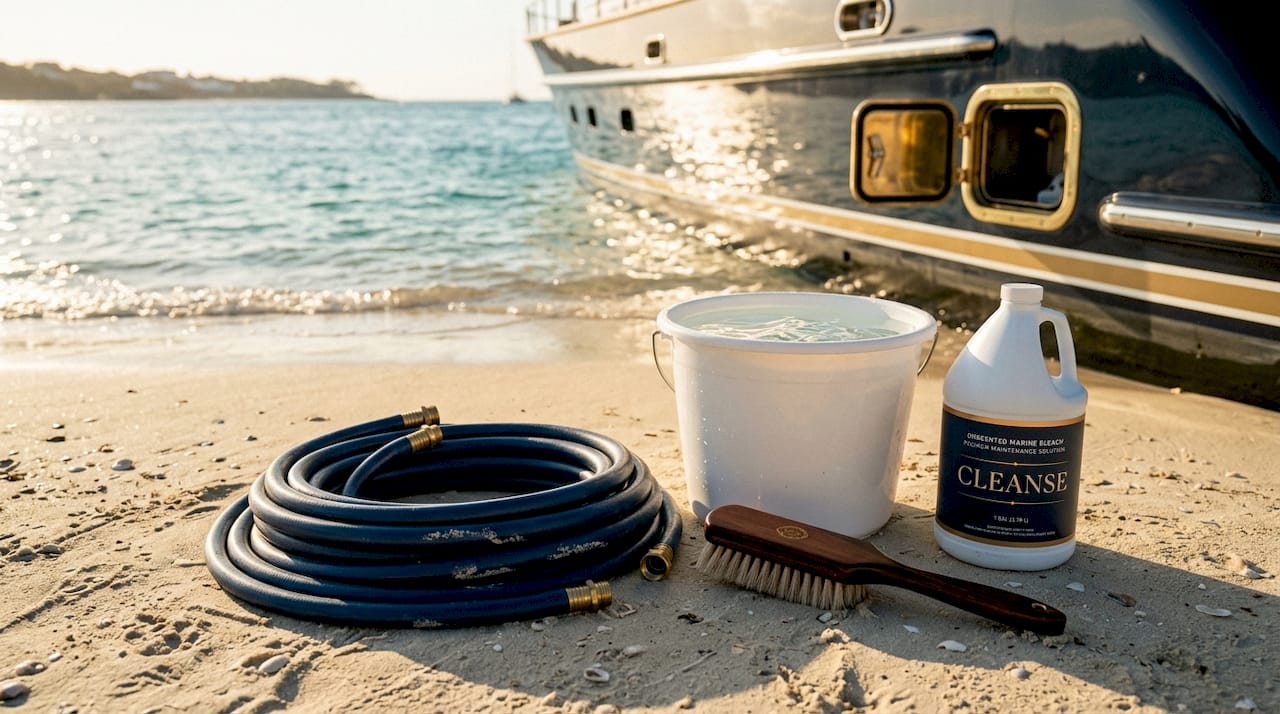
Seasonal variation matters more than most owners realize. A tank that sits partially full through a Florida summer is a petri dish. Warm, stagnant water accelerates biological growth at a rate that a single annual cleaning cannot address. Adjust your schedule to the climate, not the calendar.
Signs that you need to act sooner than scheduled:
- Sulfur or musty odor from any tap below deck
- Cloudy or slightly yellow water
- Visible slime or biofilm at inspection ports
- Unusual taste that carbon filtration alone doesn’t resolve
- Any period of layup where the tank sat partially full in warm conditions
Pro Tip: Mark your sanitizing dates on the same calendar you use for engine service intervals. Treating tank maintenance as a mechanical task, not a housekeeping chore, is what separates disciplined owners from reactive ones.
What is the step-by-step process for cleaning and sanitizing yacht water tanks?
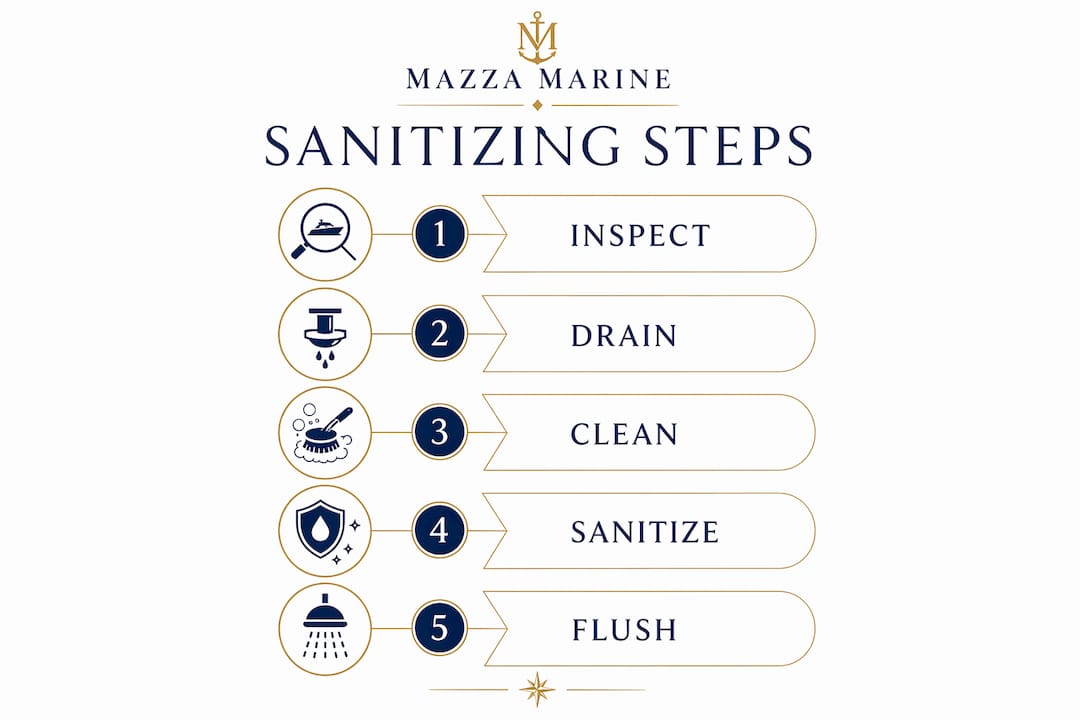
A thorough cleaning of your freshwater tanks follows a clear sequence. Skipping steps, particularly the full drain and the final rinse verification, is where most DIY attempts fall short.
Step-by-step sanitizing procedure
- Drain completely. Fully drain the system before applying any sanitizing solution. Residual water dilutes your treatment and leaves contaminated pockets untouched.
- Flush with fresh water. Run clean water through the tank and all lines to remove loose sediment and debris before introducing any chemical agent.
- Prepare your sanitizing solution. For household unscented bleach (sodium hypochlorite), the correct dosage targets 2 mg/L for clear water with a 30-minute contact time, or 4 mg/L for turbid water requiring approximately 60 minutes. Calculate your tank volume in liters before mixing.
- Circulate through all lines. Fill the tank with the solution, then open every tap below deck, including the galley, head, and shower, until you smell chlorine at each outlet. This confirms the sanitizing agent has reached every section of the plumbing system.
- Hold for contact time. Close all taps and let the solution sit for the full contact period. Do not rush this step.
- Verify with the smell test. A faint chlorine smell at the end of contact time confirms residual disinfectant is present. If you detect no smell, repeat the dosing and extend contact by 15 minutes.
- Drain and rinse thoroughly. Drain the tank completely, then refill with fresh water and flush all lines again. Repeat until no chlorine odor remains at any tap.
For deep cleaning after extended layup or heavy contamination, a commercial product like Yachticon Water Tank Super Cleaner offers a sodium percarbonate formula. Yachticon’s dosing is 75 g per 50 liters of tank capacity, with a 24-hour contact time to clean tanks, hoses, pipes, and pumps simultaneously.
Pro Tip: Never use scented bleach or bleach with added surfactants. These leave residues that are difficult to rinse out and can affect water taste for weeks.
Key material and safety considerations at a glance:
| Factor | Guidance |
|---|---|
| Bleach concentration | Use unscented sodium hypochlorite; avoid gel or scented variants |
| Contact time (clear water) | 30 minutes at 2 mg/L |
| Contact time (turbid water) | 60 minutes at 4 mg/L |
| Commercial alternative | Yachticon sodium percarbonate at 75 g per 50 L, 24-hour soak |
| Rinse verification | No chlorine smell at any tap confirms complete flush |
What filtration methods enhance yacht water tank cleanliness?
Filtration and sanitization are not interchangeable. They serve different functions, and a well-maintained freshwater system uses both in a staged arrangement. Staged filtration means pre-tank filtration at the fill point to reduce incoming sediment and impurities, combined with post-tank filtration on each delivery line to improve taste and catch residual microbial risk.
Pre-tank filters are often overlooked. When you take on water at a marina, you have no control over what’s in that hose or dock supply. A sediment pre-filter at the fill point removes particulate matter before it enters your tank, which reduces the frequency and intensity of deep cleans required downstream.
Post-tank filtration on delivery lines is where 0.5 micron carbon block filters earn their place. These filters remove chlorine taste, fine sediment, and many organic compounds before water reaches the tap. They are not a substitute for tank disinfection, but they are the final quality layer that makes onboard water genuinely pleasant to drink.
The most common mistake owners make is relying on carbon taste filters as their primary hygiene strategy. Carbon filters improve taste but cannot disinfect a contaminated tank, and an unmaintained carbon filter can itself become a site of bacterial growth. Replace carbon block filters every three to six months depending on usage.
Filtration maintenance checklist:
- Inspect pre-tank sediment filters monthly; replace when flow rate drops noticeably
- Replace 0.5 micron carbon block post-tank filters every 3 to 6 months
- Never bypass pre-tank filtration when taking on water from unknown sources
- Log filter replacement dates alongside tank sanitizing records
How to inspect and maintain related components for a healthy water system
The chemistry of sanitization only works if the plumbing system holding that water is sound. Plumbing integrity, meaning tight seals, clear vents, and undamaged hoses, is as critical as any cleaning agent you apply. A cracked fill cap O-ring or a partially blocked vent line can reintroduce contamination within days of a perfect sanitizing job.
Your monthly inspection should cover these components systematically. Think of it as a walk-through with purpose, not a casual glance. Check the fill cap and its O-ring seal for compression and wear. A loose or degraded O-ring allows deck wash, rain, or marina water to enter the tank between fills. Inspect vent lines for blockages from insects, debris, or collapsed hose. A blocked vent creates pressure differentials that stress tank walls and fittings.
Hose condition matters more than most owners acknowledge. Stiff, cracked, or discolored hoses are not just cosmetic problems. They harbor biofilm in micro-fractures and can leach compounds into your water supply. Check hose clamps for corrosion and confirm they are snug. For a deeper look at yacht plumbing components, including thru-hulls and bilge connections, a professional inspection adds a layer of confidence that DIY checks alone cannot match.
Pro Tip: Carry a small flashlight and a spare O-ring kit for your fill cap on every passage. A five-dollar O-ring replaced at the dock prevents a contaminated tank three days offshore.
Pump checks complete the monthly routine. Run the pressure pump and listen for abnormal noise, cycling without demand, or visible moisture at fittings. A pump that short-cycles often signals a waterlogged accumulator tank or a slow leak in the system, both of which affect water quality and system reliability.
What common issues arise during yacht water tank maintenance?
Even disciplined owners encounter problems. Knowing what you’re looking at, and what caused it, gets you back to clean water faster.
Odors and biofilm are the most frequent complaints. A sulfur smell usually points to anaerobic bacteria thriving in stagnant water. Biofilm visible at inspection ports means the tank needs a full drain, scrub, and sanitizing cycle, not just a flush. Tanks left partially full during warm layup periods develop biological growth rapidly. The fix is always the same: drain completely, treat, and flush.
Cloudy water after filling typically indicates sediment from the source, not a tank problem. Install or check your pre-tank filter first. If cloudiness persists after filtration, the issue may be biofilm breaking loose from tank walls, which requires a full cleaning cycle.
Pressure issues and leaks often trace back to hose clamps, pump fittings, or accumulator tanks. A smarter approach to yacht maintenance treats the water system as an integrated whole, not a collection of isolated parts.
Winterization and layup deserve special attention. Never leave a tank partially full going into storage. Drain completely, treat with a light sanitizing solution, then drain again before closing up the vessel. This single habit prevents the majority of biofilm problems that owners discover at the start of the next season.
Proper vessel sanitation involves managing temperature, disinfectant residuals, and circulation together. Measuring chlorine alone is not enough to confirm a safe system.
Key takeaways
Consistent, scheduled yacht water tank maintenance combining regular sanitizing, staged filtration, and monthly plumbing inspections is the only reliable way to guarantee clean, safe freshwater onboard.
| Point | Details |
|---|---|
| Sanitize at least twice per season | Increase frequency in warm climates like Florida to prevent bacteria and algae. |
| Drain fully before every treatment | Residual water dilutes sanitizing solutions and leaves contaminated pockets untreated. |
| Use staged filtration | Pre-tank sediment filters plus 0.5 micron carbon block post-tank filters work together for best results. |
| Inspect plumbing components monthly | Check O-rings, vent lines, hose clamps, and pump operation alongside tank chemistry. |
| Never rely on taste filters alone | Carbon filters improve flavor but cannot disinfect a tank or replace scheduled sanitizing. |
What I’ve learned from years of watching owners get this wrong
Here’s the honest truth about yacht freshwater tank care: most owners treat it like a problem to solve once, not a system to maintain continuously. I’ve seen beautifully maintained hulls with engines in perfect condition and water tanks that looked like something from a biology lab. The tank is invisible, so it gets ignored until someone gets sick or the smell becomes impossible to deny.
The piece of advice I give most often is this: your water system is only as clean as its weakest component. You can sanitize your tank perfectly and still end up with contaminated water if a cracked fill cap O-ring is letting in deck wash, or if a carbon filter that hasn’t been changed in two years is now growing bacteria rather than removing it. Freshwater system maintenance is a whole-system discipline, not a single task.
I also push back on the idea that more bleach equals more safety. Over-chlorination leaves residues that are genuinely unpleasant and can damage rubber seals over time. The correct dosage and contact time, verified with the smell test, is more effective than doubling the bleach and hoping for the best. Precision beats aggression every time in marine water systems.
The owners who never have water problems are not the ones with the most expensive equipment. They’re the ones who treat their tank schedule the same way they treat their engine hours log. Disciplined, documented, and done on time.
— Jason
Professional yacht water system care with Mazzamarine
Keeping your freshwater system in top condition takes more than a bottle of bleach and good intentions. For Florida yacht owners who want the confidence of a professionally inspected and serviced water system, Mazzamarine brings the expertise to handle every aspect of onboard plumbing, from tank cleaning and hose replacement to full system inspections. Mino and Luigi’s team has built a network of Florida’s best marine specialists, and they treat every vessel with the same care they’d give their own. Whether you’re seeing the signs you need yacht repairs or simply want a thorough seasonal service, Mazzamarine is your one-stop shop for marine mechanical systems and freshwater care done right.
FAQ
How often should I sanitize my yacht’s freshwater tank?
Sanitize at least twice per boating season as a baseline, with monthly treatment recommended in warm climates like Florida where bacteria and algae grow faster.
What bleach concentration is safe for yacht water tank disinfection?
Target 2 mg/L of chlorine for clear water with a 30-minute contact time, or 4 mg/L for turbid water requiring 60 minutes. Always use unscented sodium hypochlorite bleach.
Can carbon filters replace tank sanitizing?
No. Carbon block filters improve taste and remove some contaminants, but they cannot disinfect a contaminated tank. Unmaintained carbon filters can also become a source of bacterial growth themselves.
What causes odors in yacht freshwater tanks?
Sulfur or musty odors typically indicate anaerobic bacteria or biofilm growth, often caused by water left stagnant in warm conditions. A full drain, scrub, and sanitizing cycle is required to resolve the problem.
How do I know if my tank sanitization worked?
A faint chlorine smell at every tap at the end of the contact period confirms residual disinfectant is present. If no smell is detected, repeat the dosing and extend contact time by 15 minutes before rinsing.
Recommended
Text or Call 954-330-9653 Schedule Appointment
Mazza Marine Yacht Services & Refit

Fiberglass Upgrades and Damage Repair

Premium Yacht Paint/ Faux Teak

Fishing: Custom Rods, Reels,Tackle

Electrical, Electronics and Navigation

Paint, Hull and Gelcoat

Teak Decks, Wood Cabinets, Carpentry

Canvas, Enclosures and Upholstery

Mechanical, Repower and Running Gear

Plumbing, Bilge and Thru-Hulls

Welding and Custom Fabrication

Interior Refit And Past Work
Get your yacht value Estimate
"*" indicates required fields