
View Our Recent Work:

Overview — When a yacht window shows structural cracks, persistent leaks, or deep crazing that no reseal can fix, replacement is the right call. Your immediate next step: arrange an on-board inspection and request a written, itemized quote from a certified Florida marine-glass refit shop. ISO 11336-1 sets the governing standard for glazed openings on large yachts (LOA over 24 m), covering strength, weathertightness, and watertightness criteria. For smaller vessels, the same principles apply as best practice. A single porthole reseal typically runs a few hundred dollars; a full deckhouse laminated-glass replacement can reach several thousand, depending on fabrication complexity and whether a haul-out is required. Getting the scope in writing before any work starts is the single most protective thing you can do.
Table of Contents
- When should you replace a yacht window instead of repairing it?
- How to replace yacht windows: the professional shop workflow
- What glazing materials and frame options should you specify?
- What does yacht window replacement cost in Florida?
- How do you vet a Florida marine-glass or refit provider?
- What watertightness tests and warranties should you demand?
- Is DIY yacht window replacement realistic?
- How to prepare your yacht before the shop arrives
- Key Takeaways
- The detail most Florida owners miss until it’s too late
- Mazzamarine’s turnkey window replacement services
- Authoritative references and further reading
When should you replace a yacht window instead of repairing it?
Not every failing window needs full replacement. The decision comes down to structural integrity and whether a reseal can actually hold.
Replace when you see:
- Cracks running through the glazing, even hairline ones in laminated plates
- Crazing or deep UV haze that compromises optical clarity and structural integrity
- Delamination between glass plies or between glazing and frame
- Repeated leaks that return within one season of resealing
- Frame corrosion that has compromised the fixing system or backing structure
- Permanent condensation trapped between laminate layers
- Fastener holes that have elongated or corroded through
Repair or reseal when:
- Fasteners are simply loose and the frame is sound
- Bedding compound has dried out but the glazing itself is intact
- A chipped edge shows no crack propagation into the pane
ISO 11336-1 scope focuses specifically on glazed openings above the deepest waterline — the ones whose failure could allow water ingress and threaten vessel integrity. That framing matters practically: a porthole two feet above the waterline on a Category A ocean-going yacht carries a very different risk profile than a decorative cabin light. Strength requirements can be confirmed by calculation or by the hydrostatic test procedure in Annex A, which gives you a clear pass/fail benchmark rather than a judgment call.
Pro Tip: Before calling any shop, photograph every window showing failure signs, measure the unsupported glazing span, and record any serial or part numbers stamped on the frame. That information cuts the inspection time in half and gets you to a written quote faster.
How to replace yacht windows: the professional shop workflow
Understanding what a qualified shop actually does helps you monitor quality and catch shortcuts early.
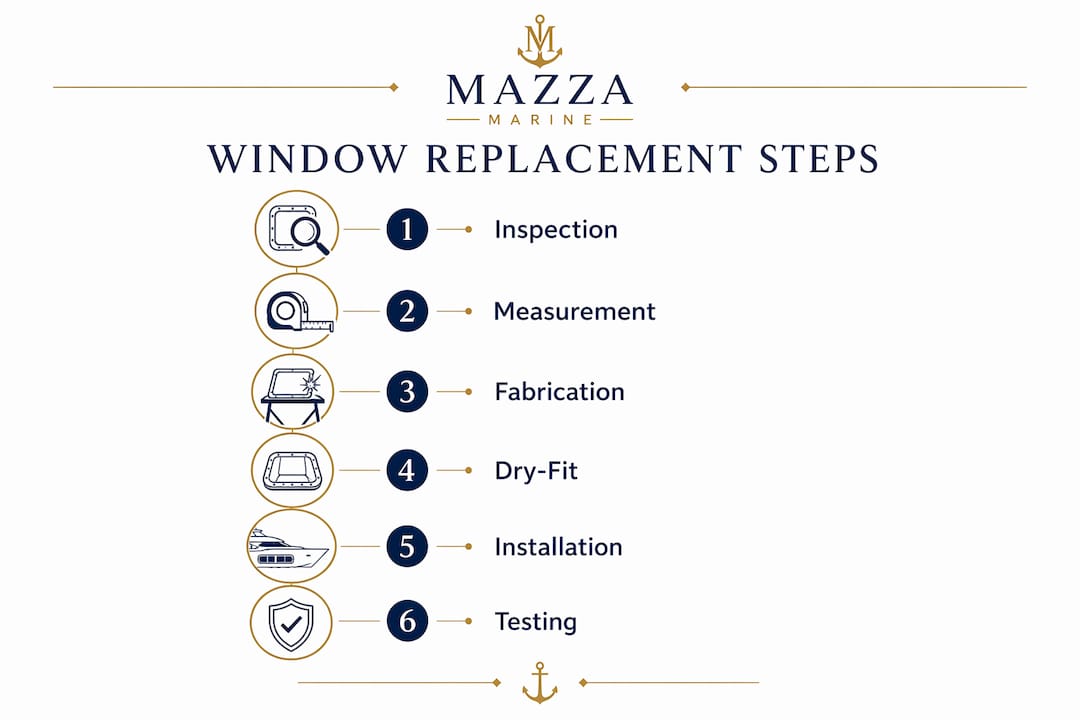
- Inspection and documentation. The shop records glazing dimensions, unsupported span, frame condition, and fixing system integrity. Photos are taken before anything is touched.
- Removal. Glazing is scored, fasteners are backed out in sequence, and the pane is supported from both sides during extraction. Interior liners, headliners, and adjacent systems are masked and protected before removal begins.
- Template and measurement verification. Physical or digital templates are made from the opening, not from the old pane. This step is where accuracy is won or lost; a 2 mm error in a laminated plate means a remake.
- Fabrication and ordering. Custom laminated glass typically carries a 3–6 week lead time from a certified fabricator. Acrylic and polycarbonate panels can often be cut and finished in under a week. The shop specifies ply schedule, edge lamination, and any toughening treatment at this stage, with full construction documentation accompanying the order.
- Dry-fit and edge prep. The new pane is test-fitted before any sealant is applied. Corroded surrounds are cleaned, primed, or replaced. Backing strips and packing are renewed.
- Sealing and fastening. Marine-grade bedding compound is applied, fasteners are torqued in a cross-sequence, and isolation washers are used wherever stainless steel meets aluminum to prevent galvanic corrosion.
- Testing and verification. A hydrostatic or pressure test confirms watertightness. The shop documents results with photos and a written report. A sea trial follows for any structural opening.
Pro Tip: Ask the shop to photograph every stage, especially the dry-fit and the torqued fastener sequence. Those photos are your warranty evidence if a leak appears six months later.
For larger refit projects, coordinating multiple upgrades during a haul-out saves significant yard time and cost.
What glazing materials and frame options should you specify?
Material choice shapes performance, longevity, and compliance. Here is how the main options stack up.
| Material | Strength | Scratch Resistance | Optical Clarity | Weight | Best Use |
|---|---|---|---|---|---|
| Laminated glass (multi-ply) | Excellent | Excellent | Excellent | Heavy | Deckhouse, pilothouse, exposed openings |
| Toughened/tempered glass | Very good | Good | Excellent | Moderate | Superstructure, cabin sides |
| Monolithic plate glass | Moderate | Good | Excellent | Moderate | Protected interior openings |
| Acrylic (Plexiglas) | Good | Poor | Very good | Light | Portlights, hatches, budget refits |
| Polycarbonate | Very good | Poor | Good | Very light | High-impact areas, safety glazing |
For exposed positions on large yachts, laminated multi-ply glazing is the specification to request. ISO guidance allows an exemption from stormshutters when laminated construction meets 1.3× the required equivalent thickness or passes the 4× design pressure hydrostatic test. In practical terms, specifying laminated plates upfront eliminates the need for deadlights and reduces lifecycle risk.
Frame and gasket considerations:
- Aluminum frames are standard; specify marine-grade alloy with anodized or powder-coated finish
- Stainless steel trims add corrosion resistance but require isolation from aluminum to prevent galvanic attack
- Bonded (structural adhesive) installations eliminate mechanical fasteners but demand precise surface prep
- EPDM or neoprene gaskets outlast silicone in UV-exposed positions
When innovative materials or non-standard thicknesses are used, physical hydrostatic testing is the accepted path to prove compliance when calculation methods are too conservative.
What does yacht window replacement cost in Florida?
Costs vary widely by opening size, material, and whether the vessel needs to come out of the water.
| Scenario | Fabrication | Labor | Haul-Out | Approximate Total |
|---|---|---|---|---|
| Small porthole (acrylic, in-water) | a few hundred dollars | a few hundred dollars | None | a few hundred dollars |
| Medium deckhouse pane (tempered glass) | several thousand dollars | several thousand dollars | Optional | several thousand dollars |
| Large laminated pilothouse plate | several thousand dollars | $800–$2,500 or more | Often required | several thousand dollars |
Haul-out adds $800–$2,500 or more depending on the Florida yard and vessel size. Custom laminated fabrication lead times of 3–6 weeks are common, so schedule well ahead of hurricane season. Florida yards fill up fast between May and June.
Factors that push costs higher:
- Corroded frames requiring fabrication or replacement
- Bonded installations needing adhesive cure time
- Multiple openings tackled simultaneously (which actually reduces per-unit labor cost)
- Expedited fabrication requests
Pro Tip: Always request an itemized quote that separates fabrication, labor, haul-out, sealants, and testing. Ask for a written change-order policy before signing. A shop that resists itemizing is a shop to avoid.
How do you vet a Florida marine-glass or refit provider?
The right shop makes the difference between a watertight result and a warranty dispute. Here is what to verify before signing anything.
Documentation to request upfront:
- Proof of general liability insurance and marine contractor coverage
- Fabricator certifications and sample test reports from prior jobs
- References from comparable yacht owners in Florida
- Before/after photo portfolios from recent window replacement work
Questions to ask in writing:
- What testing procedure do you use, and can you provide the test report?
- Is your test lab or fabricator accredited to ISO 17025?
- What is your warranty on installation and on the glazing itself?
- How do you handle change orders and scope additions?
- What is the estimated completion date, and what happens if it slips?
Red flags:
- Verbal-only quotes with no written scope
- Refusal to share test results or fabrication specs
- No written warranty on installation
- Vague timelines with no milestone structure
A solid contract includes an itemized scope, a payment schedule tied to completion milestones, warranty duration and coverage terms, a hold-harmless clause for adjacent systems disturbed during the job, and sea-trial acceptance criteria. For a broader view of what a full refit contract should cover, the yacht fixture replacement workflow guide is worth reviewing.
What watertightness tests and warranties should you demand?
Testing is not optional on structural glazing. Here is the minimum you should require.
Tests to request:
- Hydrostatic pressure test per ISO Annex A on the complete assembly including fixing system
- Visual leak inspection at design pressure
- Bolted-fastener torque verification with a calibrated wrench
- Sea trial with visual inspection of all reinstalled openings
The ISO Annex A procedure requires test chamber pressure to be raised to design load pressure and maintained for 300 seconds. Acceptance criteria include no collapse at 4× design pressure for structural acceptance and no water ingress at design pressure for watertightness.
Warranty checklist:
- Glazing fabrication warranty (typically 2–5 years from the fabricator)
- Installation workmanship warranty (minimum 1 year, ideally 2)
- Sealant/bedding warranty from the compound manufacturer
- Clear process for reporting post-installation leaks
Laboratory accreditation to ISO 17025 is a practical proxy for test reliability. Request the lab certificate or a third-party validation letter when the acceptance decision hinges on a test report.
Is DIY yacht window replacement realistic?
For most Florida yacht owners, the honest answer is: partially. Some tasks are manageable; others carry real risk if done without specialist experience.
Tasks experienced owner-operators can handle:
- Removing interior trim panels and headliner sections to expose the frame
- Photographing and measuring existing glazing for the shop’s records
- Resealing small portlights with intact frames using marine-grade polysulfide or polyurethane
- Cleaning and priming frame surfaces between professional visits
Tasks that belong to professionals:
- Structural glazing replacement on any opening above the waterline
- Fabrication of laminated or toughened plates
- Hydrostatic testing and documentation
- Frame repairs involving welding, bonding, or structural adhesive
Pro Tip: If you do reseal a portlight yourself, use a polysulfide or polyurethane compound rated for marine immersion service. Silicone is not compatible with most topcoat paints and will need to be removed entirely before any professional rebedding.
For insurance and resale purposes, document every step with dated photos and keep all receipts. Many insurers expect professional installation on structural openings; a DIY job without documentation can complicate a claim.
How to prepare your yacht before the shop arrives
A little owner preparation goes a long way toward keeping the job on schedule and on budget.
Owner checklist:
- Remove fragile items, electronics, and artwork within 3 feet of every work area
- Back up navigation and electrical systems before any interior panels are opened
- Confirm your yard’s haul-out requirements and schedule the lift well in advance
- Notify your insurer that structural glazing work is planned and confirm coverage
- Clear access routes to each window from both inside and outside the vessel
Logistics to confirm:
- Haul-out vs. afloat: discuss with the shop which openings genuinely require the vessel out of the water
- Arrange temporary weatherproof covers for any openings that will be open overnight
- Confirm crew or tender availability if the vessel needs to move during the job
Pro Tip: Create a single folder, physical or digital, containing your insurance policy, yard contract, window measurements, fabrication specs, and all inspection photos. Hand a copy to the refit team on day one. It eliminates the “we didn’t know about that” conversation mid-job.
Protecting your interior during the work is worth thinking through carefully; interior yacht materials guidance can help you decide what needs covering or temporary removal.
Key Takeaways
Replacing yacht windows correctly requires a standards-backed inspection, certified fabrication, documented testing, and a written warranty before you sign off on the job.
| Point | Details |
|---|---|
| Replace, don’t reseal, structural failures | Cracks, delamination, and repeated leaks after resealing all warrant full replacement. |
| ISO 11336-1 sets the benchmark | Request fabrication specs and hydrostatic test reports that reference this standard for any large-yacht opening. |
| Laminated glass reduces lifecycle risk | Multi-ply laminated plates can eliminate the need for stormshutters and prove compliance via 4× design pressure testing. |
| Get itemized quotes and written warranties | Separate fabrication, labor, haul-out, and testing costs; insist on a minimum 1-year installation warranty. |
| Mazzamarine handles the full scope | From inspection and fabrication coordination to testing and warranty management, Mazzamarine connects Florida owners with vetted marine-glass refit specialists. |
The detail most Florida owners miss until it’s too late
Salt air and Florida’s UV intensity are a combination that ages yacht glazing faster than almost anywhere else in the US. What surprises most owners is not the cracking or the leaks — those are visible. It’s the frame corrosion hiding behind the gasket line. By the time a window starts leaking repeatedly, the aluminum surround has often corroded to the point where a reseal is just buying time.
The shops that do this work well treat the frame as part of the glazing system, not a separate problem. They pull the gasket, inspect the full perimeter, and document what they find before quoting. The ones that skip that step are the ones whose jobs come back six months later.
Florida owners planning window work should also think about timing. Scheduling fabrication in February or March means the job lands before the summer haul-out rush, and you’re not competing with half of Miami for yard space in May. UV-stable sealants matter here too — standard silicone degrades visibly within two Florida summers. Polysulfide or polyurethane compounds rated for tropical UV exposure are worth the small premium.
Mazzamarine’s network of Florida refit specialists approaches glazing work exactly this way: frame inspection first, fabrication spec second, test documentation before final sign-off.
Mazzamarine’s turnkey window replacement services
When the inspection reveals that replacement is the right call, the last thing you want is to coordinate three separate vendors — a fabricator, a yard, and an installer — while your vessel sits on the hard.

Mazzamarine connects Florida yacht owners with vetted marine-glass specialists who handle the entire scope: on-board inspection, fabrication coordination with certified shops, haul-out management, installation, pressure testing, and warranty documentation. For general insights into boating and tours that complement your yachting experience, consider exploring Boat Tours. The network covers Miami and the broader Florida coast, with relationships at the fabricators and yards that matter. Before-and-after photo documentation and written inspection reports come standard, giving you the paper trail your insurer and future buyer will want to see.
If you’ve noticed leaks, haze, or frame corrosion and want a professional assessment, start with Mazzamarine’s Florida yacht repair guide to understand what the inspection should cover, then reach out for an itemized quote tied to your vessel’s specific openings.
Authoritative references and further reading
- ISO 11336-1:2012 standard summary (Intertek Inform) — defines strength, weathertightness, and watertightness criteria for glazed openings on large yachts; the governing standard for any serious replacement project.
- ISO technical scope and test procedures (NMMA) — full Annex A hydrostatic test procedure, acceptance criteria, and documentation requirements; share this with your shop before signing a contract.
- Yacht glass enclosures: upgrade comfort and safety — Mazzamarine’s overview of marine glass installation standards and enclosure upgrade options for Florida owners.
- Custom glass enclosures for Florida yacht owners — detailed fabrication and enclosure choices for owners considering larger structural refits.
- Marine repair service guide — Mazzamarine’s service overview covering inspection, repair, and refit booking for Florida vessels.
Recommended
Text or Call 954-330-9653 Schedule Appointment
Mazza Marine Yacht Services & Refit

Fiberglass Upgrades and Damage Repair

Premium Yacht Paint/ Faux Teak

Fishing: Custom Rods, Reels,Tackle

Electrical, Electronics and Navigation

Paint, Hull and Gelcoat

Teak Decks, Wood Cabinets, Carpentry

Canvas, Enclosures and Upholstery

Mechanical, Repower and Running Gear

Plumbing, Bilge and Thru-Hulls

Welding and Custom Fabrication

Interior Refit And Past Work
Get your yacht value Estimate
"*" indicates required fields