
View Our Recent Work:

In a major hurricane, most boats left afloat in the direct impact zone face a real chance of total loss, and it’s storm surge, not wind, doing most of the killing. The single highest-impact move you can make is hauling out or relocating inland before the watch becomes a warning. If your boat stays in the water, brace for the worst news to come later: submerged engines, corroded wiring, and electronics that never work right again.
TL;DR:
- Boats submerged for several days after a hurricane face severe damage, including hull delamination, stringer separation, and long-term corrosion of electrical systems.
- The likelihood of repair depends on the extent of submersion, structural damage, and whether engines and wiring were reached by saltwater, with deep, prolonged flooding often leading to total loss.
- Buyers should scrutinize full repair histories, look for mismatched gelcoat or interior paint, and verify documentation on hull integrity and wiring to avoid hidden storm damage.
- Insurance payouts favor agreed-value policies and documented pre-storm precautions, making early haul-out and thorough records crucial to recover damages fully.
- Early removal from the water before storm warnings drastically reduces damage risk, and professional storm recovery plans prioritize urgent repairs and in-house trades for efficient restoration.
Table of Contents
- What Actually Causes Hurricane Boat Damage?
- How Do You Know If Storm Damage Is Repairable?
- What Should Buyers Check Before Buying a Storm-Damaged Boat?
- How Does Insurance Handle Hurricane Boat Damage?
- What’s the Best Way to Prepare a Boat for a Hurricane?
- What Does a Professional Storm Recovery Actually Look Like?
- What I’d Tell Any Boat Owner Facing a Hurricane
- Getting Your Boat Assessed and Repaired After a Storm
- Sources
- FAQ
What Actually Causes Hurricane Boat Damage?
Wind gets the headlines, but storm surge is the mechanism that does the real damage. A marina that feels sheltered on a calm day can turn into open water once surge rises ten or fifteen feet, lifting floating docks clean off their pilings and letting boats swing into pilings, seawalls, and each other. That’s not a rare freak event. It’s the standard pattern in a Category 3-plus storm, and even well-built marinas with strong docks see serious losses when the water itself becomes the hazard.
Once a boat takes on water, the damage cascades in a fairly predictable order:
- Hull strikes from collisions with docks, other vessels, or seawalls, often below the waterline where you can’t see them from a dock walk.
- Delamination in fiberglass decks and hulls, where trapped moisture separates the outer skin from the coring.
- Stringer and bulkhead separation, which weakens the structural skeleton holding the hull’s shape under load.
- Progressive corrosion that starts the moment saltwater touches wiring, connectors, and engine components, and keeps working long after the storm passes.
Here’s the part most owners underestimate: time in the water matters almost as much as depth. A boat pumped out within hours has a real shot at recovery. A boat sitting submerged for three or four days is fighting a losing battle against salt intrusion in fuel tanks, electrical harnesses, and engine internals. BoatUS estimated that after Hurricanes Harvey and Irma, a very large number of recreational boats were damaged or destroyed, with combined losses reaching hundreds of millions of dollars. That figure tells you this isn’t a handful of unlucky owners. It’s a structural risk built into every hurricane season for boats left in the water.
How Do You Know If Storm Damage Is Repairable?
Not every soaked hull is a lost cause, and not every scratched gelcoat is a quick fix. The dividing line usually comes down to three questions: how long was it underwater, what structural members took the hit, and did saltwater reach the engine and wiring.
Red flags that point toward a constructive total loss include prolonged saltwater submersion (measured in days, not hours), crushed or fractured stringers, and any hull breach big enough to let water flood the bilge faster than pumps can clear it. Reporting after Hurricane Ian confirmed that sunken boats commonly suffer system-wide corrosion, with engines, wiring, and fuel tanks often failing well after the water recedes, which can lead to boats being written off after repairs are assessed.
On the more hopeful side, these repairs tend to be feasible even after a rough storm:
- Above-waterline hull patches and fiberglass or gelcoat repairs on cosmetic and moderate structural damage.
- Interior refinishing where water intrusion was limited to surfaces rather than the core.
- Isolated electronics replacement when submersion was brief and localized.
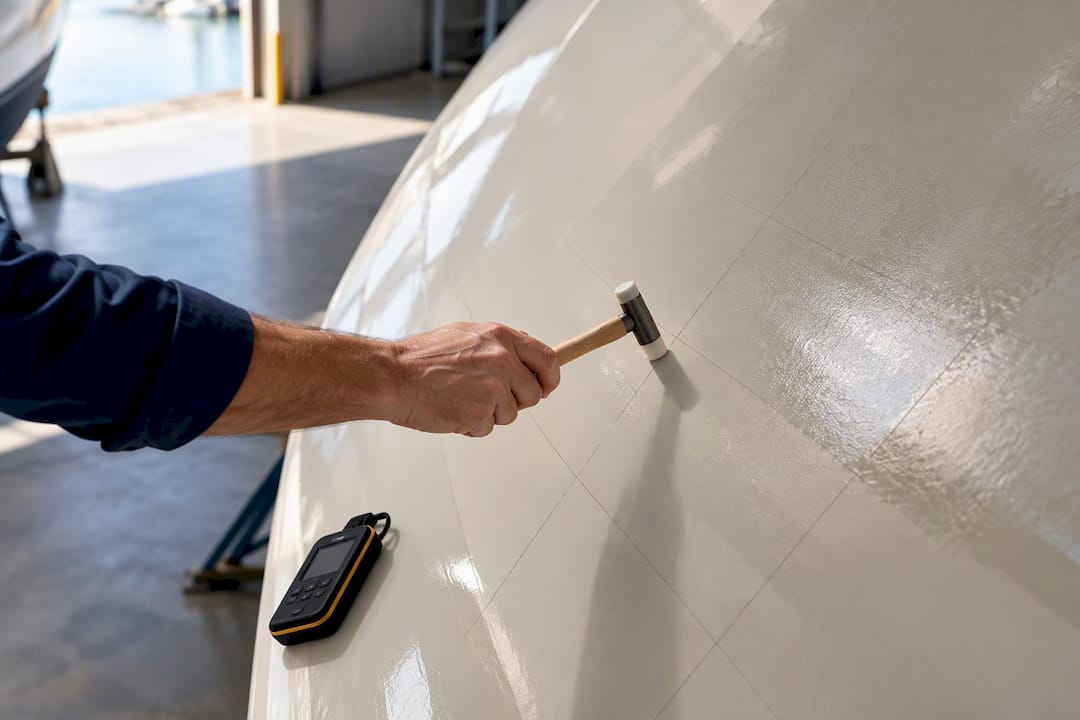
What usually can’t be patched around: full wiring harness replacement, an engine rebuild or swap, and fuel system replacement after any real submersion. A proper marine survey should include electrical corrosion checks, core sounding across the hull and deck, engine diagnostics under load, and a fuel tank inspection, not just a visual walk-around.
Pro Tip: Ask your surveyor to sound the hull in a grid pattern, not just at obvious stress points. Delamination often shows up in spots that look fine from the outside but sound hollow under a tap.
What Should Buyers Check Before Buying a Storm-Damaged Boat?
Post-hurricane markets flood with cheap boats, and a chunk of them come from owners who did the repairs fast and cheap rather than right. If you’re shopping a fixer-upper or a suspiciously well-priced used boat in a hurricane-prone region, work through this before you sign anything:
- Hire a marine surveyor with storm-damage experience specifically, not just a general pre-purchase inspector, and get findings in writing.
- Request the full paper trail: insurance claim history, repair shop invoices, before-and-after photos, and serial numbers matching the engines and electronics onboard.
- Check for mismatched paint or gelcoat, which often signals a patch job rather than a proper structural repair.
- Look for fresh interior paint in odd places, since that’s a classic way to mask a water line that would otherwise give away submersion.
- Trace the wiring for consistency, because a boat rewired in sections by different hands after a storm rarely looks uniform under a panel.
- Confirm through-hull records exist, since missing documentation on thru-hulls and fittings is one of the more common gaps experienced marine surveyors flag on storm-damaged vessels.
- Set aside real budget contingency, because hidden system failures almost always surface after the sale, not before.
How Does Insurance Handle Hurricane Boat Damage?
Your policy type decides how a total loss actually pays out. An agreed value policy pays the pre-set amount you negotiated at purchase, regardless of what the boat is “worth” the week after a hurricane. An actual cash value policy pays current depreciated value, which can leave you badly underinsured relative to what a comparable boat costs to replace in a post-storm market where prices spike. Agreed value matters more than most owners realize until the claim is on the table.
Named-storm haul-out coverage is another detail worth confirming before hurricane season, not during it. Some policies reimburse haul-out and storage costs if you move the boat ahead of a storm, but only if you can document it:
- Save haul-out confirmations and yard receipts with dates and times.
- Take pre-storm photos showing the boat’s final secured configuration, lines, covers, and all.
- Keep any third-party survey reports from before and after the event.
That paper trail is what turns “I did the right thing” into a claim insurers actually honor.
What’s the Best Way to Prepare a Boat for a Hurricane?
Preparation windows close faster than most owners expect, and the boats that come through storms in the best shape are almost always the ones moved early. Survey data going back to Hurricane Andrew found that boats hauled ashore were less likely to suffer serious damage than boats left berthed, and moving early made a measurable difference.
Here’s a practical sequence to follow once a storm enters the picture:
- Haul out early wherever possible. Yards fill up fast, and waiting until a warning is issued often means no slots left.
- Bring trailerable boats home before evacuation traffic clogs the roads. Once evacuation routes fill, towing a boat trailer becomes its own emergency.
- If the boat must stay in the water, upgrade the mooring setup. Use larger-diameter lines, double up spring lines, add chafe protection at every contact point, and tie to the highest available pilings.
- Strip the boat of anything removable. Electronics, cushions, canvas, and loose gear either come home with you or become projectiles.
- Act on the hurricane watch, not the warning. A watch typically means landfall is possible within 48 hours, and that’s your real deadline, not a comfortable buffer.
Pro Tip: Call your marina the moment a watch is issued, not after. Haul-out slots go to whoever asks first, and “I was going to call tomorrow” is a sentence a lot of owners regret every season. Mazzamarine’s own hurricane prep guide for Florida boat owners walks through this timeline in more detail if you want a printable version before the next watch is posted.
What Does a Professional Storm Recovery Actually Look Like?
Mazzamarine built a storm prep workflow for yachts specifically because the same mistakes repeat every season: owners waiting too long, repair shops treating cosmetic and structural damage the same way, and quotes that don’t separate what’s urgent from what can wait.
A credible post-storm assessment and repair plan should include:
- Scope separation up front, with safety-critical and urgent repairs prioritized ahead of cosmetic work.
- In-house trades under one project manager, covering fiberglass, mechanical, electrical, and welding, so repairs don’t stall waiting on a subcontractor’s schedule.
- A written workmanship warranty, not just a verbal assurance.
- Staged payment milestones tied to completed work rather than one lump sum upfront.
That structure is what separates a yard built for storm recovery from one just trying to squeeze in extra jobs during a busy season.
What I’d Tell Any Boat Owner Facing a Hurricane
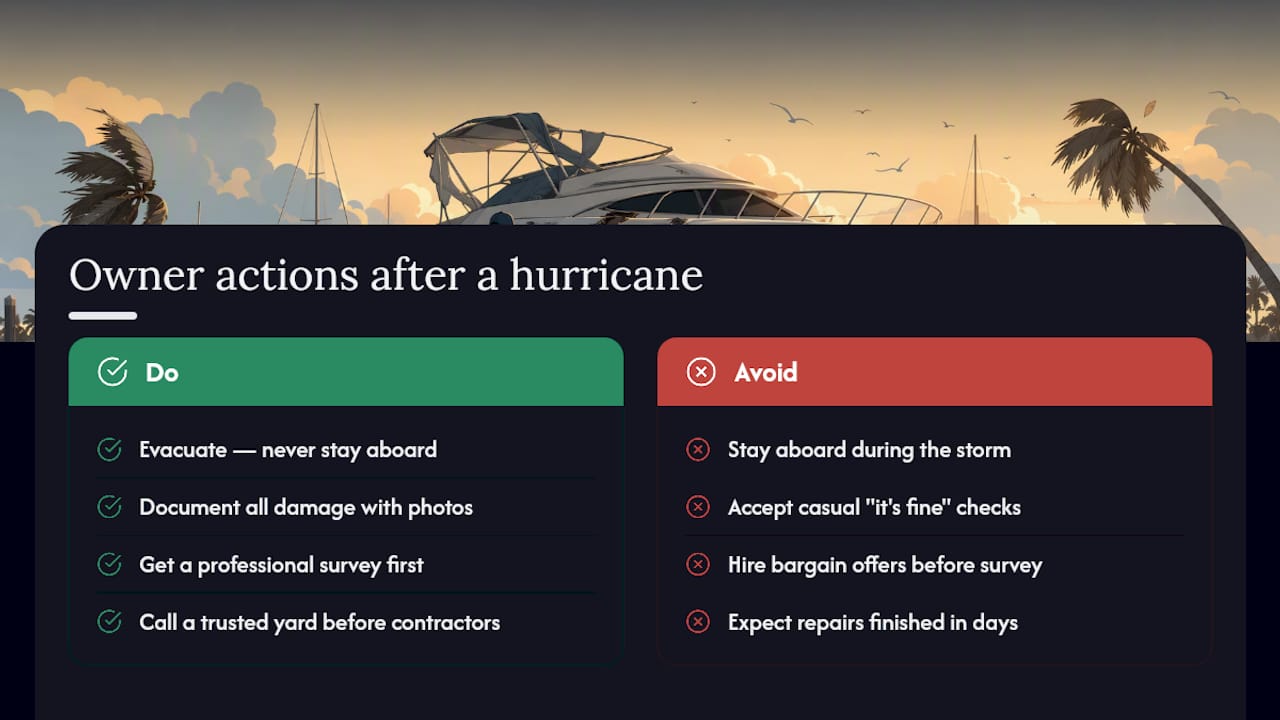
Property can be rebuilt. People can’t. Experienced mariners are near-unanimous on this point: never stay aboard during a hurricane, no matter how attached you are to the boat or how “secure” you think the mooring is. That instinct to protect the boat in person is understandable, and it’s also the single worst decision an owner can make in a landfall event.
Once the storm passes, temper your expectations on timing. Serious hull or system damage rarely gets fixed in days. Realistic repair windows run from several weeks to a few months, and even after recommissioning, don’t be shocked if a corroded connector or a fuel line issue shows up thirty days later that nobody caught during the first inspection. Document everything, get a real survey before you trust any “it’s fine” verdict, and call a yard you trust before you call anyone offering a bargain.
— Jason
Getting Your Boat Assessed and Repaired After a Storm
Other owners spend weeks chasing separate shops for fiberglass work, an electrician, and a mechanic, hoping the schedules line up before the next storm season starts. Some repair yards run those trades in-house under one project manager, which means urgent hull repair, electrical work, and engine diagnostics move on one coordinated timeline instead of three competing ones.

If your boat took a hit, here’s what to have ready before you call: photos of the damage from every angle, your insurance policy details and claim number if one exists, and your surveyor’s contact information if a survey is already scheduled. Mazzamarine covers the full range a storm-damaged boat typically needs: urgent yacht repairs, fiberglass and hull damage repair, mechanical and repower work, electrical and navigation systems, and custom welding and fabrication for structural fixes. Reach out through Mazzamarine to request an inspection, and expect initial triage findings within days of your first call, not weeks.
Sources
For deeper background, see NOAA’s storm surge overview and BoatUS damage estimates from Trade Only Today.
- Storm surge overview — NOAA
- BoatUS estimates boat damage from storms at $655 million – Trade Only Today
- Want to buy a used boat after Ian? What to know about damaged boats | Miami Herald
- NOAA repository: Study on Hurricane Andrew impact on recreational boating (industry survey)
FAQ
Can a Boat Survive a Hurricane?
Yes, but survival depends far more on location than luck. Boats hauled out or moved inland before landfall have much better odds than those left in the water, since storm surge does most of the destructive work rather than wind alone.
What Is the Number One Unspoken Rule on a Boat During a Storm?
Never stay aboard once a hurricane is approaching, no matter how well the boat is secured. Experienced boaters consistently warn against riding out a storm on the water, since no mooring setup guarantees safety once surge and wind peak.
Is There a Hurricane-Damaged Catamaran for Sale?
Storm-damaged catamarans and other boats do enter the market after major hurricanes, often at steep discounts. Any buyer considering one should demand a full survey covering hull cores, wiring, and engines, since post-storm corrosion frequently causes system failures that aren’t visible at a quick showing.
Can a Cruise Ship Survive a Category 5 Hurricane?
Cruise ships are built to far higher structural standards than recreational boats and typically avoid Category 5 storms entirely by rerouting well in advance. Recreational boats don’t have that mobility advantage, which is why early haul-out remains the most effective protection available to owners.
Recommended
Text or Call 954-330-9653 Schedule Appointment
Mazza Marine Yacht Services & Refit

Fiberglass Upgrades and Damage Repair

Premium Yacht Paint/ Faux Teak

Fishing: Custom Rods, Reels,Tackle

Electrical, Electronics and Navigation

Paint, Hull and Gelcoat

Teak Decks, Wood Cabinets, Carpentry

Canvas, Enclosures and Upholstery

Mechanical, Repower and Running Gear

Plumbing, Bilge and Thru-Hulls

Welding and Custom Fabrication

Interior Refit And Past Work
Get your yacht value Estimate
"*" indicates required fields