
View Our Recent Work:

If a marine A/C repair bill is close to the cost of a new unit and your system is older, replacement is generally recommended. Below that line, repair usually wins. But cost alone won’t tell you if a swap will actually fit, so before you order anything, check three things: physical fit and service access, electrical capacity, and seawater plumbing condition. Measure, photograph the nameplate and hose runs, and get a written quote before committing.
TL;DR:
- Proper measurements and inspections of seawater lines and drain paths are crucial to avoid costly retrofit failures and ensure system longevity.
- The new AC unit must physically fit, have adequate electrical capacity, and match seawater plumbing configurations, with clear documentation before purchasing.
- Rated capacity is a guideline; factors like boat modifications, insulation, and sunlight exposure significantly influence the actual cooling load.
- Seawater pump performance and plumbing condition often determine retrofit success more than the compressor size or type.
- Full commissioning, including pressure checks and amp readings, is essential to confirm the upgraded system functions reliably and prevents repeated service calls.
Table of Contents
- Pre-Upgrade Fit Checklist: Measurements, Access, and Drain Routing
- Choosing the Right System Type and Size for Your Boat
- Seawater Circuit and Pump Requirements
- Electrical and Power Considerations You Can’t Skip
- What to Expect: Timeline, Cost, and Common Surprises
- Commissioning Checks That Confirm the Upgrade Actually Worked
- When a Managed Refit Beats a Simple Swap
- Overview: A Note From Jason on What Retrofits Actually Teach You
- How Mazza Marine Handles a Marine AC Upgrade From Start to Finish
- Sources
Pre-Upgrade Fit Checklist: Measurements, Access, and Drain Routing
Most marine AC upgrade regrets trace back to skipped measurements. A 10-point retrofit checklist built for boat systems recommends confirming cooling load, unit envelope, airflow path, seawater circuit, drainage, electrical supply, controls, and service access before a single dollar gets spent on new equipment. That order matters. Sizing means nothing if the new box doesn’t clear the bulkhead or the drain pan can’t reach a low point.
Before you call anyone for a quote, gather this:
- Exact unit dimensions plus 2 to 3 inches of service clearance on the access side, photographed with a tape measure in frame.
- Return-air grille size and filter access, since undersized returns cause chronic underperformance regardless of BTU rating.
- Condensate drain path, checked for any point where the line rises before it falls, which traps air and backs up the pan.
- Seawater hose diameter at the strainer and pump, plus seacock location and whether the strainer is reachable without pulling floorboards.
- Photos of the existing nameplate, breaker panel, and plumbing runs for your contractor file.
Skipping the drain check is the most common miss. A single high point in a condensate line will flood a headliner months after installation, long after anyone remembers the retrofit happened.
Choosing the Right System Type and Size for Your Boat
Self-contained units remain the pragmatic choice for single-zone cabins and smaller sportfish boats. They mount fast and keep plumbing simple. Split systems separate the compressor from the air handler, which cuts cabin noise and works well when you’re adding zones. Chilled-water systems make sense on larger vessels running multiple air handlers off one central plant, trading upfront complexity for quieter, more even cooling across the boat.
Sizing isn’t just BTUs per square foot. Glazing area, insulation quality, galley and engine room heat load, and how many people typically sleep aboard all push the number up or down. Technical selection guidance from Tropical Marine’s spec sheet lays out capacity-selection methods by vessel size and layout, and it’s worth matching your boat against that before assuming the old unit’s rating is correct.
Treat the existing unit’s BTU rating as a reference point, not gospel. If the boat has had cockpit enclosures added, extra glass installed, or a layout change since the original install, an on-boat load check beats guesswork every time. A few things worth weighing:
- Adding a second zone often changes ducting and controls more than it changes total tonnage.
- Inverter-driven compressors run quieter and cycle less, which matters most in sleeping cabins.
- A boat with heavy afternoon sun exposure through large windows needs more capacity than the square footage alone suggests.
For a deeper look at sizing math and layout tradeoffs, our guide to marine air conditioning installation walks through the process in more detail.
Seawater Circuit and Pump Requirements
The refrigeration side of a marine AC upgrade rarely fails first. The seawater side does. Correct sizing prevents short-cycling, but only if the pump can actually deliver enough raw water to the condenser, and installer field reports consistently point to plumbing and pump placement, not the compressor, as the most common retrofit failure point.
Run through this sequence before finalizing scope:
- Confirm seacock condition and whether it opens fully without resistance.
- Trace strainer location and access. A strainer buried behind tankage gets skipped during cleaning, which starves the pump.
- Measure hose inside diameter at the pump inlet and outlet against the new unit’s flow requirement.
- Check pump mounting height relative to the waterline and confirm the overboard discharge routes without a high loop.
- Inspect all fittings for corrosion, especially bronze-to-plastic transitions that trap galvanic activity.
Bronze and reinforced marine hose resist corrosion far better than the mixed-material shortcuts sometimes used in older refits. If the strainer sits somewhere you’d need to remove a panel to reach, that’s a sign to relocate it during the upgrade rather than live with it again for another decade.
Electrical and Power Considerations You Can’t Skip
Verify nameplate voltage, frequency, and amp draw against your existing breaker before assuming a like-for-like swap. A slightly larger compressor can pull enough starting current to trip breakers that handled the old unit fine, and that mismatch shows up during commissioning, not before.
- Soft-start devices like EasyStart cut inrush current dramatically, which often means you can install a bigger unit without upsizing the generator.
- Confirm shore power and generator capacity together if you’re running multiple AC units simultaneously; sequencing controls stagger startup to avoid overload.
- Inverter-driven systems change the math entirely, and manufacturer guidance recommends confirming inverter compatibility and protection before wiring anything permanently.
- 12V and low-voltage designs need their own breaker and wire-gauge check, since they’re rarely a drop-in replacement for AC-powered units.
What to Expect: Timeline, Cost, and Common Surprises
A straightforward single-unit swap can often be completed in a day, but full commissioning, running the system, checking discharge, verifying amp draw, still eats hours even on a simple job. Installer reports note that split-system installs or repowers routinely stretch across multiple days once haul-out or major plumbing changes enter the picture.
Cost drivers worth asking about upfront:
- Seawater plumbing condition, since a compromised strainer or corroded fitting adds labor fast.
- Electrical upgrades, particularly breaker or wire-gauge changes.
- Haul-out requirements if seacock work is needed below the waterline.
- Control system upgrades if you’re adding zones or digital thermostats.
Apply the $5,000 repair-versus-replace heuristic as a starting filter, not a final answer. It’s a useful gut check for aging equipment, but a boat with corroded seawater plumbing might justify replacement even under that threshold. Our breakdown of boat air conditioning repair costs covers common failure points that push the decision one way or the other.
Commissioning Checks That Confirm the Upgrade Actually Worked
A completed install isn’t a successful install until it’s tested. Measure delta-T across the evaporator coil, confirm steady seawater discharge, verify the condensate drains cleanly under load, and record compressor amp draw against the nameplate rating.
- Photograph and log serial numbers, breaker IDs, pump specs, and hose sizes for your maintenance file.
- Confirm anti-short-cycle protection is active. Most controllers enforce a minimum three-minute delay before restart, and EPA guidance on building systems explains why bypassing that delay risks locked-rotor failure.
- Rapid cycling almost always signals a deeper fault, a failing thermostat, a clogged filter, a refrigerant leak, and forcing a restart during that protective window increases the odds of compressor burnout rather than fixing anything.
Pro Tip: If your new unit trips on restart and you’re tempted to cycle the breaker repeatedly, stop. That’s the anti-short-cycle timer doing its job. Wait it out.
Roughly a third of marine AC service calls trace back to skipped commissioning steps from a prior install, not equipment failure.
When a Managed Refit Beats a Simple Swap
Some boats need more than a box replacement. If the new unit changes footprint, requires rerouted seawater lines, or the existing electrical panel can’t absorb the load without rework, you’re no longer doing a swap. You’re doing a refit, and that changes who should be holding the wrench.
Coordinating plumbing, electrical, vibration isolation, and full commissioning under load is where a same-footprint DIY changeout starts to strain. We’ve seen jobs where a homeowner-grade install saved money upfront and cost far more later. They rerouted condensate lines after headliner damage and relocated a strainer after two seasons of inaccessible cleaning.
Pro Tip: Ask any contractor for documented commissioning data, not just a receipt. Serial numbers, amp readings, and photos protect your resale value and your warranty claim if something fails in year two.
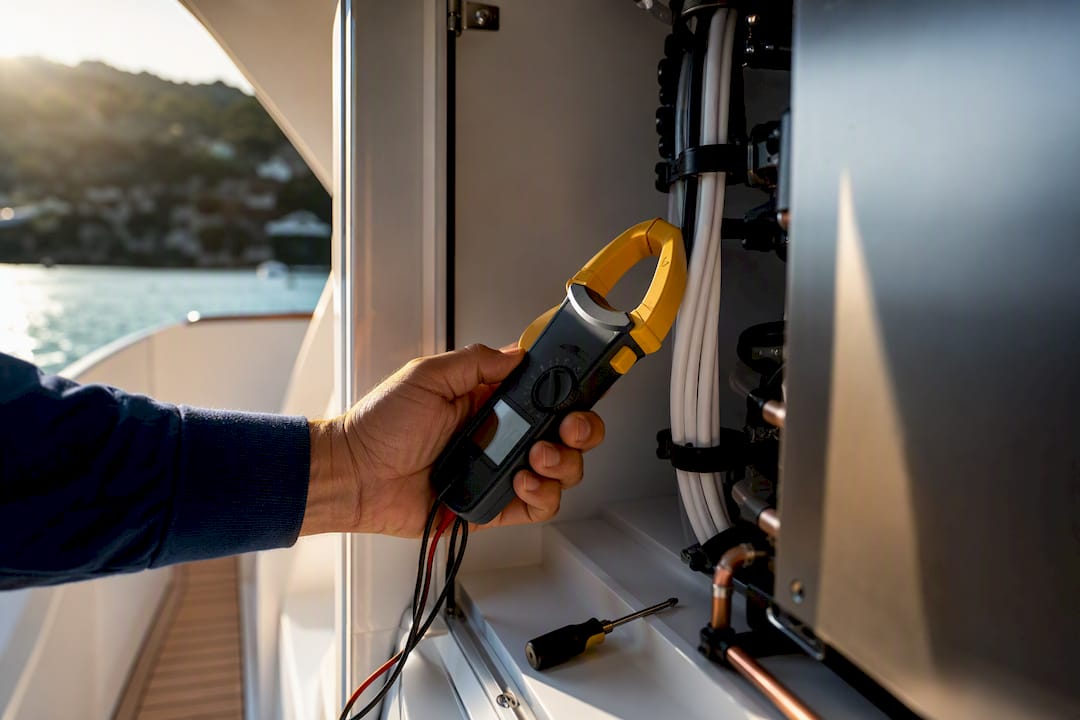
If your boat needs layout changes rather than a straight swap, a coordinated mechanical refit usually costs less overall than sequential DIY fixes.
Overview: A Note From Jason on What Retrofits Actually Teach You
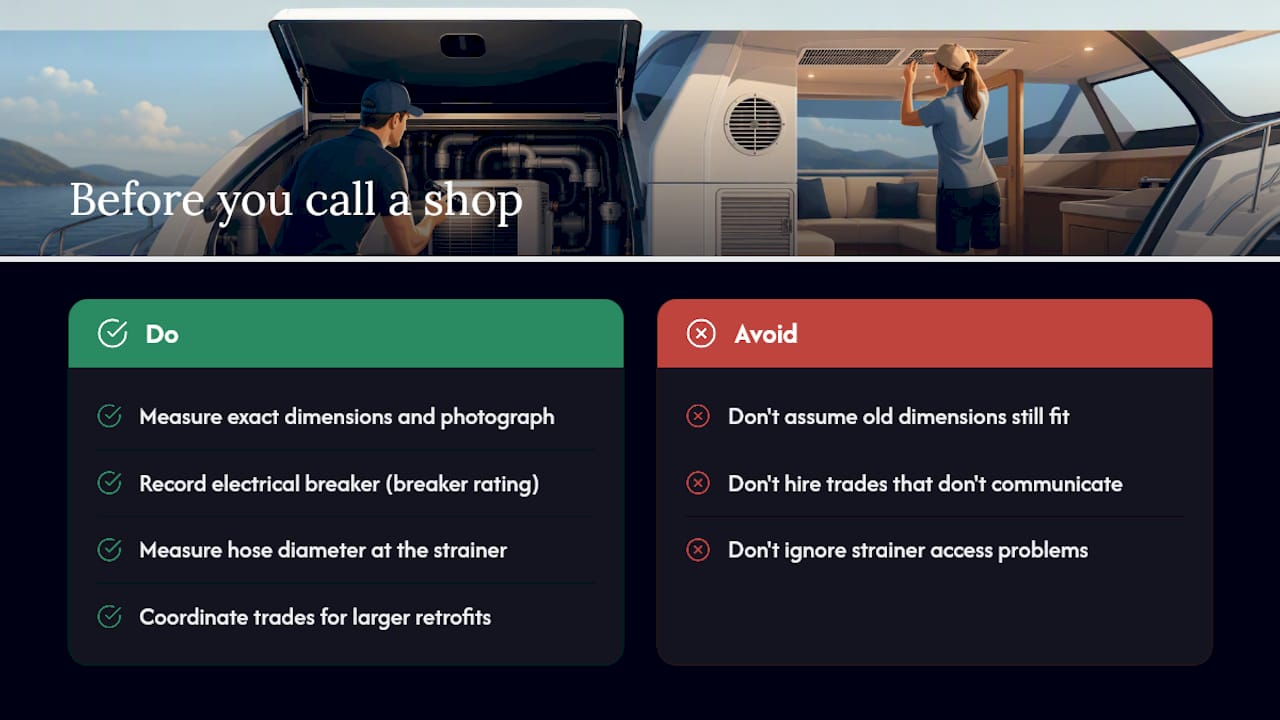
The worst call I ever heard about involved a self-contained unit ordered to match old dimensions that had shifted a half-inch over a decade of hull flex. It didn’t fit. The whole install got redone at double the labor cost.
Three things to gather before you call any shop: exact measurements with photos, your electrical panel’s breaker rating, and hose diameter at the strainer. Bigger retrofits, split systems, multi-zone additions, need trades that talk to each other. A refrigeration tech who’s never touched marine plumbing will miss the strainer access problem every time.
— Jason
How Mazza Marine Handles a Marine AC Upgrade From Start to Finish
A marine AC upgrade should be treated as one coordinated job, including sizing, seawater plumbing, electrical capacity, and commissioning, rather than a parts swap handled by whoever’s available that week. That’s the real difference between calling a single shop for the whole scope versus juggling a refrigeration tech, an electrician, and a plumber separately and hoping their work lines up.
When you request a quote, ask for the scope in writing: what’s assumed about existing plumbing and electrical, what commissioning tests will be run, and whether haul-out is included if seacock work is needed. Our marine air conditioning installation page details sizing and layout planning specific to Florida vessels, and if your boat needs broader mechanical work alongside the AC upgrade, our marine repair service guide covers how we scope multi-trade projects. Call or message us to get a written quote started this week.
Sources
The YachtAid Marine retrofit checklist covers the full 10-point fit and commissioning sequence referenced throughout this guide. Energy.gov’s cooling systems page explains the repair-versus-replace math in more depth, and Tropical Marine’s selection guidelines break down system categories by vessel size. For seawater fitting corrosion resistance, Diamondbrite’s marine coating guidance is worth a look.
- YachtAid Marine — Marine A/C retrofit checklist
- Tropical Marine — Guidelines for selecting air conditioning for your boat (spec sheet)
Recommended
Text or Call 954-330-9653 Schedule Appointment
Mazza Marine Yacht Services & Refit

Fiberglass Upgrades and Damage Repair

Premium Yacht Paint/ Faux Teak

Fishing: Custom Rods, Reels,Tackle

Electrical, Electronics and Navigation

Paint, Hull and Gelcoat

Teak Decks, Wood Cabinets, Carpentry

Canvas, Enclosures and Upholstery

Mechanical, Repower and Running Gear

Plumbing, Bilge and Thru-Hulls

Welding and Custom Fabrication

Interior Refit And Past Work
Get your yacht value Estimate
"*" indicates required fields