
View Our Recent Work:

A basic manual toilet swap typically runs a few hundred to over a thousand dollars installed, an electric or macerator upgrade costs from about one thousand to several thousand dollars, and a full holding-tank installation with new hoses and fittings can reach several thousand dollars or more. Installing composting heads generally costs a few thousand dollars once labor is added. Every one of those bands assumes normal access. A contractor still needs eyes on your compartment, hose runs, and tank location before any number becomes a real quote.
TL;DR:
- Most installation costs are driven by labor, access issues, and unexpected carpentry, not the price of the toilet unit itself.
- Additional costs for hoses, fittings, and sealing often add $150 to $400 to the total price.
- Complex installs requiring thru-hull modifications, electrical upgrades, or structural repairs can increase total costs significantly.
- Five-year costs favor composting toilets for boaters with frequent pump-outs, as they minimize ongoing expenses despite higher initial investment.
- Owners should provide detailed photos, measurements, and hardware information for accurate quotes and avoid surprises during installation.
Table of Contents
- Marine Head Replacement Cost Breakdown By System Type
- What Changes The Price: Installation Complexity And Hidden Costs
- Labor, Time, And What A Fair Hourly Rate Looks Like
- Manual, Electric, Vacuum, Or Composting: Which System Fits Your Boat
- Five-Year Cost: Where The Cheaper System Stops Being Cheaper
- How To Get A Written Quote You Can Actually Compare
- DIY Or Professional: Knowing Which Job Is Yours
- Overview: Mazza Marine’s Practical Perspective On Real-World Costs
- Where Owners Get This Wrong
- Get A Precise Quote For Your Head Replacement
- Sources
Marine Head Replacement Cost Breakdown By System Type
The unit itself is rarely the biggest line on your invoice. Hoses, a Y-valve, a new deck fitting, clamps, and sealant routinely add $150 to $400 on top of the toilet’s sticker price, and that’s before anyone picks up a wrench.
Published price surveys show manual heads running $200 to $1,750 depending on brand and materials, while electric units land at $550 to $1,600 or more once you factor in motor and control assemblies, according to Cruising World’s toilet upgrade guide. Composting systems sit at $800 to $1,200 for the unit alone, and vacuum toilets range from $400 to $2,000 depending on how the vacuum pump and holding components are configured.
Here’s how those unit prices translate into what actually shows up on a shop invoice, based on typical parts and installed totals reported across contractor cost breakdowns and marketplace project listings:
The spread within each row comes down to three things: whether the model uses proprietary parts (Jabsco and Raritan components price differently), how much old plumbing needs to be torn out, and whether the compartment gives a technician room to actually work. A cramped aft head on a 34-foot sailboat costs more to service than the same install on a flybridge motoryacht with a walk-in engine room nearby.
What Changes The Price: Installation Complexity And Hidden Costs
Quotes swing wildly because the toilet is the easy part. What drives the real number is everything around it.
- Access and space constraints. A head wedged behind a bulkhead or under a bunk can turn a 3-hour job into a 6-hour one, since technicians spend real time just getting tools into position.
- Coring and thru-hulls. If your new system needs a different intake or discharge thru-hull, expect additional cost for cutting, sealing, and reinforcing the hull, particularly on cored fiberglass decks where wet coring adds both time and material.
- Pump-out fittings. Boats without an existing deck plate for tank pump-outs need one installed, which means more fiberglass work and hardware.
- Electrical upgrades. Electric and vacuum heads draw real amperage. If your battery bank or wiring can’t support the new load, budget for a circuit upgrade before the toilet itself gets touched, a point echoed in marine trade coverage of head compartment upgrades.
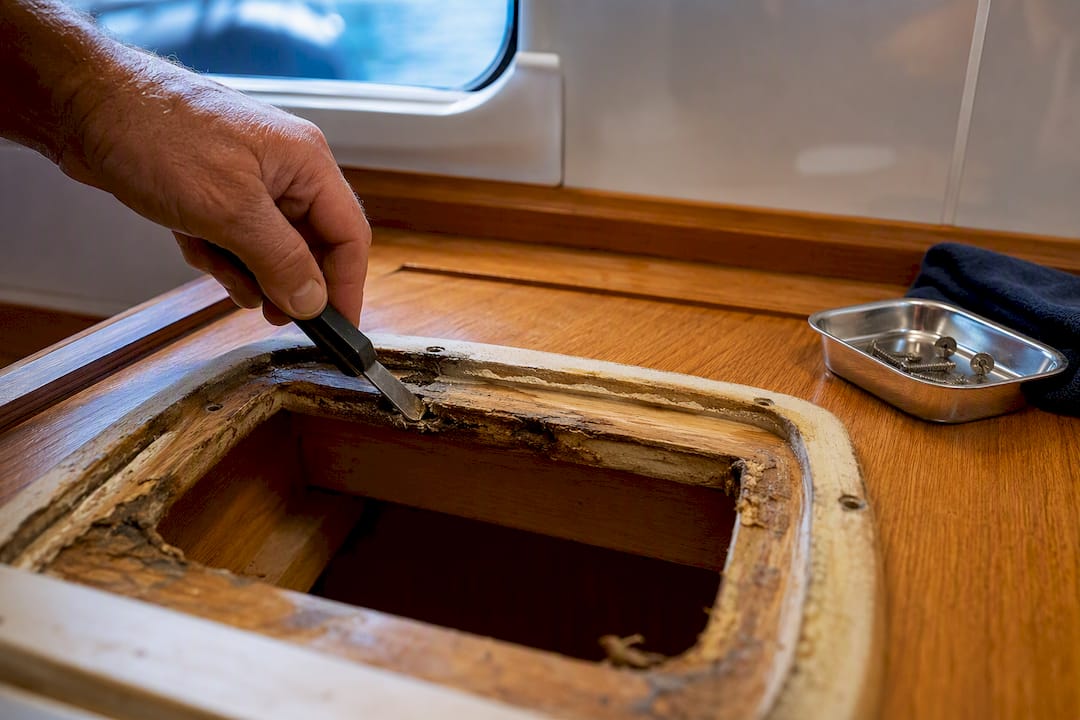
- Carpentry and structural repairs. Rot under an old base, or a soft subfloor from years of slow leaks, is one of the most common surprises. Rebuilding a base can add anywhere from $300 to $1,200 depending on the extent of the damage.
- Marina or yard fees. Some facilities charge haul-out or permit fees for thru-hull work. Confirm with your marina before assuming your quote covers everything.
Technicians on boating forums consistently point to access problems and unexpected carpentry as the single biggest source of change orders, which is exactly why photos and measurements matter before a wrench ever comes out.
Labor, Time, And What A Fair Hourly Rate Looks Like
Labor is where most of your budget actually goes, not the hardware.
- Manual head swap: 3 to 4 hours in a typical accessible install.
- Electric or macerator install: 4 to 6 hours, largely due to wiring and control panel work.
- Full holding-tank installation: 6 or more hours, sometimes stretching across two days when coring or tank fabrication is involved.
These figures track with real owner and technician reports shared on CruisersForum’s installation cost thread, though outliers exist. A boat with a previously botched DIY repair can blow past any of these estimates fast.
Statistic to know: Skilled marine technicians in Florida boatyards typically charge hourly rates that vary broadly depending on the facility and location.
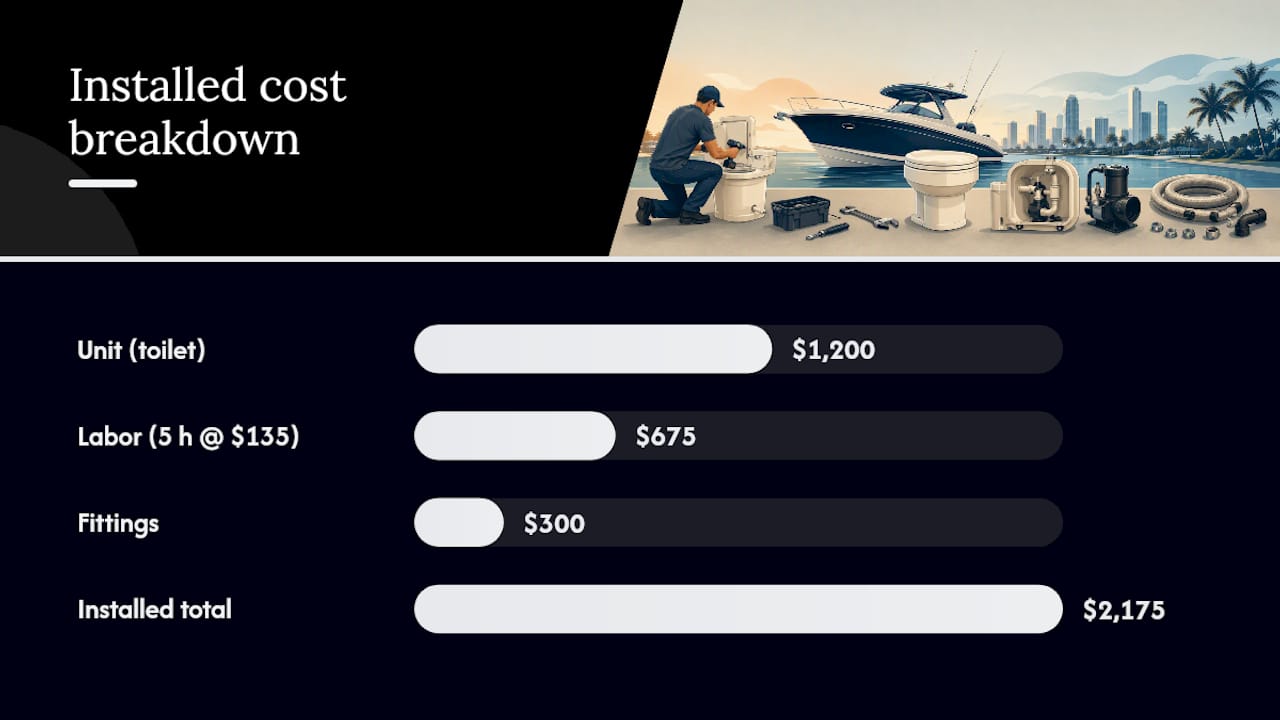
Run the math on a typical electric head swap: five hours of labor at $135 an hour is $675, plus a $1,200 unit and $300 in fittings, and you land around $2,175. That’s squarely inside the $1,200 to $3,500 band above, and it shows why asking for an hourly breakdown matters more than haggling over the toilet’s price tag.
Manual, Electric, Vacuum, Or Composting: Which System Fits Your Boat
Every system trades upfront cost against a different kind of ongoing hassle.
- Manual toilets cost the least to buy and install, and any competent boater can service a joker valve or pump gasket at the dock. They demand more physical effort per flush and are the first thing guests complain about.
- Electric or macerator systems add convenience but introduce motors, solenoids, and wiring that eventually fail, and repairs almost always need a technician rather than a wrench in your own hand, a tradeoff Power & Motoryacht Central flags as the core downside of going electric.
- Vacuum systems flush with less water and less odor but rely on a vacuum pump and sensor that, when they fail, tend to fail all at once rather than gradually.
- Composting toilets cost more upfront and require owners to manage a solids bin and ventilation fan, but they eliminate the black-water holding tank entirely.
Weekend dayboaters rarely need anything beyond a manual head. Liveaboards and long-range cruisers are the ones who most often justify the added cost of composting or vacuum systems, mainly because they’re the ones paying pump-out fees every week instead of twice a season.
Five-Year Cost: Where The Cheaper System Stops Being Cheaper
The sticker price is only half the story. Pump-out fees, which may range from modest to higher amounts per visit, can become the dominant cost for holding-tank owners who frequently use their boats.
| System | Upfront + install | 5-year pump-out/consumables | 5-year parts & maintenance | Estimated 5-year total |
|---|---|---|---|---|
| Holding tank (manual/electric) | several thousand dollars | moderately high pump-out costs over five years | ongoing maintenance costs | total cost notably higher |
| Composting toilet | higher upfront install cost | minimal consumable costs over five years | moderate maintenance costs | total cost comparatively lower |
Composting systems avoid pump-out fees entirely, which is the single biggest driver behind their lower long-term total, according to Air Head’s ownership cost comparison. A boat that pump-outs weekly during a long cruising season can rack up costs that make a holding tank several times more expensive over five years than composting. Weekend boaters who pump out only occasionally see a much smaller gap, and for them the higher composting install cost may never fully pay for itself.
How To Get A Written Quote You Can Actually Compare
A vague verbal estimate is how change orders happen. Give a contractor a real packet up front and you get a real number back.
- Photograph the compartment. Three angles: the current head and base, the hose routing, and the access panel or hatch.
- Take measurements. Note height above the tank, width of the access opening, and distance from the nearest bulkhead.
- Identify your current hardware. Make and model of the existing head and pump matter, since contractors use this exact information to price parts accurately before ever stepping aboard.
- Confirm existing fittings. Note whether a pump-out deck plate or Y-valve already exists.
- Ask for an itemized estimate. Hours allowed, parts broken out separately from labor, warranty terms, and who is responsible for sealing any core cuts.
- Request a contingency clause. Get written acceptance terms for change orders before work starts, not after a surprise gets discovered.
Pro Tip: Ask the shop point-blank whether their quote includes resealing the mounting base. It’s a five-minute question that saves you from a $200 “oversight” fee later.
DIY Or Professional: Knowing Which Job Is Yours
A straightforward like-for-like manual head swap, with no tank or thru-hull changes, is realistic for an owner with basic tools, a hacksaw, and patience for stubborn hose clamps. Anything beyond that shifts the calculus fast.
- Full holding-tank fitting, new thru-hulls, or coring work belongs with a professional every time.
- Electrical upgrades for electric or vacuum heads carry real fire and flooding risk if wired wrong.
- Inaccessible installs behind furniture or structural bulkheads usually need tools and leverage a weekend project doesn’t have.
- Watch for red flags before you touch anything yourself: a soft or flexing base, signs of prior amateur sealant work, or any hint of water intrusion around the mounting bolts. Those point to hidden rot that needs a professional assessment, not a fresh gasket.
Overview: Mazza Marine’s Practical Perspective On Real-World Costs
We’ve walked into more than a few Florida head jobs that looked simple on paper and turned into a half-day carpentry project once the old base came up soft. That’s not a scare story, it’s just what saltwater exposure does to a compartment over ten or fifteen years. Jason and the Mazza Marine team price these jobs the way this article breaks them down: labor hours first, parts second, contingency built in from the start rather than bolted on as a surprise. Our marine repair service guide and fixture replacement workflow cover how we scope jobs like this before a technician ever picks up a tool. If your compartment has any history of leaks, get it inspected before you commit to a system.
Where Owners Get This Wrong
Most cost guides treat the toilet like the expensive part of this job. It isn’t. The labor hours and the hidden carpentry are where budgets actually break, and the industry’s own forum chatter backs that up consistently, not the marketing copy of any toilet manufacturer.
The bigger mistake is comparing quotes by looking only at the bottom-line number. Two shops can quote $2,800 for the identical electric head install, and one of them has priced in resealing a soft base while the other hasn’t even opened the compartment yet. You won’t know which is which until the invoice lands, unless you demand an itemized breakdown up front.
If there’s one thing worth prioritizing over everything else in this article, it’s the photo-and-measurement packet before you ever call a shop. Owners who show up with clear documentation get tighter, more honest quotes, and they’re the ones who don’t get blindsided by a change order three days into the job. Composting systems deserve more consideration than most owners give them, not because they’re trendy, but because the five-year math genuinely favors liveaboards and heavy cruisers over holding tanks.
— Jason
Get A Precise Quote For Your Head Replacement
Every estimate above assumes normal conditions. Your boat isn’t “normal conditions,” it’s a specific compartment with its own hose routing, its own hidden wear, and its own history of past repairs, which is exactly why Mazza Marine builds every quote around an actual site visit instead of a phone-call guess. We send a technician to take measurements and photos, price parts and labor as separate line items, and bake in a contingency allowance for whatever the old base reveals once it comes up.

From inspection to completed install, most head replacements move through our shop in three to seven business days depending on parts availability and whether structural repair turns up. Have your current head’s make and model ready, along with any history of leaks or prior repairs, and we’ll walk the rest from there. Request a marine repair inspection and get a firm, itemized quote before any work begins.
Sources
- HOCANFLO — What is the cost of installing a marine toilet?
- Air Head — The real cost of owning a composting toilet on a boat
- Boatwork — Marine head replacement services
- CruisersForum — Head professional installation cost (forum thread)
- Power & Motoryacht Central — Head compartment
Recommended
Text or Call 954-330-9653 Schedule Appointment
Mazza Marine Yacht Services & Refit

Fiberglass Upgrades and Damage Repair

Premium Yacht Paint/ Faux Teak

Fishing: Custom Rods, Reels,Tackle

Electrical, Electronics and Navigation

Paint, Hull and Gelcoat

Teak Decks, Wood Cabinets, Carpentry

Canvas, Enclosures and Upholstery

Mechanical, Repower and Running Gear

Plumbing, Bilge and Thru-Hulls

Welding and Custom Fabrication

Interior Refit And Past Work
Get your yacht value Estimate
"*" indicates required fields