
View Our Recent Work:

If your holding tank smells even after cleaning, your macerator has failed twice this season, or you’re outfitting for charter guests, a full marine head upgrade is the right call, not another patch job. The Clean Water Act’s Section 312 requires a Coast Guard-certified MSD on any vessel with an installed toilet, which means compliance and comfort often point to the same fix. Book a professional inspection before deciding, since what looks like a bowl problem is usually a hose or vent problem underneath.
TL;DR:
- A full marine head upgrade is advisable if odors persist after cleaning, macerator failures happen frequently, or if the boat is used for charter or long trips.
- Signs that indicate the need for an upgrade include hoses older than recommended, odors returning quickly after cleaning, and multiple pump failures within a single season.
- A comprehensive upgrade involves replacing the toilet, hoses, holding tank, venting, and electrical wiring, with detailed planning and proper serviceability features.
- Legal requirements mandate a Coast Guard-certified marine sanitation device on vessels with toilets operating in U.S. waters, with strict regulations against untreated or unauthorized discharges.
- Costs range from $500 to over $10,000 depending on scope, and full system upgrades typically take one to two weeks, with thorough pre-job questions improving contractor selection.
Table of Contents
- Should You Repair the Head or Plan a Full Upgrade?
- What Should Be Included in a Marine Head Upgrade Checklist?
- What Are the U.S. Legal Requirements for Marine Sanitation Devices?
- How Much Does a Marine Head Upgrade Cost and How Long Does It Take?
- What Should You Ask a Yard Before Hiring Them for a Head Upgrade?
- What Mistakes Show Up Most Often in Marine Head Refits?
- Ready to Upgrade Your Marine Head the Right Way?
- Where Can You Find Official Rules on Marine Sanitation?
- Sources
- FAQ
Should You Repair the Head or Plan a Full Upgrade?
A repair usually solves the problem when the issue is isolated. If one part failed, if the hoses and tank were serviced recently, if odor is mild and occasional, and if there’s only one head aboard with light use, a targeted fix will hold up fine.
A full upgrade becomes the smarter move when the symptoms stack up. Sanitation hose has a service life, and permeated hose is a common culprit behind odor that never fully goes away no matter how much you clean the bowl, according to Bluewater Navigator’s analysis of marine plumbing systems. Watch for these signals:
- Sanitation hose older than the typical recommended replacement interval, even if it looks intact from the outside
- Odor that returns within weeks of cleaning or treatment
- Macerator or pump failures more than once in a season
- A switch to freshwater flush, or a shift to liveaboard or charter use that increases daily load
Operational goals matter too. Charter compliance, guest comfort, and extended cruising through No-Discharge Zones all favor a planned upgrade over a reactive fix. A yacht plumbing repair that only replaces the toilet while leaving 15-year-old hose in place is money spent solving the wrong problem.
What Should Be Included in a Marine Head Upgrade Checklist?
A proper upgrade touches far more than the bowl. Here’s what a competent yard should scope before quoting the job:
- Toilet unit — manual, electric, or vacuum-assist, matched to your power budget and usage pattern
- Macerator or transfer pump, sized for your discharge line length and lift
- Holding tank, either a certified Type III MSD or a properly fabricated replacement tank
- Y-valve and deck pump-out fitting, positioned for easy access and legal securing
- Venting system with charcoal filter, routed away from cabins, hatches, and cockpit seating
- Sanitation-rated hose (AHWH), sized correctly for the run, not just whatever fit last time
- Seacocks and through-hulls, inspected or replaced if corroded
- Electrical wiring and fuse sizing, matched to manufacturer specs for electric heads
Serviceability is where most upgrades succeed or fail long after the invoice is paid. Hose runs need to avoid low spots that trap waste and breed odor, every connection below the waterline needs double-clamping, and every valve and filter needs a service point a person can actually reach without pulling out half the boat. Anti-siphon loops need correct height relative to the dynamic waterline, accounting for how the boat heels under sail or in a beam sea, not just how it sits at the dock.
Tank-level alarms and optional shutdown relays are worth the extra line item. A tank that silently overflows into the bilge is a cleanup disaster that dwarfs the cost of the sensor that would have prevented it.
Pro Tip: Ask the yard to walk the entire discharge path with you before they close up any access panels. Five minutes of tracing hose routing on delivery day saves hours of guesswork the next time something needs service.
What Are the U.S. Legal Requirements for Marine Sanitation Devices?
Every vessel with an installed toilet operating on U.S. navigable waters needs an operable, Coast Guard-certified MSD. This isn’t optional equipment. It’s federal law under Section 312 of the Clean Water Act, and enforcement carries real teeth.
The EPA recognizes three device types, and which one you have shapes your upgrade options. Type I and Type II devices treat sewage and discharge it overboard, with Type I generally limited to smaller vessels. Type III is a holding tank, storing waste until it’s pumped out at a facility or legally discharged beyond the three-mile limit.
- Untreated discharge is prohibited within three miles of shore under any circumstance
- No-Discharge Zones prohibit discharge from any MSD type, treated or not, within their boundaries
- Y-valves on flow-through systems must be secured, either padlocked, wire-tied, or with the handle removed, whenever you’re in an NDZ or within the three-mile limit
- Pump-out at an approved facility is the only legal option once a holding tank is your active system in restricted waters
Civil penalties for violations can reach $2,000 per violation, and that’s before considering the cost of a boat pulled from service while the issue gets sorted out. Build the Y-valve securing method into your upgrade plan from day one rather than treating it as an afterthought at the dock.
How Much Does a Marine Head Upgrade Cost and How Long Does It Take?
Cost and timeline both scale with how much of the system you’re touching, not just the toilet itself. A detailed cost breakdown helps set realistic expectations before you call a yard, but the broad bands look like this:
- Quick repairs (joker valve, pump rebuild, hose clamp): $150 to $800
- Toilet swap with hose and valve refresh: $500 to $2,500
- Full system upgrade with holding tank, macerator, sensors, and electrical: $2,000 to $10,000 or more
Tank fabrication is usually the biggest swing factor. A tank located below the waterline in a tight bilge space costs more to access and replace than one sitting in an open aft locker. Custom fabrication, freshwater-flush plumbing, and electrical upgrades for a vacuum or electric head all add labor hours, and hose runs through cramped, poorly designed spaces take longer to route correctly than a straight shot from head to tank.
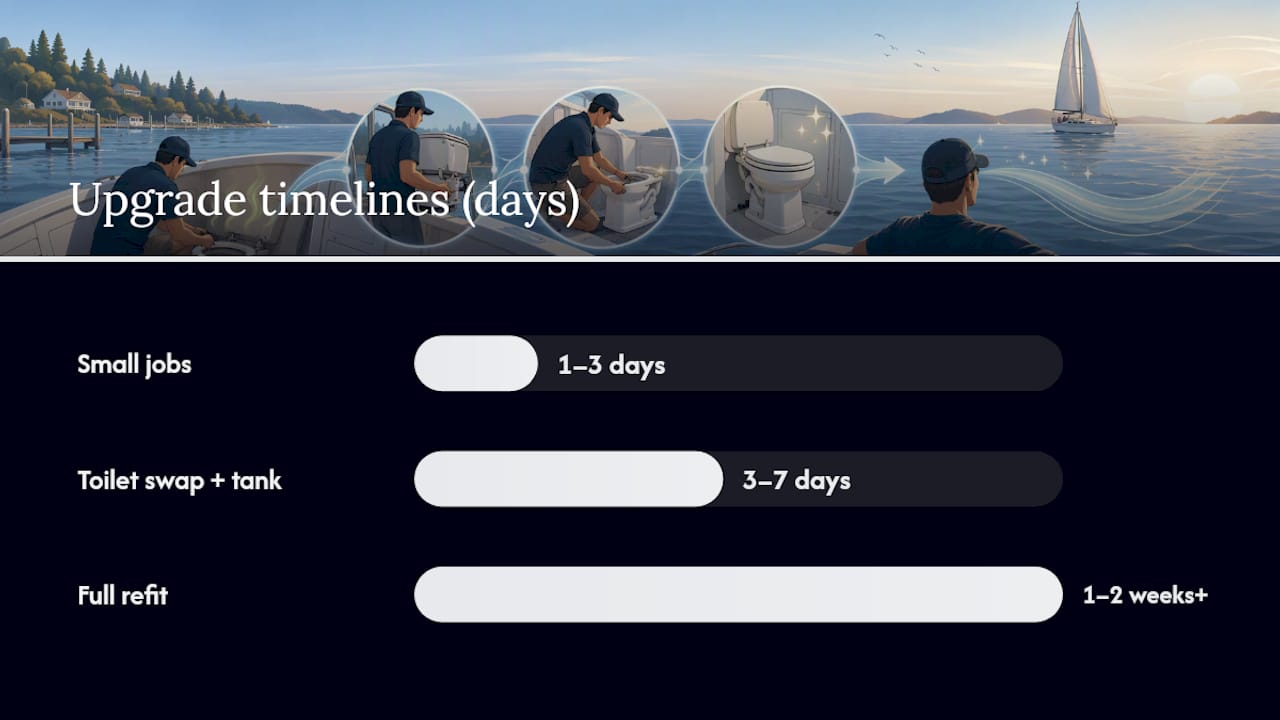
Timeline follows the same logic. Small jobs run 1 to 3 days. A toilet swap paired with hose and tank work typically takes 3 to 7 days. Full refits touching the tank, venting, and electrical can run 1 to 2 weeks or more, depending on scope and how backed up the yard’s schedule is. Booking during shoulder season, rather than right before peak cruising months, usually shortens your wait for a slip.
What Should You Ask a Yard Before Hiring Them for a Head Upgrade?
The contract you sign matters as much as the parts the yard installs. Ask these questions before work begins:
- How many MSD or holding tank installations has your team completed, and can I see photos of recent work?
- Who handles the electrical wiring for an electric or vacuum head, and do they size fuses to manufacturer specs?
- Have you fabricated custom holding tanks before, or only installed off-the-shelf units?
- Who coordinates the pump-out and disposal procedure once the old tank comes out?
- Can you explain how you’ll secure the Y-valve for NDZ compliance?
Require these items in writing before you sign anything: exact hose specifications, a venting plan showing filter and vent placement, a list of service access points, an electrical wiring diagram if the job touches power, and a workmanship warranty covering both parts and labor.
Red flags are usually easy to spot once you know what to look for. A vague scope of work, no photos from past jobs, a yard that can’t clearly explain Y-valve security or NDZ rules, or no warranty offered at all should send you elsewhere.
Pro Tip: Before the survey, photograph your current setup, including model numbers on the toilet, macerator, and tank. It cuts quoting time nearly in half and keeps the estimate accurate instead of padded for unknowns.
What Mistakes Show Up Most Often in Marine Head Refits?
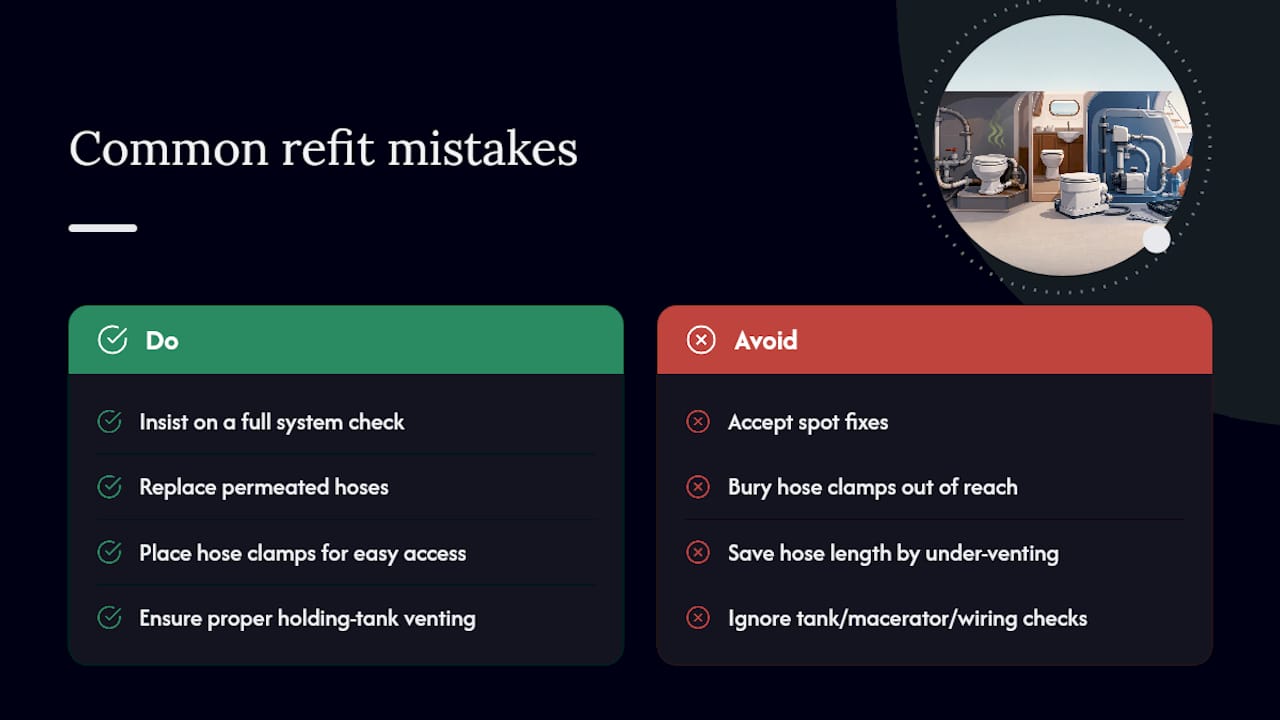
The same three problems show up again and again on boats that come in for a “simple” head repair. Permeated hose that looks fine from the outside but leaches odor through the walls is the most common. Close behind it are hose clamps buried behind bulkheads or under fuel tanks, forcing a repeat yard visit every time something needs attention. Under-vented holding tanks round out the list, usually installed by someone trying to save a foot of hose run.
The plumbing, thru-hull, and electrical teams treat every head job as a system evaluation, not a toilet swap. Tank fabrication, macerator installation, and wiring all get checked together, because fixing one component while ignoring the others just delays the next service call. The takeaway for owners is simple: insist on a full system check, not a spot fix, and you’ll spend far less over the life of the boat.
— Jason
Ready to Upgrade Your Marine Head the Right Way?
A full-service team can handle the entire scope of a marine head upgrade under one roof, from inspection through commissioning, so you’re not chasing separate contractors for plumbing, electrical, and tank fabrication. Services cover thru-hull work, holding tank fabrication, macerator and electrical installation, and full system testing before the job is considered complete.
Here’s what to expect when you call us in: an on-site inspection of your current head and plumbing, a written scope and estimate before any work starts, a realistic timeframe based on your boat’s specific layout, and a workmanship warranty on the parts and labor we install. For tank fabrication involving CNC-cut components, we also draw on marine fabrication partners like Anderson Group Australia for precision work when a job calls for it.
If your head is showing any of the signals covered above, permeated hose, recurring odor, or a macerator on its second failure this year, don’t keep patching around the problem. Visit our marine repair service guide to see our full process, or contact Mazza Marine directly to schedule an on-site inspection and get a written estimate for your upgrade.
Where Can You Find Official Rules on Marine Sanitation?
- EPA’s Marine Sanitation Devices overview explains Type I, II, and III classifications
- EPA’s recreational boater’s guide to vessel sewage covers pump-out procedures and tank treatment
- EPA’s vessel sewage statutes and regulations page details Section 312 requirements and penalties
Sources
- Vessel Sewage Discharges: Statutes, Regulations, and Related Laws and Executive Orders | US EPA
- Marine Sanitation Devices (MSDs) | US EPA
- How to install and maintain a marine toilet system | BestBoating
- A recreational boater’s guide to vessel sewage | EPA
FAQ
Do I Need a Coast Guard-Certified MSD on My Boat?
Yes, any vessel with an installed toilet operating on U.S. navigable waters must have an operable, Coast Guard-certified MSD under Section 312 of the Clean Water Act.
How Often Should Sanitation Hose Be Replaced?
Sanitation hose should generally be replaced every 5 to 7 years, even if it shows no visible damage, since permeation happens from the inside out and often causes odor before any leak appears.
Can I Discharge Treated Sewage Close to Shore?
No. Untreated discharge is prohibited within three miles of shore, and No-Discharge Zones prohibit discharge from any MSD type, treated or not, regardless of distance from shore.
What’s the Difference Between a Type I, II, and III MSD?
Type I and Type II devices treat sewage before discharging it overboard, while Type III is a holding tank that stores waste until pump-out or legal offshore discharge.
How Long Does a Full Marine Head Upgrade Take?
A full refit touching the tank, venting, and electrical system typically takes 1 to 2 weeks or more, while a simple toilet swap with hose work usually takes 3 to 7 days.
Recommended
Text or Call 954-330-9653 Schedule Appointment
Mazza Marine Yacht Services & Refit

Fiberglass Upgrades and Damage Repair

Premium Yacht Paint/ Faux Teak

Fishing: Custom Rods, Reels,Tackle

Electrical, Electronics and Navigation

Paint, Hull and Gelcoat

Teak Decks, Wood Cabinets, Carpentry

Canvas, Enclosures and Upholstery

Mechanical, Repower and Running Gear

Plumbing, Bilge and Thru-Hulls

Welding and Custom Fabrication

Interior Refit And Past Work
Get your yacht value Estimate
"*" indicates required fields