
View Our Recent Work:

Swapping out your navigation lights for LEDs seems like a straightforward upgrade until a Coast Guard boarding officer points out that your new fixtures lack the required certification and your insurance company flags the installation as noncompliant. That scenario plays out more often than most Florida yacht owners expect. Marine lighting covers far more ground than simple fixture selection. It touches on federal regulations, installation standards, electrical safety, and the kind of bespoke ambiance that defines a truly well-appointed vessel. This guide walks you through every layer, from the legal basics to smart technology choices, so you can make decisions with confidence.
Table of Contents
- Why marine lighting systems matter for your yacht
- Types of marine lighting and their specific functions
- Compliance and installation: What Florida yacht owners must know
- Performance, style, and technology: Choosing the best lighting systems
- Expert perspective: Why compliance and quality matter more than ever
- Get professional help with your yacht lighting upgrades
- Frequently asked questions
Key Takeaways
| Point | Details |
|---|---|
| Legal compliance is essential | Navigation lighting must meet U.S. regulations or you risk fines and liability. |
| Choose function-specific lighting | Navigation, utility, and decorative lights have unique roles and requirements on your yacht. |
| Use marine-grade components | Only install wiring and fixtures built to survive harsh saltwater and vibration. |
| Don’t trust brightness alone | Evaluate marine lighting by durability, optics, and certification—not just lumens. |
| Professional help prevents mistakes | Partnering with a marine systems expert can save you costly errors and optimize your yacht’s lighting. |
Why marine lighting systems matter for your yacht
Lighting on a yacht is not decoration first. It is a safety system, a legal requirement, and only then an aesthetic choice. The order matters because many owners reverse it, shopping for beautiful fixtures and hoping compliance follows. It rarely works that cleanly.
Navigation lights communicate your vessel’s position, heading, and status to every other boat within range. A burned-out or improperly colored light can cause another vessel’s operator to misjudge your course at night, with consequences that range from a near miss to a collision. USCG boating safety standards reinforce just how consequential lighting failures can be on open water.
From a legal standpoint, the rules are clear. Navigational lighting is required for U.S. vessels under 100 gross tons and under 65 feet, and must comply with applicable navigation rules, with additional and stricter requirements applying to larger vessels. This is not a guideline. It is federal law. Violations can result in fines, boarding penalties, and complications when filing insurance claims after an incident.
Navigation-light requirements covering colors, locations, and visibility ranges are governed by collision regulations and differ based on vessel type, size, and whether you are underway or at anchor. Understanding this distinction matters because many owners incorrectly assume their anchor light setup doubles as a passable underway light in low-speed marina exits. It does not.
Beyond safety and compliance, lighting shapes the character of your yacht. Here is a concise look at the broader impact:
- Safety: Proper navigation lights reduce collision risk during nighttime and reduced-visibility conditions.
- Legal compliance: Noncompliant lighting exposes you to USCG fines and potential insurance voiding.
- Vessel value: A well-executed lighting refit signals quality craftsmanship and can meaningfully lift resale appeal.
- Ambiance: Underwater lights, cockpit accent lighting, and helm area illumination create the bespoke atmosphere that separates a refined yacht from a functional one.
Understanding marine lighting compliance in Florida is the first step toward building a system that serves every one of these goals simultaneously. And when the regulatory and aesthetic elements work together, the result is a vessel that feels truly complete.
Types of marine lighting and their specific functions
Not every light on your yacht serves the same purpose, and mixing up their roles is one of the fastest ways to create compliance gaps. Marine lighting breaks down into three broad categories: navigation lights, utility lights, and decorative or aesthetic lights. Each operates under different rules, different installation locations, and different performance expectations.
Navigation lights are the most regulated. Their colors, positions, and visibility ranges are dictated precisely by COLREGS (the International Regulations for Preventing Collisions at Sea) and U.S. Inland Rules. Red and green sidelights, a white sternlight, a white masthead light, and an anchor light are the core components for most pleasure vessels. These fixtures must maintain specific arc coverage and be visible at defined minimum ranges.
Utility lights include spreader lights, cockpit lights, underwater fishing lights, and engine room illumination. They are functional but carry fewer regulatory constraints. The key restriction is that utility lights must not be positioned or aimed in ways that could be confused with navigation lights or that might impair the vision of other operators on the water.
Decorative and aesthetic lights cover underwater LEDs, accent lighting along hull lines, and interior ambient systems. These offer tremendous creative flexibility, but they still need to follow basic placement rules so they do not create confusion with required navigation lights.
Here is a comparison of the three categories across the most relevant criteria:
| Category | Regulatory oversight | Color restrictions | Typical IP rating needed | Primary goal |
|---|---|---|---|---|
| Navigation lights | High (COLREGS/USCG) | Strict: red, green, white only | IP67 minimum | Collision avoidance |
| Utility lights | Moderate | No confusing colors near nav positions | IP66 or higher | Task illumination |
| Aesthetic/decorative | Low | Avoid mimicking nav colors | IP68 for underwater | Ambiance and style |
One important development shaping modern compliance is the ABYC C-5 standard. ABYC C-5 is formally accepted by the U.S. Coast Guard as an equivalent to UL 1104 for electric navigation lights, including LED technology, improving modern compliance pathways. This matters because for years, LED navigation light upgrades existed in a gray area. Today, certified products have a clear path to compliance. When shopping for LED yacht lighting, always verify that navigation fixtures carry one of these certifications before purchasing.
The practical rule is simple: match the fixture to its function, verify the standard it meets, and install it where the rules dictate. Everything beyond that is a design conversation.
Compliance and installation: What Florida yacht owners must know
Choosing the right products is only half the job. Installation is where compliance either holds together or quietly falls apart. Florida’s saltwater environment is particularly aggressive, and wiring practices that work fine in a residential context can fail dangerously aboard a yacht.
The governing framework for marine electrical work is ABYC E-11. Electrical installation of marine lighting should be designed around marine electrical standards, not household wiring assumptions, and should follow ABYC E-11 principles for wiring reliability and safety in the salt-vibration environment. The phrase “not household wiring assumptions” is doing a lot of work there. Residential wire is bare copper. In a marine setting, bare copper corrodes rapidly when exposed to salt air and moisture, creating resistance buildup and eventual failure, often at the worst possible time.
Tinned copper wire is the standard for marine electrical circuits. The tin coating resists oxidation and maintains connection integrity over years of salt exposure. Marine-grade connectors with heat-shrink seals and crimped terminations complete the picture. Twist-and-tape connections have no place on a yacht.

Voltage drop is another issue that catches owners off guard. Marine wiring for lighting circuits commonly uses tighter voltage-drop thinking for critical circuits like navigation lights to avoid unsafe or unreliable behavior as loads vary. As a practical rule, keep voltage drop below 3% for navigation light circuits. Anything higher and you risk lights dimming or flickering under load, which undermines both performance and legal compliance.
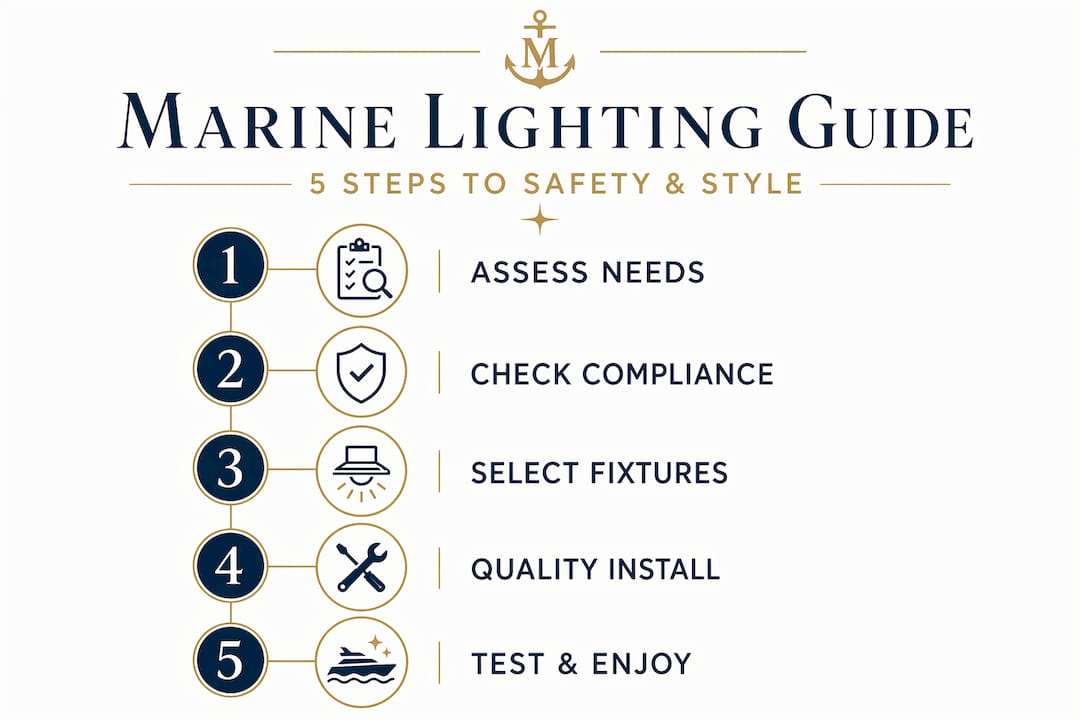
Here is a step-by-step approach to a compliant lighting installation:
- Plan circuits by function. Keep navigation lights on dedicated, fused circuits separate from decorative systems.
- Select tinned copper wire sized appropriately for the circuit’s amperage and run length.
- Calculate voltage drop before finalizing wire gauge. Use a conservative estimate and go up a gauge if you are close to the 3% limit.
- Use marine-grade connectors with heat-shrink insulation at every termination point.
- Mount fixtures per regulatory specifications, verifying arc coverage and height requirements.
- Conduct a post-installation test at night to confirm correct color output and visibility arcs are met.
“Installing lighting on a yacht without following marine electrical standards is like building a structure without accounting for the environment it will live in. Salt, vibration, and moisture will find every shortcut.”
Pro Tip: Always reference marine electrical installation best practices before starting any wiring project. And use the ABYC E-11 standard as your baseline, not as a stretch goal. A look at boating regulations can also help clarify what inspectors and insurers are looking at.
You can also review the broader picture of electronics and navigation integration to understand how lighting systems work alongside your vessel’s other electrical components.
Performance, style, and technology: Choosing the best lighting systems
The marine lighting market is crowded with products making bold claims about brightness, durability, and efficiency. Sorting out what those claims actually mean in practice takes a little discipline.
Start with lumens and IP ratings. Lumens measure raw light output, but raw output is not the same as useful light. A floodlight aimed poorly delivers less value than a focused beam hitting the right surface. For deck and underwater aesthetic lighting, vendors cite very high output benchmarks measured in lumens and specify high ingress-protection ratings and corrosion-resistant housings as differentiators. Look for IP67 as a minimum for deck lights, and IP68 for any fixture fully submerged.
The true effectiveness of marine lights comes down to beam pattern and optical design. A well-engineered fixture with thoughtful optics often outperforms a brighter one with poor light distribution. This is especially true for spreader lights and underwater fixtures where controlling glare and directing output matters as much as raw power.
Here is a performance comparison framework for evaluating any marine lighting product:
| Evaluation factor | What to look for | Why it matters |
|---|---|---|
| Lumen output | Match output to application, not maximum | Over-lit areas create glare and discomfort |
| IP rating | IP67 for deck, IP68 for underwater | Ensures long-term water ingress resistance |
| Color temperature | 5000-6000K for task, 2700-3000K for ambiance | Affects usability and atmosphere |
| Warranty length | 3 years minimum for quality products | Signals manufacturer confidence |
| Certification | ABYC C-5 or UL 1104 for nav lights | Required for legal compliance |
Smart lighting controls are also worth considering if you are doing a full refit. RGB capable LED systems let you adjust color and intensity from a helm-mounted controller or even a smartphone app, allowing the same fixture to serve as a white work light during provisioning and a warm amber accent light during an evening at anchor. These systems add meaningful value without a large footprint.
Pro Tip: When evaluating lighting upgrade ideas and retrofit kits, always ask the vendor for the photometric data sheet, not just the marketing spec. The photometric data shows you exactly how light is distributed at measured distances, which tells you far more than a single lumen number.
Expert perspective: Why compliance and quality matter more than ever
Here is the honest truth that many lighting vendors will not tell you: the LED revolution created as many compliance pitfalls as it solved. Owners see lower power draw, longer life, and brighter output and assume the upgrade is automatically an improvement. In regulatory terms, that assumption is dangerously incomplete.
Swapping incandescent navigation lights to LED is not just a physical swap. It must preserve regulatory compliance through certification and standard acceptance so that color, intensity, and performance over the service life of the fixture remain within legal limits. The problem is that not all LED drop-in replacements are tested or certified for navigation light duty. Some produce color that drifts outside the allowable spectrum as the diodes age. Others lose intensity faster than the regulations anticipate. A fixture that passes on day one may be out of compliance by year two.
The market pressure to prioritize brightness over everything else also leads owners astray. Brighter is marketed as better, but for navigation lights, the regulations define both a minimum and a maximum effective range. A light that is too intense can blind other operators approaching from certain angles, which is its own hazard. For aesthetic lighting, excess brightness creates glare that ruins the ambiance it was meant to enhance.
What we advocate is a system-thinking approach rather than a parts-swapping mindset. Every lighting circuit on your vessel interacts with your electrical system, your insurance policy, and your ability to operate legally at night. When you approach it holistically, considering certification, installation standard, optical performance, and integration with your broader electrical system, you end up with a result that is safe, legal, and genuinely beautiful.
The true effectiveness of marine lights will always come back to how well the system serves the vessel and the crew, not how impressive the spec sheet looks at first glance. Explore LED compliance upgrades that are built around certified, system-aware thinking rather than one-off product substitutions.
Get professional help with your yacht lighting upgrades
Lighting touches nearly every system on your yacht, from your electrical panel to your insurance policy to your ability to pass a USCG inspection. Getting it right requires more than a product selection. It requires a full-system evaluation by someone who knows what Florida waters demand.
At Mazza Marine, our network of Florida yacht specialists includes experienced marine electrical specialists who understand both the regulatory landscape and the craftsmanship side of a well-executed lighting refit. Whether you are replacing aging navigation fixtures, adding underwater LEDs for that bespoke nighttime look, or wiring an entirely new system from scratch, we connect you with the right hands for the job. If you are unsure where to start, our yacht repairs expert guide can help you identify what needs attention first. And for owners considering a broader refit that includes hull and finish upgrades, we coordinate across all trades so every detail aligns. Reach out today and let us help you get it done right.
Frequently asked questions
What type of navigation lights are required on my Florida yacht?
Yachts under 100 gross tons and 65 feet must comply with specific navigation-light color, placement, and visibility requirements per U.S. navigation rules, including required arcs for sidelights, sternlights, and masthead lights depending on your vessel’s size and operation.
Can I just swap incandescent bulbs for LED in my navigation lights?
No. The complete fixture must maintain compliance after the change. Swapping to LED requires verifying that the new fixture holds ABYC C-5 or UL 1104 certification so that color output, intensity, and long-term performance all remain within legal limits.
What should I look for in underwater or deck lighting?
Focus on high lumen output matched to the application, top-tier IP ratings (IP68 for submerged fixtures), and corrosion-resistant housings built for Florida’s salt environment. Optical design matters as much as raw brightness.
How do I avoid voltage drop causing lighting problems?
Use tinned copper marine-grade wiring and size your conductors so that voltage drop stays below 3% for critical navigation lighting circuits. Undersized wire in long runs is the most common cause of dimming and unreliable performance.
Are there Florida-specific marine lighting rules I need to follow?
Florida follows U.S. Coast Guard and COLREGS standards nationwide. Navigation-light rules governing colors, locations, and visibility ranges apply uniformly, so there are no significant state-specific differences beyond the federal framework.
Recommended
Text or Call 954-330-9653 Schedule Appointment
Mazza Marine Yacht Services & Refit

Fiberglass Upgrades and Damage Repair

Premium Yacht Paint/ Faux Teak

Fishing: Custom Rods, Reels,Tackle

Electrical, Electronics and Navigation

Paint, Hull and Gelcoat

Teak Decks, Wood Cabinets, Carpentry

Canvas, Enclosures and Upholstery

Mechanical, Repower and Running Gear

Plumbing, Bilge and Thru-Hulls

Welding and Custom Fabrication

Interior Refit And Past Work
Get your yacht value Estimate
"*" indicates required fields