
View Our Recent Work:

TL;DR:
- Proactive maintenance of engines, hydraulics, ventilation, and propulsion systems is essential to prevent costly failures.
- Regularly inspect and service key components like bellows, heat exchangers, and hydraulic oil to ensure system reliability.
- Understanding system interdependence and early warning signs helps avoid domino failures and extends yacht lifespan.
Most Florida yacht owners treat their mechanical systems the way they treat the bilge pump: they trust it’s working until it isn’t. That mindset is expensive. Marine engine maintenance requires proactive schedules to prevent failures that range from costly repairs to outright sinking. The good news is that understanding your yacht’s core mechanical systems doesn’t require an engineering degree. It requires curiosity, a solid framework, and the right maintenance habits. In this guide, we cover the four systems that matter most: engines, hydraulics, ventilation, and propulsion. Master these, and you’ll spend far less time at the dock waiting for a repair crew.
Table of Contents
- Understanding the building blocks: Key components of marine mechanical systems
- Marine engine fundamentals and proactive maintenance
- Keeping hydraulics reliable: From windlasses to stabilizers
- Ventilation and cooling: The often-missed link to reliability
- Propulsion innovations: Comparing traditional vs hybrid solutions
- A reality check: What most yacht owners miss about marine mechanical systems
- Take your yacht’s reliability further with expert support
- Frequently asked questions
Key Takeaways
| Point | Details |
|---|---|
| Understand core systems | Knowing how engines, hydraulics, ventilation, and propulsion work together is the foundation of proactive yacht maintenance. |
| Follow maintenance schedules | Strict 5-year engine service and regular hydraulic checks drastically reduce breakdown risks. |
| Optimize for Florida conditions | Proper ventilation, oil management, and fuel-efficient propulsion options are vital for yachts facing Florida’s heat and coastal cycles. |
| Hybrid benefits vary | Hybrids excel in fuel savings during idle and docking, but traditional engines may outperform at full cruise speeds. |
| Monitor system interdependence | Most costly failures involve multiple connected systems—track signs and feel of each to catch issues early. |
Understanding the building blocks: Key components of marine mechanical systems
A yacht is a floating ecosystem of interdependent systems. When one falters, the ripple effect can compromise your safety, your schedule, and your wallet. Before you can maintain these systems effectively, you need to understand what each one does and how they connect.
Here are the four core marine mechanical systems every Florida yacht owner should know:
- Propulsion system: Converts engine power into forward or reverse thrust through shafts, propellers, or jet drives. It’s the most visible system and often the first to show wear.
- Engine system: The power source for propulsion, electrical generation, and auxiliary functions. Marine engines face constant duty cycles and saltwater exposure that land engines never encounter.
- Hydraulic system: Uses pressurized fluid to operate heavy-duty components. Hydraulic systems power vital functions such as steering, thrusters, windlasses, and stabilizers.
- Ventilation system: Manages heat, humidity, and fuel vapor in the engine room. Poor airflow is a silent performance killer and a genuine fire hazard.
These systems don’t operate in isolation. A hydraulic failure can lock your steering mid-channel. An overheated engine room degrades both engine and hydraulic performance simultaneously. Understanding this interdependence is the first step toward reducing machinery breakdowns before they happen.
| System | Primary function | Failure impact |
|---|---|---|
| Engine | Power generation and propulsion drive | Loss of propulsion, overheating, sinking risk |
| Hydraulics | Steering, stabilizers, thrusters, windlass | Loss of control, inability to anchor or dock |
| Ventilation | Airflow, heat dissipation, vapor removal | Power loss, overheating, fire risk |
| Propulsion | Thrust delivery via shaft or jet | Reduced speed, vibration, complete loss of drive |
Think of these four systems as the legs of a table. You can limp along with one slightly short leg, but remove one entirely and the whole structure collapses.
Marine engine fundamentals and proactive maintenance
Marine engines are not automotive engines dropped into a fiberglass hull. They run at higher sustained loads, breathe saltwater-laden air, and cycle heat through raw water cooling systems that corrode from the inside out. That distinction matters enormously when you plan your maintenance calendar.
The gold standard in marine engine care is the 5-year proactive maintenance schedule. This means replacing and servicing components based on time elapsed, not just visible wear. A bellows that looks intact can be cracked internally. A heat exchanger that seems to flow fine may be silting up. Proactive 5-year maintenance includes replacing bellows, servicing heat exchangers, flushing coolant, and replacing exhaust elbows and risers.
Here’s a practical 5-year engine maintenance checklist:
- Replace all bellows (transom assembly, shift cable, trim tab)
- Service or replace heat exchangers (raw water and oil cooler)
- Flush and replace engine coolant
- Inspect and replace exhaust elbows and risers
- Replace raw water pump impeller and housing if worn
- Inspect engine mounts for deterioration
- Service fuel injectors and throttle bodies
- Check and replace zincs throughout the drive system
| Task | Interval | Why it matters |
|---|---|---|
| Bellows replacement | Every 5 years | Prevents water ingestion and sinking |
| Heat exchanger service | Every 5 years | Avoids overheating and engine seizure |
| Coolant flush | Every 5 years | Removes corrosive buildup |
| Exhaust elbow/riser swap | Every 5 years | Prevents water backflow into engine |
| Impeller replacement | Annually or 200 hours | Maintains raw water flow |
Missing a cycle doesn’t just risk a breakdown. A failed bellows on an inboard can flood the bilge faster than your pump can handle it. That’s not a repair bill. That’s a sinking vessel. Use our engine troubleshooting guide if you’re already seeing warning signs, and bookmark our spring maintenance checklist for seasonal readiness.
Pro Tip: Keep a detailed maintenance log with dates, hours, and parts used. Documented service history adds real resale value and gives your next technician a clear picture of what’s been done.
Keeping hydraulics reliable: From windlasses to stabilizers
Hydraulic systems are the unsung workhorses of a well-equipped yacht. They operate quietly, move enormous loads with minimal effort, and rarely demand attention until something goes wrong. By then, you’re usually mid-passage with a locked stabilizer or a windlass that won’t drop anchor.
On Florida yachts, hydraulics typically power:
- Bow and stern thrusters for tight marina maneuvering
- Stabilizer fins to reduce roll in open water
- Windlass systems for anchor handling
- Hydraulic steering on larger vessels
- Trim tabs for hull attitude adjustment
The system works by circulating pressurized hydraulic oil through pumps, valves, and actuators. The oil transfers force, and a heat exchanger keeps it from overheating. Contaminated or degraded oil is the most common root cause of hydraulic failure, and it’s entirely preventable.
Hydraulic maintenance centers on checking oil levels frequently, changing oil every 3 years or 4,000 hours, and servicing heat exchangers for cooling performance. Always top up with clean, manufacturer-specified fluid. Mixing oil types or using contaminated fluid introduces particles that score valve bores and destroy pump seals.
For your hydraulic maintenance guide, focus on these core habits:
- Check hydraulic oil level before every offshore trip
- Inspect hoses and fittings for weeping or chafe marks monthly
- Monitor fluid color: dark or milky oil signals contamination
- Service heat exchangers annually in Florida’s warm operating environment
- Replace filters at every oil change
Pro Tip: Before a long cruise, send a hydraulic oil sample to a marine fluid analysis lab. A $30 test can identify metal particles, water intrusion, or oxidation that would otherwise go undetected until a component fails offshore.
Ventilation and cooling: The often-missed link to reliability
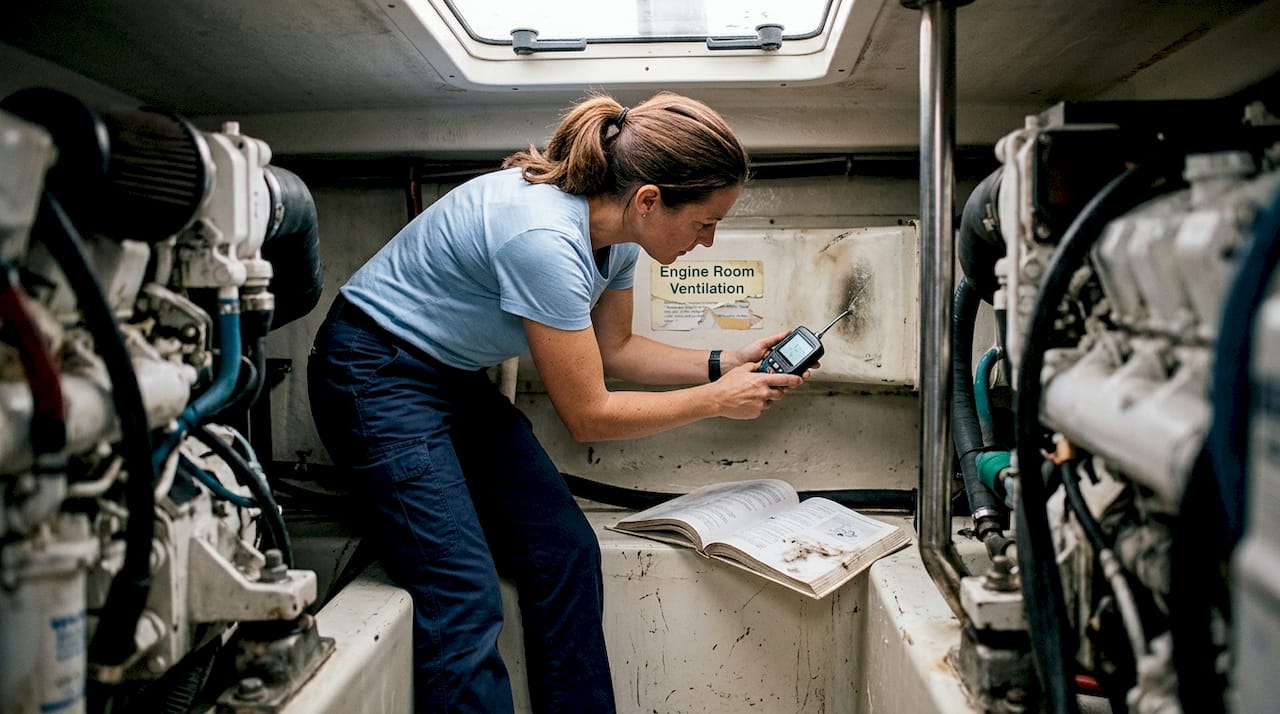
If you’ve ever noticed your engines losing power on a hot Florida afternoon, poor engine room ventilation may be the culprit. Most owners assume overheating is a coolant problem. Often, it starts with airflow.
Engine rooms need ventilation for three critical reasons:
- Heat removal: Engines and hydraulic systems generate enormous heat. Without adequate airflow, ambient temperature climbs and components run hotter than designed.
- Humidity control: Florida’s marine environment means moisture intrusion is constant. Proper ventilation reduces condensation and corrosion on electrical and mechanical components.
- Fuel vapor safety: Gasoline vapors are heavier than air and accumulate in low spaces. Adequate blower capacity removes vapor before it reaches explosive concentration.
Insufficient engine room airflow causes power loss and overheating. The minimum airflow requirement is approximately 2.75 times your engine’s horsepower minus 90 CFM per engine. For a 400 HP engine, that’s roughly (2.75 x 400) minus 90 = 1,010 CFM minimum. Most production yachts are underventilated from the factory.
Here’s how to evaluate and improve your system:
- Measure engine room temperature at operating load. It should be no more than 30°F above outside air temperature.
- Count your blower capacity against the CFM formula for your engine size.
- Inspect blower intake and exhaust locations. High-mounted exhausts work best for heat removal.
- Wire blowers to the ignition circuit so they run automatically when the engine starts.
- Check that blower ducts are unobstructed and free of mold or debris.
Simple upgrades like high-capacity blowers and repositioned ducts can meaningfully reduce operating temperatures. Pair that with the fuel-efficient cooling tips we’ve compiled for Florida sportfish and cruiser owners.
Propulsion innovations: Comparing traditional vs hybrid solutions
Propulsion technology is evolving faster than most yacht owners realize. For Florida boaters weighing a refit or new build, understanding the difference between traditional mechanical and hybrid systems is increasingly relevant.
Traditional mechanical propulsion uses a diesel engine connected directly to a shaft and fixed-pitch or controllable-pitch propeller (CPP). It’s proven, simple to service, and still the dominant choice for long-range cruising.
Hybrid propulsion adds electric motors to the drivetrain, allowing the vessel to operate on electric power alone at low speeds, recover energy during deceleration, and reduce engine load at anchor or in port.
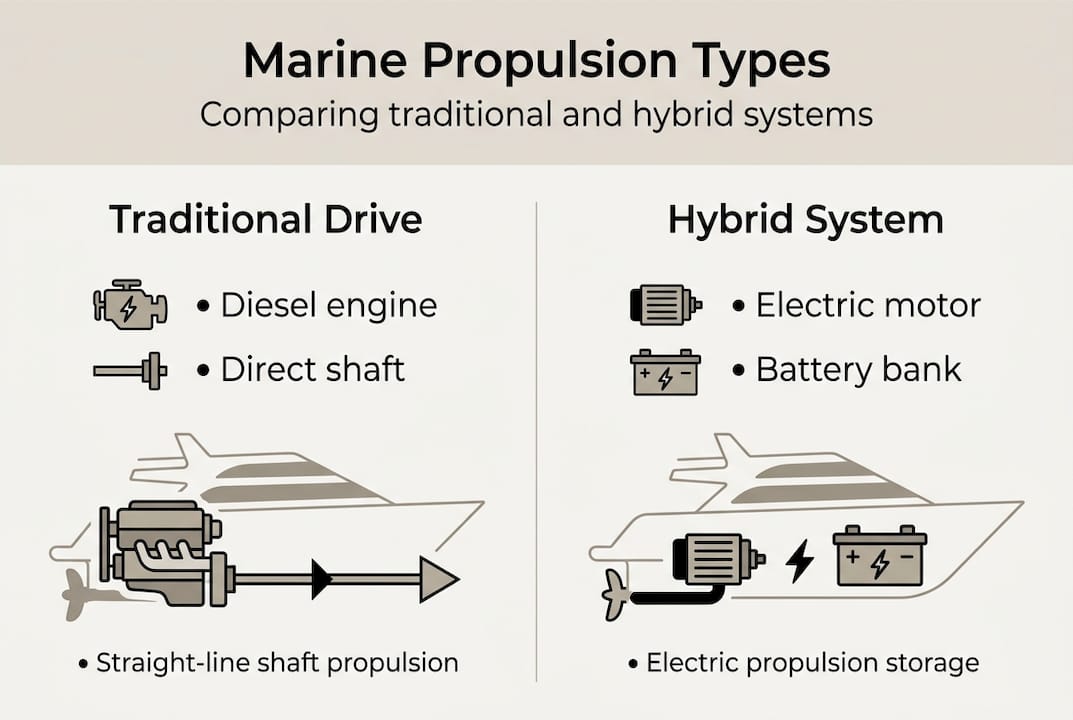
Real-world data supports the efficiency case for hybrid systems. Hybrid propulsion delivers 2.02% annual fuel savings and reduced CO2 emissions compared to conventional mechanical systems. That figure grows meaningfully for yachts that spend significant time idling, docking, or cruising at displacement speeds in Florida’s Intracoastal Waterway.
For CPP-equipped vessels, the picture is more nuanced. Combinator mode improves SFOC by 5.4% at 25% load but increases NOx emissions compared to constant-speed modes. Choosing the right operating mode for your speed and load profile matters.
Key trade-offs to consider:
- Hybrid advantages: Lower fuel burn at slow speeds, quieter operation, reduced emissions, potential tax incentives
- Hybrid limitations: Higher upfront cost, more complex servicing, added weight from battery banks
- Traditional advantages: Lower purchase cost, simpler maintenance, proven long-range reliability
- Traditional limitations: Higher fuel consumption at idle, greater emissions, noisier at anchor
| Factor | Traditional mechanical | Hybrid system |
|---|---|---|
| Fuel savings | Baseline | ~2% annually |
| Upfront cost | Lower | Higher |
| Best use case | Long-range offshore | Coastal, ICW, short passages |
| Maintenance complexity | Moderate | Higher |
For Florida owners who cruise the Keys, the ICW, or the Bahamas at modest speeds, hybrid propulsion deserves serious consideration in 2026.
A reality check: What most yacht owners miss about marine mechanical systems
Here’s something we’ve observed after years working with Florida yacht owners: the most expensive repairs rarely come from a single catastrophic failure. They come from a small problem in one system that quietly stresses a connected system until something breaks under load.
A slightly degraded raw water impeller runs warm. That warm water reduces heat exchanger efficiency. The hydraulic oil overheats. The stabilizer actuator seizes. You’re now looking at a $12,000 repair that started with a $40 impeller. This domino effect is the real enemy, not bad luck.
The owners who avoid these cascades share one habit: they pay attention to how their boat feels during normal operation. A slight vibration at cruise speed, a hydraulic pump that takes a second longer to respond, an engine room that smells faintly different. These are early signals. Developing that sensitivity is more valuable than any checklist. We explore this further in our piece on craftsmanship essentials for Florida yacht owners.
Treat your mechanical systems as a single organism, not four separate checklists. That shift in perspective is what separates reactive owners from those who genuinely enjoy their time on the water.
Take your yacht’s reliability further with expert support
Understanding your yacht’s mechanical systems is the foundation. Keeping them in peak condition over years of Florida cruising is where expert support makes the real difference.
At Mazza Marine, Mino, Luigi, and our network of Florida yacht specialists are ready to help you build a maintenance plan that fits your vessel, your schedule, and your cruising style. Whether you’re tracking down an issue with our engine troubleshooting help, learning the signs you need yacht repairs before a small problem becomes a big one, or implementing fewer breakdowns strategies for your heavy machinery, we’re your one-stop resource. Reach out today and let’s build a long-lasting relationship that keeps you on the water.
Frequently asked questions
What is the most important marine mechanical system for a Florida yacht owner to maintain?
Engine and cooling system maintenance is most critical, as failures here can cause major damage or even sinking. Proactive scheduling prevents the most dangerous and costly outcomes.
How often should I change hydraulic oil in my yacht’s stabilizers or thrusters?
Change hydraulic oil every 3 years or 4,000 hours, and run periodic oil analysis to catch contamination before it damages components.
Do hybrid propulsion systems really save fuel on Florida yachts?
Yes. Real-sea data shows 2.02% fuel savings with hybrid systems versus mechanical, with the greatest gains during low-speed coastal and ICW operation.
How do I know if my engine room has enough ventilation?
Use the formula: approximately 2.75 times HP minus 90 CFM per engine as your minimum airflow target, and confirm engine room temperature stays within 30°F of outside air at operating load.
What simple maintenance step prevents most engine problems on yachts?
Following a strict 5-year replacement schedule for bellows, coolant, heat exchangers, and exhaust elbows eliminates the most common and dangerous failure points before they develop.
Recommended
- Yacht Heavy Machinery: 30-50% Fewer Breakdowns Guide
- Marine heavy machinery guide for Florida yacht owners 2026
- Marine Welding: Enhancing Yacht Safety and Performance
- Marine craftsmanship explained: Florida yacht owner guide
- Marine Electronics – Smye-Rumsby – Experts in Two-Way Radios and Marine Electronics
Text or Call 954-330-9653 Schedule Appointment
Mazza Marine Yacht Services & Refit

Fiberglass Upgrades and Damage Repair

Premium Yacht Paint/ Faux Teak

Fishing: Custom Rods, Reels,Tackle

Electrical, Electronics and Navigation

Paint, Hull and Gelcoat

Teak Decks, Wood Cabinets, Carpentry

Canvas, Enclosures and Upholstery

Mechanical, Repower and Running Gear

Plumbing, Bilge and Thru-Hulls

Welding and Custom Fabrication

Interior Refit And Past Work
Get your yacht value Estimate
"*" indicates required fields