
View Our Recent Work:

Many Florida yacht owners assume a marine surveyor is something like a one-stop inspector who can catch every hidden problem aboard. In reality, the role is far more nuanced, and misunderstanding it can cost you dearly. A qualified marine surveyor is an independent professional who assesses your vessel’s overall condition, safety, and compliance, but within carefully defined limits. Whether you’re protecting a major investment, satisfying your insurance provider, or preparing for a purchase, understanding yacht survey basics is the foundation of smart ownership. This guide walks you through what surveyors actually do, where their scope ends, and how to get the most value from the process.
Table of Contents
- What does a marine surveyor actually do?
- Key areas marine surveyors inspect on your yacht
- Survey limitations: What marine surveyors can and cannot guarantee
- How to work with a marine surveyor for the best results
- Our perspective: What most yacht owners get wrong about marine surveys
- Next steps: Enhance your yacht’s safety and value
- Frequently asked questions
Key Takeaways
| Point | Details |
|---|---|
| Understand survey scope | Marine surveyors assess condition and safety but cannot guarantee discovery of every issue. |
| Prioritize communication | Clear, open discussion with your surveyor clarifies limitations and reduces unwelcome surprises. |
| Prepare your yacht | Ensuring access, documentation, and cleanliness will maximize the effectiveness of a survey. |
| Act on findings | Use your survey results to proactively address repairs, maintenance, and compliance. |
What does a marine surveyor actually do?
A marine surveyor is an independent, licensed professional who evaluates a vessel’s condition, value, and fitness for purpose. They are not repair technicians, inspectors-for-hire with unlimited access, or guarantors of a flawless yacht. Their role is to observe, document, and report, always using non-destructive methods.
There are several distinct types of marine surveys, each serving a specific purpose:
- Pre-purchase survey: Assesses overall condition before you commit to buying.
- Insurance survey: Required by underwriters to confirm the vessel meets their standards.
- Appraisal survey: Establishes fair market value for financing or legal purposes.
- Compliance survey: Confirms the yacht meets regulatory safety requirements.
During a typical survey, a surveyor will perform thorough visual inspections of all accessible areas, test operational systems, review documentation such as registration and safety certificates, and photograph areas of concern. Their daily work is methodical and detailed, but it operates within firm professional limits.
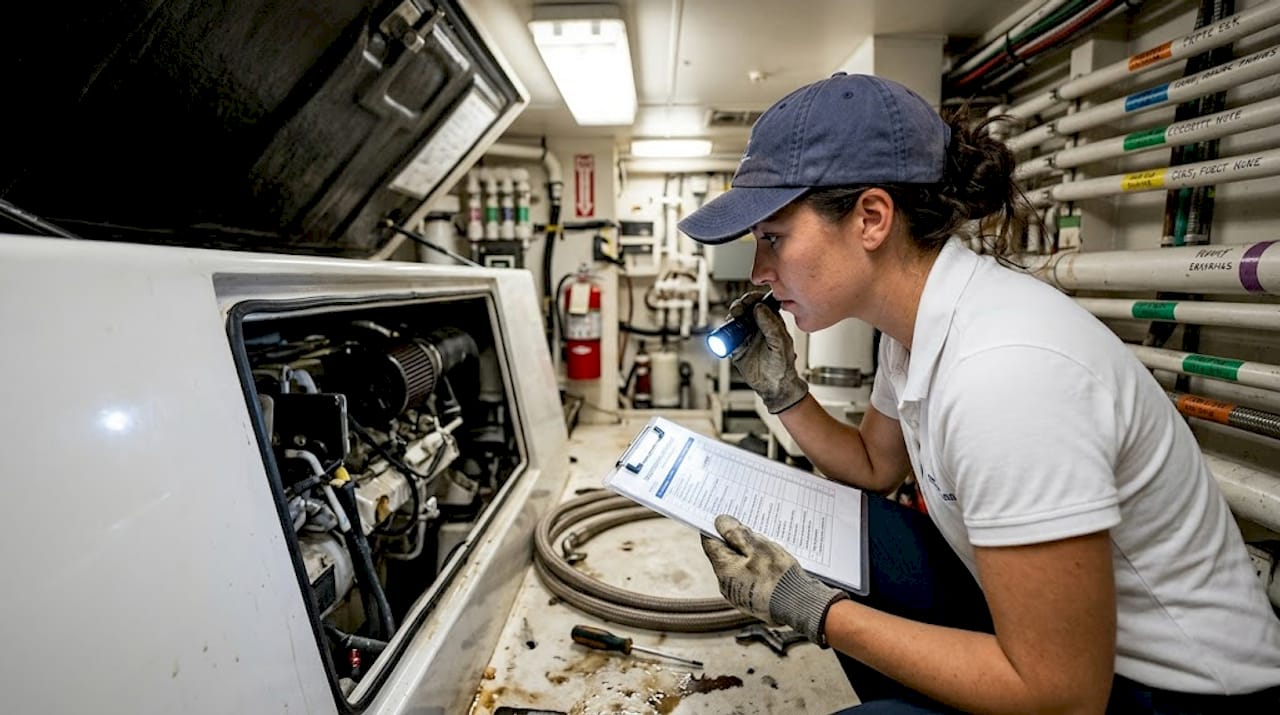
Here’s a quick breakdown of what a standard inspection day looks like:
| Task | Description |
|---|---|
| Visual hull inspection | Tap testing, checking for delamination, osmotic blistering |
| Systems check | Bilge pumps, through-hulls, electrical panels |
| Documentation review | USCG documentation, prior surveys, manuals |
| Safety gear audit | Life rings, flares, fire extinguishers, EPIRBs |
| Report preparation | Written findings with photos and recommendations |
As David Pestridge notes, “survey coverage is a compromise; surveyor access and methods are limited by non-destructive testing.”
Pro Tip: Always request a sample report before hiring a surveyor. A well-organized, clearly written sample is a reliable sign of professionalism and thoroughness.
The formal survey report is where surveyors communicate findings, flag deficiencies, and note areas they could not access. Recommendations in the report range from urgent safety repairs to routine maintenance suggestions, giving you a real map of your vessel’s condition.
Key areas marine surveyors inspect on your yacht
Understanding the surveyor’s job, let’s detail exactly where your yacht will be put under the microscope. Surveyors follow a structured approach that covers major systems while acknowledging that some areas are simply off-limits without owner authorization or destructive methods.
Here’s a comparison of what typically gets inspected versus what does not:
| Area | Typically inspected | Typically not inspected |
|---|---|---|
| Hull and structure | Yes, visual and tap testing | Internal framing behind liners |
| Propulsion and engines | Yes, visual and operational | Internal engine teardown |
| Electrical systems | Yes, panel and accessible wiring | Wiring inside sealed conduits |
| Interior spaces | Yes, accessible compartments | Sealed bulkheads or hidden tanks |
| Safety equipment | Yes, inventory and condition | Hydrostatic release internal mechanism |
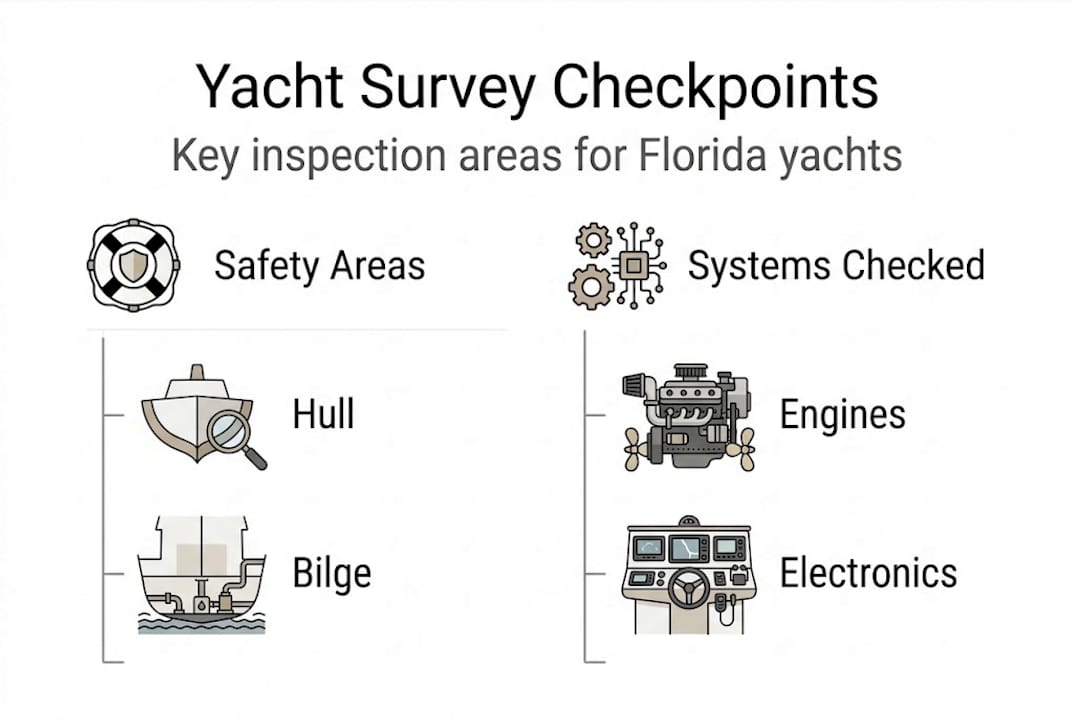
As confirmed by marine inspection guidance, surveyors inspect major hull, engine, electrical, and interior systems but cannot access all areas without owner authorization.
Surveyors generally follow this sequence for each major area:
- Observe and photograph all accessible surfaces.
- Use non-destructive tools such as moisture meters and sounding hammers.
- Test operational systems where safe to do so.
- Note any restrictions in access and document them in the report.
- Flag deferred items requiring specialist follow-up.
For your engines and mechanical systems maintenance, surveyors will run the engines at dock and observe performance, check for visible leaks, and review service records. But they won’t pull apart a raw water pump or pressure-test a fuel system. That level of investigation requires a qualified marine mechanic.
Safety and compliance are the primary drivers of a thorough survey. This is especially relevant in Florida, where USCG and state regulations require specific safety equipment aboard. The surveyor checks that all required gear is present, serviceable, and properly installed. If access is restricted, whether by locked compartments, hidden structural areas, or sealed systems, the surveyor must note this openly. Conducting regular boat inspections between surveys helps keep these access points ready and your yacht truly audit-ready.
Survey limitations: What marine surveyors can and cannot guarantee
Knowing what’s inspected, it’s just as important to grasp where those assurances end, and why. Many yacht owners walk away from a survey with more confidence than is warranted. A clean report does not mean a perfect boat.
Here are the key limitations every owner should understand:
- No destructive testing: Surveyors cannot cut open bulkheads, drain tanks, or remove structural liners to check what’s behind them.
- Hidden wiring: Internal electrical runs concealed inside walls or under sole boards are not fully accessible.
- Covered fuel tanks: Unless a tank access port is present, the internal condition of an aluminum or fiberglass fuel tank remains unknown.
- Machinery internals: Engines, transmissions, and generators are assessed visually and operationally, not internally.
- Latent defects: Problems that are hidden, dormant, or not yet visible at the time of the survey will simply not appear in the report.
Surveyors are trained to manage client expectations about what can and cannot be inspected and the uncertainty that comes with non-destructive methods. Good surveyors communicate these limitations explicitly, both verbally and in writing.
If you have concerns about specific areas, such as the condition of fuel tanks or heavy machinery expectations like a genset or windlass, you can request a specialist investigation. This is typically arranged as a separate, additional service and may involve a marine mechanic, electrical technician, or structural engineer.
Pro Tip: If you’re buying a vessel with significant engine hours or an older fuel system, budget for a specialist engine survey and tank inspection on top of the standard survey. The extra cost is minimal compared to discovering a failed tank or worn injectors after closing.
Experienced surveyors are also more skilled at communicating uncertainty clearly. They know how to say “I could not verify” without alarming a buyer unnecessarily, and how to flag genuine red flags with the weight they deserve. Being present during the survey lets you hear these nuances in real time.
How to work with a marine surveyor for the best results
To move from theory to practice, here’s how you can ensure your own survey delivers clarity and confidence. The quality of your survey outcome depends as much on your preparation as it does on the surveyor’s skill.
Start by researching credentials. Look for membership in recognized bodies such as SAMS (Society of Accredited Marine Surveyors) or NAMS (National Association of Marine Surveyors). Ask these questions before booking:
- What types of vessels do you specialize in?
- What is included and excluded in your standard scope?
- How long will the survey take, and what format is the final report?
- Do you carry professional liability insurance?
Next, prepare your yacht using this checklist:
- Clear access to all bilges, lockers, and engine spaces.
- Organize all documentation: registration, prior surveys, engine service records.
- Ensure all systems are operational and charged (batteries, bilge pumps, navigation lights).
- Remove excess gear and personal items that block access to structural areas.
- Arrange a haul-out if a full hull inspection is required.
Attending the survey is strongly recommended. You’ll learn things about your own vessel that may never make it into a written report. Surveyors often point out minor wear or quirks verbally that shape the bigger picture of your boat’s condition.
As highlighted in marine vendor collaboration best practices, clear communication with your surveyor ensures the most useful and actionable results. After the survey, read the report carefully. Ask for clarification on any item you don’t understand before acting on recommendations or negotiating repairs.
Our perspective: What most yacht owners get wrong about marine surveys
Here’s a truth we’ve seen play out repeatedly with Florida yacht owners: they treat the survey as a finish line rather than a starting point. Once the report comes back with no major red flags, the instinct is to relax and stop asking questions. That’s a costly mistake.
A survey is a snapshot in time, taken under imperfect conditions. As noted by industry experts, surveyor access and findings will always be a compromise between thoroughness and the realities of inspection. The best surveyors are not the ones who find the most problems. They’re the ones who communicate uncertainty most honestly.
The real value of a survey is that it should inspire a proactive maintenance culture. Use the report as a living document. Schedule follow-up inspections for flagged items. Build a relationship with trusted breakdown prevention strategies that go beyond survey day. The owners who get the most years and joy from their vessels are the ones who never stop being curious about what’s behind the bulkhead.
Next steps: Enhance your yacht’s safety and value
You now have a clear picture of what a marine surveyor can offer, where their scope ends, and how to work with one effectively. The survey is just one piece of a larger ownership strategy.
At Mazza Marine, we help Florida yacht owners turn survey findings into action. Whether the report flags urgent issues or simply reveals opportunities for improvement, our trusted vendor network is ready. Explore our guide to yacht repair warning signs to know when to act fast, learn how to reduce machinery breakdowns with proven maintenance habits, and review our paint and hull services if your survey revealed surface or structural concerns. Mino and Luigi are here to connect you with the right Florida experts for every need.
Frequently asked questions
What types of marine surveys are most important for Florida yacht owners?
Pre-purchase and insurance surveys are the most vital for safeguarding your investment and ensuring compliance in Florida. These two survey types directly address key safety and regulatory needs that lenders and underwriters require.
Do marine surveyors check every part of my yacht?
No. Surveyors perform non-destructive inspections and cannot access or test every component, especially hidden or sealed parts. Non-destructive testing limitations mean some systems will always carry a degree of uncertainty.
How can I prepare my yacht for a successful survey?
Clean all spaces, ensure every system is accessible and operational, and provide complete documentation to help your surveyor work thoroughly. Good preparation directly improves the quality and completeness of the survey outcome.
Is it necessary to be present for the marine survey?
It is not strictly required, but being present adds real value. Owner presence enhances communication and lets you ask questions and hear nuanced findings that may not make it into the written report.
Recommended
Text or Call 954-330-9653 Schedule Appointment
Mazza Marine Yacht Services & Refit

Fiberglass Upgrades and Damage Repair

Premium Yacht Paint/ Faux Teak

Fishing: Custom Rods, Reels,Tackle

Electrical, Electronics and Navigation

Paint, Hull and Gelcoat

Teak Decks, Wood Cabinets, Carpentry

Canvas, Enclosures and Upholstery

Mechanical, Repower and Running Gear

Plumbing, Bilge and Thru-Hulls

Welding and Custom Fabrication

Interior Refit And Past Work
Get your yacht value Estimate
"*" indicates required fields