
View Our Recent Work:

For most boat seating, high-quality marine vinyl is the best choice because it’s fully waterproof, wipes clean in seconds, and comes engineered with UV and mildew inhibitors built into the material. Marine vinyl handles bait slime, sunscreen, and salt spray better than any woven alternative. That said, it’s not the only fabric worth knowing.
- Seating and cushions: marine vinyl (waterproof, antimicrobial, easy to hose down)
- Covers, biminis, enclosures: solution-dyed acrylic (breathable, fade-resistant)
- Budget covers or short-season use: treated canvas or coated polyester
Expect anywhere from $12 to $45 per yard depending on grade, and a full reupholstery job can run from around $1,150 for a basic setup to $3,000 to $5,000 for a premium fit-out. The thread, foam, and seam construction your upholsterer chooses often matter as much as the fabric itself.
Key Takeaways
Marine vinyl is the strongest default for boat seating because it’s waterproof and mildew-resistant, while solution-dyed acrylic outperforms canvas on covers and tops.
| Point | Details |
|---|---|
| Default seating fabric | Marine vinyl handles waterproofing, cleaning, and mildew resistance better than woven alternatives. |
| Covers need acrylic | Solution-dyed acrylic lasts 5 to 10 years on biminis and enclosures versus 3 to 6 for standard canvas. |
| Check the spec sheet | Look for UV hours above 1,000 and stated abrasion cycle ratings before buying. |
| Budget realistically | Full reupholstery jobs run from about $1,150 basic to $3,000 to $5,000 for premium builds. |
| Build quality matters as much as fabric | Mazzamarine pairs fabric choice with PTFE thread and reticulated foam to prevent early seam and mildew failure. |
Table of Contents
- Marine Upholstery Fabrics Compared: Vinyl, Acrylic, and Canvas
- What UV Hours, Abrasion Ratings, and Cold-Crack Numbers Actually Tell You
- Choosing Marine Fabric by Boat Type
- Budgeting for Boat Upholstery: Costs and What to Ask Suppliers
- How to Clean and Maintain Marine Upholstery
- What Years of Florida Refits Teach You About Fabric Failure
- Why the Fabric Label Isn’t the Whole Story
- Get Your Boat Seating Professionally Rebuilt in Florida
- Sources
Marine Upholstery Fabrics Compared: Vinyl, Acrylic, and Canvas
Boat owners usually land on one of three fabric families, and each one earns its keep in a different spot on the boat. Understanding what separates them saves you from picking the wrong material for the wrong job, which is the single most common mistake we see in Florida refits.
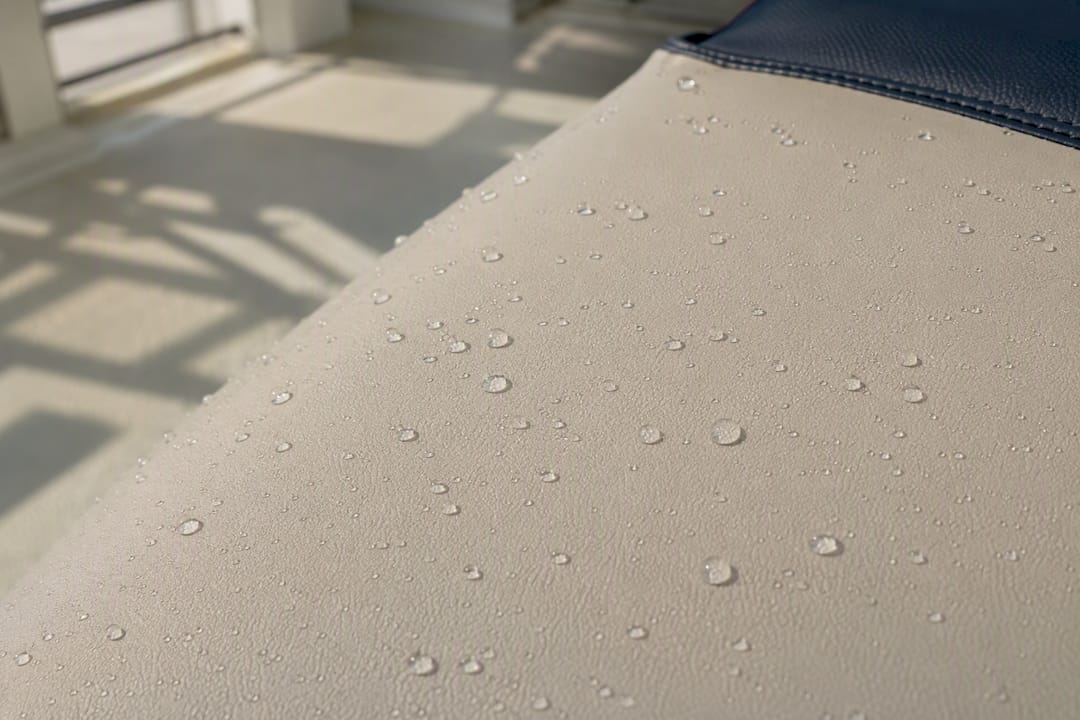
Marine vinyl wins on waterproofing, full stop. Water beads and rolls off rather than soaking in, which starves mildew of the moisture it needs to take hold. Quality vinyl also ships with UV inhibitors baked into the compound and antifungal treatments on the surface, so it resists cracking and staining season after season.
Solution-dyed acrylic takes a different approach. Instead of coating a fabric with color, the dye gets mixed into the fiber before it’s even spun, so the color doesn’t fade the way a surface-printed fabric does. That’s why solution-dyed acrylic typically lasts 5 to 10 years on covers and enclosures, versus 3 to 6 years for untreated canvas. Acrylic also breathes, which matters for biminis and tops where trapped moisture would otherwise cause condensation and mildew underneath.
Canvas and coated polyester sit at the value end. Standard canvas is water-repellent, not waterproof, so it’s a poor fit for seating that takes direct spray. It still has a place on covers where cost matters more than a decade of colorfastness.
- Marine vinyl: waterproof, high abrasion resistance, 5 to 10 year lifespan, $15 to $40/yard
- Solution-dyed acrylic: water-resistant and breathable, 5 to 10 year lifespan, $18 to $45/yard
- Coated canvas/polyester: water-repellent, budget option, 3 to 6 year lifespan, $10 to $25/yard
What UV Hours, Abrasion Ratings, and Cold-Crack Numbers Actually Tell You
Product spec sheets throw around numbers that mean nothing until you know what they measure. Here’s how to read them like someone who’s actually replaced a season’s worth of seat cushions.
UV hours (often listed from QUV testing) measure how long a fabric can sit under accelerated ultraviolet exposure before it noticeably fades. Solution-dyed acrylics can handle 1,000 to 1,500-plus hours with minimal color shift, which roughly translates to years of full Florida sun without the chalky, faded look you see on cheaper outdoor fabric.
Abrasion resistance gets measured with Martindale or Wyzenbeek rub tests, both of which simulate years of sitting, sliding, and gear scraping across the surface. Heavy-duty coated PVC collections list up to 400,000 Martindale cycles, a number that signals serious commercial-grade durability rather than residential-grade vinyl dressed up for a boat show.
Cold-crack testing matters if you dock anywhere that sees real winter. It checks whether a fabric stays flexible instead of stiffening and splitting at low temperatures, which is a bigger deal for northern liveaboards than for year-round Florida boaters.
- Look for UV ratings above 1,000 hours for anything left in direct sun
- Confirm antimicrobial or antifungal treatment is stated, not implied
- Ask what the warranty actually covers (fading vs. seam failure vs. material defects differ)
Choosing Marine Fabric by Boat Type
Different boats put different stress on upholstery, so the “right” fabric shifts depending on how you actually use the boat.
- Center consoles and fishing boats: Go with heavy marine vinyl paired with reticulated drainage foam underneath. Bait, blood, and standing water are constants here, and drainage foam keeps cushions from turning into sponges.
- Pontoons and bowriders: Vinyl still leads for seating, but solution-dyed acrylic bimini tops handle sun exposure better than untreated canvas over a full season.
- Cabin cruisers and interior salons: Softer acrylic blends or indoor-rated vinyl improve comfort where the fabric isn’t taking direct spray every outing.
- Sailboats and covers: Acrylic or treated canvas covers breathe well and resist the fading that comes from being lashed down under sun for days at a stretch.
- Special cases: Neoprene adds grip for high-performance bolster seats, while mesh panels help ventilate seating on boats that sit in the sun without much airflow. For PWCs and jet skis, cover material choice matters just as much as it does on a full-size boat.
Budgeting for Boat Upholstery: Costs and What to Ask Suppliers
Marine fabric pricing runs from roughly $10 a yard for basic coated canvas up to $45 a yard for premium coated vinyl or solution-dyed acrylic. A full reupholstery project layers labor, foam replacement, and thread on top of the fabric bill, and that’s where totals really spread out.
Representative project costs run from about $1,150 for a basic bench-seat job to $3,000 to $5,000 for a full premium fit-out with new foam, hardware, and coordinated canvas pieces. Boat size, seat count, and foam condition drive most of that variance.
Before you commit to a fabric, order physical swatches and test them under your own boat’s sun exposure rather than trusting a screen color. A few habits protect the investment:
- Match thread to fabric grade; mismatched thread is a common failure point long before the fabric itself wears out
- Confirm the foam is marine-grade and drains rather than absorbing water
- Ask specifically whether the fabric is rated for saltwater, not just “outdoor use”
- Decide upfront whether this is a DIY panel swap or a full professional refit, since seam sealing and pattern work get complicated fast on curved bolsters
How to Clean and Maintain Marine Upholstery
Fabric longevity comes down to habits more than brand name. Most premature failures we see trace back to trapped moisture, not the material itself.
- Wipe down seating after every outing with fresh water to rinse off salt before it dries into the fibers.
- Deep clean monthly with a marine-specific vinyl or fabric cleaner, and for stubborn mildew, a diluted bleach solution (no more than a quarter cup per gallon of water) works on vinyl, though never on acrylic or canvas without checking manufacturer guidance first.
- Let cushions dry completely, standing on edge if possible, before storing or covering them. Trapped moisture between cushion and seat base is the number one cause of mildew we encounter.
- Ask your upholsterer about PTFE thread and reticulated foam if you’re having anything rebuilt. Standard thread breaks down under UV faster than the fabric it’s holding together.
- Repair small seam splits immediately. A quarter-inch gap becomes a soaked cushion core within a couple of outings.
Pro Tip: Store cushions vertically with airflow between them during off-season layup instead of stacking them flat. Flat stacking traps humidity right where mildew loves to start.
What Years of Florida Refits Teach You About Fabric Failure
The most common failure we see in Florida boats isn’t the fabric wearing out. It’s the stitching or foam underneath giving out first while the fabric itself still looks fine on the surface.
- Standard polyester thread breaks down under UV exposure well before marine vinyl does, leaving perfectly good fabric hanging by loose stitches
- Closed-cell foam without drainage channels holds water against the underside of vinyl, which accelerates the exact mildew problem the vinyl was supposed to prevent
- Seams sewn without sealing let water wick sideways into the stitch line, even when the fabric itself is fully waterproof
Every seating job coming out of our shop pairs marine-grade vinyl or coated PVC with PTFE (V-92 or V-138) thread, reticulated drainage foam, and sealed underside seams. That combination addresses the actual failure points instead of just the surface fabric.
The fabric almost never fails first. It’s the thread, the foam, and the seam construction underneath that determine whether a reupholstery job lasts three seasons or twelve.
If your cushions look tired or you’re hearing that telltale squish underfoot, our interior refit team can walk the boat with you and point out exactly where the failure started.
Why the Fabric Label Isn’t the Whole Story
Most guides treat fabric choice like the entire decision. It isn’t. We’ve replaced plenty of “premium” marine vinyl that failed in eighteen months, not because the vinyl was bad, but because whoever installed it used standard thread and skipped drainage foam entirely. The fabric held up fine. Everything holding it in place didn’t.
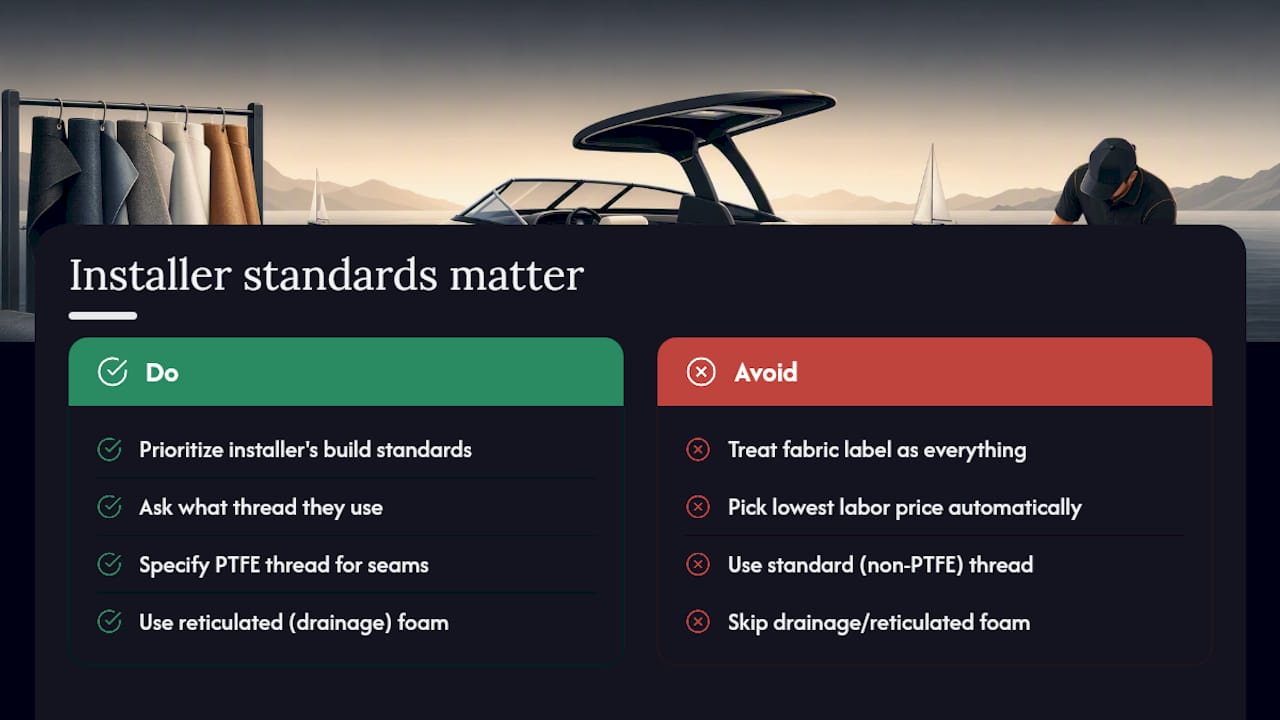
That’s the gap conventional advice skips. Shoppers spend hours comparing ounce weights and UV hour ratings, then hand the fabric to whoever quotes the lowest labor price, and the build quality underneath gets zero scrutiny. A $40 a yard vinyl installed with cheap thread over solid foam will underperform a $22 a yard vinyl installed correctly with PTFE thread and reticulated foam.
If you take one thing from this, prioritize the installer’s build standards as heavily as the fabric spec sheet. Ask what thread they use before you ask what fabric they recommend. The fabric family, vinyl for seating, acrylic for covers, gets you most of the way there. The construction choices get you the rest.
— Jason
Get Your Boat Seating Professionally Rebuilt in Florida
If the last few sections made you realize your cushions need more than a deep clean, that’s exactly the gap Mazzamarine closes for Florida yacht and boat owners. We don’t just sell you a yard of vinyl and wish you luck. We pair the right fabric for your boat type with PTFE thread, reticulated drainage foam, and sealed seams, the same build standards covered above, so the work actually holds up through Florida summers and hurricane season storage.
Whether you need a full interior refit or matching canvas work for your enclosures, our canvas upgrade specialists can walk your boat, recommend the right grade of vinyl or acrylic, and quote the job before any fabric gets cut. Reach out to schedule a walkthrough and get a real quote instead of guessing at yardage.
Sources
- Marine Vinyl vs. Canvas vs. Acrylic
- Marine Upholstery Fabric: A Complete Guide To Types, Selection, & DIY
- MARINA collection — Monteiro Fabrics
- Cost to Reupholster Boat Seats – Current Cost
Recommended
Text or Call 954-330-9653 Schedule Appointment
Mazza Marine Yacht Services & Refit

Fiberglass Upgrades and Damage Repair

Premium Yacht Paint/ Faux Teak

Fishing: Custom Rods, Reels,Tackle

Electrical, Electronics and Navigation

Paint, Hull and Gelcoat

Teak Decks, Wood Cabinets, Carpentry

Canvas, Enclosures and Upholstery

Mechanical, Repower and Running Gear

Plumbing, Bilge and Thru-Hulls

Welding and Custom Fabrication

Interior Refit And Past Work
Get your yacht value Estimate
"*" indicates required fields