
View Our Recent Work:

A well-executed mechanical refit can save Florida yacht owners 30 to 50% compared to certain rebuild options, yet most owners still assume a new vessel is the only path to peak reliability. That assumption costs time, money, and unnecessary stress. The truth is that a targeted mechanical refit can breathe new life into a vessel you already love, extending its service life by decades when done right. This guide walks you through exactly what a mechanical refit involves, how to recognize when your yacht needs one, what your options look like, and how to plan the process from start to finish.
Table of Contents
- What is a mechanical refit?
- When does your yacht need a mechanical refit?
- Mechanical refit options: What are your choices?
- Plan your refit: Steps for a successful upgrade
- Why expert coordination trumps do-it-yourself upgrades
- Upgrade your yacht with expert mechanical refit services
- Frequently asked questions
Key Takeaways
| Point | Details |
|---|---|
| Mechanical refit defined | A mechanical refit upgrades and restores key yacht systems for better reliability and performance. |
| Know when to refit | Recurring problems, age, and efficiency drops signal the right time for a mechanical overhaul. |
| Compare your options | Weigh rebuild, repower, and upgrades based on cost, warranty, and vessel lifespan. |
| Choose coordinated service | A full-service refit yard avoids costly cascade failures and ensures project success. |
What is a mechanical refit?
A mechanical refit is the process of renewing, upgrading, or repairing your yacht’s core propulsion and support systems. It is not the same as a full rebuild or a repower, and understanding those distinctions will save you from over-spending or under-investing.
Here is how the three main terms break down:
- Repair: Fixing a specific failed component without replacing the surrounding system. Fast and affordable, but limited in scope.
- Rebuild: Disassembling and reconditioning an existing engine or system using replacement parts. A rebuild costs 30 to 50% less than a repower but typically comes with a shorter service life and no manufacturer warranty.
- Repower: Removing old engines entirely and installing new ones. Higher upfront cost, but you gain modern fuel efficiency, full warranty coverage, and a longer lifespan.
- Full mechanical refit: A coordinated upgrade across multiple systems, which may include elements of all three approaches above.
The systems most commonly addressed in a mechanical, repower and running gear refit include engines, gearboxes, generators, hydraulics, marine plumbing, and HVAC. Each of these systems interacts with the others. A failing gearbox puts stress on the engine. Degraded hydraulics affect steering response. Thinking about them together, rather than in isolation, is what separates a smart refit from a patchwork fix.
“The condition of your vessel today determines the scope of work tomorrow. A thorough survey before committing to any refit plan is not optional, it is essential.”
Most Florida yachts operating in warm, salt-heavy waters benefit from periodic mechanical upgrades rather than waiting for a catastrophic failure. The subtropical climate accelerates corrosion, heat stress, and wear on rubber seals and cooling systems. Knowing your vessel’s current condition, through a professional marine survey, is the non-negotiable first step before deciding how deep your refit needs to go.
When does your yacht need a mechanical refit?
Recognizing the right moment for a mechanical refit is part art, part science. Some signs are obvious. Others are easy to dismiss until they become expensive problems.
Here are the most common red flags that signal an urgent need:
- Recurring breakdowns that happen even after recent repairs, suggesting a systemic issue rather than a one-off failure.
- Reduced top speed or sluggish throttle response, which often points to engine wear, fouled injectors, or propeller damage.
- Fuel inefficiency that has crept up over time, a sign your engine is working harder than it should.
- Overheating during normal operation, which can indicate cooling system degradation or raw water pump failure.
- Unusual vibrations felt through the hull or helm, often linked to shaft alignment issues or worn cutlass bearings.
Beyond reactive triggers, there are proactive ones. If your engines have crossed the 3,000 to 4,000 hour mark without a major service, or if you are planning an extended offshore voyage, a refit before departure is not just smart, it is responsible seamanship. Aging systems beyond their recommended service intervals are a liability on open water.
One of the most overlooked risks is the cascade effect. As full-service coordination prevents cascade failures that occur with fragmented trade work, a single neglected component can stress adjacent systems and multiply your repair bill rapidly. A worn impeller leads to overheating. Overheating warps a head gasket. A blown head gasket can ruin a cylinder. Each step in that chain is avoidable with early intervention.
Pro Tip: If your yacht has had three or more unrelated mechanical issues in a single season, stop treating them as separate events. Commission a full mechanical survey and address everything as one coordinated project. You will spend less and stay on the water longer.
For a deeper look at timing and scope, the refit guide for Florida yachts and these engine maintenance tips are excellent starting points.
Mechanical refit options: What are your choices?
Once you know a refit is needed, the next question is which type of work actually fits your situation. The answer depends on your budget, how long you plan to keep the vessel, and what level of reliability you need.
Here is a side-by-side comparison of the main options:
| Option | Relative cost | Expected lifespan | Warranty | Best for |
|---|---|---|---|---|
| Targeted repair | Low | Short term | None | Single component failure |
| Rebuild | Medium (saves 30 to 50% vs repower) | Moderate | Rarely included | Budget-conscious owners |
| Repower | High | Long (new engine life) | Full manufacturer | Long-term ownership plans |
| Full system upgrade | Highest | Longest | Varies by component | Pre-sale or major voyage prep |
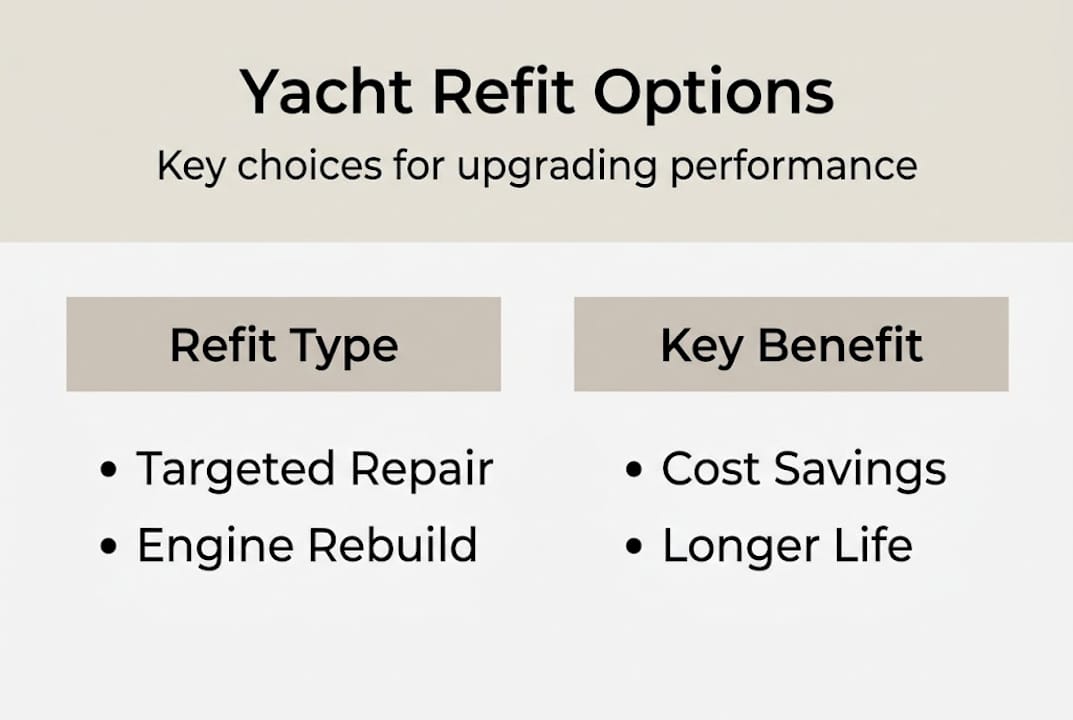
As noted, a rebuild saves 30 to 50% compared to a repower but may offer a shorter service life and no warranty protection. That trade-off is worth understanding clearly before you commit.
To help match your situation to the right approach:
- Choose repair if the failure is isolated and the surrounding system is in good health.
- Choose rebuild if your budget is tight and the vessel is not your long-term boat.
- Choose repower if you plan to keep the yacht for many years and want the peace of mind that comes with a factory warranty.
- Choose a full system upgrade if you are preparing for offshore passages, increasing resale value, or dealing with multiple aging systems at once.
The service yard you choose also shapes the outcome. Yards experienced in refit work approach projects with flexibility, which matters enormously when hidden issues surface mid-project. Learning how to reduce yacht machinery breakdowns starts with choosing the right team. Reviewing mechanical systems maintenance best practices before you start will also help you ask better questions and set smarter expectations.
Plan your refit: Steps for a successful upgrade
A mechanical refit without a clear plan is just an expensive gamble. Here is a practical step-by-step framework that Florida yacht owners can follow to keep projects on time and on budget.
- Commission a full mechanical survey. Before anything else, get a professional assessment of every major system. This sets your baseline and defines the true scope of work.
- Define your goals. Are you refitting for reliability, performance, resale value, or a specific voyage? Your goals shape every decision that follows.
- Select your refit yard carefully. As refit yards emphasize flexibility for surprises unlike the rigid processes of new-build yards, look for a team with a track record of managing complex, multi-system projects.
- Build a realistic budget with contingency. Add 15 to 20% above your initial estimate for unexpected discoveries. In older vessels especially, surprises are the rule, not the exception.
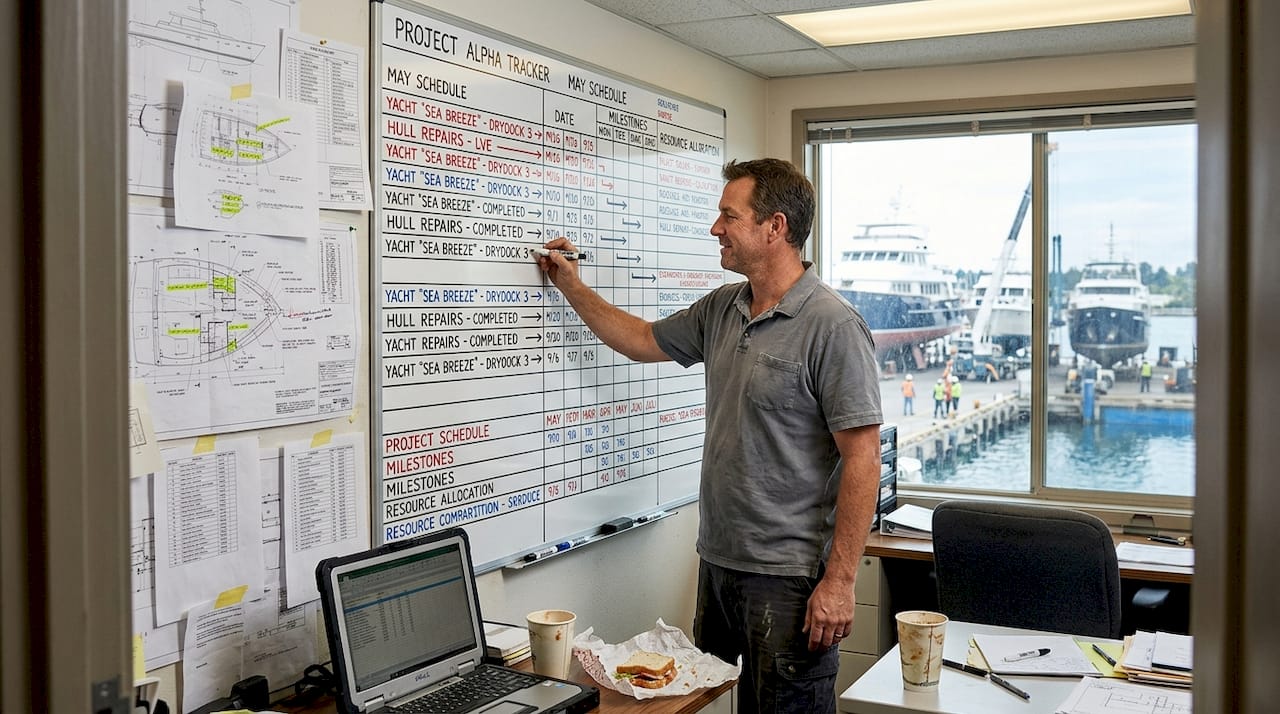
- Establish a project timeline with milestones. Break the work into phases so you can track progress and catch delays early.
- Conduct a final sea trial before accepting the vessel. Do not sign off on any refit without running the boat under real operating conditions.
Pro Tip: When vetting project managers, ask specifically how they handle cascade failures. A coordinator who can answer that question clearly and confidently is worth their weight in gold.
Here is a quick reference for common refit tasks and approximate completion times:
| Task | Typical completion time |
|---|---|
| Engine rebuild | 2 to 4 weeks |
| Repower (twin engines) | 3 to 6 weeks |
| Generator replacement | 1 to 2 weeks |
| Hydraulic system overhaul | 1 to 3 weeks |
| HVAC system upgrade | 1 to 2 weeks |
| Full plumbing refresh | 2 to 4 weeks |
For guidance on minimizing breakdowns during refit and a broader overview of the Florida refit explained process, those resources will sharpen your planning considerably.
Why expert coordination trumps do-it-yourself upgrades
Here is a perspective that does not get said often enough: the how of your refit matters just as much as the what.
Many yacht owners attempt piecemeal engine or system upgrades to save money upfront. It is understandable. But what looks like a cost-saving move often becomes the most expensive decision they make. Individual tradespeople working in isolation rarely see the full picture. One contractor replaces the raw water pump without knowing the impeller housing is corroded. Another rebuilds the gearbox without flagging the misaligned shaft. The result is a vessel that still underperforms, with a repair bill that keeps growing.
Full-service, coordinated refit teams are trained to spot interconnected issues. They address root causes, not just symptoms. As full-service coordination prevents cascade failures that fragmented trades simply cannot catch, the investment in holistic oversight pays back in reliability and vessel value many times over.
Our experience at Mazza Marine confirms this every season. The boats that come to us after a series of fragmented repairs almost always need more work than if we had been involved from the start. Expert mechanical maintenance guidance is not a luxury. It is the foundation of a vessel that performs when it matters most.
Upgrade your yacht with expert mechanical refit services
A well-planned mechanical refit is one of the smartest investments a Florida yacht owner can make. It protects your vessel, improves performance, and adds real market value when it comes time to sell.
At Mazza Marine, our network of Florida yacht experts covers everything from engine repowers and generator replacements to full system overhauls. If you are not sure where to start, review our guide on signs you need yacht repairs to identify your priorities. When you are ready to move forward, our Florida yacht refit services team is here to build a plan tailored to your vessel and your goals. Reach out to Mino, Luigi, and the Mazza Marine team today.
Frequently asked questions
How long does a typical mechanical refit take for a Florida-based yacht?
Most mechanical refits take from two weeks to several months depending on project complexity and parts availability. Flexible refit yards can often accommodate tight schedules when surprises arise mid-project.
Is a rebuild or a repower more cost-effective for an older vessel?
A rebuild typically costs 30 to 50% less than a repower but usually offers a shorter service life and no manufacturer warranty, making the right choice dependent on your long-term ownership plans.
What are the biggest dangers of delaying a mechanical refit?
Delays can trigger cascade failures, where one failing component places stress on related systems and creates a chain of increasingly costly breakdowns. Full-service coordination is the most reliable way to prevent this scenario.
Does a mechanical refit improve resale value for Florida yachts?
Yes, updated mechanical systems can significantly boost a yacht’s market value and buyer confidence, as prospective buyers place a premium on vessels with documented, professional service histories.
Recommended
Text or Call 954-330-9653 Schedule Appointment
Mazza Marine Yacht Services & Refit

Fiberglass Upgrades and Damage Repair

Premium Yacht Paint/ Faux Teak

Fishing: Custom Rods, Reels,Tackle

Electrical, Electronics and Navigation

Paint, Hull and Gelcoat

Teak Decks, Wood Cabinets, Carpentry

Canvas, Enclosures and Upholstery

Mechanical, Repower and Running Gear

Plumbing, Bilge and Thru-Hulls

Welding and Custom Fabrication

Interior Refit And Past Work
Get your yacht value Estimate
"*" indicates required fields