
View Our Recent Work:

Most boats do not need a full rewire to get onto NMEA 2000. A gateway or analog-to-digital converter can bridge your existing NMEA 0183 gear or engine senders into a modern network, and your three real options are bridging, digitizing, or replacing outright. If your boat is complex or aging, calling in a professional for a turnkey job saves you from the calibration headaches that trip up most DIY attempts.
TL;DR:
- Most boat retrofits can be completed with a gateway or converter, avoiding the need for a full rewiring, especially on simpler or older vessels.
- Correct installation requires precise backbone wiring, including two terminators at each end and power feeding from a central point to prevent network issues.
- Proper calibration and testing are crucial, with calibration errors more common than wiring faults, especially when mixing standard and non-standard sensors.
- Complex jobs like dual-station senders, engine harnesses, or a full helm rebuild should be entrusted to professionals to ensure correct wiring, calibration, and data accuracy.
- Budgeting should account for hardware, labor, and extensive commissioning time, with phased approaches reducing overall costs and risks.
Table of Contents
- What an NMEA 2000 Retrofit Actually Involves
- The Gateways, Converters, and Backbone Hardware You Will Need
- Planning the Backbone: Length, Power, and Grounding Rules
- Wiring Three Common Retrofit Scenarios Step by Step
- Configuring, Testing, and Troubleshooting the Network
- Deciding Between a DIY Job and Calling in a Professional
- Budgeting for a Realistic Retrofit Project
- Choosing Sensors and Devices That Actually Fit Your Retrofit
- Making Sure New Electronics Play Nicely With What You Already Own
- Where Retrofits Go Wrong: Senders, Stations, and Custom Curves
- What Fifteen Years of Refit Work Taught Me About These Jobs
- How Professional Shops Handle NMEA 2000 Retrofits in Florida
- Sources
What an NMEA 2000 Retrofit Actually Involves
An NMEA 2000 retrofit is not one job. It is three different jobs wearing the same name, and picking the wrong one for your boat is how a weekend project turns into a winter-long project.
NMEA 0183 and NMEA 2000 are not enemies. They coexist just fine on most boats, and that coexistence is the entire reason retrofitting is realistic instead of a demolition project. NMEA 0183 sends serial ASCII sentences point to point, usually one talker to one or a few listeners. NMEA 2000 runs on a CAN bus backbone where every device can hear every other device. A gateway sits between the two worlds and translates 0183 sentences into NMEA 2000 PGNs (parameter group numbers) in real time.
Here is how the three paths break down in practice:
- Bridge with a gateway. You keep your existing NMEA 0183 GPS, AIS, or autopilot and add a gateway that republishes that data as NMEA 2000 PGNs. This is the fastest, cheapest path, and it is the right call for a boat with a handful of 0183 instruments and one new chartplotter that only speaks NMEA 2000.
- Digitize with an analog converter. Your engine gauges, tank senders, and rudder reference are analog voltage or resistance signals with no data language at all. A converter reads those signals and publishes them as N2K data, letting your new multifunction display show engine RPM, oil pressure, and fuel level without touching the engine harness.
- Replace outright. Sometimes the smartest move is pulling old analog senders and instruments and installing NMEA 2000 native sensors from the start, particularly on boats getting a full helm refit anyway.
A weekend cruiser adding a new plotter to an old GPS and VHF is a textbook bridge job. A sportfish boat with twin diesels and analog gauges from the 1990s is a digitizing job. A yacht undergoing a helm rebuild during a larger refit is often better served by replacement, since you are already opening up the dash. Each path reduces wiring complexity differently, and each has a different ceiling on what it can eventually support, from simple data sharing to full wireless streaming across the boat.
The Gateways, Converters, and Backbone Hardware You Will Need
Two device categories do almost all the work in a retrofit, and confusing them is the single most common shopping mistake owners make.
A gateway or multiplexer translates data that is already digital. It takes NMEA 0183 sentences from your GPS, AIS, or old autopilot and converts them into NMEA 2000 PGNs, or vice versa. It does not create data from nothing. An analog-to-digital converter does the opposite job: it reads a raw electrical signal (a resistance value from a fuel sender, a voltage pulse from a tachometer pickup) and turns it into digital NMEA 2000 data for the first time. A unit like Actisense’s EMU-1 engine monitoring device handles multiple gauge inputs, alarm inputs, and two tachometer inputs, then outputs standard N2K engine PGNs once you configure it for your specific senders.
Before you buy a converter, verify three input types against your actual sensors:
- Resistive inputs for fuel, water, and temperature senders, since resistance curves vary by manufacturer.
- Pulse inputs for tachometers and speed sensors, which need the right pulses-per-revolution setting.
- Age-specific inputs where dual-engine boats need two independent channels calibrated separately.
Configuration is not optional here. Out-of-the-box settings assume standard senders, and if your engine has an aftermarket or non-standard sender, the readings will be wrong until you dial in the calibration curve.
On the backbone side, your shopping list should include T-connectors at every device drop, 120-ohm terminators (you need exactly two, one at each end of the backbone), a fused power feed with the correct gauge wire for your run length, and a running tally of your network’s total Load Equivalency Number, or LEN, so you do not overload the bus.
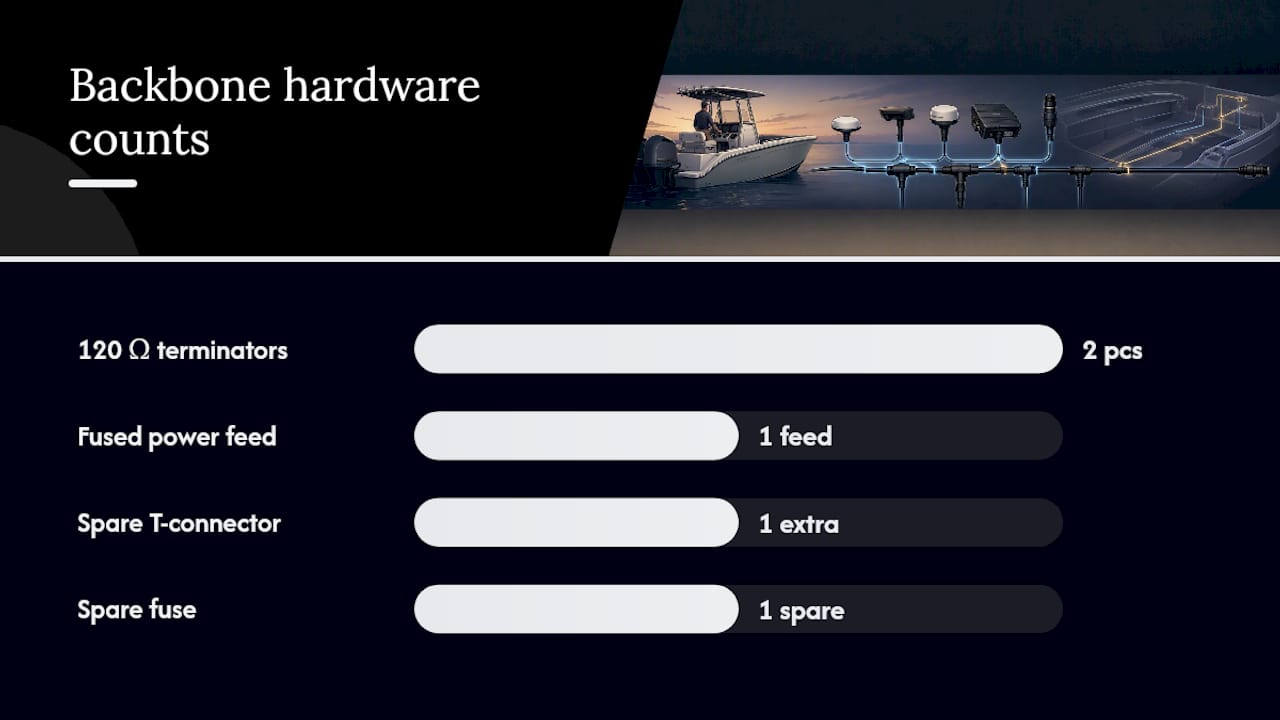
Pro Tip: Buy one extra T-connector and one spare fuse of the correct amperage before you start. Nothing kills retrofit momentum faster than a hardware store run mid-install for a $4 part.
Planning the Backbone: Length, Power, and Grounding Rules
Get the backbone wrong and every downstream device inherits the problem, whether that shows up as flaky depth readings or a network that drops out every time you start the generator.
NMEA 2000 runs as a multi-drop CAN bus network at 250 kbps, built around a twisted-pair backbone cable with short drop cables branching off through T-connectors to reach each device. The rules governing that backbone exist because CAN bus electrical signaling is sensitive to cable length and impedance mismatches.
Follow these five planning rules before you cut a single cable:
- Keep every drop cable at 6 meters or less, running from the T-connector to the device.
- Install exactly two 120-ohm terminators, one at each physical end of the backbone, never more and never fewer.
- Feed power into the backbone at a single point, ideally near the center of the run, using a fused connection sized to your total network current draw.
- Never power the N2K bus from your multifunction display’s port. MFDs are not designed to carry backbone current, and doing so risks brownouts across the whole network as you add devices.
- Keep the backbone shield connected properly at one point per NMEA 2000 wiring standards to avoid ground loops that show up as electrical noise in your data.
The two-terminator rule is worth dwelling on because it is the most common wiring mistake on boats built up over multiple projects. Every backbone needs precisely two 120-ohm terminators at the physical ends of the network. Add a third and the network can behave erratically, dropping devices intermittently or refusing to boot at all. Miss one entirely and you may see no data whatsoever.
Budget your current draw with the same discipline. Every NMEA 2000 device consumes a Load Equivalency Number, and standard-gauge backbone cable can only carry so many LEN before voltage drops too low at the far end of the run. On a boat with a long run from the helm to the stern, that often means switching to heavy-gauge backbone cable or adding a second power injection point rather than daisy-chaining twenty devices off one feed. If your boat already runs lithium house batteries with CAN bus monitoring, a product like the Skyenergi Elite battery system shows how battery-side CAN networks and NMEA 2000 backbones can run in parallel without interfering, as long as grounding stays isolated between the two.
Wiring Three Common Retrofit Scenarios Step by Step
Three scenarios cover the overwhelming majority of retrofit jobs, and walking through each in order shows how the complexity scales.
Scenario one: the simple autopilot and plotter bridge. You have an aging NMEA 0183 autopilot and GPS, plus a new NMEA 2000 chartplotter that needs that data.
- Confirm the baud rate on both your GPS and autopilot output ports, since most run at 4,800 bps while AIS units typically run at 38,400 bps.
- Wire the 0183 devices into the gateway’s input ports, matching baud rate settings in the gateway’s configuration software.
- Connect the gateway to the N2K backbone through a T-connector and drop cable.
- Power up and confirm position and heading data appear on the new plotter.
Scenario two: engine analog conversion. Your gauges are original analog senders and you want engine data on a modern display, following the staged pattern of senders, then digitizer, then network.
- Map and label every existing sender wire at the engine before disconnecting anything.
- Wire senders into the converter’s resistive, pulse, or tach inputs matching each sender type.
- Configure the converter’s gauge curves using the manufacturer’s PC software.
- Connect the converter to the backbone and verify readings against a known-good analog gauge.
Scenario three: full helm retrofit. Multiple instruments, a new plotter, and engine data all converging at once, which is where most owners underestimate the wiring time.
- Photograph and label every existing wire run before removing old instruments.
- Install the backbone first, then add gateways and converters as drops.
- Bring in each data source (GPS, engine, wind, depth) one at a time, testing after each addition.
Before you apply power to a freshly wired backbone, run through this checklist: confirm every T-connector is fully seated, verify both terminators are installed at the true physical ends, check that shield connections are landed correctly, and test your fuse rating against your calculated current draw. Once power is on, check backbone voltage at both ends of the run, then open an NMEA reader tool and confirm live PGNs are streaming before you reconnect a single display.
Configuring, Testing, and Troubleshooting the Network
A retrofit is not finished when the wiring is done. It is finished when you can prove the data is correct, and that proof requires the right tools and a methodical process.
Baud rate mismatches cause more failed conversions than any other single issue. Many older instruments transmit at 4,800 bps while AIS units commonly use 38,400 bps, and if your gateway is configured for the wrong rate, it will not error out, it will simply stay silent. That silence is the number one reason DIYers assume a gateway is defective when it is actually just misconfigured.
PGN mapping is the next layer to understand. Each NMEA 2000 data type, position, depth, wind, engine RPM, has a corresponding PGN, and translation tables show exactly which 0183 sentence maps to which PGN. You do not need to memorize these, but your gateway’s configuration software should let you see which PGNs are active. Mapping only the PGNs you actually need, rather than broadcasting everything by default, reduces bus chatter and keeps the network responsive as you add more devices down the road.
A PC-based configuration tool connected through a USB or Ethernet gateway is how you actually diagnose problems rather than guess at them. These tools display live PGNs streaming across the bus in real time, which turns “the depth isn’t showing up” into a specific, solvable question: is the PGN present at all, or present but not reaching the display?
Run through this list when something is not working right:
- No data at all: check baud rate first, then verify the gateway is actually powered and wired into the backbone, not just the sensor.
- Wrong readings: recheck converter calibration curves against your sender’s actual specification.
- Intermittent values: suspect a loose T-connector or a backbone terminator that is not fully seated.
- Calibration drift over time: corroded sender connections are the usual cause, especially in bilge or engine-room environments.
Pro Tip: Update gateway and converter firmware before you troubleshoot anything else. Manufacturers frequently patch PGN handling bugs, and a five-minute firmware check can save you an afternoon of chasing a phantom wiring fault.
Deciding Between a DIY Job and Calling in a Professional
Some retrofit work is genuinely approachable for a patient owner with a multimeter and a Saturday. Other work carries enough risk of expensive rework that hiring it out is the cheaper choice in the long run, even before you count your own time.
Hand these tasks to a professional rather than learning them on your own boat:
- Dual-station sender replacement, since removing one gauge or helm station changes the electrical resistance the remaining sender sees, and getting that math wrong means every reading downstream is off.
- Engine harness work, where a wiring mistake can damage expensive engine control modules.
- Calibration of custom or non-standard gauge curves, particularly on older or aftermarket senders with no published specification.
- Complex multiplexing or J1939 conversions, common on diesel engines with digital engine data that needs translation into standard N2K PGNs.
A professional retrofit package worth paying for should include a written survey of your existing systems, a wiring plan showing backbone routing and power injection points, an itemized parts list, the installation itself, and a commissioning step where every PGN is verified against a known-good reading before the technician leaves the boat.
Cost and time on these jobs scale mostly with two things: how many analog senders need digitizing, and how much of the existing wiring is reusable versus needing replacement. A simple bridge job might take an afternoon. A full helm retrofit with engine digitizing and multiple instrument replacements is a multi-day project, and that is true whether you do it yourself or hire it out. Mazzamarine’s electronics refit guide walks through how these projects typically scope out on Florida yachts.
Budgeting for a Realistic Retrofit Project
Retrofit costs break into three buckets, and owners who skip straight to “how much for a gateway” usually undercount the project by half.
The first bucket is hardware: gateways, converters, backbone cable, T-connectors, terminators, and a fused power feed. This is the smallest line item on most jobs, and it is also the most predictable, since you are pricing known parts against a known parts list.
The second bucket is labor, and it scales directly with how many analog senders you are digitizing and how accessible your existing wiring is. A boat with clean, labeled wiring behind an accessible dash panel costs far less to retrofit than one where the previous owner ran wires through the bilge with no documentation at all.
The third bucket, and the one almost everyone forgets to budget for, is calibration and commissioning time. Configuring a converter for a non-standard sender, verifying PGNs with a reader tool, and cross-checking every gauge against a known reference takes real hours, and rushing this step is how boats end up with a network that “mostly works” but reads fuel level wrong at the quarter-tank mark.
A sensible way to scope your own budget is to separate the project into phases: bridge your existing 0183 gear first and confirm it works, then digitize engine and tank senders as a second phase, then consider full replacement of aging instruments only if the first two phases leave gaps. Phasing the work this way lets you spread cost over time and avoids paying to rewire something that a $200 gateway would have solved just as well.
Choosing Sensors and Devices That Actually Fit Your Retrofit
Not every NMEA 2000 sensor on the market is interchangeable with what came off your boat, and matching specifications matters more than matching brand names.
Start by identifying whether your existing sender is resistive, pulse-based, or a simple switch. Fuel and water tank senders are almost always resistive, reporting a variable resistance across a range like 0 to 190 ohms depending on manufacturer. Tachometer and speed sensors are typically pulse-based, and the converter needs to know the pulses-per-revolution value for your specific engine, not a generic default. Getting this wrong is why some owners see an RPM gauge that reads exactly double or half the true value.
For new sensors going into a retrofit, look for devices that publish standard NMEA 2000 PGNs rather than proprietary data formats, since proprietary formats often only display correctly on the same manufacturer’s own screens. Depth, wind, and GPS sensors have been standardized long enough that compatibility is rarely an issue, but engine-side sensors and tank senders still vary enough between manufacturers that checking the specification sheet against your converter’s supported input range is worth the ten minutes it takes.
If you are adding a device to a network that already has several instruments running, check its Load Equivalency Number against your remaining backbone budget before installing, not after.
Making Sure New Electronics Play Nicely With What You Already Own
The instruments already on your boat were not designed with a retrofit in mind, and that mismatch shows up in ways that are easy to misdiagnose as a bad connection.
Older NMEA 0183 devices often use proprietary sentence variations that a generic gateway does not fully translate, meaning some data fields (a wind angle correction, a specific alarm state) may not carry through even when the basic position and heading data works fine. This is not a wiring fault. It is a translation gap, and the fix is usually a gateway with a documented sentence support list rather than a generic low-cost unit.
Depth, speed, and wind instruments installed decades apart from each other sometimes use different reference points or units internally, so even after a successful NMEA 2000 conversion, you may need to adjust display settings on your new plotter to match the calibration your old analog gauge used. This is a configuration step, not a hardware problem, and it is easy to mistake for a converter fault if you do not know to check display-side unit settings first.
Multifunction displays from different manufacturers generally read standard NMEA 2000 PGNs correctly since the protocol is standardized, but proprietary extensions, radar overlays, and some autopilot integrations can be manufacturer-specific. If your retrofit plan includes a new autopilot alongside an older plotter, verify autopilot compatibility with your specific display brand before wiring anything permanently.
Where Retrofits Go Wrong: Senders, Stations, and Custom Curves
The single most expensive mistake in a retrofit is not a wiring error. It is misunderstanding what happens electrically when you change a sender setup that feeds more than one gauge.
Dual-station boats, common on sportfish and center console layouts with a lower and upper helm, often run one sender feeding two gauges wired in parallel or series. You cannot simply add a digitizing converter to that same sender without accounting for the changed electrical load. If you remove one of the two gauges from the circuit, the remaining resistance the sender sees changes, and every reading downstream shifts unless you either replace the sender with a single-station unit or precisely recalibrate the converter to compensate.
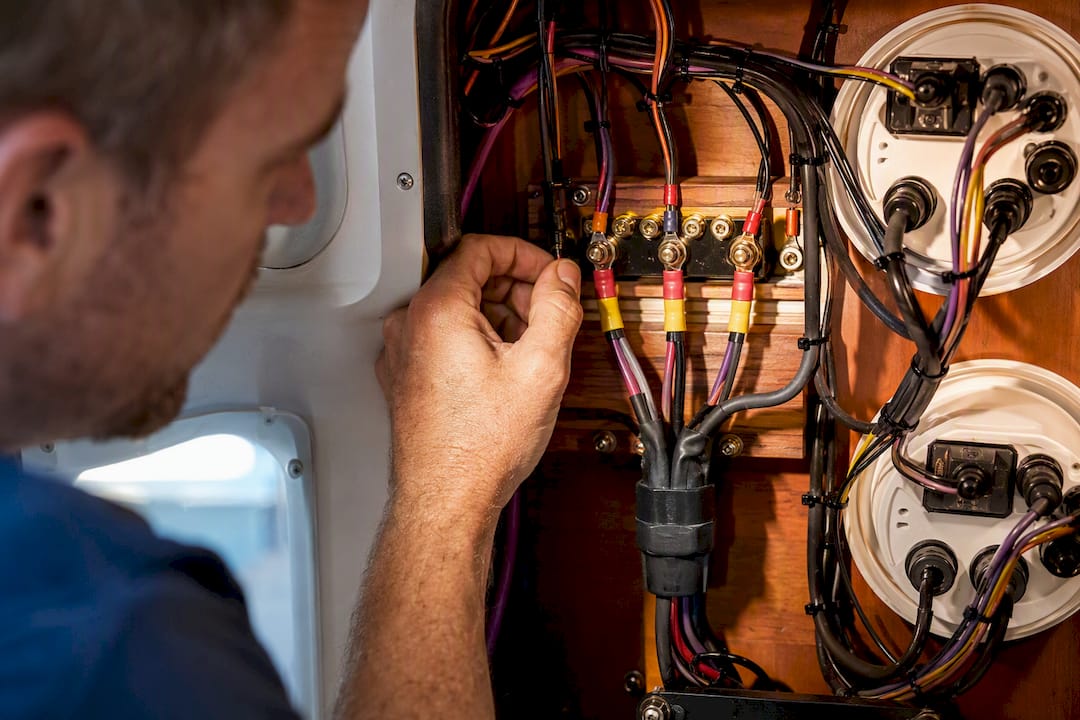
Custom gauge curves are the second major pitfall. Standard converters ship configured for common, widely used senders. If your boat has an aftermarket sender, a rebuilt engine with a non-original sensor, or simply an older sender whose resistance curve does not match modern published specifications, the out-of-the-box calibration will be wrong, sometimes subtly enough that you will not catch it until the gauge reads full when the tank is actually at a quarter.
Marine technicians who work on these systems regularly point to calibration as the most error-prone step in the entire retrofit process, more so than the wiring itself. The wiring either works or it does not. Calibration can look like it is working while quietly reporting the wrong number, which is a far harder problem to catch without deliberately testing against a known reference.
What Fifteen Years of Refit Work Taught Me About These Jobs
The retrofits that go sideways almost never fail because of the gateway. They fail because someone assumed an old sender would behave exactly like a new one, and corrosion or a decades-old resistance curve proved otherwise.
I have seen dual-station setups where a well-meaning owner added a digitizer to one gauge circuit without realizing the second station’s wiring was still pulling current, throwing every reading off by a consistent, maddening margin. I have also seen boats where the “broken” sender turned out to be a perfectly good part wired to a corroded ground lug that had been quietly failing for years before anyone touched the network.
My honest advice: photograph your harness before you disconnect anything, label every wire with tape and a marker even if you are certain you will remember, and keep a spare fuse and T-connector aboard after commissioning, because vibration and salt air do not respect a finished project. The retrofit that seems simplest on paper, a basic gateway bridging an old GPS, is usually fine for a confident DIYer. The one with dual stations, custom senders, or a full helm rebuild is where the math and the metal both need real experience.
— Jason
How Professional Shops Handle NMEA 2000 Retrofits in Florida
If your retrofit involves dual-station senders, engine harness work, or a helm that needs more than a single gateway box, a professional service can provide a written plan instead of a parts list and a guess. That is the real difference between hiring a shop and buying a converter online and hoping the calibration guide covers your exact sender.

Some electronics teams handle the full scope of a retrofit under one roof: nav electronics wiring, backbone installation, engine digitizing, and the commissioning step where every PGN gets verified against a known-good reading before the job is called done. That last part matters more than owners expect, since a network that “looks finished” and one that is actually calibrated correctly can look identical until the numbers are checked against the tank.
When you contact the shop, expect a survey of your existing wiring first, a written plan covering backbone routing and parts before any cutting starts, and a commissioning report once the install is live. Whether you are adding a single plotter to old NMEA 0183 gear or rebuilding a full helm as part of a larger refit, our navigation upgrade services cover the wiring plan through final testing. Reach out for a survey and a straight answer on scope before you buy a single part.
Sources
For readers who want to go deeper on wiring rules or PGN behavior, a few sources are worth bookmarking. Actisense’s technical guide to retrofitting NMEA 2000 covers gateway selection and staged installation in detail. Ocean Science & Technology’s network guide explains backbone topology and terminator placement clearly. For a hands-on walkthrough of digitizing engine data, Practical Boat Owner’s conversion article shows the process on a real boat, start to finish.
- Retrofitting NMEA 2000 onto a boat with legacy NMEA 0183 equipment
- NMEA 2000 / NMEA 0183 guide
- How to convert analogue engine data and battery levels to show on your chartplotter — Practical Boat Owner
Recommended
Text or Call 954-330-9653 Schedule Appointment
Mazza Marine Yacht Services & Refit

Fiberglass Upgrades and Damage Repair

Premium Yacht Paint/ Faux Teak

Fishing: Custom Rods, Reels,Tackle

Electrical, Electronics and Navigation

Paint, Hull and Gelcoat

Teak Decks, Wood Cabinets, Carpentry

Canvas, Enclosures and Upholstery

Mechanical, Repower and Running Gear

Plumbing, Bilge and Thru-Hulls

Welding and Custom Fabrication

Interior Refit And Past Work
Get your yacht value Estimate
"*" indicates required fields