
View Our Recent Work:

Osmosis treatment cost typically varies by extent of damage, from a lower rate for spot repairs on small blister patches, to a mid-range cost for partial-hull treatments, and higher for full-hull cures on boats with widespread laminate damage. On a cruiser of typical length, the price difference may be significant, ranging from a few thousand dollars for minor repairs to well over ten thousand for a full treatment requiring haul-out and long drying times.
Three things push a quote from the low end to the high end faster than anything else: how long the hull needs to dry (weeks versus months), whether the yard finds deep laminate damage requiring relamination, and how many months of haul-out and storage fees stack up while the hull cures. A boat with a few dime-sized blisters near the waterline is a different animal than one with a laminate soaked through below the boot stripe.
Before you sign anything, get a professional moisture survey. Guessing at scope from the outside is how owners end up arguing with a yard over a change order six weeks into the job.
- Spot repair: moderate cost per foot, typically completed within days to a few weeks
- Partial-hull treatment: higher cost per foot, with drying and preparation taking several weeks
- Full-hull cure: substantial cost per foot, generally involving multi-month drying and extensive labor
- Biggest cost multipliers: drying time, relamination need, extended storage
Key Takeaways
Professional osmosis treatment cost depends far more on drying time and laminate depth than on boat length alone, and a moisture survey before any quote is the single best money-saving step an owner can take.
| Point | Details |
|---|---|
| Get a survey first | A moisture map lets yards price selectively instead of defaulting to full-hull quotes. |
| Budget by severity, not just length | Spot repairs run $1,500–$4,000; full cures on 30–40 ft boats run $12,000–$22,000. |
| Drying drives the timeline | Full cures often take three to six months, with storage fees accumulating throughout. |
| Ask for itemized quotes | Separate inspection, blister removal, drying, materials, labor, and storage on every bid. |
| Prevent rather than remediate | Regular haul-outs and epoxy barrier coats cut future osmosis risk more cheaply than any cure. |
| Get help scoping the job | Mazzamarine builds itemized quotes with moisture mapping and separated storage costs for Florida owners. |
Table of Contents
- Osmosis Treatment Pricing: What Actually Drives the Quote
- What Happens During a Professional Osmosis Cure?
- How Much Should You Budget by Boat Length and Severity?
- Why Does Drying Time Add So Much to the Final Bill?
- Should You Attempt Osmosis Repair Yourself?
- How Do You Get an Accurate, Comparable Quote?
- Preventing Osmosis Before It Becomes a Repair Bill
- What Does a Real Osmosis Invoice Actually Look Like?
- Where to Read More on Osmosis Diagnosis and Cost
- What Owners Get Wrong About Osmosis Budgeting
- Get a Straight Answer on Your Osmosis Repair Cost
- Frequently Asked Questions About Osmosis Treatment Cost
- Sources
Osmosis Treatment Pricing: What Actually Drives the Quote
Two boats the same length can get wildly different quotes, and it rarely comes down to the yard padding one bill. It comes down to what’s actually happening inside the laminate.
Severity and scope matter more than length. A hull with a dozen small blisters confined to one section costs far less to treat than a hull peppered with hundreds of blisters, or one where moisture has traveled deep into the glass rather than sitting between gelcoat and laminate. True osmosis, chemical decomposition of the resin itself, is a different repair than a coating blister that never touched the structural glass, and distinguishing the two is the first job any competent surveyor does.
Hull shape changes per-foot math too. A deep-V sportfish carries more wetted surface area per foot of length than a flat-bottomed sailboat of the same LOA, so per-foot estimates only work as a rough starting point, not a promise.
Material choice adds another layer. Epoxy barrier coat systems cost more upfront than polyester-based alternatives, but they hold up longer against future water intrusion, a tradeoff worth weighing against how long you plan to keep the boat.
Then there’s labor intensity. Grinding gelcoat off a 40-footer by hand takes days; sandblasting speeds it up but adds equipment fees and cleanup costs. If moisture reached the structural laminate, core repair or partial relamination can double the labor line item alone.
- Severity: isolated blisters vs. widespread laminate saturation
- Hull geometry: wetted surface area, not just LOA
- Material system: epoxy barrier vs. polyester
- Prep method: hand grinding vs. sandblasting
- Labor and yard rates: regional and seasonal swings
- Hidden fees: moisture testing, extended storage, surveyor sign-off, relaunch
Pro Tip: Ask every yard to quote moisture testing and storage as separate line items rather than folding them into “labor.” That single request exposes more padding than any other question you can ask.
What Happens During a Professional Osmosis Cure?
A legitimate treatment follows a sequence, and skipping steps to save money is usually how owners end up paying twice.
- Survey and moisture mapping. A surveyor uses a moisture meter to chart wet zones across the hull, giving the yard a real target instead of a guess. Insisting on a moisture map before signing off on a quote lets the yard price selectively rather than defaulting to “full hull,” which is almost always the pricier option.
- Blister removal and inspection. Techs grind out each blister down to sound laminate, then inspect what’s underneath. This is where a “small” job sometimes becomes a “large” one, because surface blisters can hide deeper saturation.
- Drying. The hull sits under forced-air dryers or dehumidifiers, sometimes for months, since trapped moisture has to fully evaporate before any coating goes on. This stage is the single biggest reason full cures take so long.
- Core repair or relamination. If moisture penetrated the structural glass, sections get cut out and rebuilt. Severe cases can require a full gelcoat strip and relamination, and in the worst scenarios the repair cost approaches the value of the boat itself.
- Epoxy barrier coats and finish. Once dry, the yard applies epoxy primer and barrier coats, then gelcoat or paint finish, followed by antifouling.
- Quality checks and warranty sign-off. A final moisture reading confirms the hull is dry before launch, and reputable yards back the work with a written warranty.
Each stage has its own labor and material cost, which is exactly why itemized quotes matter more than a single lump-sum number.
How Much Should You Budget by Boat Length and Severity?
Numbers help more than percentages here, so let’s get specific.
Spot repairs apply when a survey turns up a handful of isolated blisters, usually near the waterline, with no sign of deep laminate involvement. Expect $1,500 to $4,000 total on most boats under 35 feet, done in days rather than weeks. This is the repair category where DIY overlaps most with professional work, and where a smart owner can save real money by catching the problem early.
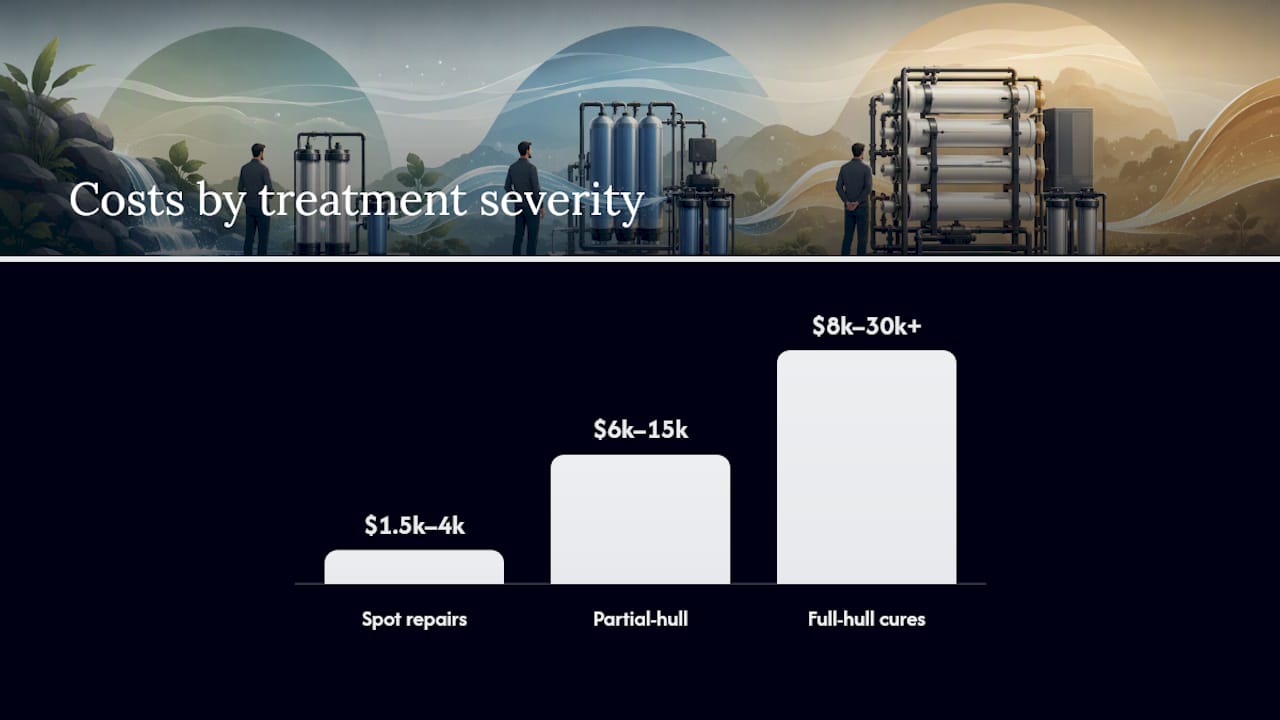
Partial-hull treatments cover a section of the hull, often the bottom half below the waterline, where blistering is widespread but hasn’t penetrated the structural laminate. Budget $6,000 to $15,000 on a 30 to 40-foot boat, with the job running four to eight weeks including drying time.
Full-hull cures mean stripping the entire hull, drying it completely, and rebuilding the barrier system from scratch. This is where the industry-standard per-foot rate, historically quoted around £150 to £200 per foot in UK yard reporting, translates roughly to the $300 to $500+ per foot range common in US yards once you factor in labor rates, drying equipment, and materials.
Here’s how that maps to common lengths:
- 25–30 ft: $8,000–$14,000 for a full cure; $3,000–$6,000 for partial
- 30–40 ft: $12,000–$22,000 for a full cure; $6,000–$15,000 for partial
- 40–50 ft: $18,000–$30,000+ for a full cure; $10,000–$20,000 for partial
Published cost comparisons from industry sources tracking osmosis remediation show a similarly wide spread between DIY materials-only budgets, preventive yard treatments, and full remediation, reinforcing a pattern worth remembering: early intervention often runs two to three times cheaper than waiting until the blistering is severe.
Court records have also documented itemized osmosis invoices running into the thousands once deeper structural issues surfaced mid-job, a reminder that an initial estimate is a starting point, not a ceiling, when a yard opens up the hull and finds more than expected.
If you’re staring at a 45-foot sportfish with moderate blistering across the bottom third, budget toward the middle of the partial-hull range and ask your surveyor point-blank whether they see any laminate saturation. That single answer moves your number more than anything else in the quote.
Why Does Drying Time Add So Much to the Final Bill?
Drying is the part owners underestimate every single time. A hull that’s been soaking up water for a decade doesn’t give it back in a weekend, and the yard can’t apply barrier coats to a laminate that’s still releasing moisture. Depending on saturation level and climate, drying windows run anywhere from six weeks to six months.
That stretch of time isn’t free. Every week the boat sits on stands is a week of haul-out fees, storage, and often insurance adjustments, on top of the repair labor itself. Owners who forget to budget for this end up shocked by a final invoice that’s 20 to 30 percent higher than the repair quote alone.
- Haul-out and lift fees: typically $10–$20 per foot, one-time
- Storage during drying: often $15–$40 per foot per month, depending on region and yard capacity
- Moisture testing and lab analysis: $150–$500 for professional readings and reports
- Warranty coverage: frequently included but confirm terms in writing
- Re-launch fee: usually bundled with haul-out but ask to confirm
Add repair cost, storage across the full drying window, and re-launch fees together to get your real total, not just the labor line the yard quotes upfront.
Should You Attempt Osmosis Repair Yourself?
If a survey confirms a handful of small, isolated blisters with no deep laminate involvement, a DIY spot fix with epoxy filler and gelcoat repair kits is a reasonable option, and it’s a far cheaper way to handle early-stage cosmetic damage. Our DIY gelcoat repair guide walks through what that looks like on a small scale.
Widespread blistering or any sign the moisture reached structural glass is where DIY stops making sense. Sealing a coating over a hull that hasn’t fully dried traps moisture inside the laminate, which accelerates the very problem you’re trying to fix.
- DIY works for: a few isolated surface blisters, confirmed cosmetic-only by survey
- Professional work required: widespread blistering, structural laminate involvement, or any core damage
- Risk of DIY on serious cases: sealing in moisture, voiding manufacturer or yard warranties
- Resale risk: buyers and surveyors often discount hulls with undocumented DIY osmosis work, sometimes more than the repair would have cost
How Do You Get an Accurate, Comparable Quote?
Getting three quotes that actually compare apples to apples takes more preparation than most owners expect.
- Gather your documentation first. Have your LOA, hull material, any prior repair history, recent photos of visible blistering, and a copy of your latest survey ready before you call a yard.
- Request an itemized breakdown, not a lump sum. Ask for separate lines covering inspection, blister removal, drying, materials, labor, haul-out, storage, and relaunch.
- Insist on a moisture map as part of the quote process. Surveyors who chart wet zones precisely let a yard price the actual affected area instead of defaulting to a full-hull number out of caution.
- Ask for a realistic drying timeline in writing, and ask what happens to the price if drying runs longer than estimated.
- Get the warranty terms in writing before you sign, including what voids it.
Watch for red flags: a quote with no moisture map, a drying estimate under four weeks on a hull with any real saturation, or pricing that’s a single number with no breakdown. Any of those is a reason to get a second opinion before committing.
Pro Tip: Owner forums are full of stories where drying and storage costs ballooned the final bill well past the original estimate. Always ask the yard to separate the drying/storage line from the repair labor line, because that’s where quotes quietly grow.
Preventing Osmosis Before It Becomes a Repair Bill
The cheapest osmosis treatment is the one you never need. Keeping the hull dry between seasons, through regular haul-outs and proper storage, is the single highest-leverage habit against future blistering, and our guide to climate-driven maintenance scheduling covers how Florida’s heat and humidity change that calendar.
Applying a quality epoxy barrier coat, even on a hull with no current symptoms, is widely recommended by marine coating specialists as meaningfully reducing future osmosis risk, especially on boats that stay in the water year-round. Pair that with sealed, well-maintained thru-hulls and a bilge that doesn’t sit wet for weeks at a time, since chronic dampness inside the hull contributes to the same moisture migration that causes blistering from outside.
- Schedule regular haul-outs and hull inspections, not just when something looks wrong
- Apply epoxy barrier coats proactively on older polyester hulls
- Keep bilges dry and thru-hull seals in good condition
- Get a moisture check every one to two years, especially on boats over 15 years old
What Does a Real Osmosis Invoice Actually Look Like?
Every osmosis quote Mazzamarine builds starts with the same question a good surveyor asks first: is this cosmetic, or is it structural? That distinction decides whether an owner is looking at a four-figure weekend job or a five-figure season-long project, and getting it wrong in either direction costs money.
A typical itemized invoice on a moderate case includes inspection and moisture mapping, blister grind-out labor, drying equipment rental across the dry-out period, epoxy barrier materials, application labor, and haul-out and storage fees tracked separately from the repair itself. Owners who ask for that breakdown upfront rarely get surprised at pickup.
The invoices that go smoothly are the ones where the owner asked for a moisture map and a written drying timeline before any grinding started. The ones that go sideways are almost always missing one of those two things.
- Inspection and moisture mapping documented before work begins
- Drying and storage tracked as separate, transparent line items
- Written warranty terms attached to the final invoice, not verbal promises
More detail on how full-hull scoping and sample invoices work is in our fiberglass blister and osmosis repair guide for Florida yachts.
Where to Read More on Osmosis Diagnosis and Cost
- How to recognize osmosis — Interlux expert advice
- Osmosis – the professional treatment — Practical Boat Owner
- What is boat osmosis? Guide to causes, treatment & prevention — CraftInsure
- Marine ceramic coating: what owners need to know — Diamondbrite
What Owners Get Wrong About Osmosis Budgeting
The conventional advice treats osmosis treatment cost like a simple per-foot lookup table, and that’s where most owners get burned. The real number depends far more on drying time and laminate depth than on length, yet nearly every online estimate leads with a per-foot figure as if it’s the whole story.
The bigger blind spot is storage. Owners fixate on the repair labor line and forget that three to six months of haul-out fees can rival the treatment cost itself. I’d argue the smartest move isn’t shopping for the lowest labor quote. It’s asking every yard the exact same question: what’s your realistic drying timeline, and what does storage cost during that window?
Get the moisture map before you get the quote. A surveyor’s findings turn a vague “full hull treatment” estimate into a scoped, itemized bid that you can actually negotiate. Skip that step, and you’re negotiating blind against a number the yard picked to cover their worst-case scenario.
Get a Straight Answer on Your Osmosis Repair Cost
Getting three vague ballpark numbers from three different yards doesn’t actually tell you what your boat needs. What you need is a real moisture survey, an itemized quote, and someone who separates the drying and storage costs from the repair labor before you ever sign anything. That’s the exact process Mazzamarine runs on every osmosis case across Florida, from a quick spot repair to a full-hull cure with relamination.
Whether you’re evaluating a boat before purchase or dealing with blistering on a boat you already own, Mazzamarine’s network of Florida yacht specialists can scope the job properly, itemize every line item, and give you a drying timeline you can actually plan around instead of guessing at. Our comprehensive marine repair service guide covers how we structure these projects from first inspection to relaunch. If you’re trying to reduce the odds of ever needing this kind of repair again, our maintenance package guide walks through the ongoing care that keeps hulls dry between haul-outs.
Reach out to Mazzamarine for a real inspection and an itemized quote before you commit to any yard’s number.
Frequently Asked Questions About Osmosis Treatment Cost
Is osmosis treatment covered by boat insurance?
Most marine insurance policies treat osmosis as a maintenance issue rather than a covered peril, since it develops gradually rather than from a sudden event. Some policies offer optional osmosis coverage or partial reimbursement, so check your specific policy wording rather than assuming coverage exists.
How does osmosis affect a boat’s resale value?
A survey showing osmosis typically leads to a price reduction equal to the estimated repair cost, or the seller agreeing to complete repairs before closing. Buyers should always get an independent survey before finalizing a purchase, since undisclosed blistering is one of the most common post-sale disputes in the used boat market.
Are laser-based osmosis detection tools worth the extra cost?
Some yards now offer laser or advanced moisture-scanning diagnostics that map hull moisture more precisely than a traditional handheld meter alone. They add a modest fee to the survey but can reduce guesswork on borderline cases, which sometimes saves money by avoiding an unnecessarily large scope of work.
Can I finance osmosis treatment through the yard?
Many yards offer payment plans or work with third-party marine financing for larger jobs, particularly full-hull cures running into five figures. Ask about financial options for osmosis treatment directly with your chosen yard, since terms vary widely by region and shop size.
How long does a warranty on osmosis treatment typically last?
Warranty terms vary by yard and by the barrier system used, with many professional treatments backed by multi-year written warranties covering the specific work performed. Always get warranty terms in writing before the job starts, not after you’ve paid the final invoice.
Sources
- How to recognize osmosis — Interlux expert advice
- Osmosis – the professional treatment — Practical Boat Owner
- Keeping your boat afloat: how to find and fix hull moisture — Yachting Monthly
- Osmosis on polyester hulls: detect, treat and prevent — YachtMate
Recommended
Text or Call 954-330-9653 Schedule Appointment
Mazza Marine Yacht Services & Refit

Fiberglass Upgrades and Damage Repair

Premium Yacht Paint/ Faux Teak

Fishing: Custom Rods, Reels,Tackle

Electrical, Electronics and Navigation

Paint, Hull and Gelcoat

Teak Decks, Wood Cabinets, Carpentry

Canvas, Enclosures and Upholstery

Mechanical, Repower and Running Gear

Plumbing, Bilge and Thru-Hulls

Welding and Custom Fabrication

Interior Refit And Past Work
Get your yacht value Estimate
"*" indicates required fields