
View Our Recent Work:

Fix safety-critical systems first. That’s the whole verdict. Before you touch cosmetic items or “nice to have” upgrades, address anything tied to loss of propulsion, flooding, fire, steering failure, or injury, such as through-hulls, seacocks, bilge pumps and alarms, fuel and exhaust lines, and lifesaving gear. Call your surveyor and get written clarification on any recommendation you don’t fully understand before you hire anyone. Then start a paper trail immediately, because insurers and lenders will ask for it later.
TL;DR:
- Immediate repairs that could cause sinking, fire, or injury should be addressed before any cosmetic upgrades or “nice to have” fixes.
- Sorting survey findings into four priority tiers helps focus urgent repairs, with safety-related issues requiring prompt, documented action and re-inspection if needed.
- Costs are mainly driven by access and haul-out fees, making grouping repairs and scheduling during haul-outs essential to minimize expenses and downtime.
- Proper documentation, including test results, photos, and referenced standards, is crucial for closeout packets to satisfy insurers and avoid future survey delays.
- Coordinating repairs through a single team reduces miscommunication and streamlines repairs, ensuring safety-critical issues meet current ABYC standards.
Table of Contents
- What Does “Post-Survey Repairs Yacht” Prioritization Actually Look Like?
- What Is the Repair Workflow After a Yacht Survey?
- What Drives the Cost and Timeline of Post-Inspection Yacht Repairs?
- What Should Be in a Yacht Repair Closeout Packet?
- Mazza Marine’s Perspective: What Actually Trips Up Owners
- The Real Lesson From Post-Survey Repair Lists
- Get Your Post-Survey Repairs Handled by One Team, Not Five
- Where to Verify Standards and Requirements
- Sources
- FAQ
What Does “Post-Survey Repairs Yacht” Prioritization Actually Look Like?
A survey report isn’t a to-do list sorted by importance. It’s usually organized by system or by deck level, which means a critical safety item can sit right next to a scuffed handrail with equal visual weight. Sorting that list yourself, or with your repair yard, is the real work of post-survey repairs.
Here’s a rubric that holds up across most Florida vessels, from center consoles to 60-foot sportfish boats:
- Immediate: Failures that could sink the boat, start a fire, or injure someone underway, like a corroded seacock, a bilge pump that doesn’t trigger its alarm, or a steering cable close to failure.
- High: Conditions likely to become Immediate soon, such as exhaust elbow corrosion, batteries without proper overcurrent protection, or fuel line chafe.
- Medium: Reliability items that won’t strand you but will annoy you, like a slow-charging alternator or an aging raw water pump.
- Low: Cosmetic and comfort upgrades, teak that needs refinishing, canvas that’s faded, upholstery that’s seen better seasons.
One distinction trips up a lot of owners: U.S. Coast Guard carriage requirements set a legal floor, not a safety ceiling. Meeting the minimum count of fire extinguishers or life jackets satisfies federal law, but a surveyor’s recommendation to add a second bilge pump or upgrade wiring insulation is about reliability, not legality. Treat those recommendations as condition-based judgment calls from someone who just spent hours in your bilge, not boxes to check.
Pro Tip: Print the survey, grab three highlighters, and mark Immediate, High, and Medium items in different colors before your first call to a repair yard. It turns a 40-page PDF into a five-minute crew briefing.
What Is the Repair Workflow After a Yacht Survey?
Once you know what’s urgent, the sequence you follow determines whether repairs go smoothly or drag into a season-long headache. A practical post-survey workflow generally runs through five steps.
- Get the complete signed survey, including haul-out photos and any test notes, then call the surveyor with specific questions. Ask directly: who confirms the repair is acceptable, and does it require re-inspection?
- Sort every finding into Immediate, High, Medium, or Low, then request written scopes and fixed quotes for the top two tiers. Any scope involving electrical, fuel, or steering work should reference the specific ABYC edition the technician is working to, since standards get revised and older methods can fall out of compliance.
- Schedule work around access, not convenience. If the boat is already hauled for through-hull work, that’s the moment to also inspect adjacent seacocks and open electrical panels for protection upgrades.
- Require documented commissioning tests before signing off on anything. A bilge pump that “sounds fine” isn’t the same as one with a measured flow rate on paper.
- Assemble a closeout packet for your insurer, lender, or next surveyor, and update your maintenance log the same week the work finishes, not months later.
| Step | What You Need | Who Signs Off |
|---|---|---|
| Clarify findings | Written notes from surveyor | Surveyor |
| Scope and quote | Written scope citing ABYC edition | Repair yard / project manager |
| Schedule | Haul-out grouped by system access | Yard scheduler |
| Commission and test | Measured readings, not verbal confirmation | Technician + owner |
| Closeout | Photos, invoices, test data | Owner, filed with insurer |
Working with a single point of contact, rather than juggling a rigger, an electrician, and a fiberglass shop separately, cuts down on the finger-pointing that happens when three trades touch the same system. A marine surveyor’s role in this process doesn’t end at the report. Good surveyors want to hear back once repairs are done, because it protects their own credibility too.
What Drives the Cost and Timeline of Post-Inspection Yacht Repairs?
Access is the single biggest cost driver in post-inspection yacht repairs, more than parts or labor rates. Pulling a 50-footer for a through-hull replacement costs real money in yard fees and travel-lift time, regardless of how small the actual fix is. That’s why grouping work matters so much.
- If you’re hauled out for one seacock, inspect every other seacock and thru-hull fitting on that visit.
- If an electrical panel is already open for one repair, address any undersized breakers or missing overcurrent protection at the same time.
- Bundle gelcoat or fiberglass touch-ups with any other hull work scheduled during the same haul-out window, since set-up and cleanup time often costs more than the repair itself.
Timelines vary widely by category. Small safety fixes, a new bilge alarm, tightened stuffing box, replaced fire extinguisher, typically run days to two weeks depending on parts availability. Major mechanical work, repowers, running gear replacement, or extensive fiberglass repair, can run weeks to months, especially during peak Florida boating season when yards book out early. Build in contingency time for parts delays, particularly on older engines where OEM components may need to be sourced or fabricated. And if your vessel carries passengers for hire or faces potential commercial inspection, confirm COI and Subchapter requirements early. A recreational survey does not substitute for commercial certification, and discovering that gap mid-repair is an expensive surprise.
What Should Be in a Yacht Repair Closeout Packet?
Surveyors, insurers, and lenders don’t want your word that a repair happened. They want proof, and that proof needs a consistent format across every system you touched.
| System | Commissioning Check | What to Record |
|---|---|---|
| Bilge pumps & alarms | Flow rate, alarm trigger point | Liters per minute, trigger depth |
| Electrical | Insulation resistance, overload protection | Megohm reading, breaker rating |
| Steering & running gear | Sea trial response, alignment | Trial notes, shaft alignment reading |
| Fire systems | Pressure test, discharge check | PSI reading, discharge date |
| Navigation lights | Intensity, mounting height | Photo, compliance note |
A complete closeout packet ties each repair back to its original deficiency: what the surveyor flagged, before-and-after photos, part numbers used, the technician’s identification, measured test readings, the paid invoice, and the specific ABYC or USCG standard edition referenced in the scope. That last detail matters more than owners expect. A 2024 supplement update to ABYC standards changed acceptable navigation light and helm visibility rules, which means a repair done to an older edition could get flagged again at your next survey even though nothing physically changed.
File everything alongside your ongoing maintenance log rather than in a separate folder. When your next survey rolls around, a surveyor who can see documented test readings from last year’s repair moves faster and asks fewer questions.
Mazza Marine’s Perspective: What Actually Trips Up Owners
Overview: the survey surprise that catches most owners isn’t the big mechanical item. It’s discovering that three different specialists need to touch the same panel, the same bilge, or the same run of wiring, and none of them talk to each other. That’s where a single point of contact earns its keep. When one project manager owns the whole repair list, from a corroded seacock to a rewired helm, nothing falls through the cracks between trades.
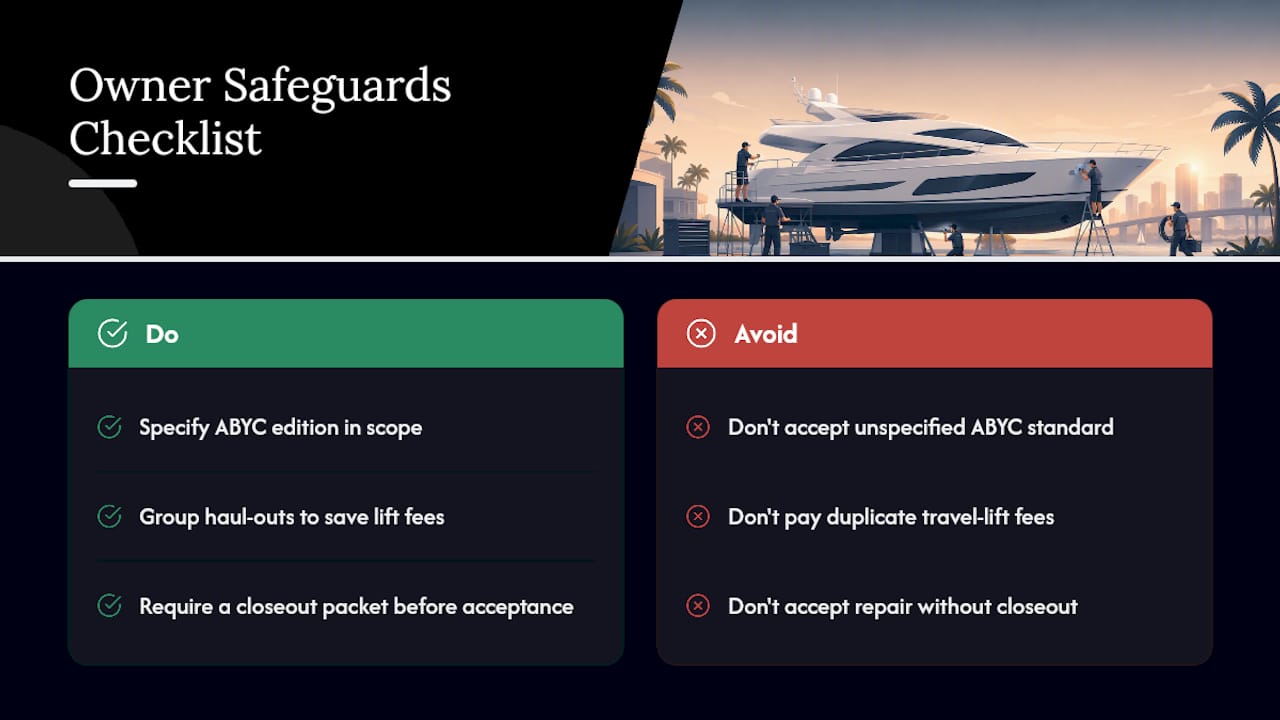
A few things worth insisting on: always ask your repair yard to name the ABYC edition in the written scope, group haul-out work so you’re not paying for the same travel-lift fee twice, and never accept a “repair complete” without a closeout packet in hand. Owners who skip that last step are the ones re-explaining the same repair to a skeptical surveyor two years later.
The Real Lesson From Post-Survey Repair Lists
Most advice on this topic treats the survey report like a punch list to clear as fast as possible. That’s backwards. The report is a snapshot of risk at one moment, and the smarter move is using it to build a documentation habit that outlasts this one repair cycle.
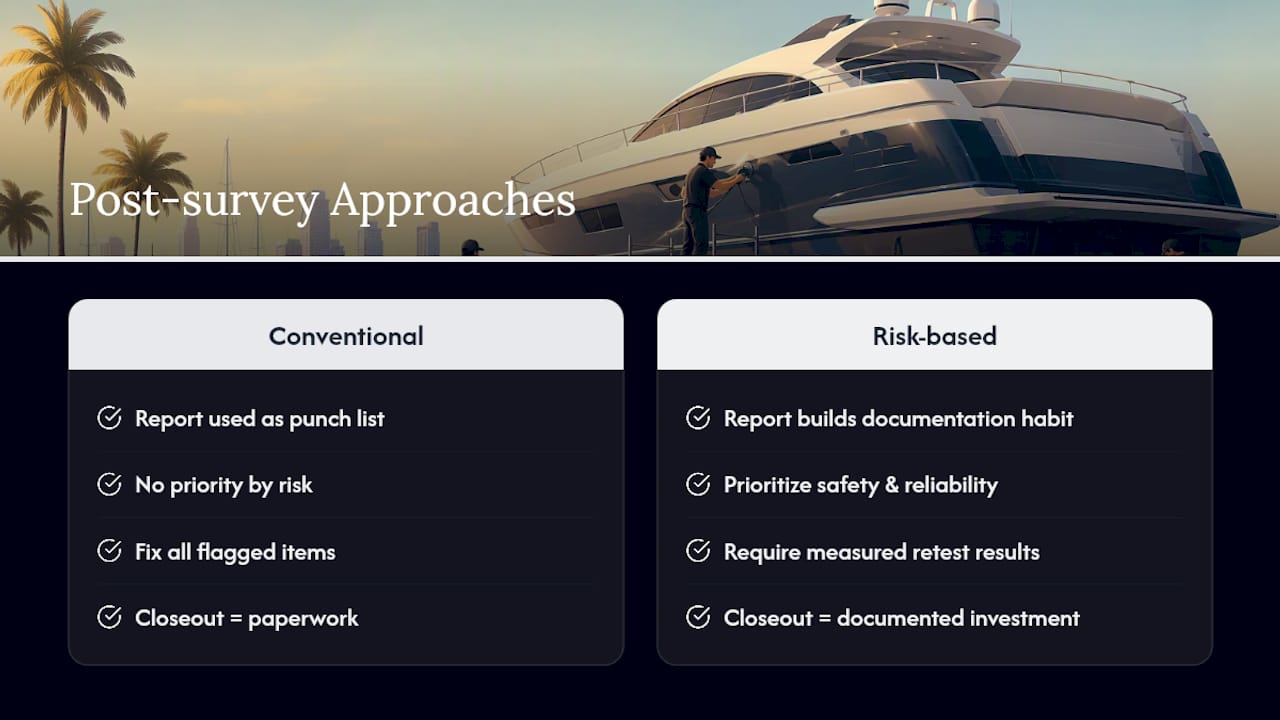
Where conventional advice falls short: it tells owners to “fix everything the surveyor flagged” without distinguishing between a federal minimum, a reliability recommendation, and a cosmetic note. That flattens genuinely urgent items, like steering cable wear, into the same category as faded canvas. Owners who prioritize by actual risk, not by the order items appear on the page, spend their repair budget where it protects the boat and the people on it.
What matters most is retesting. A repair without a measured commissioning result is a promise, not a fact. Insist on the numbers, keep the photos, and treat every closeout packet as an investment in your next survey, not paperwork for this one.
— Jason
Get Your Post-Survey Repairs Handled by One Team, Not Five
Coordinating an electrician, a fiberglass shop, and a rigger separately after a survey is how small repairs turn into a summer-long project. Urgent repairs, complete maintenance packages, engine and mechanical work, and electrical and navigation upgrades can be coordinated through in-house teams with a single project manager to prevent repair issues from getting lost between vendors.
If your survey flagged propulsion or running gear concerns, our mechanical, repower, and running gear team scopes those jobs against current ABYC standards from the start. Electrical panel work, navigation light compliance, or wiring protection findings route through our electrical, electronics, and navigation specialists, and any fiberglass or gelcoat damage found during haul-out goes to our fiberglass and hull repair crew. Reach out through Mazzamarine to request a survey clarification visit, get a written scope quoting the ABYC or USCG standard in question, and ask for your closeout packet the day work wraps.
Where to Verify Standards and Requirements
Three sources anchor most post-survey decisions. The USCG Boater’s Guide covers federal carriage minimums. ABYC sets the technical standards editions repair yards should quote in scopes. NMMA tracks industry-wide standards updates, which is why confirming the edition referenced in any repair quote protects you at your next survey.
Sources
- A boater’s guide to the federal requirements for recreational boats (USCG via BoatUS)
- ABYC explained (Blue Sea Systems reference)
FAQ
What Repairs Are Required After a Yacht Survey?
There’s no universal legal requirement to complete every item on a survey report, but insurers and lenders often condition coverage or financing on addressing Immediate and High priority findings, such as through-hull integrity, bilge pump function, and fire protection. Cosmetic and Low priority items are typically owner discretion.
How Long Do Post-Survey Yacht Repairs Take?
Small safety fixes like a bilge alarm or fire extinguisher replacement usually take days to two weeks. Major mechanical work, including repowers or extensive running gear replacement, can run weeks to months depending on parts availability and yard scheduling during peak season.
Do I Need to Follow ABYC Standards for Post-Survey Repairs?
ABYC standards aren’t federal law for recreational vessels, but they’re the accepted industry reference for evaluating design, construction, and repair quality. Specifying the ABYC edition in your repair scope protects you if standards update before your next survey.
What Should Be in a Yacht Repair Closeout Packet?
A complete closeout packet includes the original deficiency noted by the surveyor, before-and-after photos, part numbers, measured test readings, the technician’s identification, the invoice, and the ABYC or USCG standard edition referenced during the repair.
Does Mazza Marine Handle Post-Survey Repairs in Florida?
A single service provider can coordinate urgent repairs, mechanical work, electrical and navigation upgrades, and fiberglass repair through in-house teams with a single project manager. Current pricing for each service is available directly through Mazzamarine.
Recommended
Text or Call 954-330-9653 Schedule Appointment
Mazza Marine Yacht Services & Refit

Fiberglass Upgrades and Damage Repair

Premium Yacht Paint/ Faux Teak

Fishing: Custom Rods, Reels,Tackle

Electrical, Electronics and Navigation

Paint, Hull and Gelcoat

Teak Decks, Wood Cabinets, Carpentry

Canvas, Enclosures and Upholstery

Mechanical, Repower and Running Gear

Plumbing, Bilge and Thru-Hulls

Welding and Custom Fabrication

Interior Refit And Past Work
Get your yacht value Estimate
"*" indicates required fields