
View Our Recent Work:

Tune your propeller if your wide open throttle RPM falls outside the manufacturer’s recommended range, or if you’re feeling vibration, sluggish acceleration, or fuel burn that doesn’t match your engine hours. The fix starts with data, not guesswork: run a proper WOT test, log your numbers, and either adjust pitch yourself using the rule of thumb below or bring those numbers to a prop shop for a precise evaluation.
TL;DR:
- Proper WOT testing must be done with your boat loaded as usual, at half fuel, and in calm water conditions for accurate measurements.
- Every 1-inch increase in propeller pitch typically decreases WOT RPM by about 150 to 200, requiring precise adjustments based on your engine’s maximum RPM.
- A misaligned prop might cause vibrations, sluggish starts, or increased fuel consumption, which can often be resolved by a professional propeller tune or repair.
- Changes in blade count, diameter, cup, and material significantly influence boat performance and should be considered along with pitch adjustments for optimal results.
- Routine inspection and record-keeping after tuning help maintain performance gains and identify when a prop needs repair or replacement.
Table of Contents
- When to Tune: Clear Signs, Engine Risks, and Performance Payoffs
- How to Measure Performance Correctly: The Test-Run Protocol Pro Shops Expect
- Pitch Math and Rule-of-Thumb: Estimating How Much Pitch to Change
- Blade Count, Diameter, Cup and Material: Trade-Offs That Affect Tuning Choices
- What Pro Shops Do: Prop Scan, ISO-Class Repair Tolerances, Balancing and Realistic Outcomes
- Diagnose Your Propeller Before You Book a Shop Visit
- Post-Tune Verification and Maintenance: How You Confirm Results and Keep Gains
- Detailed Explanation of Blade Pitch Measurement Techniques and Tools
- Safety Considerations and Precautions During Propeller Tuning Procedures
- Common Mistakes to Avoid When Tuning a Propeller
- Different Types of Propellers and How Tuning Approaches Vary
- Jason at Mazza Marine: Practical Lessons From Real Tuning Jobs
- Get Your Propeller Professionally Evaluated at Mazza Marine
- Sources
- FAQ
When to Tune: Clear Signs, Engine Risks, and Performance Payoffs
A propeller that’s wrong for your boat rarely announces itself with a single dramatic failure. It shows up as a collection of small annoyances that add up to real engine wear over a season.
Watch for these signals:
- WOT RPM outside spec: Your tachometer reads below or above the engine manufacturer’s recommended wide open throttle range under a normal load.
- Vibration that wasn’t there before: A hum or shudder through the hull, especially noticeable at cruise speed.
- Sluggish hole shot: The boat takes longer to plane than it used to, or struggles with a full load of fuel, gear, and passengers.
- Rising fuel burn: You’re burning more gallons per hour for the same cruise speed you got last year.
- Overheating or climbing exhaust temperatures: The engine works harder than it should to hold RPM, which raises exhaust gas temperature over time.
Running an engine below its rated WOT range is called lugging, and it’s genuinely damaging. The engine can’t reach the RPM where it was designed to make peak power, so it compensates with higher cylinder pressure and heat. Mercury Marine warns that operating outside the recommended WOT range risks engine damage, and that risk compounds every hour you run it that way.
The payoff for correcting it is real: smoother running at cruise, better fuel economy over a season of use, and less vibration fatigue on shaft seals, engine mounts, and your own patience. Common triggers we see include owners who added a tower or outriggers, changed their typical passenger load, or started running heavier with full fuel and ice for long offshore trips. Each of those changes the load your prop has to push, and a pitch that worked before might not work now.
How to Measure Performance Correctly: The Test-Run Protocol Pro Shops Expect
Before anyone can tell you what to change on your propeller, they need real numbers from your boat, running your load, on your water. Guessing from memory doesn’t cut it.
Preparation matters as much as the run itself. Start with a clean bottom, since even light growth skews your top speed and RPM numbers. Load the boat the way you actually use it, not empty and not maxed out. Run with tanks around half full, trim tabs neutral, and note the wind and sea state, since a stiff chop or following current will throw off your speed readings.
Follow this sequence for a clean data set:
- Run one leg on a heading, then immediately reverse course and run the reciprocal heading to cancel out current and wind effects.
- Push to wide open throttle and hold it long enough for RPM to stabilize, usually 15 to 20 seconds once it stops climbing.
- Record RPM, GPS speed, engine load percentage, and fuel flow at WOT.
- Back off to your normal cruise setting and record the same figures.
- Repeat the readings in 200 RPM increments between idle and WOT (or 100 RPM increments if you want finer resolution).
- Video your gauge cluster during each run as a backup in case you misread something in the moment.
Pro tuners rely on exactly this kind of detail. Shops collecting speed and fuel burn at full throttle alongside cruise RPM and incremental readings can optimize a propeller well beyond what the factory spec sheet assumes, because they’re tuning for your hull and your load, not a generic test boat.
Pro Tip: Don’t change more than one variable between test sessions. If you swap your prop and re-trim your tabs on the same run, you’ll never know which change actually moved the needle.
Use your GPS for speed rather than a paddle wheel, which can read low at higher speeds. Cross-check your tachometer against a handheld or phone-based strobe tach if you suspect the factory gauge drifted. A fuel flow meter beats a fuel-burn estimate every time, but a simple time-and-distance calculation against a known tank volume works in a pinch.
Pitch Math and Rule-of-Thumb: Estimating How Much Pitch to Change
The rule most riggers use: every 1-inch change in propeller pitch shifts your WOT RPM by roughly 150 to 200 RPM. It’s not exact physics, since hull shape, gear ratio, and engine torque curve all play a role, but it gets you remarkably close on a first estimate.
Here’s how the math works in practice:
- Say your engine’s recommended WOT range tops out at 5,800 RPM, and your loaded test run shows you spinning at 5,400 RPM. That 400-RPM shortfall suggests you’re roughly 2 inches over pitched.
- Going the other direction, if you’re at 6,200 RPM against a 5,800 max, you’re under pitched by around 2 inches and losing thrust and cruise efficiency to unnecessary RPM.
- Gear ratio matters here. A lower gear ratio (higher numerical reduction) means the prop turns slower relative to the crankshaft, so the same pitch change can produce a slightly different RPM shift than the flat rule suggests.
Aim for the upper half of your engine’s recommended WOT band rather than the dead center or bottom. That gives you margin for a heavier day on the water (full fuel, more gear, choppier conditions) without dropping the engine below its safe operating range. If your calculated pitch change lands you close to a half-inch or more of adjustment, that’s the point to call a shop rather than trial-and-error your way through props. A pro tuner will factor in your hull’s specific drag and your engine’s actual torque curve instead of the generalized rule of thumb.
Blade Count, Diameter, Cup and Material: Trade-Offs That Affect Tuning Choices
Pitch isn’t the only lever. Blade count, diameter, cup, and even the metal the prop is cast from all shape how your boat feels and performs, and pro tuners weigh all of them together.
- Blade count: Moving from three blades to four (or adding skew) typically improves grip out of the hole and smooths out vibration at cruise, since more blades distribute thrust more evenly through the water column. The trade-off is a slight loss of top-end speed, since more blade surface area means more drag at high RPM. Research on propeller pitch, diameter, and blade number confirms that raising blade count increases torque and thrust while sometimes shaving peak efficiency at the top of the RPM range.
- Diameter: A smaller diameter prop draws less draft and clears shallow water more easily, which is why flats boats and some sportfish builders spec them intentionally, even though it can mean sacrificing some low-speed thrust.
- Cup: Adding cup to the trailing edge lets the prop hold the stern up higher at cruise, which often improves fuel economy without pushing the engine into an unsafe RPM range. It’s a subtle geometry change with an outsized effect on how the boat rides.
- Material: Stainless steel and nickel bronze alloys (NiBrAl) hold their shape under heavy load far better than standard manganese bronze, which matters if you push the boat hard offshore. Manganese bronze is more forgiving if you clip a sandbar, since it bends before it snaps.
What Pro Shops Do: Prop Scan, ISO-Class Repair Tolerances, Balancing and Realistic Outcomes
Once a propeller comes off the shaft, a professional shop measures it in ways no owner can replicate on the dock. That’s where the real precision lives.
- Prop scanning: Technicians sample pitch at multiple points along each blade’s radius, not just one reading, then check chord width, cup depth, and tracking (whether each blade follows the exact same path as the others).
- ISO-class repair targets: Reputable shops repair to recognized tolerances. ISO Class 1 specifications call for local pitch accuracy within 2% and mean pitch within 0.75%, which is tight enough that a repaired prop can perform indistinguishably from new.
- Static balancing: A basic check that confirms the prop’s weight is distributed evenly around its hub, done at rest.
- Dynamic balancing: A more revealing test that spins the prop at speeds around 500 RPM to catch wobble and imbalance that only appears once the prop is actually turning, which is the real source of most vibration complaints.
A prop shop’s edge over DIY tuning comes down to this kind of instrumented precision. Skilled shops can also add cup or adjust tip geometry on an existing propeller to raise cruise efficiency without pushing the engine past safe limits, which often costs far less than buying new.
What should you actually expect from a professional tune? Reduced vibration, a modest speed gain of a few miles per hour in many cases, and noticeably better fuel burn at cruise. If your prop shows significant blade damage, corrosion pitting, or has been repaired more than once already, replacement usually beats another repair cycle. There’s no single perfect propeller. Tuning means matching the prop’s characteristics to how you actually use the boat, whether that’s top speed, fuel economy, or hauling a heavy spread of outriggers and tackle.
Diagnose Your Propeller Before You Book a Shop Visit
You can rule out a lot of problems, or confirm you need professional help, before you ever pull the boat out of the water.
- Read the hub markings. Most props are stamped with diameter and pitch, like “14 x 19,” meaning a 14-inch diameter and 19-inch pitch. Confirm this matches what your engine manufacturer recommends for your model and typical load.
- Inspect the blades by hand. Run your fingers along each leading and trailing edge, feeling for nicks, dings, or a blade that looks even slightly bent compared to its neighbors.
- Check for lost cup or rounded tips. A prop that’s been sand-struck or heavily used often loses cup definition at the trailing edge, which shows up as reduced holding power at cruise.
- Run a safe WOT test. With a normal load aboard and calm water, bring the engine to wide open throttle and note whether RPM lands in the recommended range.
- Try trim adjustments before blaming the prop. Running with too much positive trim can mimic the symptoms of an over pitched prop by pushing RPM down artificially, so test at a few trim settings before drawing conclusions.
Stop immediately and call a professional if you notice sudden, sharp vibration that wasn’t building gradually, any smoke from the engine compartment, or a rapid rise in exhaust gas temperature during a WOT run. Those aren’t propeller tuning issues anymore. They’re signs of potential engine or drivetrain damage, and pushing through them risks turning a prop repair into an engine rebuild.
Post-Tune Verification and Maintenance: How You Confirm Results and Keep Gains
The only way to know a tune actually worked is to repeat your original test protocol exactly. Run the same headings, the same load, the same conditions where possible, and compare WOT RPM, top speed, fuel burn, and how the boat feels at cruise against your baseline numbers.
Keep the gains with a short maintenance routine:
- Clean the hull on a regular schedule, since bottom growth alone can erase the benefit of a perfect tune within a few months.
- Visually inspect the blades every few outings for new nicks or dings, especially after running in unfamiliar or shallow water.
- Schedule a dynamic balance check periodically, particularly if you’ve noticed any new vibration creeping back in.
Shops keep detailed records of every prop they service because it makes future adjustments faster and more accurate. Owners should do the same. A simple run log with date, load, RPM, speed, and fuel burn turns every future test into a comparison instead of a guess.
Detailed Explanation of Blade Pitch Measurement Techniques and Tools
Measuring pitch accurately requires more than eyeballing the blade angle. A true pitch reading accounts for the fact that a propeller blade is a twisted airfoil, with pitch angle changing continuously from hub to tip.
Shops use a pitch block, sometimes called a pitch gauge, which clamps onto the blade at a specific radius and measures the angle relative to the shaft centerline. Because pitch varies across the blade’s length, technicians take readings at multiple radial stations, typically at 0.6 and 0.9 of the blade’s radius, then calculate a mean pitch across the whole blade and compare it to the manufacturer’s design specification.
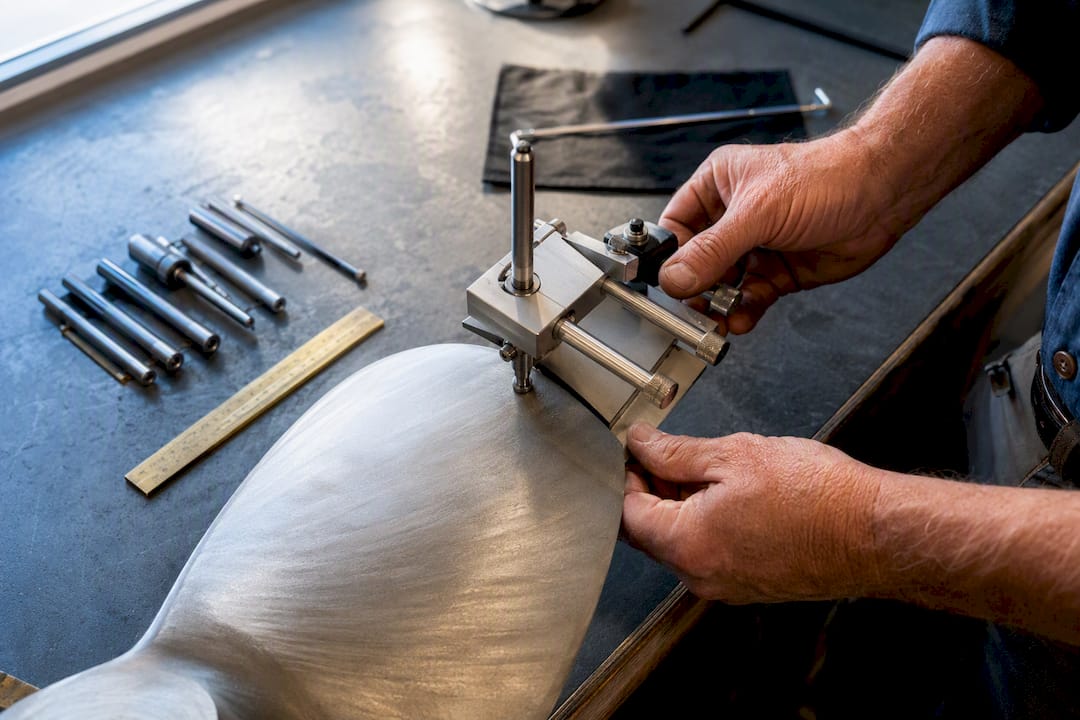
Laser-based prop scanning systems have largely replaced manual pitch blocks in high-volume shops. These systems map the entire blade surface in three dimensions, catching subtle deviations in cup, rake, and chord width that a manual gauge would miss entirely. The scan produces a full geometric profile, letting a technician see exactly where a blade has worn, been bent, or drifted from spec, down to fractions of a degree.
For owners without access to a scanning rig, a simpler field check involves measuring the distance a blade travels forward in one full rotation using a straightedge and tape measure against the theoretical pitch distance. It’s rough compared to a lab-grade scan, but it can confirm whether a prop is roughly what its hub stamp claims, which matters if you bought it secondhand or suspect a previous repair changed its geometry.
Safety Considerations and Precautions During Propeller Tuning Procedures
Propeller work involves sharp blades, heavy castings, and a boat that needs to be secured properly before anyone touches the running gear. Treat every step with the same caution you’d use around any rotating machinery.
Always disconnect the battery or engine kill switch before removing or handling a propeller, since an accidental start with someone’s hand near the blades causes serious injury. Block the boat securely if it’s on a trailer or lift, and never work underneath a hull supported only by a hydraulic jack without solid stands in place.
When performing WOT test runs, choose open water away from other boats, swimmers, and fixed obstacles, since you’ll have your attention split between gauges and steering. Wear the engine kill switch lanyard every time, particularly during full-throttle testing when an unexpected wave or wake could throw you off balance.
If you’re removing a prop yourself, use the correct puller tool rather than pry bars or hammers, which can damage the shaft or send the prop flying under sudden release of tension. Torque the retaining nut to the engine manufacturer’s specification when reinstalling, since an under-torqued prop can work loose at speed and an over-torqued one can damage the shaft threads.
Never exceed your engine’s rated maximum RPM during test runs, even briefly, to “see what happens.” That’s exactly the kind of shortcut that turns a routine tuning session into an expensive repair bill.
Common Mistakes to Avoid When Tuning a Propeller
The single biggest mistake owners make is testing with the wrong load aboard. A prop that looks perfectly pitched with two people and a quarter tank of fuel can be badly over pitched once you load four passengers, full fuel, and a cooler full of ice for an offshore trip. Testing under the load you actually carry isn’t optional if you want numbers you can trust.
A close second is changing multiple variables at once, swapping the prop and adjusting trim tabs and changing fuel load in the same test session. When performance shifts, you won’t know which change caused it, and you’ll end up chasing your tail on the next outing.
Owners also frequently trust a single WOT reading instead of running reciprocal headings. Current and wind can shift your RPM and speed numbers by a meaningful margin, and a one-way run can lead you to “fix” a problem that wind, not pitch, actually caused.
Chasing top speed at the expense of everything else is another common trap. A prop tuned purely for maximum speed often sacrifices hole shot, cruise economy, and comfort in a chop, which matters more for most owners’ actual use pattern than an extra mile or two per hour.
Finally, ignoring the manufacturer’s WOT range because “it feels fine” is a mistake that compounds slowly. Engines run outside spec for months before symptoms become obvious, and by then you’re often looking at more than a propeller bill.
Different Types of Propellers and How Tuning Approaches Vary
Most recreational and sportfish boats run fixed-pitch propellers, where blade angle is cast permanently into the propeller and the only way to change pitch is to swap props or send the existing one out for a pitch adjustment. Tuning a fixed-pitch prop is the scenario this entire article addresses: test, measure, calculate a pitch change, and either repair or replace.
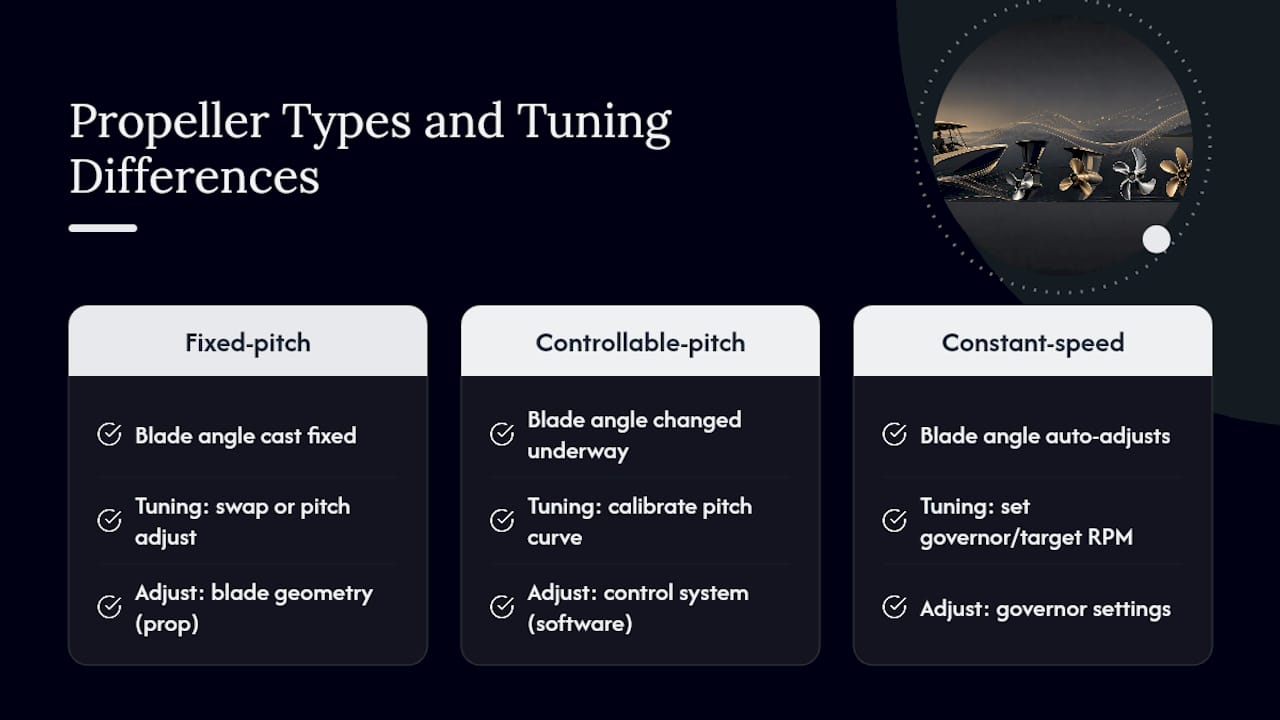
Controllable-pitch propellers, common on larger commercial and some higher-end yacht platforms, let the operator or an automated system change blade angle while underway, without swapping hardware. Tuning here shifts from a one-time mechanical adjustment to calibrating the control system’s pitch curve against RPM and throttle position, a job that generally requires the manufacturer’s software and a technician familiar with that specific hydraulic or electric actuation system.
Constant-speed propellers, more common in aviation but present on some specialized marine applications, automatically adjust pitch to maintain a target RPM regardless of load. Tuning a constant-speed system means adjusting the governor settings rather than the blade geometry directly, since the mechanism handles pitch changes on its own once the target RPM is set.
For the overwhelming majority of boat owners reading this, you’re working with a fixed-pitch prop, and everything in the test protocol and pitch math sections above applies directly to your situation.
Jason at Mazza Marine: Practical Lessons From Real Tuning Jobs
A boat that came in running rough at cruise turned out to need nothing more than a half-inch pitch reduction and a fresh cup profile. No new prop, just a repair that brought vibration down and cruise fuel burn with it. The recurring trade-off we walk owners through is speed versus grip versus comfort. Squeeze more top end out of a prop and you often give up some of that smooth, settled feel at cruise. Bring your pre-tune run logs, a video of your gauges at WOT, and an honest description of your typical load. That’s what turns a guess into a real fix.
— Jason
Get Your Propeller Professionally Evaluated at Mazza Marine
Mazza Marine is the direct route to a shop-grade propeller evaluation instead of piecing together a fix from forum advice and trial-and-error swaps. Our Florida network handles prop inspection, precision measurement, repair, and balancing under one roof, backed by two decades of hands-on experience with the sportfish and cruising boats that call South Florida home.

Bring whatever data you’ve already gathered, your WOT run numbers, a video of your gauges, a description of your normal load, and we’ll take it from there. If you haven’t run the test protocol yet, that’s fine too; a physical inspection catches a lot of what a hub stamp and a visual check can miss. Appointments typically start with a hands-on inspection of the existing prop, followed by a recommendation on whether a pitch adjustment, cup repair, or full replacement makes sense for your boat and how you use it. Head over to our propeller repair and tuning page to see the full scope of service and get a quote started for your boat.
Sources
- How data and fine-tuning your propellers can boost your fishing (Marlin)
- Propeller characterization — pitch, diameter, and blade number (JoVE)
FAQ
What Happens if Prop Pitch Is Too Low?
A pitch that’s too low lets the engine over rev past its recommended WOT range, which can lug the motor into dangerous territory from a different direction, running too fast without enough load, risking internal engine damage over time.
What Prop Pitch Is Best for Speed?
The pitch that maximizes speed is the highest one that still lets your engine reach the top of its manufacturer-recommended WOT range under your typical load, since going any higher would push RPM below that range and cost you both speed and engine health.
Is a 21 Pitch Prop Faster Than a 19?
Not automatically. A higher-pitch prop moves the boat farther per revolution, which can mean higher speed, but only if your engine can still reach its rated WOT range with the added load; if it can’t, the RPM drop can leave you slower and lugging the engine.
Will Lowering Prop Pitch Increase Speed?
Lowering pitch generally raises RPM rather than speed directly. It helps only if your current WOT RPM sits below the engine’s recommended range. Going lower when you’re already in range often just adds wasted RPM without a meaningful speed gain.
Recommended
Text or Call 954-330-9653 Schedule Appointment
Mazza Marine Yacht Services & Refit

Fiberglass Upgrades and Damage Repair

Premium Yacht Paint/ Faux Teak

Fishing: Custom Rods, Reels,Tackle

Electrical, Electronics and Navigation

Paint, Hull and Gelcoat

Teak Decks, Wood Cabinets, Carpentry

Canvas, Enclosures and Upholstery

Mechanical, Repower and Running Gear

Plumbing, Bilge and Thru-Hulls

Welding and Custom Fabrication

Interior Refit And Past Work
Get your yacht value Estimate
"*" indicates required fields