
View Our Recent Work:

Overview: For most damaged rudder stocks, the fastest and safest path is class-approved shop reconditioning — cold straightening where the geometry allows, or controlled weld-build plus precision machining when material loss is involved — followed by independent surveyor sign-off. That single recommendation covers the majority of cases Florida yacht owners face. Mazzamarine coordinates exactly this process for owners throughout Florida, from initial inspection through NDT certification and final sign-off.
Before you call a yard, take these immediate steps aboard:
- Secure the helm. Lock the steering or lash the wheel hard to prevent further movement that could worsen a bent or cracked stock.
- Remove propulsion if the rudder is binding. A jammed rudder under power can fracture a stock that might otherwise be salvageable by cold straightening.
- Tag out and limit movement. Mark the vessel “do not move” and notify your marina. Even a short transit to a fuel dock can turn a repairable bend into a fracture.
When you call the yard or surveyor, have this information ready:
- Vessel LOA, beam, and displacement
- Rudder stock diameter (measured at the stuffing box if accessible)
- Observed runout in millimeters or thousandths of an inch
- Photos or a sketch showing visible pitting, rust staining, or crack locations
- Your class society or flag state, if applicable
That’s the checklist. The rest of this guide explains why each repair route works, what the paperwork looks like, and how to choose a shop that won’t cut corners on NDT or class approval.
Key Takeaways
Class-approved cold straightening or controlled weld-build plus machining, backed by independent NDT and surveyor sign-off, is the correct repair route for the vast majority of damaged rudder stocks.
| Point | Details |
|---|---|
| Immediate safety steps | Lock the helm, remove propulsion if binding, and tag the vessel out before any movement. |
| Best repair route | Class-approved shop reconditioning (cold straightening or weld-build + machining) with NDT and surveyor sign-off. |
| Cold straightening timeline | Shops with the right press and measurement rig can often complete cold straightening in 24–48 hours. |
| Documentation to demand | Require NDT certificates, alignment records, bearing clearance measurements, and a written surveyor acceptance stamp. |
| Mazzamarine | Coordinates the full repair scope for Florida owners: inspection, welding, NDT, haul-out, and class sign-off. |
Table of Contents
- How do you inspect a rudder stock and its bearings?
- What repair options are available for a damaged rudder stock?
- When should you choose onsite repair over a full shop haul-out?
- What class approval and NDT documentation does your repair actually require?
- What are realistic timelines and cost factors for rudder stock repairs?
- How do you choose a repair yard? Questions, capabilities, and red flags
- How Mazzamarine handles a rudder stock repair for a Florida yacht owner
- What surprises most owners when the rudder stock comes out
- Mazzamarine: Florida’s partner for class-approved running gear repairs
- Sources
How do you inspect a rudder stock and its bearings?
A thorough inspection takes less than an hour and tells you whether you’re looking at a routine bearing swap or a full haul-out. The Cruising World sailboat rudder inspection guide is one of the clearest references available, and it makes a point that surprises many owners: crevice corrosion often starts directly beneath the stuffing box packing or behind bearing collars, where oxygen depletion accelerates attack on stainless steel. The only visible symptom at that stage may be a faint rust stain or weeping at the stuffing box, long before through-wall pitting becomes obvious.
Visual checks to run first:
- Look for rust staining at the packing gland and around bearing collars. Brown streaks on stainless are a red flag, not a cosmetic issue.
- Check for pitting along the exposed shaft. Even shallow pitting in the bearing zone warrants measurement.
- Inspect weld fillets and flange edges for hairline cracks. These are easy to miss in poor light; use a flashlight held at a low angle.
- A green patina on bronze or copper alloy components is generally benign oxidation. Pitting or active rust on stainless is not.
Physical tests to perform:
- Apply a lever test: grip the rudder blade and push side-to-side and fore-aft. Any perceptible play in the radial or axial direction points to worn rudder bearings or a loose bearing collar.
- Check stiffness at the stuffing box. Resistance that feels gritty or inconsistent can indicate bearing debris or a deformed stock.
- Spin the stock slowly by hand (if accessible) and feel for high spots or binding, which suggest runout.
Measurements to record and report:
- Runout at the bearing journals, measured in thousandths of an inch or millimeters. IMO guidance requires surveyors to measure rudder bearing clearances at dry-docking, document them against maximum clearance formulas, and present the records for class review.
- Bearing clearance at each journal. Compare against the class-stated maximum for your shaft diameter.
- Depth of any pitting. A dial indicator or pit gauge gives you a number the yard can act on.
- Diameter loss at worn journals, which determines whether a wear sleeve, machining, or weld-build is needed.
Stop and haul out immediately if you find:
- Runout exceeding class tolerance (typically 0.5–1.0 mm depending on shaft diameter and class society)
- Through-wall pitting or any crack at a weld or flange
- Severe bearing wear with metal debris in the bilge
- Axial play that suggests the bearing collar has shifted
Pro Tip: When surveying for hidden crevice corrosion, always remove the packing from the stuffing box and inspect the stock directly beneath it. That 2–3 inch zone is where the most aggressive attack concentrates, and it is almost never visible from outside the vessel without removal.
What repair options are available for a damaged rudder stock?
The right repair route depends on what the stock has actually suffered: a bend, surface pitting, material loss, or a fracture. Each method carries different class paperwork, lead times, and cost profiles. Understanding the options before you call a yard puts you in a much stronger position to evaluate quotes.
Cold straightening
Cold straightening is a class-approved, permanent repair method that restores shaft geometry without introducing welding metallurgy issues. Shops with dedicated hydraulic presses and precision measurement rigs can often complete the work in as little as 24–48 hours, depending on shaft diameter and facility capacity. This makes it the fastest route for a bent but otherwise sound stock. The key qualification: the stock must be free of significant pitting, cracks, or material loss. A bent stock with clean surfaces is an ideal candidate; one with corrosion pitting in the bend zone is not.
Weld build-up and machining
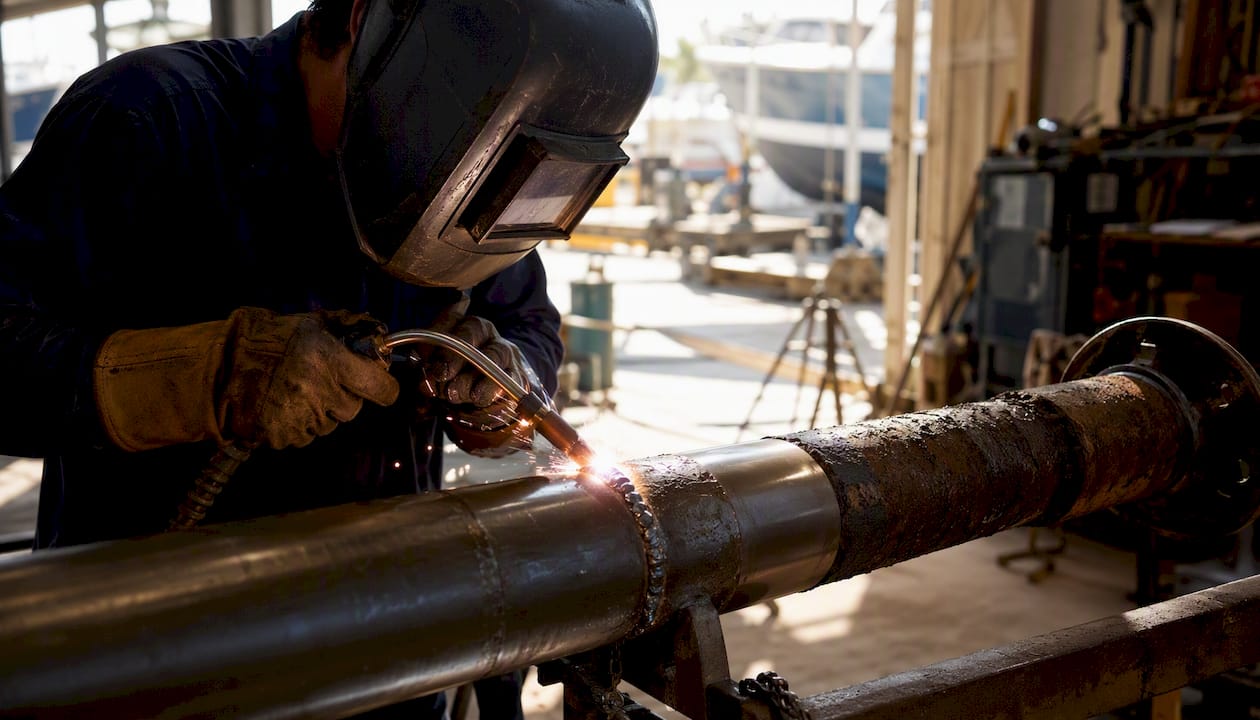
When pitting or material loss is present, controlled weld build-up followed by precision machining is the standard restoration approach. The process involves removing all pitted material, building up the affected area with approved filler wire using a controlled welding sequence, annealing the weld zone to relieve residual stress, and then machining back to the specified shaft diameter. This method requires written welding procedures submitted to and accepted by the class society before work begins. Post-weld NDT (magnetic particle inspection or dye-penetrant testing, plus ultrasonic) is mandatory before the shaft returns to service.
In-place machining and stepped bushing solutions
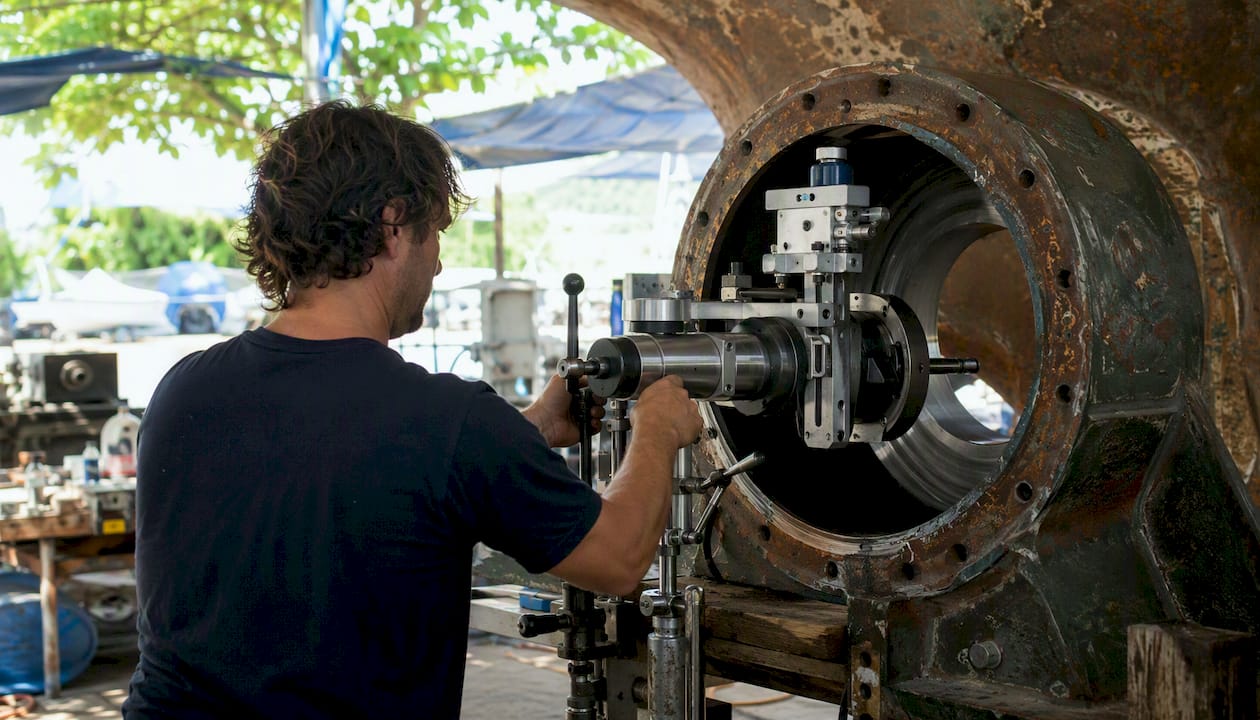
For large vessels where removal is impractical, in-place machining can restore a worn rudder bore or taper without pulling the stock. Case studies from specialist shops document the fabrication of stepped bushes, blue fitting, and press-up techniques that restore conical rudder-to-stock assemblies under class oversight with tight dimensional control. This approach demands specialized tooling and experienced operators; it is not a general-purpose option for smaller yards.
Full replacement
When a stock is fractured, extensively pitted through the wall, or made from a material specification that no longer meets class requirements, replacement is the only safe answer. Fabricating a new stock to the original drawing (or a class-approved revised specification) is straightforward for most shops with CNC lathe capacity. Lead time is driven by material procurement and machining schedule, not the repair process itself.
Bearing work: line boring, bushing replacement, and cutlass bearing service
Rudder bearing replacement and cutlass bearing replacement are often performed alongside stock repairs. Line boring restores the bearing housing to a true, concentric bore after wear or corrosion has distorted it. New bushings are pressed or bonded in, then finish-bored to the target clearance. For worn shaft journals that don’t yet require full machining, SKF Speedi-Sleeve wear sleeves offer an accepted method to restore journal geometry as a temporary or preparatory measure prior to full machining or bush installation. Clearance targets vary by shaft diameter and class society; always confirm the as-fitted clearance is recorded and signed off.
For FRP small craft, splitting the rudder shell, removing saturated foam, and rebuilding the stock interface with new foam and fiberglass encapsulation is a well-documented repair workflow. Making a jig to locate the stock during rebuild and sealing the stock-to-shell interface carefully are the steps most often skipped by shops unfamiliar with this type of construction.
| Repair Method | Class Approval Paperwork | Typical Lead Time | Onsite vs. Shop | Suitable Shaft Sizes | Testing / Warranty |
|---|---|---|---|---|---|
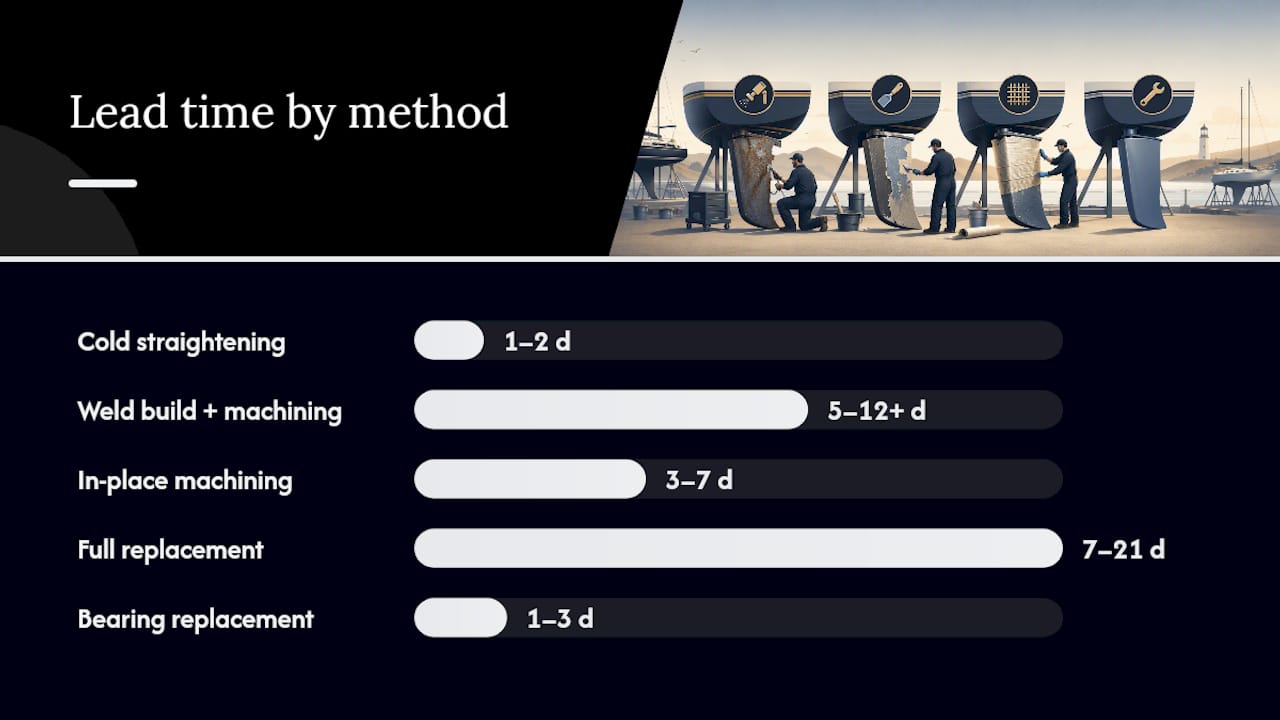
| Cold straightening | Class notification; procedure review | 24–48 hours | Shop preferred | Small to medium | Runout certificate; dimensional report |
| Weld build + machining | Written weld procedure; NDT plan pre-approved | 5–12+ days | Shop or onsite (large vessels) | All sizes | MPI/UT NDT; post-machine dimensional check |
| In-place machining | Class oversight; dimensional records | 3–7 days | Onsite | Large / commercial | Blue-fit report; clearance certificate |
| Full replacement | New stock drawing approval | 7–21 days (material dependent) | Shop | All sizes | Full NDT; alignment record |
| Bearing replacement | Clearance records for class file | 1–3 days | Onsite or shop | All sizes | Clearance measurement certificate |
When should you choose onsite repair over a full shop haul-out?
The honest answer is that most class-quality rudder stock repairs benefit from a controlled shop environment. That said, haul-out logistics, vessel size, and urgency sometimes make onsite work the practical choice. Knowing the real tradeoffs helps you push back on a yard that recommends the cheaper option when the job genuinely needs a press and a CNC lathe.
Advantages of onsite repair:
- Faster mobilization for urgent situations, particularly for large commercial vessels where dry-docking is expensive and slow to arrange
- Lower transport and haul-out costs
- Viable for bearing replacements, minor in-place machining, and wear sleeve installations
Limitations of onsite work:
- Cold-straightening presses and CNC lathes cannot be brought to a berth; bent stocks must go to a shop
- Heat treatment and annealing require controlled furnace conditions that no onsite rig can replicate
- Quality control for precision machining is harder to achieve without a stable, climate-controlled environment
- Some class societies will not accept onsite weld repairs without a pre-approved procedure and an attending surveyor
Advantages of shop reconditioning:
- Full access to hydraulic presses, CNC lathes, NDT equipment, and heat treatment facilities
- Controlled environment for dimensional measurement and blue fitting
- Easier for the independent surveyor to attend and document the work
- Warranty terms are typically stronger when the shop controls the full process
Practical decision points to work through:
- If the stock is bent only, with no pitting or cracks: cold straightening in a shop is almost always the right call.
- If the vessel is too large to haul: onsite weld-build plus in-place machining, performed under class oversight, is the documented route. Goltens has published case studies showing how large conical rudder assemblies are restored this way with strong dimensional outcomes.
- If the stock has through-wall pitting or a fracture: haul out, remove, and replace. No onsite fix is appropriate.
Questions to ask any yard about their onsite capability:
- Do you have a cold-straightening press, or will the stock need to go to a specialist?
- What in-place machining rigs do you own, and what shaft diameters have you worked on recently?
- Do you have a qualified NDT technician on staff, or do you subcontract?
- Has your onsite welding procedure been accepted by ABS, Lloyd’s, or DNV in the past 24 months?
For a broader look at haul-out sequencing and refit logistics, the Mazzamarine custom refit guide walks through how to stage a project to minimize downtime.
What class approval and NDT documentation does your repair actually require?
This is where a lot of owners get burned. A shop that does technically competent work but hands you no paperwork has given you a repair that may be uninsurable and will fail a class survey. The documentation requirements are not bureaucratic formality; they are the evidence trail that proves the repair was done correctly.
Core trust signals every class-compliant repair must produce:
- Class society sign-off from ABS, Lloyd’s, DNV/GL, or your flag state’s recognized organization, confirming the repair method and procedure were accepted
- NDT reports covering magnetic particle inspection (MPI) or dye-penetrant testing of weld zones, plus ultrasonic testing of the full shaft cross-section
- Alignment and load testing records showing pre- and post-repair runout measurements
- Bearing clearance measurements taken at installation and signed by the attending surveyor
- Photographs documenting as-found condition, in-process work, and final assembly
Which repairs typically require prior class approval:
- Any weld repair on a structural rudder stock
- Cold straightening of a classed vessel’s stock (notification and procedure review at minimum)
- Full stock replacement (new drawing approval required)
- In-place machining where dimensional tolerances affect class-stated clearances
IMO guidance is explicit: surveyors measure rudder bearing clearances at dry-docking, compare them against maximum clearance formulas, and document all repairs for class review. Owners should request to see the class acceptance plan and the procedure reference number before work begins.
What an independent surveyor’s final package should contain:
- Pre-repair as-found condition report with runout data and photographs
- NDT certificates from a qualified technician (not just the shop’s own staff)
- Post-repair dimensional check confirming shaft geometry is within tolerance
- Bearing clearance record
- Final acceptance stamp and written certification
For a deeper look at what independent surveyors document and how to use their reports, the Mazzamarine marine surveyor guide covers the full scope of surveyor responsibilities for Florida yacht owners.
What are realistic timelines and cost factors for rudder stock repairs?
Owners consistently underestimate how much lead time varies between repair methods, and how many cost drivers sit outside the actual machining work. Here is a realistic breakdown.
Typical lead times by method:
- Cold straightening: 24–48 hours at a facility with the right press and measurement rig, per documented industry practice. Add travel and haul-out time.
- Weld build-up plus machining: 5–12 days in a shop environment. Onsite weld-plus-machine jobs on large vessels have run to 12 days or more when annealing and precision finishing are included.
- In-place machining only: 3–7 days depending on access and shaft diameter.
- Full replacement: 7–21 days, driven almost entirely by material procurement and class drawing approval.
- Bearing replacement (line boring + bush): 1–3 days in most cases.
What extends lead time beyond the baseline:
- Class approval backlog (procedure review can add 3–5 business days)
- NDT technician availability, particularly in smaller Florida yards
- Alloy matching for replacement stock fabrication
- Annealing furnace scheduling
- Haul-out slot availability at the boatyard
Key cost drivers to understand before you request a quote:
- Vessel and rudder size: a 60-foot sportfish has a very different stock diameter than a 110-foot motoryacht, and machining time scales with diameter and length
- Removal complexity: stocks with corroded keyways, seized bearings, or inaccessible stuffing boxes add significant labor
- Alloy specification: duplex stainless or Aquamet grades cost more to source and machine than standard 316
- Annealing requirement: heat treatment adds both time and cost
- Transport and haul-out fees: these often exceed the machining cost on smaller repairs
Pro Tip: When requesting quotes, ask specifically for a line-item breakdown that separates haul-out, NDT, machining, annealing, and class fees. A single lump-sum quote makes it impossible to compare shops or identify where cost savings are realistic.
A single dollar figure for rudder stock repair is genuinely misleading because the range between a simple cold-straightening job and a full replacement with class approval spans an order of magnitude. What you should ask every shop: What is included in the scope? Does the quote cover NDT and the surveyor’s fee? What is the warranty period and what does it cover?
How do you choose a repair yard? Questions, capabilities, and red flags
Not every yard that advertises marine welding has the equipment, procedures, or class relationships to do this work correctly. Here is how to vet them before you commit.
Essential capabilities to demand from any shortlisted yard:
- Class-approved welding procedures on file, accepted by at least one major society (ABS, Lloyd’s, DNV/GL) within the past 24 months
- A hydraulic cold-straightening press with a documented measurement rig
- CNC lathe capacity for the shaft diameter in question
- In-house or contracted qualified NDT technicians (Level II minimum for MPI and UT)
- Established relationships with independent surveyors
- Written warranty terms, not verbal assurances
Scripted questions to ask during first contact:
- How many rudder stock jobs have you completed in the past 12 months, and what was the largest shaft diameter?
- Can you show me your current class-accepted welding procedure reference?
- Which NDT methods do you use post-weld, and is your technician in-house or subcontracted?
- Do you have a cold-straightening press, or would you send the stock to a specialist?
- What alignment tools do you use to verify runout after repair?
- What does your warranty cover, and for how long?
- Will you allow an independent surveyor to attend and document the work?
Red flags that should end the conversation:
- Refusal to allow an independent surveyor on-site
- No written welding procedure or vague reference to “standard practice”
- Post-work NDT described as optional or an add-on
- Warranty terms that exclude corrosion or “pre-existing conditions” without defining them
- No recent experience with your class society
A simple scoring checklist for comparing quotes:
- Technical capability (press, CNC, NDT): 0–3 points
- Documentation offered (procedures, NDT plan, surveyor access): 0–3 points
- Lead time relative to your timeline: 0–2 points
- Warranty clarity and coverage: 0–2 points
A shop scoring 8–10 is worth serious consideration. One scoring below 6 should be passed over regardless of price. The Mazzamarine marine repair guide covers how to evaluate service tiers and what documentation a quality Florida yard provides post-repair.
How Mazzamarine handles a rudder stock repair for a Florida yacht owner
The process Mazzamarine follows is worth walking through in detail, because it illustrates what a well-managed repair actually looks like from the owner’s perspective.
Step 1: Initial inspection and triage. When an owner contacts Mazzamarine with a suspected rudder issue, the first step is a documented inspection: runout measurement, bearing clearance check, visual and tactile assessment of the stock, and photographs of any pitting, staining, or cracking. This inspection report becomes the basis for the repair plan.
Step 2: Repair method selection. Based on the inspection findings, Mazzamarine determines whether cold straightening, weld-build plus machining, or replacement is the appropriate route. For a bent but clean stock, the recommendation is cold straightening through a class-approved specialist partner. For a stock with pitting or material loss, the recommendation is weld-build with a controlled procedure, post-weld anneal, and precision machining.
Step 3: Class and NDT planning. Before any structural work begins, Mazzamarine coordinates the class notification or procedure submission. The NDT plan (MPI or dye-penetrant plus ultrasonic) is agreed with the attending surveyor in advance.
Step 4: Repair execution and documentation. Mazzamarine’s welding and custom fabrication capabilities cover the weld-build and fabrication stages. For in-place machining on larger vessels, Mazzamarine coordinates with specialist machining partners. The independent surveyor attends key stages and documents as-found and post-repair conditions.
Step 5: Sign-off and owner handover. The owner receives a complete package: NDT certificates, alignment records, bearing clearance measurements, surveyor acceptance stamp, and warranty terms in writing.
What to have ready when you call:
- Vessel name, LOA, and displacement
- Rudder stock diameter and material (if known)
- Photos of any visible damage
- Your class society or flag state
- Your preferred haul-out timeline
Pro Tip: Owners who stage the job by arranging haul-out, surveyor availability, and NDT technician scheduling before the stock is removed save an average of several days of unnecessary yard time. Mazzamarine handles this coordination as part of the project management scope, so you’re not chasing three separate vendors.
What surprises most owners when the rudder stock comes out
There’s a moment in almost every rudder stock job when the stock clears the trunk and you get your first real look at the bearing zone. More often than not, what you find there is worse than what the inspection suggested from outside the boat.
The single most common surprise is crevice corrosion directly beneath the stuffing box packing. From outside, the owner saw a faint rust stain and assumed surface oxidation. What the stock actually shows is a band of aggressive pitting 2–3 inches wide, right where the packing sat against the shaft. The oxygen-depleted environment under the packing accelerates attack on stainless steel in a way that produces almost no external warning until the pitting is already deep. By the time you see weeping at the stuffing box, the damage has usually been progressing for a season or two.
The practical lesson from the shop floor: never skip the packing removal step during inspection, and never assume a clean exterior means a clean shaft beneath the gland. The second thing owners consistently forget to ask about is bearing debris. A worn cutlass bearing or rudder bushing sheds material into the bearing housing, and that debris accelerates wear on the stock journal. When you’re already hauled out for a stock repair, replacing the bearings at the same time is almost always the right call, even if they look serviceable. Putting a reconditioned stock back into a worn bearing housing is a false economy that brings the vessel back to the yard sooner than it should.
Mazzamarine: Florida’s partner for class-approved running gear repairs
When your rudder stock needs attention, the difference between a quick fix and a class-compliant repair that holds up through the next survey comes down to who manages the process. Mazzamarine offers Florida yacht owners a single point of contact for the full scope: urgent inspection and triage, welding and custom fabrication, NDT coordination, haul-out management, specialist machining partner access, and independent surveyor scheduling. You don’t have to coordinate three vendors and hope the paperwork lines up.

Mino and Luigi built Mazzamarine on the principle that Florida yacht owners deserve the same level of craftsmanship and accountability that the best European yards deliver. That means written repair plans, class-accepted procedures, NDT certificates, and a warranty you can actually read before you sign. If you’re seeing rust stains at the stuffing box, feeling play in the rudder, or heading into a survey and want the running gear checked properly, contact Mazzamarine for an urgent inspection. Have your vessel details and any photos ready, and the team will give you a clear repair recommendation and timeline within 24 hours.
Sources
Bringing these references to your first conversation with a yard or surveyor signals that you understand what class-compliant work looks like and sets the right expectations from the start.
- Section 3 Rudders
- Sailboat Rudder Inspection Guide | Cruising World
- Rudder Repair – Small Craft Advisor
- Repair And Restoration Of Corroded Rudderstock
- SKF Speedi‑Sleeve (wear sleeves)
Show these to your yard and ask for matching procedures and certificates. A shop that pushes back on providing documentation that aligns with these standards is telling you something important.
Recommended
Text or Call 954-330-9653 Schedule Appointment
Mazza Marine Yacht Services & Refit

Fiberglass Upgrades and Damage Repair

Premium Yacht Paint/ Faux Teak

Fishing: Custom Rods, Reels,Tackle

Electrical, Electronics and Navigation

Paint, Hull and Gelcoat

Teak Decks, Wood Cabinets, Carpentry

Canvas, Enclosures and Upholstery

Mechanical, Repower and Running Gear

Plumbing, Bilge and Thru-Hulls

Welding and Custom Fabrication

Interior Refit And Past Work
Get your yacht value Estimate
"*" indicates required fields