
View Our Recent Work:

Budget somewhere in a broad range for most gyro stabilizer refits once the unit and installation labor are both on the invoice, with small Ride installs landing lower and large yacht gyros running well past typical mid-range costs. That range excludes haul-out, sales tax, shipping, and yard fees, which is exactly why the number on a Seakeeper spec sheet never matches the number on your final bill. Your next move should be booking a site survey with a dealer or refit yard before you commit to a model, because access and structure, not the gyro itself, usually decide the final price.
TL;DR:
- Installation costs vary widely, typically ranging from $5,000 to over $100,000 depending on boat size, structural requirements, and electrical upgrades.
- The Seakeeper unit’s MSRP covers only the hardware, with installation, foundation work, and electrical modifications adding significant extra costs.
- A site survey before ordering is essential to determine access, foundation needs, electrical capacity, and overall scope, preventing unexpected expenses.
- Smaller boats can often be refitted in under two days, while larger yachts may require one to three weeks, influenced heavily by structural and electrical prep.
- Using a full-service yard like Mazzamarine consolidates all work into a single scope and schedule, reducing change-order risks and total project costs.
Table of Contents
- Seakeeper Installation Cost: MSRP Ranges by Model
- How Much Does Seakeeper Installation Actually Cost?
- What Drives the Price of a Seakeeper Refit?
- How Long Does a Seakeeper Installation Take?
- Three Realistic Seakeeper Budget Scenarios
- Why a Full-Service Yard Changes the Math
- What I’d Do Before Signing Any Seakeeper Quote
- How Mazzamarine Handles Seakeeper Refits
- Sources
- FAQ
Seakeeper Installation Cost: MSRP Ranges by Model
The sticker price you see on a Seakeeper unit and the total you’ll pay to have it running are two completely different conversations. Seakeeper’s own product pricing pages list unit MSRPs starting in the low five figures, climbing sharply as you move up through the model lineup toward larger vessels. That number is the hardware only. Installation gets quoted separately, every single time, and dealers will tell you that upfront if they’re being straight with you.
Sizing isn’t a matter of picking whatever fits your budget. A dealer matches the gyro to your boat’s displacement and length overall, because an undersized unit won’t tame roll on a heavier hull, and an oversized one wastes money and power draw you didn’t need to spend. This is where a lot of first-time buyers get it backwards: they price-shop the unit before anyone has confirmed which model their boat actually needs.
Here’s what the MSRP covers, and what it flatly does not:
- Included: the gyro unit itself, factory electronics, and the manufacturer’s warranty coverage
- Excluded: installation labor, structural foundation work, electrical upgrades, haul-out, shipping to the yard, and applicable sales tax
- Variable by model: smaller Ride units carry lower MSRPs and generally simpler install requirements than full gyro systems built for 40 to 75 foot yachts.
Seakeeper’s dealer FAQ is blunt about this split for a reason: too many owners call a yard expecting the MSRP to be the finish line, when it’s really just the entry fee.
How Much Does Seakeeper Installation Actually Cost?
Installation pricing swings harder than most owners expect, and the spread isn’t random. Industry sourcing on gyro refits puts install costs somewhere between roughly $5,000 and $35,000, depending almost entirely on how much structural and electrical prep your boat needs before the unit can go in. A boat with a clean, accessible mounting location near existing power might land near the low end. A boat needing a fabricated foundation, rerouted plumbing, and a generator upgrade will sit near the top.
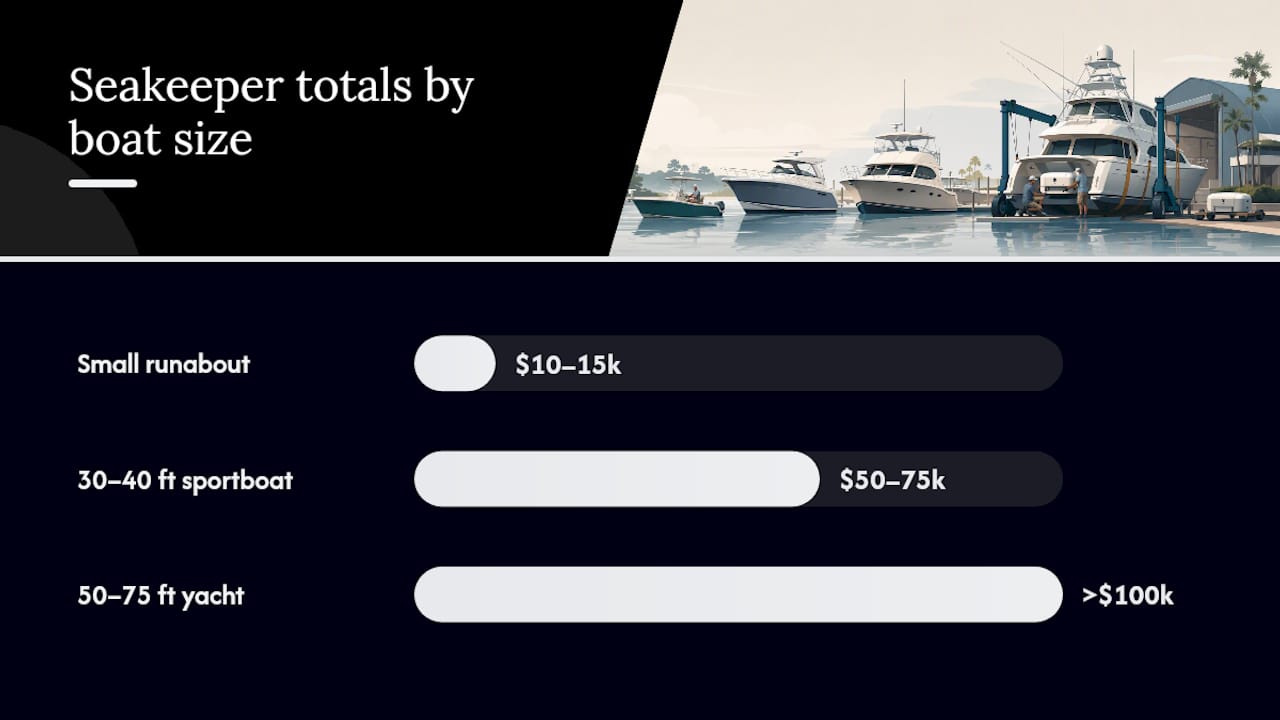
Cost snapshot: Combine a Seakeeper unit MSRP with a typical mid-range install, and a 35 to 45 foot sportboat refit commonly totals somewhere in the $40,000 to $70,000 range once labor, mounting hardware, and basic electrical work are included. Larger yachts with bigger gyros or dual-unit setups push well past six figures once you add structural fabrication and extended yard time.
To make this concrete, here’s how the math tends to shake out across boat sizes:
- Small runabout with a Ride unit: unit MSRP plus a modest install often totals under $10,000 to $15,000 when the mounting location needs minimal prep, according to installation examples from Power & Motoryacht
- 30 to 40 foot sportboat with a mid-size gyro: unit MSRP plus average install commonly lands in the $50,000 to $75,000 neighborhood
- 50 to 75 foot yacht with a larger gyro or multiple units: total costs frequently exceed $100,000 once foundation engineering, electrical capacity, and extended labor hours are factored in.
None of these figures include haul-out fees, travel charges for out-of-area technicians, or regional labor rate differences, which can shift a quote by thousands depending on whether you’re refitting in a high-demand Florida yard during peak season or a slower market. Seakeeper’s own refit FAQ page explicitly flags these as separate line items, and any dealer who doesn’t mention them upfront is setting you up for a surprise invoice later.
What Drives the Price of a Seakeeper Refit?
Ask five different yards for a quote on the same boat and you’ll get five different numbers, and the gap almost never comes down to the gyro itself. It comes down to how much work your boat needs before the unit can even be mounted. Seakeeper’s own dealer guidance lists access, structural readiness, electrical capacity, and plumbing as the four variables that swing a quote the most, and understanding each one helps you read a proposal instead of just trusting the bottom-line number.
- Access. If the mounting compartment requires cutting a hatch, removing furniture, or crane-lifting the unit through a deck opening, labor hours climb fast. Every extra hour of disassembly and reassembly gets billed, and access problems compound rather than add, since a tight space slows down every subsequent step of the job.
- Structural foundation. Gyros generate real gyroscopic force, and most hulls need an engineered mounting foundation to handle it safely. Many refit checklists recommend a formal weight study or performance prediction report before ordering, confirmed by Seakeeper’s own technical bulletin, and skipping that step is how owners end up with expensive change orders mid-project.
- Electrical capacity. DC-powered gyros need battery bank capacity checked against existing house loads; AC models often need generator load testing. Uncovering an alternator or charger shortfall after the gyro arrives means a second mobilization, which costs more than catching it during the survey.
- Cooling and plumbing. Most units need a dedicated seawater pump, new hose routing, and a heat exchanger tie-in, all of which mean new thru-hull work or rerouting existing plumbing.
- Haul-out and yard days. Bottom access for plumbing work often requires a haul-out, and every additional yard day adds storage fees, labor, and calendar time before your sea trial.
Pro Tip: Ask your yard whether they pre-fabricate the foundation off-boat before your slot begins. Shops that build the mount in the metal shop and bolt it in during the yard window routinely finish faster and sometimes cheaper than crews improvising structural work in place.
How Long Does a Seakeeper Installation Take?
Most gyro refits run one to three weeks from haul-out to sea trial, according to Seakeeper’s own refit guidance, though the timeline depends heavily on how much structural and electrical prep the boat needs. Some smaller-boat installations, particularly Ride units mounted in a leaning post or console with minimal structural work, can be completed in as little as 48 hours.
The site survey is where that timeline gets set, and skipping it or rushing it is the single biggest reason refits run long. During a proper survey, a dealer or yard measures the mounting compartment, checks access routes, evaluates your electrical system against the unit’s draw requirements, and often recommends a weight study to confirm the hull can handle the added mass and gyroscopic loading without trim or performance issues.
A few things worth locking in before you schedule yard time:
- Confirm whether your slot includes haul-out or if that’s billed separately
- Ask whether the electrical load test happens before or during your scheduled window, since finding a shortfall mid-install adds days
- Request a written scope that separates structural, electrical, and plumbing labor so delays in one area don’t blow up the whole schedule
- Coordinate your refit around the off-season if your schedule allows it, since yard capacity during peak boating months can stretch timelines regardless of how straightforward your install is.
Three Realistic Seakeeper Budget Scenarios
Numbers land differently depending on what you’re starting with, so here are three scenarios built around real boat categories rather than abstract averages.
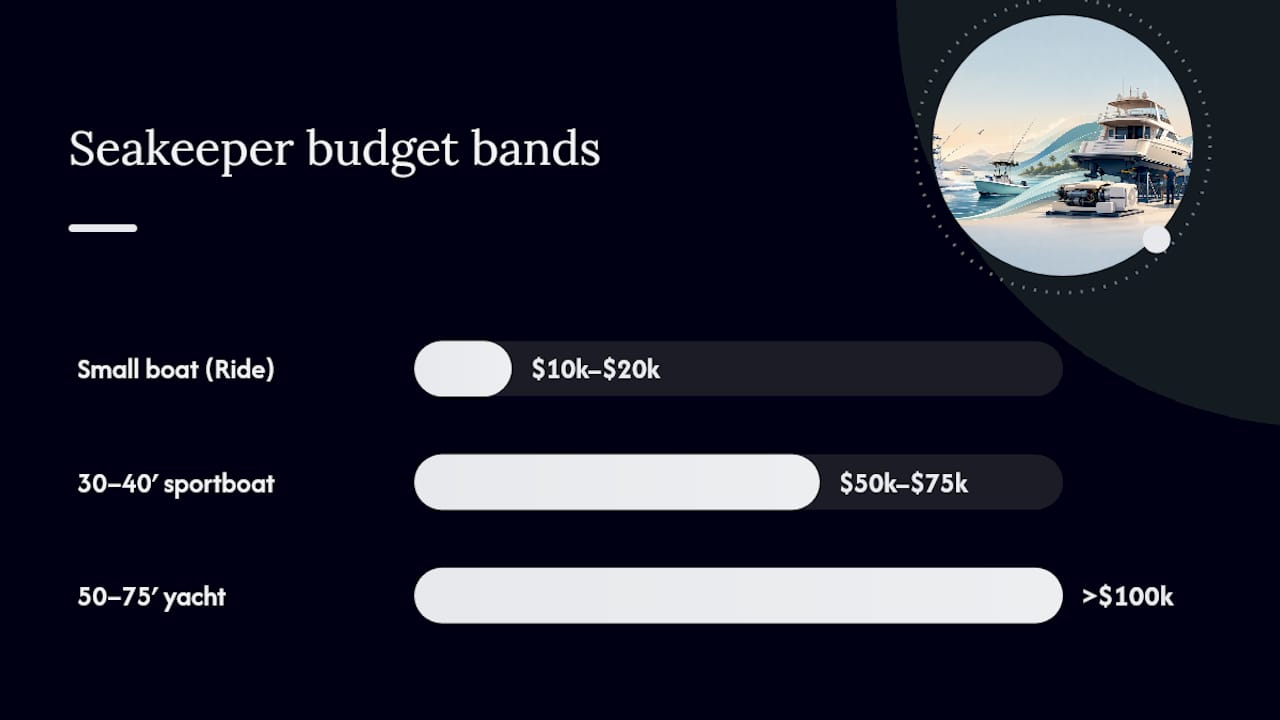
Scenario A: small boat, Ride-style install. A runabout or center console getting a Ride unit mounted into an existing leaning post, with minimal structural work, typically totals $10,000 to $20,000 for unit and install combined, per dealer install examples.
Scenario B: 30 to 40 foot sportboat, mid-range gyro. Add a fabricated foundation, moderate electrical work, and a haul-out, and total project costs commonly run $50,000 to $75,000 once unit MSRP and average install labor are combined.
Scenario C: 50 to 75 foot yacht, large gyro or dual-unit setup. Structural engineering, generator capacity upgrades, and extended yard time push totals past $100,000 in many cases, with the exact figure hinging on how much of the boat’s electrical and plumbing infrastructure needs upgrading alongside the gyro itself.
Budget reality check: Owners who set aside a 10 to 25 percent contingency above their initial quote, a range backed by industry guidance on stabilizer refits, consistently avoid the sticker shock that hits owners who budget only the MSRP plus a rough labor guess.
A contingency checklist worth keeping on hand:
- Electrical upgrades discovered during load testing (alternator, charger, or generator capacity)
- Unexpected structural reinforcement once the mounting area is opened up
- Additional yard days if haul-out reveals unrelated hull or thru-hull issues
- Sea trial and commissioning time, which some quotes bundle and others bill separately
Why a Full-Service Yard Changes the Math
A gyro refit touches structural fabrication, electrical systems, plumbing, and commissioning all at once, which is exactly the kind of project that goes sideways when four different specialists are scheduling around each other. A yard running everything in-house, with one project manager tracking the structural work, the electrical load testing, and the final sea trial, tends to compress both timeline and the change-order risk that piecemeal contracting invites.
That’s the model a full-service refit yard runs for Florida projects: one team, one schedule, one point of accountability from the first site visit through commissioning. For owners weighing whether to hire separate specialists or one full-service yard, the deciding factor usually comes down to how much you value a single fixed scope versus juggling multiple invoices and calendars yourself.
What I’d Do Before Signing Any Seakeeper Quote
Get two things done before you sign anything: a written survey documenting access and electrical capacity, and two competing quotes built from that same survey. Comparing quotes based on different assumptions about your boat is comparing nothing at all.
When a dealer walks your boat, ask specifically about mounting clearance, whether the foundation plan is engineered or improvised, what the power study found, and whether the sea trial and commissioning are included in the price or billed separately. On lifecycle, don’t lose sleep over longevity. The internal components inside a gyro’s vacuum sphere are built for 8,000 to 12,000 hours of service, which translates to years of typical recreational use with routine external maintenance.
— Jason
How Mazzamarine Handles Seakeeper Refits
Mazzamarine is the alternative to juggling four separate contractors on a Seakeeper refit, one in-house team handles the structural fabrication, electrical capacity upgrades, plumbing, and commissioning under a single project manager and one written scope.
When you contact us about a gyro installation, the process starts with a site visit where we assess access, evaluate your electrical system, and put together a structural foundation plan before any metal gets cut. We coordinate the mechanical, repower, and running gear work alongside the electrical, electronics, and navigation upgrades your gyro might trigger, so you’re not scheduling separate yard visits for each trade. Fixed-price scopes are available once the survey confirms what your boat actually needs, which is the only way to avoid the change-order creep that turns a $50,000 estimate into a $70,000 final bill.
If you’re planning a refit and want a straight answer on what your specific boat will need, reach out to our team to schedule a site visit and get a written scope started.
FAQ
Is a Seakeeper Worth the Money?
For owners who spend real time offshore or in chop, most report the ride improvement justifies the cost, since eliminating roll changes how guests and crew experience time aboard rather than just smoothing the ride at anchor.
How Many Hours Does a Seakeeper Last?
The internal components inside the vacuum sphere are rated for roughly 8,000 to 12,000 hours of operation, which typically stretches across many years of normal recreational use with routine anode and fluid maintenance.
How Hard Is It to Install a Seakeeper?
Difficulty depends entirely on access and structure. Small Ride installs in an open leaning post can take as little as 48 hours, while full gyro refits requiring a fabricated foundation and electrical upgrades typically run one to three weeks.
How Much Does a Seakeeper 3 Stabilizer Cost?
Current unit pricing by model is listed on Seakeeper’s own pricing pages and doesn’t include installation. Combined with a typical install for a boat that size, most owners should budget a total that reflects both the unit MSRP and a mid-range labor quote from a dealer survey.
What’s Included in a Mazzamarine Seakeeper Refit Quote?
A Mazzamarine quote covers structural foundation fabrication, electrical capacity work, plumbing modifications, and commissioning under one written scope. Pricing is provided after a site visit and is available on request through our contact page.
Recommended
Text or Call 954-330-9653 Schedule Appointment
Mazza Marine Yacht Services & Refit

Fiberglass Upgrades and Damage Repair

Premium Yacht Paint/ Faux Teak

Fishing: Custom Rods, Reels,Tackle

Electrical, Electronics and Navigation

Paint, Hull and Gelcoat

Teak Decks, Wood Cabinets, Carpentry

Canvas, Enclosures and Upholstery

Mechanical, Repower and Running Gear

Plumbing, Bilge and Thru-Hulls

Welding and Custom Fabrication

Interior Refit And Past Work
Get your yacht value Estimate
"*" indicates required fields