
View Our Recent Work:

Most yacht owners do everything right on paper. They follow the engine hour intervals, change the oil on schedule, and keep a tidy logbook. Yet some of the most costly and disruptive mechanical failures still happen to well-maintained vessels. That contradiction is worth taking seriously. Traditional calendar and hour-based maintenance schedules are a solid foundation, but they leave real blind spots. Condition-based strategies, combined with expert-verified checks, fill those gaps with precision. This article walks you through a smarter approach to mechanical care, built specifically for Florida yacht owners who want reliability, not surprises.
Table of Contents
- Understanding yacht mechanical systems and what can go wrong
- Beyond the schedule: Why condition-based maintenance matters
- Key practices: Building a smarter maintenance plan
- Training, standards, and when to call in the pros
- Our perspective: What most yacht owners get wrong about maintenance
- Expert solutions for smarter yacht maintenance in Florida
- Frequently asked questions
Key Takeaways
| Point | Details |
|---|---|
| Don’t rely on the calendar alone | Hidden risks often develop between scheduled checkups—condition monitoring is key. |
| ABYC standards ensure safety | Critical systems should always be serviced to established standards by trained professionals. |
| Monitor fluids and cooling | Vigilance with oil, fuel, and seawater systems prevents most major mechanical failures. |
| Verify with sea trials | Confirm repairs and upgrades with post-service sea trials, not just dockside checks. |
| Record and track data | Keep logs of maintenance and system metrics to spot developing problems early. |
Understanding yacht mechanical systems and what can go wrong
To understand effective maintenance, you must first know what’s at stake and how each system contributes to overall reliability.
Your yacht is not a collection of independent machines. It is a floating piece of craftsmanship where fuel delivery, exhaust routing, propulsion, steering, and ventilation all talk to each other constantly. When one system weakens, the stress transfers. A partially blocked raw water strainer quietly forces the impeller to work harder. That impeller wears faster and eventually fails. Then your engine overheats. What started as a $15 strainer problem becomes a $6,000 engine repair. This domino effect is the core reason serious captains treat mechanical maintenance as a whole-system discipline, not a task list.
Understanding the mechanical systems overview on your specific vessel takes time, but the investment pays off every time you leave the dock. Knowing how your exhaust system connects to engine backpressure, or how your shaft alignment affects propeller vibration and cutlass bearing wear, gives you the ability to spot a problem before it becomes a crisis.
Common system failures and their typical consequences:
| System | Common Failure | Typical Consequence |
|---|---|---|
| Fuel delivery | Clogged filters or water intrusion | Engine stall, loss of power, fuel pump damage |
| Raw water cooling | Failed impeller or blocked strainer | Engine overheating, cylinder head damage |
| Propulsion | Shaft misalignment or cutlass bearing wear | Vibration, transmission strain, rudder stress |
| Steering | Hydraulic fluid leak or cable fatigue | Loss of directional control underway |
| Exhaust | Restricted riser or wet exhaust failure | Carbon monoxide buildup, engine damage |
| Ventilation | Blocked bilge blower or intake | Fuel vapor accumulation, fire risk |
Hidden failure risks that scheduled maintenance often misses:
- Fluid contamination (water in fuel tanks, coolant glycol depletion, hydraulic fluid oxidation)
- Shaft vibration caused by minor propeller damage or slight misalignment
- Progressive overheating from a partially blocked heat exchanger
- Hairline cracks in exhaust elbows or risers that bypass visual inspection
- Soft or corroded motor mounts that transmit abnormal vibration to the hull
ABYC standards bodies emphasize that mechanical systems aboard vessels are safety-critical and that trained professionals working to recognized standards are essential for maintaining the integrity of those systems. That perspective deserves respect, especially when you are operating far offshore.
“Marine mechanical systems are not forgiving of guesswork. The difference between a well-trained technician and an untrained one is not just efficiency. It is the safety of everyone aboard.” This reflects the core principle behind ABYC’s commitment to technician training and certification standards.
Maintenance, at its best, is not about fixing what breaks. It is about understanding what is silently moving toward failure and acting before the sea makes the decision for you.
Beyond the schedule: Why condition-based maintenance matters
Knowing what can go wrong, let’s investigate why relying only on routine schedules puts your yacht at risk and how condition-based maintenance (CBM) changes the game.
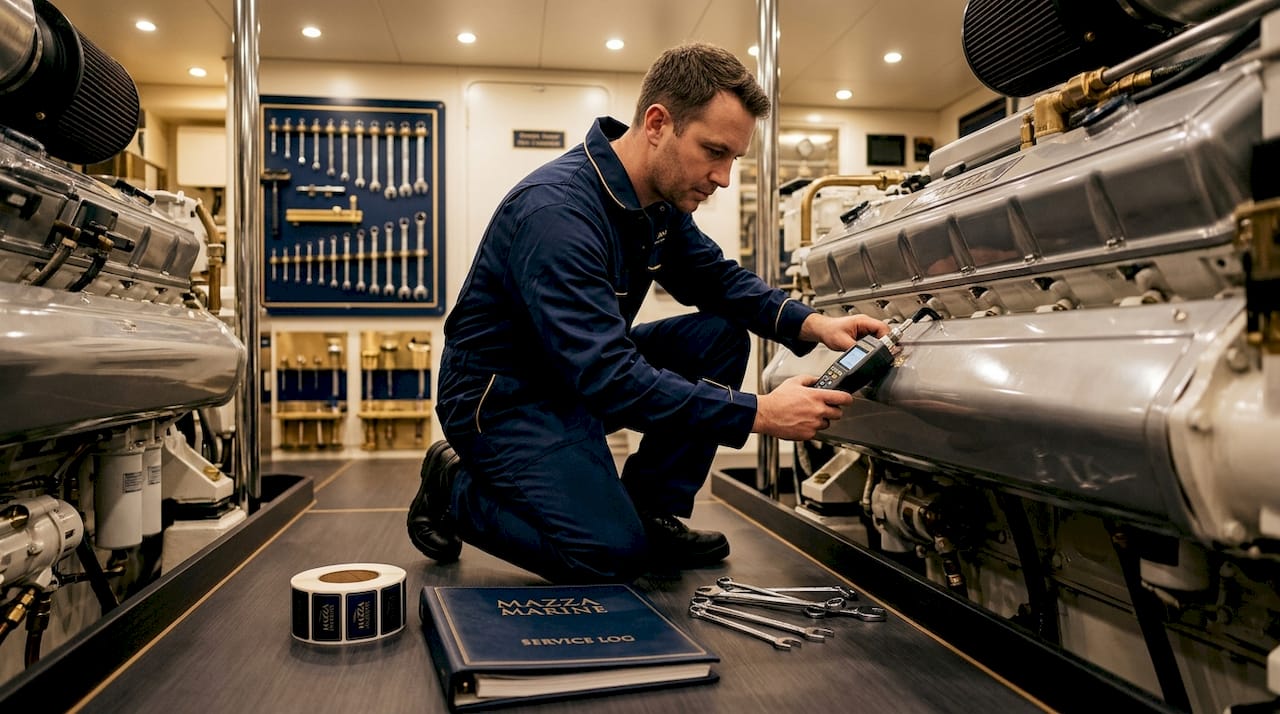
Hour meters and calendar dates give you structure, and that structure matters. But they cannot tell you whether your engine mounts are softening, whether your transmission oil has absorbed moisture, or whether your turbocharger is running two percent hotter than it did six months ago. Those are the signals that predict failures. CBM is the practice of monitoring measurable indicators, such as vibration frequency, operating temperatures, oil viscosity, and pressure readings, to detect deterioration before it becomes damage.
Proactive maintenance strategies using condition-based measurements like vibration and temperature monitoring can significantly reduce unplanned failures and extend equipment life across complex mechanical systems. For Florida yachts that see heavy seasonal use and demanding offshore conditions, that reduction in unplanned downtime is not just a convenience. It is a financial and safety advantage.
CBM in practice: What it catches and what it saves
| Trigger Detected | System Affected | Likely Avoided Consequence | Estimated Cost Comparison |
|---|---|---|---|
| Rising exhaust temp at cruise RPM | Cooling system | Engine overheating, head gasket failure | $150 sensor check vs. $8,000 repair |
| Increased vibration at shaft | Propulsion | Cutlass bearing failure, transmission damage | $200 alignment check vs. $4,500 repair |
| Coolant pH drop below spec | Engine | Corrosion of heat exchanger internals | $50 fluid test vs. $2,200 heat exchanger |
| Hydraulic pressure fluctuation | Steering | Loss of steering underway | $300 service vs. potential emergency |
Here is how to begin implementing CBM on your vessel, even if you are starting from scratch:
- Establish baselines. Record operating temperatures, RPM, oil pressure, and vibration levels when the system is new or recently serviced. These numbers are your reference point for everything that follows.
- Install or use portable monitoring tools. Vibration meters, infrared thermometers, and digital manometers give you real data without expensive permanent installations. Wearable sensor kits for larger vessels are increasingly affordable.
- Log readings at consistent intervals. Every 50 engine hours is a reasonable starting point for most Florida yachts. Consistency matters more than frequency.
- Analyze trends, not just absolute values. A temperature reading of 185°F means nothing in isolation. A temperature that has climbed from 175°F to 185°F over three data points tells a story of something changing.
- Plan corrective action before failure occurs. Once a trend signals concern, schedule the service before your next offshore trip, not after.
Pro Tip: Start your CBM program with vibration and temperature monitoring on your main engines and drives. These two metrics catch the widest range of developing problems and require the least investment in equipment to track effectively.
Looking at reducing machinery breakdowns through smarter monitoring reveals just how much downtime is actually preventable. Pairing these strategies with consistent engine maintenance tips creates a complete picture of proactive mechanical care. Understanding fleet management basics also offers useful frameworks for organizing your maintenance records and vendor relationships systematically.
Key practices: Building a smarter maintenance plan
Having explored why and how condition-based maintenance works, the next step is making it practical for every yacht owner and captain.
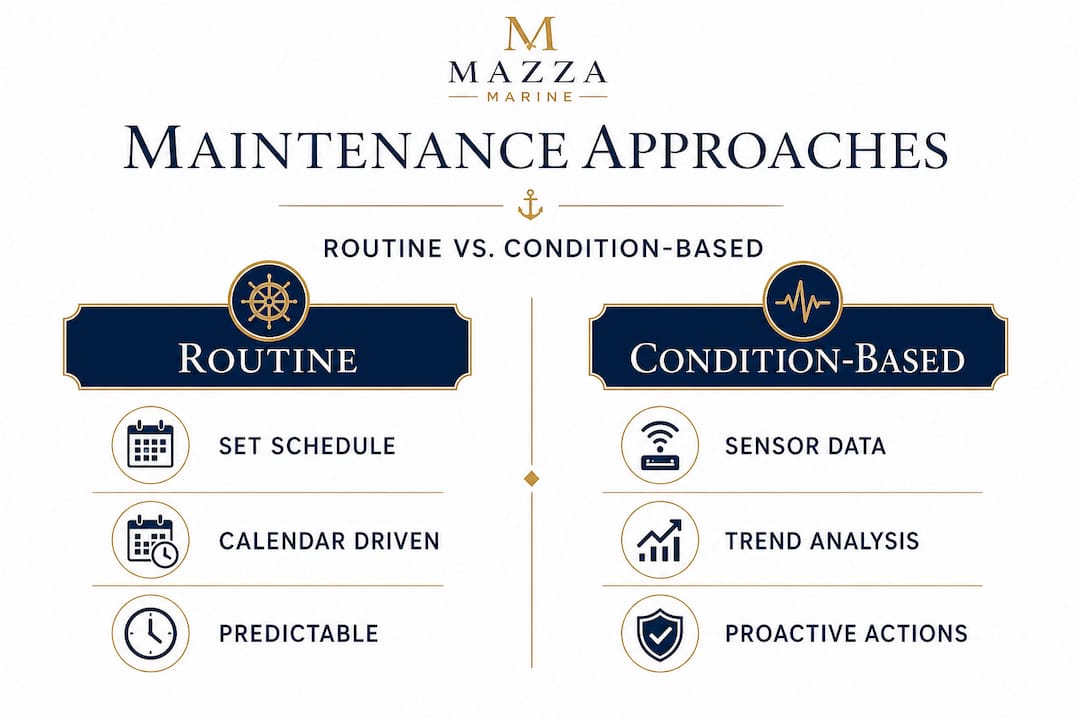
Smarter maintenance is not about abandoning your OEM manual. It is about layering better intelligence on top of a solid foundation. The framework below combines proven tradition with modern tools, and it works whether you own a 42-foot sportfish or a 70-foot custom cruiser.
A four-step framework for modern yacht mechanical maintenance:
-
Follow the OEM schedule as your baseline. Your manufacturer’s recommended intervals for oil changes, filter replacements, impeller checks, and transmission service exist for good reason. They reflect the design tolerances of your specific engines and drives. Skipping or stretching these intervals without compensating data is not smart maintenance. It is gambling.
-
Prioritize fluid quality and cooling water checks above all else. Engine oil, transmission fluid, coolant, and hydraulic fluid are the blood of your mechanical systems. Test coolant pH at least twice per season. Pull oil samples for analysis annually. Check for water contamination in fuel tanks before any extended offshore passage. These simple steps reveal what no visual inspection ever will.
-
Use sea trials as verification tools, not just shakedown runs. After every major service, take the vessel out and record your operating data. Compare it against your baseline logs. Did the engine temperature return to its pre-service range? Did the vibration profile improve? A sea trial is your most honest performance review, and the proactive maintenance framework supports this approach as a way to verify outcomes rather than assume them.
-
Add condition monitoring to every safety-critical system. Engines and drives first, then steering hydraulics, then exhaust. Build from there as your program matures and your data confidence grows. For owners considering a full upgrading your yacht mechanically, this monitoring foundation makes every refit decision more precise and cost-effective.
Pro Tip: Keep a physical or digital maintenance logbook that records not just what was done, but what was found. A note like “coolant slightly darker than last check, monitor” is worth more than a blank checkbox when you are trying to identify a slow-building problem six months later.
Two pitfalls to avoid with vigilance. First, never rely solely on visible wear as your trigger for service. Bearings, seals, and impellers can look fine and still be near the end of their functional life. Second, do not treat fluid changes as cosmetic. Dark oil or discolored coolant is a symptom, and the cause deserves investigation before you simply swap fluids and move on.
Training, standards, and when to call in the pros
Once you have a robust plan, it is crucial to know your limits and when professional help or formal standards are needed to avoid serious consequences.
There is real pride in hands-on ownership, and a skilled owner or captain can handle a meaningful portion of routine maintenance personally. But some systems are genuinely not DIY territory, and recognizing that line is part of being a responsible operator. Fuel system repairs, exhaust component replacements, steering system rebuilds, and propulsion control adjustments all fall into a category where ABYC-certified technicians are not optional extras. They are the standard of care.
ABYC, the American Boat and Yacht Council, sets the technical standards that govern how marine systems are designed, installed, and serviced in the United States. Their certification programs train technicians specifically in the systems most likely to cause catastrophic failures when mishandled. Knowing your technician holds current ABYC certification is one of the most straightforward ways to protect your vessel and everyone aboard.
When hiring a technician, ask these questions directly:
- Do you hold current ABYC certification, and in which systems?
- Have you worked on my specific engine brand and model before?
- Are you familiar with the exhaust and fuel routing layout on vessels of this type?
- Can you provide documentation of the work performed and any findings noted during service?
- Do you follow ABYC standards for thru-hull and through-deck fittings on any penetration work?
For vessels undergoing structural or heavy mechanical work, including thru-hull replacements or custom welding, the stakes rise further. Proper welding safety standards and materials matter enormously in a saltwater environment. Understanding vendor management tips can also help you build reliable relationships with qualified marine service providers.
“The marine industry’s commitment to safety depends on technicians who are trained to the same high standards. ABYC certification is not a formality. It is a professional baseline that protects vessels and the people who sail them.”
The misconception that all yacht repairs are within a capable owner’s reach gets people into serious trouble. A DIY exhaust elbow replacement that creates a carbon monoxide pathway, or a steering bleed done without proper pressure verification, can turn a routine weekend trip into an emergency. Respect the systems. Know when to call the right professional.
Our perspective: What most yacht owners get wrong about maintenance
With safety and standards in mind, it is time to reflect on what actually prevents breakdowns for Florida yachts in the real world.
After years of working with yacht owners across Florida, we have noticed a consistent pattern. The owners who experience the most damaging mechanical failures are not the ones who neglect their vessels. They are the ones who follow their maintenance schedule religiously but never verify what the maintenance actually achieved. They check the box and move on. The sea does not care about your logbook. It only responds to the actual condition of your equipment.
The uncomfortable truth is that interval checklists are planning tools, not outcome guarantors. You can change your oil on schedule with the wrong viscosity grade, or flush your cooling system without checking the pH, and feel completely confident that you have done your job. You have not. You have performed the motion of maintenance without confirming the result.
What separates genuinely reliable yachts from repeatedly troubled ones is a habit of verification. After every service, the owner or captain takes the vessel out, records the numbers, and compares them to baseline. They look for more breakdown prevention tips not because something went wrong, but because they want to know before something does. That proactive mindset is not paranoia. It is seamanship.
Pro Tip: Make your maintenance program visual. Trend charts showing engine temperature over six months, oil sample results plotted across seasons, and post-service sea trial notes create a living picture of your vessel’s health that no static checklist can replicate.
The owners who sleep well at anchor are the ones who trust their data, not just their schedule.
Expert solutions for smarter yacht maintenance in Florida
As you look to elevate your yacht’s maintenance, harness Florida’s best resources for the job.
Mazza Marine connects Florida yacht owners and captains with a carefully built network of experts who specialize in exactly what your vessel needs, from complete mechanical refits to targeted condition monitoring upgrades. Whether you are looking to upgrade your yacht’s mechanical systems or need reliable guidance on engine diagnostics, our partners bring the kind of precision and experience that keeps your vessel performing at its best season after season.

If you are not sure where a problem is coming from, start with our detailed engine troubleshooting tips to identify symptoms before they become serious damage. And if your vessel is already showing warning signs, our guide on signs you need repairs walks you through what to act on immediately. Mazza Marine is your one-stop partner for long-term mechanical confidence on Florida waters. Reach out today and let’s build a maintenance strategy that actually works.
Frequently asked questions
What’s the difference between routine and condition-based maintenance for yachts?
Routine maintenance follows a fixed calendar or engine-hour schedule, while condition-based maintenance uses measured data like vibration and temperature to detect developing failures earlier and more accurately.
Which mechanical yacht systems require ABYC-certified technicians?
Fuel, exhaust, steering, and propulsion controls should always be serviced by ABYC-certified professionals because errors in these systems can create life-threatening safety risks.
How can I monitor vibration or temperature trends on my yacht?
Portable vibration meters and infrared thermometers are affordable starting points, and dedicated sensor kits provide continuous logging for larger vessels using CBM practices that track early warning trends in marine engines.
What are the top warning signs of a developing mechanical issue?
Unusual vibration at the helm or throughout the hull, unexpected temperature spikes, changes in fluid color or smell, and any new or worsening noise from the drivetrain all deserve immediate investigation.
Is it safe to perform my own mechanical maintenance on a yacht?
Basic tasks like filter changes and fluid checks are reasonable for trained owners, but ABYC guidelines make clear that safety-critical systems require certified technician involvement to meet industry standards and protect everyone aboard.
Recommended
Text or Call 954-330-9653 Schedule Appointment
Mazza Marine Yacht Services & Refit

Fiberglass Upgrades and Damage Repair

Premium Yacht Paint/ Faux Teak

Fishing: Custom Rods, Reels,Tackle

Electrical, Electronics and Navigation

Paint, Hull and Gelcoat

Teak Decks, Wood Cabinets, Carpentry

Canvas, Enclosures and Upholstery

Mechanical, Repower and Running Gear

Plumbing, Bilge and Thru-Hulls

Welding and Custom Fabrication

Interior Refit And Past Work
Get your yacht value Estimate
"*" indicates required fields