
View Our Recent Work:

Florida yacht ownership carries a romantic image: open water, warm breezes, and effortless days on the ocean. But smooth sailing explained properly means something far more grounded. As an idiom, “smooth sailing” describes a situation that moves forward with ease and without problems. For yacht owners in Florida, that ease is real and achievable. It just does not arrive by accident. It arrives through deliberate maintenance, smart preparation, and knowing exactly what your vessel needs before the water ever gets rough.
Table of Contents
- Understanding smooth sailing for Florida yachts
- Mastering yacht maintenance: the key to effortless operation
- Preparing for hurricane season: smooth sailing starts with readiness
- Choosing the right maintenance tracking system for your yacht
- Why thinking beyond the voyage leads to truly smooth sailing
- Get expert yacht maintenance and hurricane prep services in Florida
- Frequently asked questions
Understanding smooth sailing for Florida yachts
Now that we’ve explored the idiom’s meaning, let’s get into what it really takes to achieve smooth sailing for your yacht in Florida. The phrase itself sounds passive, almost lucky. But smooth sailing implies particularly easy progress born from effort already invested, not from skipping the work altogether. That distinction matters enormously for anyone who owns a vessel in Florida’s demanding marine environment.
Many new yacht owners arrive with the same misconception: that a quality vessel should largely take care of itself. It doesn’t. Florida’s climate is relentless. Salt air, UV exposure, humidity, and hurricane season create a maintenance environment unlike almost anywhere else in the world. Understanding smooth sailing as a yacht owner means accepting that the calm on the water is a direct reflection of the work done at the dock.
Common misconceptions worth clearing up:
- “New boats don’t need much attention.” Even a brand-new yacht needs immediate break-in service and a defined maintenance schedule from day one.
- “Seasonal use means less maintenance.” Lower usage doesn’t reduce calendar-based deterioration. Seals dry out, fuel degrades, and antifouling paint works on a schedule, not engine hours.
- “Florida’s warm weather is easier on boats.” Warm weather accelerates UV damage, marine growth, and corrosion far faster than cooler climates.
- “I can catch problems when they appear.” Reactive maintenance costs three to five times more than proactive care. By the time a problem is visible, it’s usually expensive.
Your Florida spring checklist and yacht safety checklist are two practical tools that anchor the understanding smooth sailing concept in real, actionable steps. Start there.
Mastering yacht maintenance: the key to effortless operation
Understanding smooth sailing means mastering your yacht’s maintenance schedule to prevent surprises on the water. A well-maintained yacht is not just more reliable. It holds its value, performs better, and protects the investment you’ve made in it.
The gold standard for Florida owners is a hybrid tracking model that uses both calendar time and engine hours as service triggers. Whichever threshold arrives first triggers the service. This approach accounts for boats that sit idle for weeks as well as vessels that run hard through busy seasons.
Top maintenance tasks with recommended intervals:
- Engine oil and filter change — Every 100 engine hours or 12 months, whichever comes first
- Raw water impeller replacement — Every 200 hours or annually
- Fuel filter service — Every 200 hours or 12 months
- Zincs inspection and replacement — Every 3 to 6 months in Florida’s saltwater
- Antifouling bottom paint — Annually, with haul-out scheduled well in advance
- Through-hull and seacock service — Annually, exercising each valve to prevent seizing
- AC system maintenance — Every 6 months given Florida’s year-round use
| Maintenance task | Trigger (hours) | Trigger (calendar) |
|---|---|---|
| Engine oil change | 100 hours | 12 months |
| Impeller replacement | 200 hours | 12 months |
| Fuel filter service | 200 hours | 12 months |
| Zinc replacement | N/A | 3 to 6 months |
| Bottom paint | N/A | 12 months |
| AC system service | N/A | 6 months |
Missing these intervals carries real consequences. A seized through-hull discovered during hurricane prep, for example, is not a minor inconvenience. It can delay haul-out and leave your vessel exposed during storm season. Your engine maintenance plan and marine mechanical systems guide provide a deeper look at protecting your drivetrain specifically.
Pro Tip: Print or save a physical copy of your maintenance log alongside the digital version. If your phone dies, your cloud app glitches, or you hand the boat to a captain, a printed record keeps everyone accountable and avoids duplicate or missed services.
Your hull maintenance guide is equally worth bookmarking. In Florida’s warm, nutrient-rich waters, marine growth on an untreated hull can reduce fuel efficiency by 10 to 15 percent within months.
Preparing for hurricane season: smooth sailing starts with readiness
Beyond routine maintenance, hurricane preparedness is crucial for true smooth sailing in Florida waters. If maintenance is the daily practice of good seamanship, hurricane prep is its annual exam.
Florida hurricane prep guidance recommends starting in May, before marinas and haul-out facilities fill their calendars. The prep is organized into three phases:
- 30-day phase (early May): Audit all docklines and chafe gear, service bilge pumps and automatic float switches, schedule haul-out or storm mooring reservations, review your insurance policy for named storm requirements, and photograph every part of the vessel.
- 7-day phase (when a storm is forecast): Remove sails, biminis, and canvas enclosures, top off or stabilize fuel, double all docklines, secure all loose gear topside and below, and confirm your haul-out reservation or hurricane hole location.
- 24-hour phase (storm imminent): Final inspection of all lines and chafe protection, confirm bilge pump operation, remove electronics and valuables, and document vessel condition with video.
Key tasks by phase:
- Cancel or relocate any scheduled trips or charters
- Notify your marina and insurer of your storm plan
- Verify that all through-hulls are properly closed
- Confirm that zincs and anodes are current (damaged hull below the waterline is often invisible until haul-out)
Documentation is often overlooked but carries serious weight in insurance claims. A full photo and video record taken before a storm, with timestamps, can dramatically accelerate your claim and prevent disputes over pre-existing damage. Your spring checklist for hurricane prep covers this documentation process step by step. And if you’re weighing haul-out vs. staying in the water, the vessel haul-out guide breaks down the decision with clarity.
Pro Tip: Book your haul-out slot in early May, even if a named storm is not yet on the radar. The most reputable yards in South Florida fill their hurricane slots by June 1. Waiting until a storm is named means you’re competing for the last available spaces, often at elevated prices.
Choosing the right maintenance tracking system for your yacht
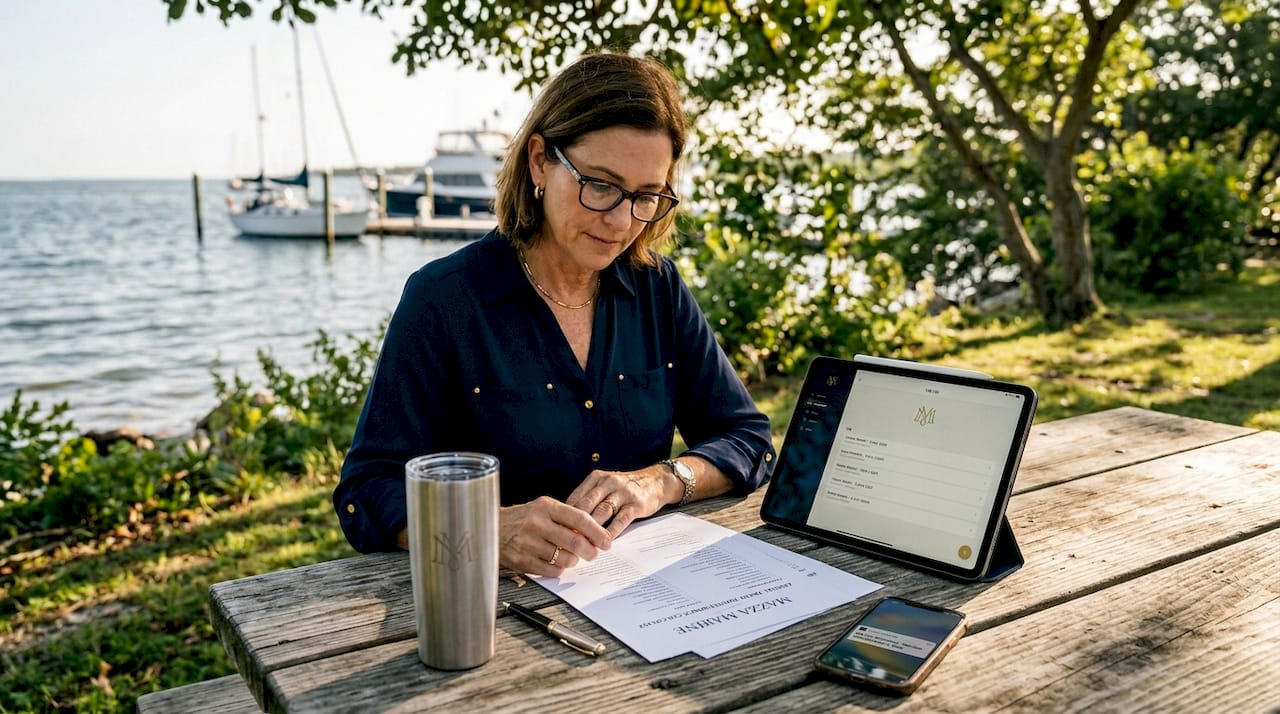
With the right system in place, you can effectively track your yacht’s upkeep and prepare for any challenge Florida throws your way. The honest truth? Most maintenance plans fail not because owners don’t care but because tracking breaks down due to human error and missed reminders. The fix isn’t more discipline. It’s a better system.

| System type | Pros | Cons |
|---|---|---|
| Spreadsheet | Free, customizable, familiar | No reminders, easy to forget, error-prone |
| Mobile maintenance app | Reminders, portable, photo logs | Subscription cost, app-specific learning curve |
| AI-powered yacht management software | Auto-logs engine hours, predictive alerts, cloud backup | Higher cost, best on larger or actively managed vessels |
For most Florida yacht owners, a quality mobile app with hour-based and calendar-based triggers strikes the best balance. Critical features to look for:
- Dual triggers — alerts fire on either hours or calendar dates, whichever comes first
- Photo and note logging — attach service records and receipts to each entry
- Captain handoff notes — allows a hired captain to log hours independently
- Offline access — critical when you’re offshore with spotty service
- Vendor contact list integration — so your mechanic’s number is one tap away when something needs attention
Pro Tip: When evaluating apps, run a 30-day free trial during active use months. An app that works perfectly while the boat is docked but fails to log GPS-based hours underway is not actually useful in Florida’s conditions. Test it on the water before committing.
Your boat management guide offers a broader view of structuring ownership with professional support, which pairs naturally with any tracking system you choose.
Why thinking beyond the voyage leads to truly smooth sailing
Here’s a view most ownership guides won’t offer: smooth sailing in life, and certainly on the water, has less to do with your vessel’s condition on any given day and everything to do with the system behind it. Florida yacht owners who truly master the smooth sailing concept aren’t the ones who never encounter problems. They’re the ones who encounter problems that are small, predictable, and already half-solved before they become emergencies.
Reactive ownership is the quiet killer of enjoyment on the water. A yacht owner who only thinks about maintenance when something breaks spends their season dealing with urgent repairs, missed departures, and unexpected bills. The owners we’ve seen genuinely thrive are the ones who’ve built continuous vigilance into their routine. Not seasonal resets. Not annual panic. A living, updated system that never really goes dormant.
Modern tools change the equation considerably. AI-powered diagnostics can now monitor engine performance data and flag anomalies before they become failures. A deviation in oil pressure trending over 60 days tells a different story than a sudden drop, and smart software catches the former. That kind of predictive insight was once reserved for commercial shipping operations. Today it’s accessible to private yacht owners.
The deeper mindset shift is this: stop thinking of maintenance as a cost and start treating it as the price of freedom. Every dollar spent proactively on a schedule is a dollar that buys you the ability to leave the dock without hesitation. Every hour invested in hurricane prep before June is an hour that keeps your vessel where it belongs after a storm. True comprehensive boat management means weaving strategy into every season, not just reacting to whatever arrives next.
Get expert yacht maintenance and hurricane prep services in Florida
Putting this knowledge to work is exactly where professional support makes the difference. Knowing what smooth sailing tips to follow is one thing. Having a trusted team execute them on time, every time, is another entirely.
At Mazza Marine, brothers Mino and Luigi have built a Florida-wide network of yacht specialists covering everything from urgent yacht repairs and complete maintenance packages to marine mechanical systems service and interior refit work. Whether your vessel needs engine long-term care, custom canvas, electronics upgrades, or a haul-out before hurricane season, we connect you with the right experts at the right time. Reach out to the Mazza Marine team and let’s build a maintenance plan that keeps your yacht ready for every season Florida offers.
Frequently asked questions
What does ‘smooth sailing’ mean for yacht owners?
For yacht owners, smooth sailing means operating their vessel with minimal problems through consistent maintenance and careful preparation, not just calm seas.
How should Florida yacht owners track maintenance?
They should use a hybrid tracking system that schedules service based on whichever comes first, engine hours or calendar dates, ensuring timely upkeep even with low use.
When should hurricane preparation begin for Florida yachts?
Preparation should start in early May to avoid service bottlenecks and ensure ample time for securing haul-out reservations and completing essential tasks before hurricane season opens on June 1.
Why do many maintenance tracking attempts fail?
Most tracking failures stem from human error and missed reminders; using organized systems with automatic triggers reduces missed services and keeps critical systems from falling through the cracks.
Can technology improve yacht maintenance tracking?
Yes, AI-powered diagnostics and mobile apps can automate reminders, log usage data, and predict maintenance needs, saving time and preventing the kind of costly repairs that come from missed service windows.
Recommended
Text or Call 954-330-9653 Schedule Appointment
Mazza Marine Yacht Services & Refit

Fiberglass Upgrades and Damage Repair

Premium Yacht Paint/ Faux Teak

Fishing: Custom Rods, Reels,Tackle

Electrical, Electronics and Navigation

Paint, Hull and Gelcoat

Teak Decks, Wood Cabinets, Carpentry

Canvas, Enclosures and Upholstery

Mechanical, Repower and Running Gear

Plumbing, Bilge and Thru-Hulls

Welding and Custom Fabrication

Interior Refit And Past Work
Get your yacht value Estimate
"*" indicates required fields