
View Our Recent Work:

A step by step custom refit is a structured process that transforms your vessel’s technical systems and aesthetic character to match your exact vision. Industry professionals define a refit as more than repair. It is a deliberate project to restore functional coherence while updating a boat for modern use. Done well, a custom refit increases safety, comfort, and resale value. Done poorly, it drains budgets and extends timelines far beyond what any owner expects. This guide walks you through every phase, from the first survey to the final sea trial, with the practical detail you need to get it right.
What preparations are essential before starting a custom refit?
The most expensive mistake in any refit happens before a single tool touches the boat. Skipping a thorough pre-refit survey is the single fastest way to blow your budget. A comprehensive condition survey, conducted at least 12 months before your target start date, gives you a clear picture of what the vessel actually needs versus what you think it needs. Those two lists are rarely the same.
Defining scope and setting a realistic budget
Scope definition is the foundation of the entire refit project plan. Every item must be measurable and specific. “Upgrade the electrical system” is not a scope item. “Replace the 12V DC distribution panel with a 200A Blue Sea Systems panel and rewire all cabin circuits to ABYC E-11 standards” is a scope item. Vague language creates ambiguity, and ambiguity costs money.
Budget planning must include a contingency fund of 15–25% over the base quote for unforeseen discoveries after strip-down. Older vessels or those that have not been refitted in many years may require contingencies beyond 25%. That number is not padding. It reflects the reality that hidden corrosion, delamination, or outdated wiring only reveals itself once the boat is opened up.
Pro Tip: Appoint a single point of contact on your side before the project begins. This person owns all communication with the yard, tracks every decision, and signs off on every change. Without this role, critical details fall through the cracks.
Essential pre-refit documents
| Document | Purpose |
|---|---|
| Condition survey report | Establishes baseline for all structural and systems work |
| Detailed scope of work | Defines every task with measurable specifications |
| Budget with contingency | Sets financial limits and reserves for surprises |
| Refit project schedule | Maps phases, milestones, and critical path items |
| Vendor contact list | Centralizes all supplier and subcontractor information |
Getting these documents in order before you approach a single yard puts you in a position of control. Yards respect owners who arrive prepared. It also makes comparing quotes far more accurate, since every yard prices the same defined scope.
How do you manage the step by step execution of a custom refit?
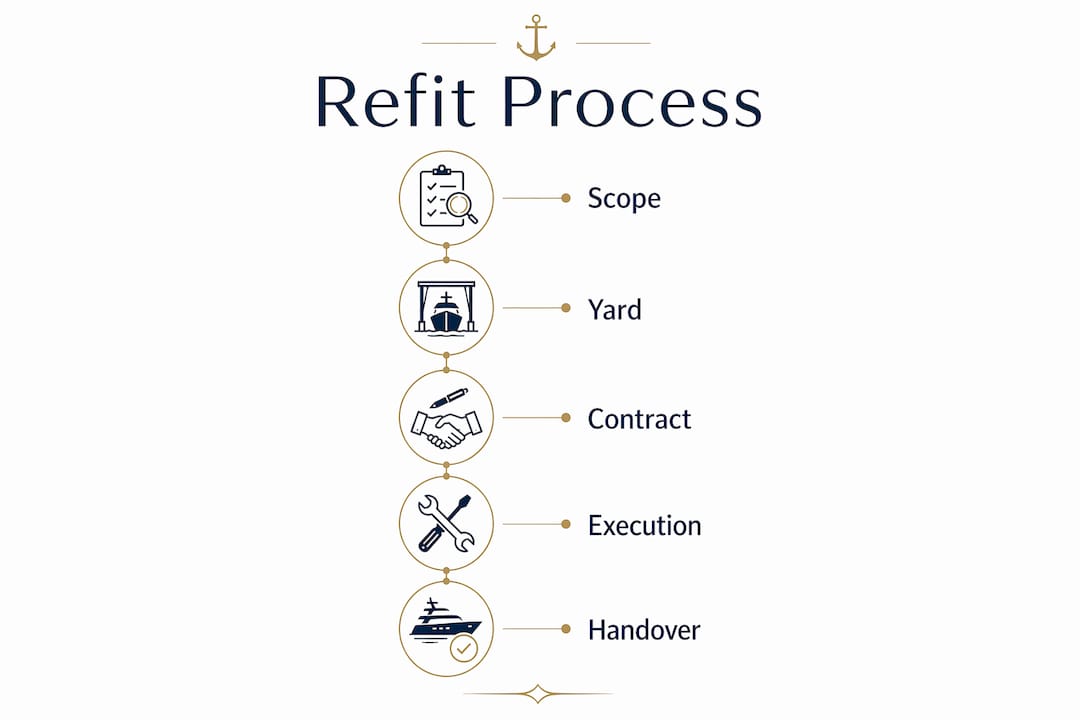
The standard refit process follows five phases: scope definition, yard selection, contract negotiation, execution with reporting, and handover with testing. Each phase builds on the last. Skipping or rushing any one of them creates problems that compound downstream.
Phase 1: Yard tendering and selection
Selecting the right yard is not simply a matter of finding the lowest quote. A yard that quotes significantly below market typically recoups that margin through expensive change orders once the project is underway. Always request a detailed pricing breakdown, not a lump sum. Compare yards on their experience with your vessel type, their subcontractor network, and their communication practices. For Florida owners, choosing a refit yard in a hub like Fort Lauderdale gives you access to a deep pool of specialized tradespeople.

Phase 2: Contract negotiation
The contract is your protection. It must define the scope, payment schedule, change order procedures, and dispute resolution process in writing. Verbal agreements have no place in a refit project. A formal written change order process, where every modification is documented and approved before work begins, is the single most effective way to prevent cost and schedule creep.
Phases 3–5: Execution, quality control, and handover
“Most refit uncertainty stems from unclear expectations and fragmented communication rather than technical complexity. Consistent processes with transparent oversight mitigate these risks.”
Daily oversight during execution keeps the project on track. Weekly progress meetings with the yard foreman are the minimum standard. These meetings surface problems early, when they are still cheap to fix. Quality assurance checkpoints should be scheduled at defined milestones, not just at the end. Handover must include documented sea trials, updated vessel records, and delivery of all warranties and manuals for new equipment.
Pro Tip: Ask the yard for a daily written log of work completed. This creates a paper trail that protects both parties and makes it easy to track progress against the schedule.
Common project management pitfalls to avoid:
- Approving work verbally without a written change order
- Allowing the yard to begin new scope items before pricing is agreed
- Missing scheduled inspections because of travel or time constraints
- Failing to confirm supplier lead times before locking the project schedule
- Skipping the final sea trial to save time or money
What are the best practices for customizing boat elements during a refit?
A refit is a cascade of interconnected systems. Changing one component almost always affects others. Replacing a teak deck, for example, requires addressing the underlying substrate, the fastening method, and the deck hardware. A deck refit affects rigging and safety systems as well as interior headliner access. Treating each upgrade in isolation is how owners end up doing the same job twice.
Structural and deck upgrades
Modern teak decking refits increasingly move from mechanical fasteners to structural bonding in a vacuum, which eliminates screws and improves long-term adhesion. Composite and bonded synthetic alternatives offer similar aesthetics with far lower maintenance demands. For Florida owners dealing with intense UV exposure and salt air, this trade-off is particularly worth considering.
Mechanical and electrical systems
Upgrading propulsion and electrical systems during a refit delivers compounding returns. A new engine installation paired with updated fuel lines, sea cocks, and exhaust components costs more upfront but avoids the labor of revisiting those systems individually later. The same logic applies to marine electrical upgrades, where integrating LED lighting, updated navigation electronics, and shore power management into a single project reduces total installation time and ensures system compatibility.
Interior and aesthetic customization
Interior refits balance livability with market positioning. The choices you make here affect both how you use the boat and what it is worth when you sell it. Key considerations include:
- Joinery and upholstery: Use marine-grade materials rated for UV and moisture exposure. Cheap shortcuts here show within two seasons.
- Galley and head upgrades: Plumbing and cabinetry changes affect structural access. Plan these alongside any systems work happening in the same space.
- Helm and electronics: Integrating a new nav electronics suite during an interior refit avoids duplicate labor on dash panels and wiring runs.
- Lighting and ambiance: LED conversion throughout the vessel reduces power draw and creates a noticeably more refined interior feel.
| Upgrade category | Cascade effect to plan for |
|---|---|
| Deck replacement | Substrate condition, hardware rebedding, rigging inspection |
| Engine replacement | Fuel system, exhaust, engine mounts, electrical integration |
| Interior joinery | Plumbing access, electrical routing, ventilation |
| Electronics upgrade | Wiring, antenna placement, helm panel redesign |
Involving an independent specialist or project manager for customization decisions protects you from yard-driven upsells and keeps the project aligned with your actual priorities.
How can boat owners avoid costly mistakes during a custom refit?
Late-discovered scope items after strip-out are the largest scheduling risk in any refit. The best defense is a detailed pre-refit survey that opens up suspect areas before the project begins. Paying for a thorough survey upfront is always cheaper than discovering a problem mid-project when the yard’s day rate is running.
The most common mistakes boat owners make during a custom refitting project:
- Underestimating contingencies: Budget overruns are almost always traced back to an insufficient reserve, not unexpected bad luck.
- Skipping written change orders: Verbal or informal agreements lead to costly overruns and disputed invoices. Every change, no matter how small, needs a signed document.
- Ignoring supplier lead times: A custom portlight or a specific engine component can take 8–12 weeks to arrive. Failing to order early stalls the entire project.
- Inconsistent communication: Technical failures in refits are less common than failures in communication and expectation management. Set a regular meeting cadence and stick to it.
- Skipping independent oversight: An independent project manager who works exclusively for you reduces cost overruns and maintains quality and schedule in ways that self-managing rarely achieves.
Pro Tip: Keep a refit decision log. Every time you approve a change, note the date, the cost impact, and the reason. This document becomes invaluable if disputes arise and gives you a clear record of how the project evolved.
Scheduling pitfalls deserve special attention. Inspection delays from classification societies or flag state surveyors can add weeks to a timeline. Build those windows into the schedule from day one, not as an afterthought.
Key Takeaways
A successful custom refit depends on thorough pre-project planning, a written change order process, and consistent communication between owner, yard, and project manager throughout every phase.
| Point | Details |
|---|---|
| Budget with contingency | Reserve 15–25% above the base quote to cover discoveries after strip-down. |
| Define scope precisely | Every task must be measurable and specific before approaching any yard. |
| Use written change orders | Document and approve every change before work begins to prevent overruns. |
| Plan for cascade effects | Changes to one system almost always affect adjacent systems and costs. |
| Hire independent oversight | A project manager working for you protects budget, quality, and schedule. |
What I’ve learned managing custom refit projects
The thing that surprises most boat owners is how rarely the technical work is the hard part. I’ve watched well-funded refits go sideways not because of a bad weld or a failed engine, but because the owner and the yard had two completely different pictures of what “finished” looked like. That gap almost always traces back to a scope document that was too vague or a conversation that happened over the phone instead of in writing.
The cascade effect is real, and it catches people off guard every time. I’ve seen a straightforward interior refit uncover corroded through-hulls that nobody knew about, turning a four-week project into a twelve-week one. That’s not a failure of the yard. That’s a failure of the pre-project survey. The money you spend on a thorough survey before the project starts is the best money in the entire budget.
My honest advice: treat the refit as a long-term investment in the vessel, not a one-time expense. Owners who approach it that way make better decisions at every trade-off point. They choose the bonded deck over the mechanical fasteners. They upgrade the electrical system properly instead of patching it. And when they sell the boat five years later, the refit pays them back.
— Jason
Mazzamarine’s approach to custom refit projects
Boat owners across Florida trust Mazzamarine to manage every phase of a custom refit, from the first condition survey to the final sea trial. Mino and Luigi built Mazzamarine on the belief that every owner deserves an expert in their corner, not just a yard contact.
Mazzamarine coordinates a vetted network of Florida specialists covering interior refits, mechanical upgrades, custom paint, canvas work, welding, and electronics. Whether you need a complete refit or targeted upgrades, the team acts as your independent project manager, protecting your budget and your timeline. Explore the full range of marine repair services or reach out directly to start planning your project with people who genuinely love what they do.
FAQ
What does a step by step custom refit involve?
A custom refit follows five phases: scope definition, yard selection, contract negotiation, project execution with regular reporting, and handover with sea trials. Each phase requires documented decisions and clear communication between the owner and the yard.
How much contingency should I budget for a boat refit?
Budget a contingency of 15–25% above your base quote to cover discoveries made after the vessel is opened up. Older boats or those with long gaps between refits may require reserves beyond 25%.
Why do refit projects go over budget?
Most overruns trace back to vague scope documents, verbal change approvals, and late-discovered structural or systems issues. A detailed pre-refit survey and a formal written change order process prevent the majority of budget problems.
When should I hire an independent project manager for a refit?
Hire an independent project manager for any refit that involves multiple trades, systems upgrades, or a timeline longer than four weeks. An independent manager works exclusively for you and reduces both cost overruns and quality issues.
How do I choose the right yard for a custom refit?
Evaluate yards on their experience with your vessel type, their subcontractor network, and their willingness to provide detailed pricing breakdowns. Avoid yards that quote lump sums or significantly below market without explanation.
Recommended
Text or Call 954-330-9653 Schedule Appointment
Mazza Marine Yacht Services & Refit

Fiberglass Upgrades and Damage Repair

Premium Yacht Paint/ Faux Teak

Fishing: Custom Rods, Reels,Tackle

Electrical, Electronics and Navigation

Paint, Hull and Gelcoat

Teak Decks, Wood Cabinets, Carpentry

Canvas, Enclosures and Upholstery

Mechanical, Repower and Running Gear

Plumbing, Bilge and Thru-Hulls

Welding and Custom Fabrication

Interior Refit And Past Work
Get your yacht value Estimate
"*" indicates required fields