
View Our Recent Work:

Overview: A stepwise yacht emergency plan is a phase-based procedure that tells every person aboard exactly what to do the moment something goes wrong. It moves through five stages: Prepare, Respond, Notify, Stabilize/Mitigate, and Abandon/Survive. Each phase is built around a few non-negotiables that belong on your bridge and in your crew’s muscle memory:
- A posted muster list and emergency instructions, visible in conspicuous and accessible locations
- A registered 406 MHz EPIRB and a working VHF radio on Channel 16/DSC
- Serviced life rafts and a float plan left with someone ashore
Florida yacht owners who build their plans around federal guidance stay ahead of trouble instead of reacting to it. The framework here draws on 46 CFR 26.03-2 emergency check-off requirements, 33 CFR 155 exercise rules, and the USCG Boater’s Guide.
Key Takeaways
A stepwise yacht emergency plan works because it assigns exact actions, exact people, and exact timing to each of five phases, backed by required equipment and a proven exercise cadence.
Table of Contents
- Building Stepwise Yacht Emergency Plans Phase by Phase
- Who Does What: Crew Duties and the Communications Rule
- What Regulatory Documents Must Be Onboard?
- How Often Should Crews Run Emergency Drills?
- Appendices Every Yacht Emergency Binder Needs
- Supporting Crew Mental Health During and After an Emergency
- Coordinating With Nearby Vessels and Rescue Services
- Turning Every Drill and Incident Into a Better Plan
- A Captain’s Note on What Actually Breaks Down
- Let Mazza Marine Help You Build a Plan That Holds Up
- Frequently Asked Questions
- Sources
Building Stepwise Yacht Emergency Plans Phase by Phase
A stepwise yacht emergency plan only works if the actions inside it are specific enough that a tired, adrenaline-soaked crew member can follow them without thinking twice. Here is how the five phases break down by the clock.
Prepare (before anything happens)
- Post the muster list and emergency instructions at the helm, in the crew mess, and near each cabin.
- Assign and drill roles: master, deputy, rescue boat leader, medical lead, communications officer.
- Verify EPIRB registration with NOAA and confirm VHF/DSC and SATCOM are functioning.
- File a float plan with a shoreside contact, including identification details and intended track.
- Inspect life rafts, lifejackets, fire extinguishers, and bilge pumps on a fixed maintenance calendar.
Respond (0 to 5 minutes)
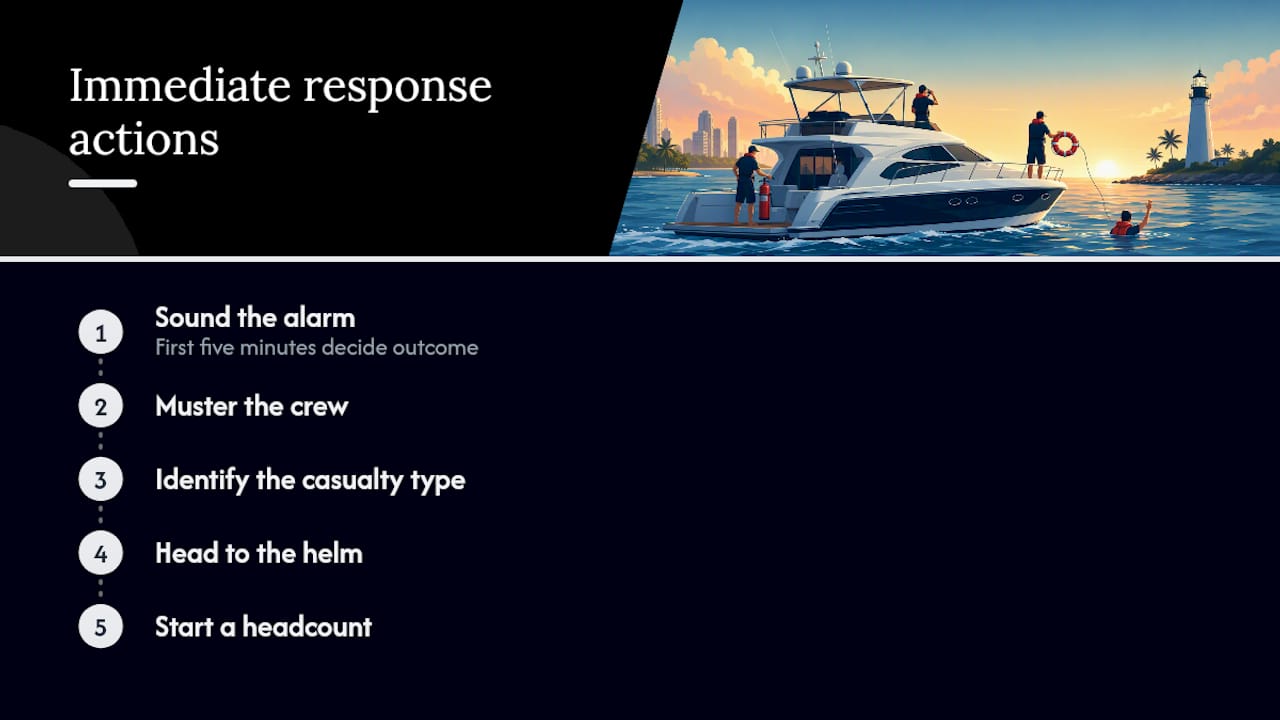
The first five minutes decide the outcome more than any other phase. Sound the alarm, muster the crew, and identify the casualty type immediately. Someone heads to the helm; someone else starts a headcount.
Notify (5 to 30 minutes)
Once the situation is confirmed, the communications officer transmits on Channel 16, activates DSC distress if warranted, and prepares to trigger the EPIRB if the situation escalates. This is also when you contact the Coast Guard sector or the National Response Center if pollution is involved.
Stabilize/Mitigate (30-plus minutes)
Crew works the casualty-specific checklist below while the master reassesses stability, weighs salvage or Coast Guard assistance, and keeps a written log of every decision and timestamp.
Abandon/Survive (last resort)
If the vessel’s structural integrity is compromised beyond control, or firefighting or dewatering efforts are failing to keep pace, abandon takes priority over property. The rule of thumb: stay with a floating vessel unless staying is more dangerous than leaving it.
Casualty checklists, condensed:
- Fire at sea: Cut fuel/power to the area, deploy extinguishers, close ventilation, alert nearby vessels.
- Man overboard: Throw flotation, mark GPS position, assign a spotter who never loses visual contact, launch the tender.
- Flooding/ingress: Locate the source, start bilge pumps, shore up the breach, monitor list and trim.
- Grounding/collision: Stop engines, check for hull breach, assess tide and bottom before attempting to refloat.
- Medical emergency: Apply first aid, contact Coast Guard for medevac coordination, prepare a clear landing zone if helicopter extraction is needed.
- Oil spill containment: Stop the discharge source, deploy containment boom if available, begin required notifications.
Equipment readiness checklist: EPIRB/PLB registration current, VHF/DSC tested monthly, SATCOM charged, life rafts serviced per manufacturer schedule, lifejackets sized and accessible, fire extinguishers inspected, bilge pumps tested under load.
Pro Tip: Laminate a quick-card for each muster station listing that station’s top three actions. In a real emergency, nobody wants to flip through a binder. They want three lines they can read in five seconds.
Who Does What: Crew Duties and the Communications Rule
Confusion kills more time in an emergency than the emergency itself. Every stepwise yacht emergency plan needs a chain of command that survives chaos, plus a communications rule everyone can recite: who reports, what happened, when it happened, how to respond. That script should live on the bridge, in the crew mess, and at each muster station, exactly as the USCG Boater’s Guide recommends for reliable emergency communications.
- Master: Final decision authority on stabilize, salvage, or abandon.
- Deputy/master’s designee: Assumes command if the master is incapacitated.
- Rescue boat leader: Commands tender launch and recovery operations.
- Medical lead: Runs first aid and coordinates medevac communication.
- Communications officer: Owns the VHF, DSC, and EPIRB activation sequence.
| Role | Primary Contact | Backup Location |
|---|---|---|
| Master | Captain | Bridge binder |
| Communications | First mate | Pocket card |
| Medical | Crew medic/designee | Crew mess posting |
Experts recommend a safety management system that assigns these duties formally, so nobody is improvising a role mid-emergency.
What Regulatory Documents Must Be Onboard?
Every yacht subject to federal oversight needs specific paperwork ready to hand over or reference, not buried in a filing cabinet ashore. Muster lists and emergency instructions must be posted in conspicuous locations under 46 CFR 199, and a shipboard oil pollution emergency plan, where applicable, must include a preamble, reporting steps, and appendices with 24-hour contacts under 33 CFR 151.26.
- Posted muster list with assigned duties and alarm signal meanings
- SOPEP with initial notification forms and discharge-control steps
- 24-hour contact list, including Coast Guard sector and port authority numbers
- Hard copy in the bridge binder, digital copy on the captain’s tablet or e-SMS
Ship-specific drawings, tank tables, and contact appendices dramatically speed up decisions during stability and lightening actions after a casualty. Plans approved under the Coast Guard’s SOPEP process carry a five-year approval window before resubmission is required, per plan submission and approval rules.
How Often Should Crews Run Emergency Drills?
Federal exercise rules set the floor, not the ceiling, for how sharp your crew stays. Under 33 CFR 155.4052, vessels subject to response plan requirements need regular quarterly exercises, at least one unannounced exercise each year, and a full-plan exercise on a multi-year cycle. PREP-compliant programs satisfy these same requirements.
- Quarterly: tabletop or hands-on drills for a single casualty type
- Annual: one unannounced scenario, sprung without warning to the crew
- Every three years: a full-plan exercise involving every role and system
- Announce the drill type and timing to build initial muscle memory.
- Run at least one unannounced drill per year to expose real gaps.
- Log corrective actions and review them at the next management meeting.
Unannounced drills reveal the human factors problems that scripted ones never do. That is the whole point of running one.
Appendices Every Yacht Emergency Binder Needs
A plan is only as useful as its appendices. Keep 24-hour contacts, port and harbor numbers, ship-specific drawings, an equipment inventory, and notification forms together, version-controlled, and synced between the bridge binder and captain’s tablet.
| Appendix | Where It Lives |
|---|---|
| 24-hour contacts | Bridge binder, e-SMS |
| Equipment inventory | Engine room, tablet |
| Notification forms | Bridge binder |
A printable stepwise checklist mapping each phase to three to six immediate actions belongs posted at the helm and in the crew mess, alongside your Florida yacht safety checklist.
Supporting Crew Mental Health During and After an Emergency
The physical response gets all the attention in most plans, but the psychological aftermath shapes whether your crew performs well next time. Fear, adrenaline, and guilt after a bad outcome do not switch off when the Coast Guard clears the scene.
Build a brief psychological first aid step into your plan: after the immediate danger passes, the master or medical lead checks in with each crew member individually, not just as a group. Ask simple, direct questions. Is anyone injured beyond what’s visible? Does anyone need to step away from duty? Normalize the fact that shaking hands and a racing heart after a fire or a man-overboard event are expected reactions, not weakness.
Longer term, especially after a serious incident involving injury or loss, plan for a follow-up conversation days later, not just an immediate debrief. Some captains bring in a counselor experienced with maritime trauma for crew who want it. Others simply build in a mandatory day of lighter duties after any major casualty response, recognizing that decision-making stays impaired for hours after intense stress. Whatever your approach, write it into the plan itself. If mental health support only exists as a verbal promise, it disappears under the next deadline.
Coordinating With Nearby Vessels and Rescue Services
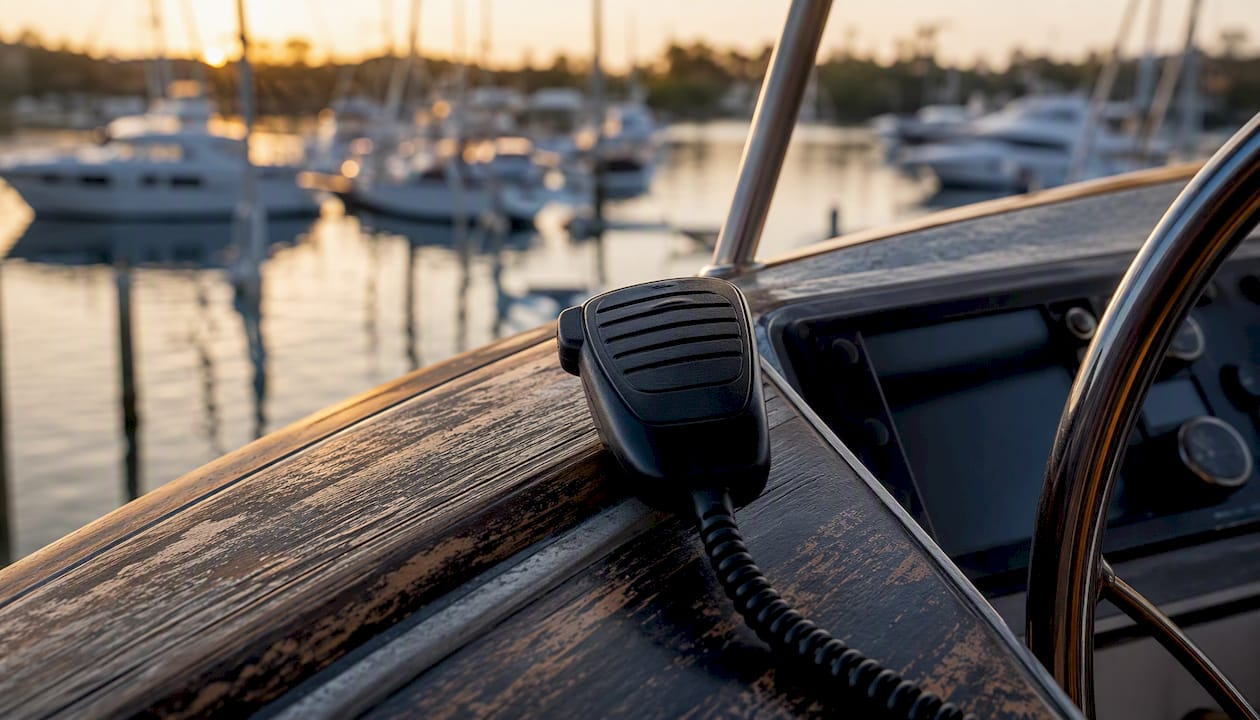
A single yacht rarely handles a serious emergency alone, and your plan should assume help is coming from multiple directions at once. The moment your communications officer transmits on Channel 16 or triggers DSC distress, nearby vessels may respond before the Coast Guard arrives on scene.
Your stepwise plan needs a clear protocol for handing off control once outside assets arrive. Designate who speaks for your vessel on the radio once a Coast Guard cutter, helicopter, or Good Samaritan boat is involved, so instructions do not get contradicted mid-rescue. Share your GPS position, headcount, casualty type, and immediate hazards in that first transmission using the who/what/when/how format your crew already knows from drills.
If a nearby vessel arrives first, give them a single point of contact aboard your yacht and a clear picture of what help you need: dewatering pumps, a tow line, medical evacuation space, or simply a radio relay if your own signal is weak. Multi-asset responses fail when everyone transmits at once and nobody defers. Practice this handoff during your annual unannounced drill, not just the mechanical casualty response, so the radio discipline is already built in when a real rescue asset shows up.
Turning Every Drill and Incident Into a Better Plan
A stepwise yacht emergency plan that never changes after a drill is a plan that is quietly going stale. The debrief matters as much as the drill itself, and skipping it is the single most common way owners let a good plan rot.
Within 24 to 48 hours of any drill or real incident, gather the crew for a short, honest debrief. What worked? What took longer than it should have? Did anyone hesitate because a role wasn’t clear? Write down every gap, even minor ones like a laminated card that was hard to read in low light.
Feed those findings back into the plan itself, not just a notebook that nobody reopens. Update the muster list, revise the quick-cards, and adjust contact information if anything changed. A digital or e-SMS system that stores version history makes this loop faster, since the whole crew sees the same updated document instead of working from outdated printouts scattered across the boat. Treat every drill as a live audit of your plan, not a box to check for the exercise cadence alone.
A Captain’s Note on What Actually Breaks Down
Most gaps I have seen trace back to one thing: a muster list that looked complete on paper but nobody had actually rehearsed against a real clock. The single best fix is running your unannounced drill like it’s real, timed and all.
Let Mazza Marine Help You Build a Plan That Holds Up
A written plan only earns its keep when the crew, the equipment, and the vessel itself are ready to execute it. Mazza Marine works directly with Florida owners and operators to build stepwise yacht emergency plans from scratch, run on-board drills that expose real gaps, and inspect the equipment your plan depends on, from EPIRBs to bilge pumps to fire suppression systems.

If a recent drill or inspection turned up aging gear, worn wiring, or a system that would not hold up under real stress, that is exactly the kind of issue our team fixes before it becomes an emergency instead of after. Between plan development, equipment readiness checks, and urgent repair capability across South Florida, Mazza Marine functions as a genuine one-stop partner rather than another vendor to coordinate separately. Reach out to request a plan-build estimate or schedule an on-site readiness assessment, and check our guide to signs you need yacht repairs if your last drill exposed anything that needs attention now.
Frequently Asked Questions
What is a stepwise yacht emergency plan?
It is a phase-based procedure covering Prepare, Respond, Notify, Stabilize/Mitigate, and Abandon/Survive, giving crew exact actions for each stage of an emergency.
How often do yacht emergency drills need to happen?
Quarterly exercises are the baseline, with at least one unannounced drill annually and a full-plan exercise every three years under 33 CFR 155.4052.
What must be posted on board under federal rules?
A muster list and emergency instructions must be posted in a conspicuous location, per 46 CFR 26.03-2.
Who decides when to abandon a yacht?
The master makes that call, weighing whether the vessel remains safer to stay aboard than to leave, based on structural integrity and firefighting or dewatering progress.
Does Mazza Marine help build emergency plans, not just repairs?
Yes. Mazza Marine works with Florida owners to build stepwise plans, run drills, and inspect the safety equipment those plans rely on.
This article is general information, not a substitute for advice from a qualified lawyer. Consult a qualified legal professional about your own circumstances before acting on anything here.
Sources
Build your plan on primary regulatory text, not secondhand summaries. Start with 46 CFR 26.03-2 for emergency check-off list requirements, 33 CFR 155.4052 for exercise cadence and PREP compliance, and the USCG Boater’s Guide for practical EPIRB and float plan guidance.
- 46 CFR § 26.03-2 – Emergency instructions. | Electronic Code of Federal Regulations (e-CFR) | US Law | LII / Legal Information Institute
- A Boater’s Guide to the Federal Requirements for Recreational Boats (USCG Boater’s Guide PDF)
Download the PREP guidelines and sample notification forms before your next drill cycle, and keep local port contacts filed in your appendices where the whole crew can find them.
Recommended
Text or Call 954-330-9653 Schedule Appointment
Mazza Marine Yacht Services & Refit

Fiberglass Upgrades and Damage Repair

Premium Yacht Paint/ Faux Teak

Fishing: Custom Rods, Reels,Tackle

Electrical, Electronics and Navigation

Paint, Hull and Gelcoat

Teak Decks, Wood Cabinets, Carpentry

Canvas, Enclosures and Upholstery

Mechanical, Repower and Running Gear

Plumbing, Bilge and Thru-Hulls

Welding and Custom Fabrication

Interior Refit And Past Work
Get your yacht value Estimate
"*" indicates required fields