
View Our Recent Work:

Most boat owners think of maintenance logs the way they think of tax receipts: necessary but dull, filed away and forgotten. That framing is a mistake. The role of maintenance logs goes far beyond paperwork. A well-kept log is your vessel’s biography, your compliance shield, and your first line of defense when something goes wrong on the water. For yacht owners managing complex mechanical systems, tracking regulatory requirements, and protecting a serious financial investment, the log is one of the most practical tools you have. Here is what you actually need to know.
Table of Contents
- Key Takeaways
- What maintenance logs are and why they matter
- Regulatory and safety compliance
- Best practices for keeping maintenance logs
- Benefits of thorough records beyond compliance
- Paper logs vs. digital tools for boat owners
- My perspective on logs as the cornerstone of ownership
- Keep your yacht in top condition with Mazzamarine
- FAQ
Key Takeaways
| Point | Details |
|---|---|
| Logs are auditable evidence | Maintenance records translate completed work into time-stamped proof that satisfies Coast Guard inspections and insurance claims. |
| Organization matters as much as content | Disorganized receipts separated from your log timeline create compliance gaps even when the work was done correctly. |
| Digital logs outperform paper | Digital tools improve retrieval speed, record completeness, and defect-to-repair traceability compared to paper files. |
| Logs speed up diagnostics | Technicians use documented service history to isolate root causes faster, cutting labor time and guesswork. |
| Resale value depends on records | Buyers and surveyors use maintenance history to assess condition and justify pricing on pre-owned yachts. |
What maintenance logs are and why they matter
A maintenance log is a chronological record of every service event performed on your vessel. Not a rough memory. Not a folder of receipts somewhere in the salon. A structured, retrievable account of what was done, when, and why, along with the parts used, the technician involved, and any observations made during the work.
For a yacht, the core components of a thorough log entry include:
- Date and location of the service
- Engine hours at the time of service
- Description of work performed
- Parts replaced, with part numbers when available
- Fluid types and quantities, torque specs where relevant
- Technician name or company
- Observations, unusual findings, or follow-up notes
That last item gets skipped more often than any other, and it is the one that saves you money. A note saying “impeller showing early wear, monitor next season” costs thirty seconds to write. Finding out your raw water cooling system failed because that observation went unrecorded costs considerably more.
Unrecorded service intervals lead to under-maintenance risks or unnecessary duplicate services. Both outcomes are expensive. The log prevents both by giving you a clear picture of where your vessel stands at any given moment. For yachts with multiple systems, including generators, watermakers, air conditioning, and complex electronics, that clarity is not a luxury. It is a management necessity.
Pro Tip: Track calendar dates alongside engine hours in every entry. These two metrics work together. A yacht sitting in a slip for months still needs time-based inspections even with low hours on the clock.
Warranty claims and resale credibility also depend directly on log quality. When a buyer or surveyor asks for documentation, a thorough log communicates that this vessel was cared for with intention. That perception translates into real dollars at the negotiating table.
Regulatory and safety compliance
The U.S. Coast Guard does not take a casual view of documentation. Under applicable CFRs, vessel operators are required to maintain logs covering inspections, safety drills, and equipment checks. Drill logs must include date, scenario description, and participant details to satisfy Coast Guard review.
Survival equipment logging falls under the same expectation. Weekly visual inspections of survival craft, monthly checks performed per manufacturer instructions, and any corrective action taken should all appear as distinct entries. Surveyors checking your yacht before a charter season or insurance renewal will look for exactly this type of documentation.
“Maintenance logs translate ‘we did the work’ into time-stamped, auditable evidence critical for safety regulation compliance.” — Tractian Maintenance Logs Definition
Consider what happens during an actual audit. Investigators verify repairs against your maintenance file records. If your receipts exist but are separated from the service timeline, or if entries are missing, that disorganization increases the auditor’s burden and puts you at risk of a compliance failure even if every repair was completed correctly. The work being done is not sufficient. The work being documented is what matters to an auditor.
Documented vessels with accurate records are better positioned for safety boardings and show regulators a pattern of responsible ownership. Surveyors working to USCG CFRs and ABYC standards expect photo documentation and corrective action tracking as part of any thorough inspection. A log that captures this history does not just protect you during audits. It signals to every professional who works on your boat that you take stewardship seriously.
The consequences of incomplete records are real. Failed audits, rejected insurance claims, delayed charter certifications, and reduced resale value are all downstream effects of logging that was treated as optional.
Best practices for keeping maintenance logs
Knowing the importance of maintenance logs is one thing. Knowing how to keep maintenance logs that actually hold up is another. The gap between the two is where most owners fall short.
Here is a structured approach that works across vessel types and management styles:
- Log every service event at the time of completion. Memory fades. A note made the same day the work is done is worth ten times a note written three months later from a receipt.
- Attach receipts and invoices directly to log entries. Whether digital or physical, receipts should be immediately accessible alongside the relevant entry, not filed separately.
- Record observations, not just actions. Note anything that looked unusual, anything deferred, and any manufacturer recommendations for follow-up.
- Use a consistent format across all technicians. If multiple contractors work on your yacht across a season, a standardized entry format prevents gaps and confusion.
- Review your log at the start of each season. A quick audit before splash day reveals overdue services, deferred items, and patterns that inform your upcoming schedule.
The log also functions as a communication tool between technicians. Multiple technicians working seasonally benefit from structured logs that enable smooth transitions of maintenance responsibility and prevent duplicate or missed services. When a new technician opens your log and can trace every service back through the vessel’s history, they work faster and make better decisions.
Pro Tip: If you manage your yacht remotely, share log access digitally with your captain and any contracted service providers. Everyone working on the vessel should be reading from and writing to the same record.
Paper vs. digital: a quick comparison
| Factor | Paper log | Digital log |
|---|---|---|
| Retrieval speed | Slow, especially for older entries | Fast, searchable by date or system |
| Audit readiness | Vulnerable to loss or disorganization | Cloud-backed, always accessible |
| Receipt linking | Manual attachment, easy to separate | Direct file attachment or photo link |
| Multi-technician access | Requires physical access | Shareable with any authorized user |
| Completeness enforcement | Relies entirely on discipline | Can prompt required fields |
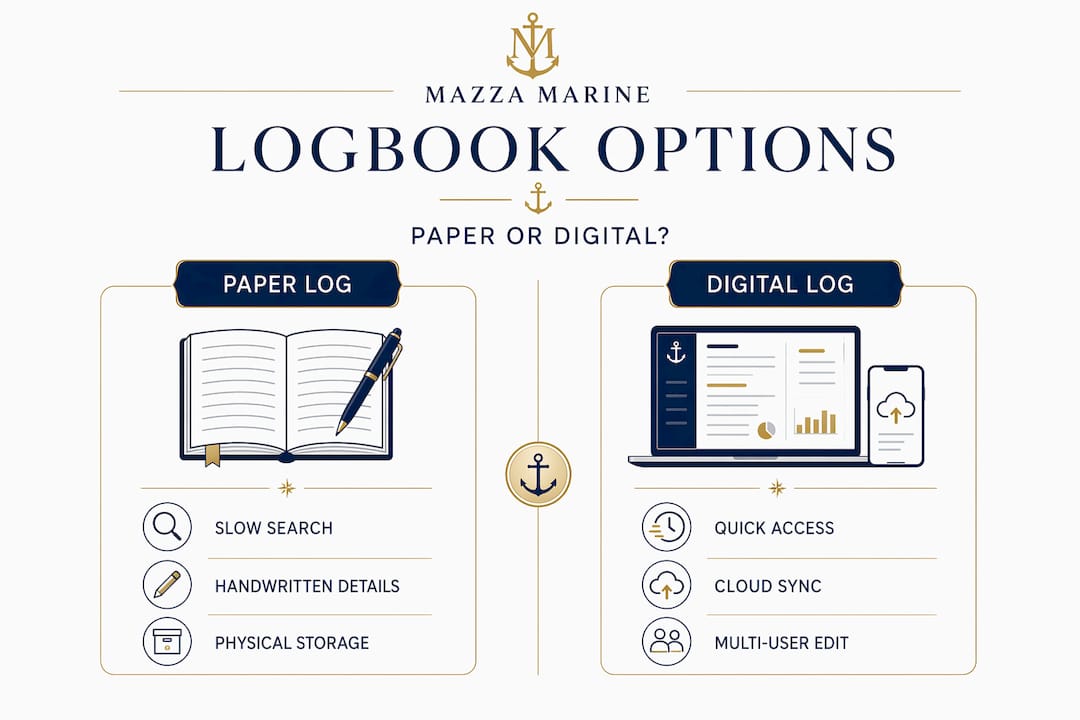
The smart choice for most owners today is a digital log that mirrors what you would capture on paper, with the added benefits of search, backup, and remote access built in.
Benefits of thorough records beyond compliance
The compliance angle gets most of the attention, but the day-to-day operational benefits of maintenance records are just as compelling. When a system fails unexpectedly, your log is the fastest diagnostic tool you have.
Technicians rely on documented service history to narrow hypotheses efficiently, reviewing engine hours, part change dates, symptoms previously recorded, and recent repairs to isolate root causes without starting from scratch. A job that might take four hours of diagnosis with no history can take forty-five minutes with a complete log. That difference shows up directly on your labor invoice.
The benefits of well-maintained records extend across several areas:
- Pattern recognition. A recurring coolant issue noted across three consecutive seasons signals a systemic problem, not a random one. Logs reveal these patterns before they become expensive failures.
- Insurance support. Many marine insurers require documented maintenance history to process claims. A thorough log strengthens your position and reduces disputes.
- Warranty protection. Manufacturers can and do deny warranty claims when service records are absent. Your log is your proof of compliance with service intervals.
- Resale confidence. Buyers paying serious money for a pre-owned yacht want to see the history. A complete log removes doubt and supports your asking price.
- Usage-aligned maintenance planning. Tracking engine hours alongside calendar dates lets you plan service around actual usage patterns rather than guessing.
For Florida yacht owners who use their vessels heavily or charter them seasonally, these benefits compound quickly. A yacht that is well documented is a yacht that holds its value and earns trust from every professional who touches it. That trust, built over years of smarter maintenance practices, is one of the most durable assets you can cultivate as an owner.
Paper logs vs. digital tools for boat owners
The debate between paper and digital maintenance logging has a clear answer for most modern yacht owners. Digital logbooks outperform paper in compliance readiness, retrieval speed, and record completeness. That does not mean paper is worthless. For a small runabout with minimal systems, a paper logbook kept aboard is far better than nothing. But for any vessel with significant mechanical complexity, paper creates real risks.
The core problem with paper logs is not that owners fail to write things down. The problem is retrieval and linkage. A surveyor reviewing your vessel before a charter renewal does not have time to page through a physical binder from 2019 looking for the last impeller change. A digital system searched by keyword or date gives the same answer in seconds.
Modern digital tools built for boat owners go further than simple record-keeping:
- They prompt required fields so entries stay complete
- They link defects to repairs, creating an auditable trail
- They store photos alongside entries for visual confirmation
- They generate service reminders based on hours and calendar intervals
- They allow remote access for owners, captains, and technicians simultaneously
The transition from paper to digital does not need to happen overnight. Start by digitizing your current records, even if that means photographing existing paper logs and uploading them to a cloud folder organized by system and date. Then adopt a digital tool for all new entries going forward. Within one season, you will have a retrievable, searchable record that serves you far better during any yacht documentation review or compliance check.
My perspective on logs as the cornerstone of ownership
I have worked alongside enough yacht owners over the years to know that the ones who stay ahead of problems share one consistent habit: they treat their log as the source of truth for every decision about their vessel.
What I have seen too often is owners who do excellent maintenance but record nothing. They know when the impeller was changed, when the injectors were serviced, when the last bottom paint was applied. Then a new technician comes aboard, or the vessel gets sold, or an insurance claim gets filed, and none of that institutional knowledge exists anywhere outside of someone’s memory. The work was done. The value of having done it evaporates.
The hidden cost of neglected record-keeping is not just regulatory. It is relational. When multiple technicians work a vessel across a season without a shared log, you get duplicate work on some systems and zero attention on others. I have seen both scenarios cost owners thousands of dollars. Structured logging prevents this with almost no effort once the habit is established.
My honest take is that the owners who resist logging treat it as a burden added on top of maintenance. The ones who thrive treat it as part of maintenance. The entry is not a chore you do after the work. It is the final step of the work itself.
— Jason
Keep your yacht in top condition with Mazzamarine
Your maintenance log tells you what has been done. What comes next is making sure the right professionals are doing it.

At Mazzamarine, Mino, Luigi, and their network of Florida yacht specialists work with owners who take their vessels seriously. Whether your log reveals overdue engine performance issues or flags recurring mechanical concerns that need expert attention, Mazzamarine connects you with the right people. From heavy machinery reliability work to hull maintenance, interior refits, and urgent repairs across Florida, the team handles every aspect of ownership with the craftsmanship and care your vessel deserves. Reach out today and let your log guide the conversation.
FAQ
What is the role of maintenance logs for yacht owners?
Maintenance logs serve as documented proof that scheduled inspections and repairs were performed, supporting regulatory audits, warranty claims, and resale credibility. They function as the central record of your vessel’s service history, enabling faster diagnostics and better upkeep planning.
Are maintenance logs required by the U.S. Coast Guard?
Yes. The U.S. Coast Guard requires logging of safety drills, survival equipment inspections, and defect repairs for inspected vessels, with entries that include dates and scenario descriptions. Incomplete logs can result in compliance failures during boardings or formal audits.
What should every maintenance log entry include?
Each entry should capture the date, engine hours, work performed, parts used, technician name, and any observations or deferred items. Linking receipts and invoices directly to each entry strengthens the record for insurance, warranty, and audit purposes.
Do maintenance logs affect yacht resale value?
Absolutely. Buyers and marine surveyors evaluate maintenance history as a primary indicator of vessel condition and care. A thorough, well-organized log supports your asking price and removes doubt for serious buyers.
Is a digital maintenance log better than a paper one?
For most yacht owners, yes. Digital logs offer faster retrieval, cloud backup, searchability, and the ability to link photos and receipts directly to entries, all of which paper records cannot match during audits or remote access situations.
Recommended
Text or Call 954-330-9653 Schedule Appointment
Mazza Marine Yacht Services & Refit

Fiberglass Upgrades and Damage Repair

Premium Yacht Paint/ Faux Teak

Fishing: Custom Rods, Reels,Tackle

Electrical, Electronics and Navigation

Paint, Hull and Gelcoat

Teak Decks, Wood Cabinets, Carpentry

Canvas, Enclosures and Upholstery

Mechanical, Repower and Running Gear

Plumbing, Bilge and Thru-Hulls

Welding and Custom Fabrication

Interior Refit And Past Work
Get your yacht value Estimate
"*" indicates required fields