
View Our Recent Work:

Overview: A yacht condition report is the written product of a professional marine survey, documenting a vessel’s structural integrity, mechanical systems, safety equipment, and fair market value at the time of inspection. Reading one correctly can save you from a costly mistake or give you real leverage at the negotiating table.
Table of Contents
- What a yacht condition report actually contains
- Why yacht condition reports matter for buyers and owners
- Understanding the yacht survey process and the surveyor’s role
- Types of yacht surveys and when you need each
- How to read and interpret a yacht condition report effectively
- What to do after you receive the report
- Mazzamarine knows Florida yachts from the hull up
- Key Takeaways
What a yacht condition report actually contains
A marine survey report is far more than a pass/fail checklist. Think of it as a vessel’s health record, compiled by a credentialed marine surveyor who has spent hours aboard, below the waterline, and at the helm during a sea trial. The document captures everything from hull construction and electrical systems to safety gear compliance and current market value.
Every well-structured condition report includes these core components:
- Scope and purpose: Defines the survey’s objectives, limitations, and conditions under which the inspection was performed
- Definitions of terms: Explains what words like “serviceable,” “monitor,” and “deficient” mean within the report’s specific grading framework
- Vessel data: Hull Identification Number (HIN), registration, dimensions, build date, engine details, and documentation status
- Executive summary: A snapshot of overall condition and the most significant findings
- Detailed findings and recommendations: Organized by system, with photos illustrating each deficiency
- Valuation: Fair market value and, often, replacement value based on comparable sales
The American Boat and Yacht Council (ABYC) notes that after reading a report thoroughly, you should have a clear picture of the vessel’s overall condition and what repairs are needed to make it safe and functional.
Why yacht condition reports matter for buyers and owners
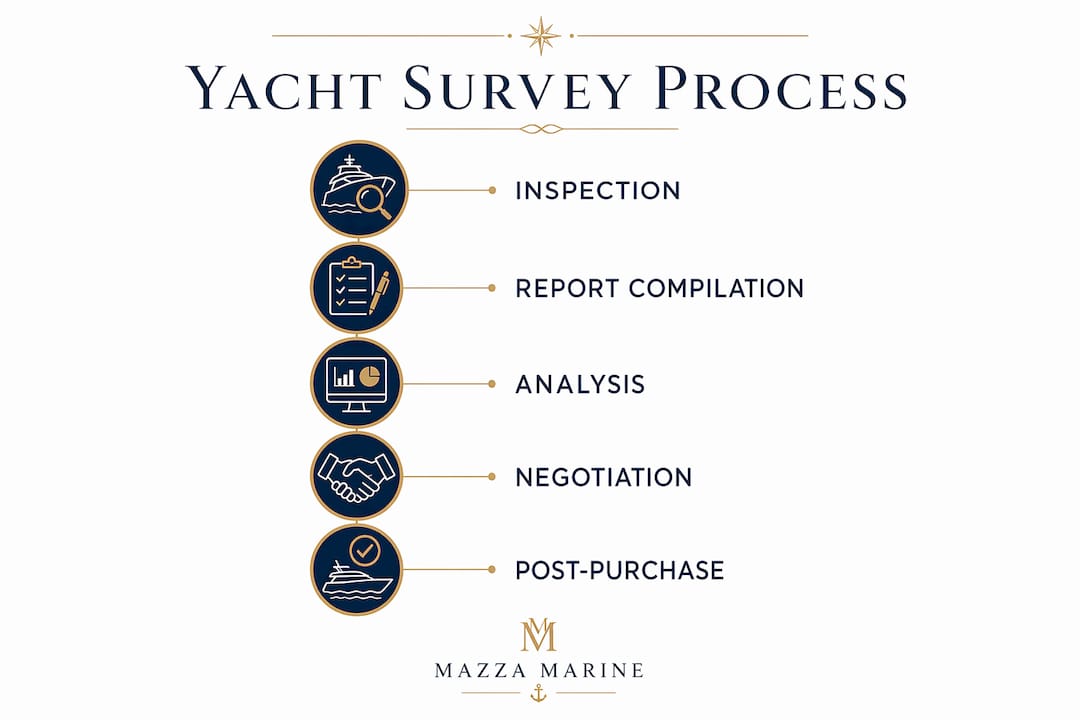
A condition and valuation (C&V) survey does three things at once: it documents the vessel’s physical state, establishes fair market value, and gives you a factual basis for negotiation. Insurance companies and marine lenders routinely require one before issuing coverage or approving financing. Without it, you are essentially buying blind.
The benefits go beyond the transaction itself:
- Uncovers hidden defects such as hull blistering, corroded through-hulls, or deteriorated wiring that a casual walkthrough would miss
- Verifies maintenance history and flags deferred work that will become your problem after closing
- Supports insurance compliance by confirming safety equipment meets current regulations
- Establishes a maintenance baseline for planning future upkeep and budgeting repairs
One thing a condition report does not do: certify seaworthiness. Surveyors deliberately avoid that term because seaworthiness depends on crew experience, voyage conditions, and preparations that fall well outside any inspector’s scope. The report is an objective record of verifiable conditions, not an operational endorsement.
Understanding the yacht survey process and the surveyor’s role
The classic pre-purchase survey follows a defined sequence. The surveyor begins with an in-slip inspection, then arranges a haul-out for hull inspection below the waterline, followed by re-launching and a sea trial under load. On most boats, the full process takes one day.
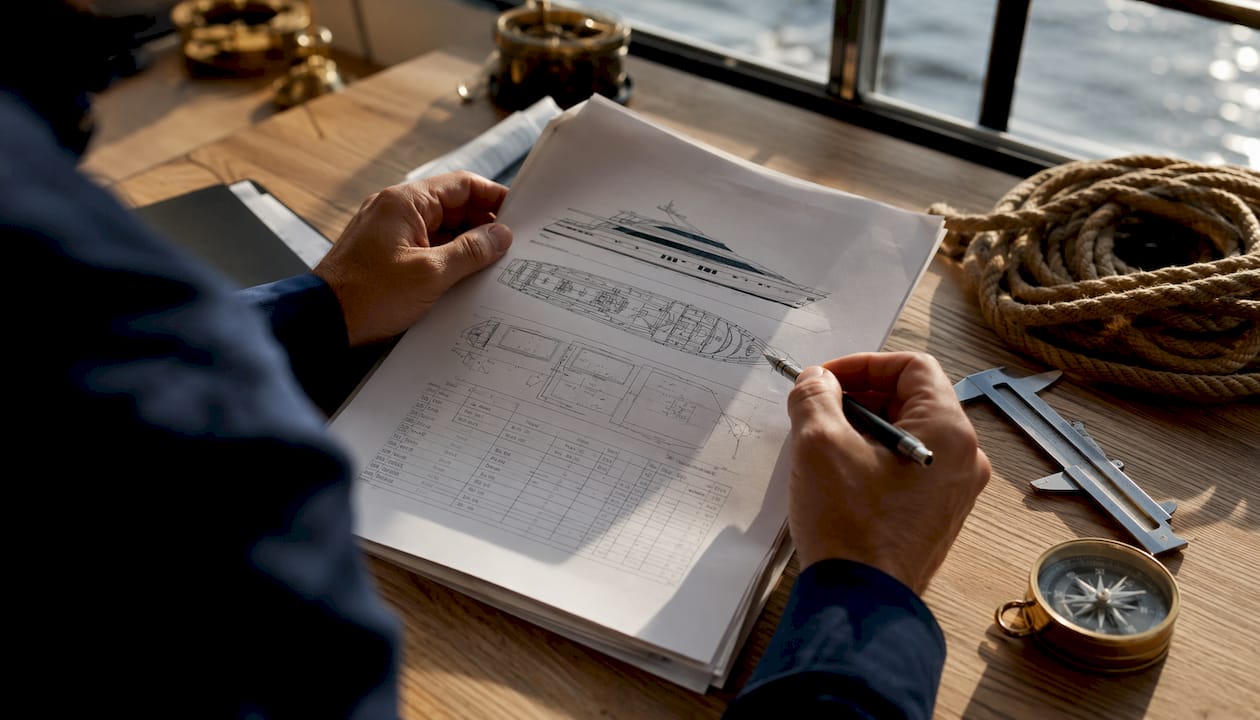
A surveyor’s job is to be impartial. Their role is not to tell you whether to buy, whether the price is fair, or whether to walk away. Their role is to document what they found, accurately and without exaggeration in either direction. Surveyors work within a professional framework guided by the Code of Federal Regulations (CFRs), ABYC standards, and NFPA guidelines, which govern everything from fuel systems to navigation lights.
One limitation every buyer should understand: marine surveys use non-destructive testing, meaning surveyors do not disassemble sealed components. Engine internals, hidden structural cavities, and sealed compartments may not be fully accessible. For a thorough mechanical picture, a separate engine specialist, borescope inspection, or oil analysis is often worth the added cost.
Types of yacht surveys and when you need each
Condition surveys vary significantly in scope, depth, and intended audience depending on why they are commissioned. Choosing the right type matters.
- Pre-purchase condition and valuation (C&V): The most thorough option. Includes haul-out, sea trial, full systems inspection, and valuation. Required by most lenders and the right choice for any serious buyer.
- Insurance survey: A narrower inspection focused on current condition and insurable value. Insurers often require one when a vessel reaches a certain age or when renewing a policy on an older boat.
- On-hire/off-hire charter survey: Documents vessel condition at the start and end of a charter contract to resolve disputes about damage or wear.
- Damage survey: Commissioned after an incident to assess the nature, extent, and probable cause of damage. Typically requested by owners, insurers, or P&I Clubs.
- Operational suitability survey: Evaluates whether a vessel is fit for a specific cargo, route, or operational requirement before a charter begins.
A pre-purchase survey is not interchangeable with an insurance survey. They serve different purposes, and using one in place of the other can leave you with gaps in either your purchase decision or your coverage.
How to read and interpret a yacht condition report effectively
Most buyers flip straight to the findings list. That is the wrong place to start. Reading a yacht inspection report correctly begins with the definitions section, which explains exactly what each finding classification means. Skipping it is the most common mistake buyers make, and it leads to misreading the severity of issues.
Once you understand the grading framework, work through the report in this order:
- Scope and limitations first: Know what was and was not inspected before drawing conclusions
- Executive summary: Get the overall picture before drilling into details
- Safety-critical findings: Address these before anything else; insurers often require correction within a set window required for correction before coverage remains in force of binding coverage
- Recommended repairs: Prioritize by severity, not by count. Two structural findings outweigh fifteen cosmetic ones
- Photos: Use them to visualize each issue rather than relying solely on text descriptions
The term “monitor” in a report does not mean ignore. It signals a condition that needs observation before it escalates into an urgent repair, giving you a maintenance timeline to plan around.
Pro Tip: Request the full photo archive from the surveyor’s working folder. Final reports often include only a fraction of the images taken during inspection; the omitted photos frequently reveal corrosion, wear patterns, or maintenance details that never make it into the written narrative. The omitted photos frequently reveal corrosion, wear patterns, or maintenance details that never make it into the written narrative.

If any section is unclear, call the surveyor. The ABYC advises that buyers re-read the report and contact the surveyor directly for clarification on anything ambiguous. That conversation is part of what you paid for.
What to do after you receive the report
The report lands in your inbox. Now what? The first step is separating findings by category: safety-critical items, functional repairs, and cosmetic or long-term maintenance. Each category demands a different response.
For safety-critical findings, get repair estimates from a qualified marine yard before you go back to the seller. A documented list of costs is far more persuasive than a vague request for a price reduction. Sellers expect negotiation after a survey; what they respond to is specifics. If the report shows $4,200 in needed repairs, that number becomes your opening position.
Functional repair items are negotiation tools. You can ask the seller to complete repairs before closing, reduce the purchase price by the estimated cost, or split the difference. Walk away when structural findings are severe, such as transom compromise, stringer separation, or a corroded through-hull, and the seller is unwilling to address them.
After purchase, share the report with your insurer immediately. Many policies issue conditional coverage requiring specific deficiencies to be corrected within a set window. Missing that deadline can lapse your policy without warning. Use the maintenance recommendations in the report to build a service schedule, and keep the document on file as a baseline for tracking the vessel’s condition over time.
Mazzamarine knows Florida yachts from the hull up

When a survey report lands on your desk full of technical findings, knowing what to do next is where most buyers get stuck. Mazzamarine was built for exactly that moment. Founded by brothers Mino and Luigi, whose love of the sea started on the Italian coast, Mazzamarine has spent years building a trusted network of Florida yacht specialists covering everything a condition report might flag: urgent repairs in Miami, engine and mechanical work, electrical systems, custom paint, canvas, welding, and complete maintenance packages.
You do not need to coordinate five different vendors after a survey. Mazzamarine handles the full scope, from interpreting what the report means to getting the right specialist on the job. Whether you are a first-time buyer working through a pre-purchase C&V or an experienced owner planning a refit based on survey findings, the team brings the expertise and the relationships to move from report to resolution without the usual runaround. Reach out to Mazzamarine today and put the survey findings to work.
Key Takeaways
A yacht condition report is a professional, time-stamped assessment of a vessel’s structure, systems, safety equipment, and value, and reading it correctly is the difference between a sound purchase and an expensive surprise.
| Point | Details |
|---|---|
| Start with definitions | The “Definitions of Terms” section sets the grading framework; skipping it leads to misreading finding severity. |
| Non-destructive limits | Surveys do not disassemble sealed components; hire an engine specialist for a complete mechanical picture. |
| Photos tell the full story | Request the surveyor’s full working photo archive, not just the images selected for the final report. |
| Findings drive negotiation | Get repair cost estimates before approaching the seller; specific dollar figures outperform vague requests. |
| Mazzamarine acts on findings | Mazzamarine connects Florida yacht owners with specialists to address every category a condition report flags. |
Recommended
Text or Call 954-330-9653 Schedule Appointment
Mazza Marine Yacht Services & Refit

Fiberglass Upgrades and Damage Repair

Premium Yacht Paint/ Faux Teak

Fishing: Custom Rods, Reels,Tackle

Electrical, Electronics and Navigation

Paint, Hull and Gelcoat

Teak Decks, Wood Cabinets, Carpentry

Canvas, Enclosures and Upholstery

Mechanical, Repower and Running Gear

Plumbing, Bilge and Thru-Hulls

Welding and Custom Fabrication

Interior Refit And Past Work
Get your yacht value Estimate
"*" indicates required fields