
View Our Recent Work:

A yacht classification society is defined as an independent, non-governmental technical organization that sets and verifies standards for yacht design, construction, and ongoing maintenance. These bodies, including well-known names like Lloyd’s Register, DNV, and ABS, sit at the heart of international maritime safety. For any yacht owner or maritime professional, understanding how classification societies work is not optional knowledge. It shapes your insurance options, your flag state compliance, and the long-term value of your vessel.
What is a yacht classification society and what does it actually do?
A yacht classification society is an independent technical body that develops rules governing how a yacht must be designed, built, and maintained to meet recognized safety standards. The industry term you will hear most often is simply “class” or “classed vessel.” These organizations are not government agencies. They operate independently, though they work closely alongside flag states and international regulatory bodies.

Classification is generally expected as a de facto industry standard for superyachts above 24 meters and is mandatory for most vessels operating internationally in the charter market. That threshold matters because it marks the point where informal safety practices give way to formal, documented compliance. Crossing that line without understanding what it means can cost owners dearly.
Societies like DNV, ABS, and Lloyd’s Register do not just stamp a piece of paper and walk away. They perform technical audits that inform whether a vessel qualifies for flag state certificates ensuring adherence to international conventions like SOLAS and MARPOL. Think of them as the technical backbone behind the legal certificates your flag state ultimately issues.
How do yacht classification societies work from design to survey?
The process begins long before a yacht touches water. Classification societies review and approve design plans, checking structural calculations, stability data, and engineering drawings against their published rules. Getting this right at the drawing board stage is far cheaper than fixing problems after steel is cut or fiberglass is laid.
Early engagement of classification societies during design reduces costly non-compliance risks. This is one of the most underappreciated facts in yacht building. Owners who bring a society in late often face expensive redesigns or retrofits that could have been avoided with a single early consultation.
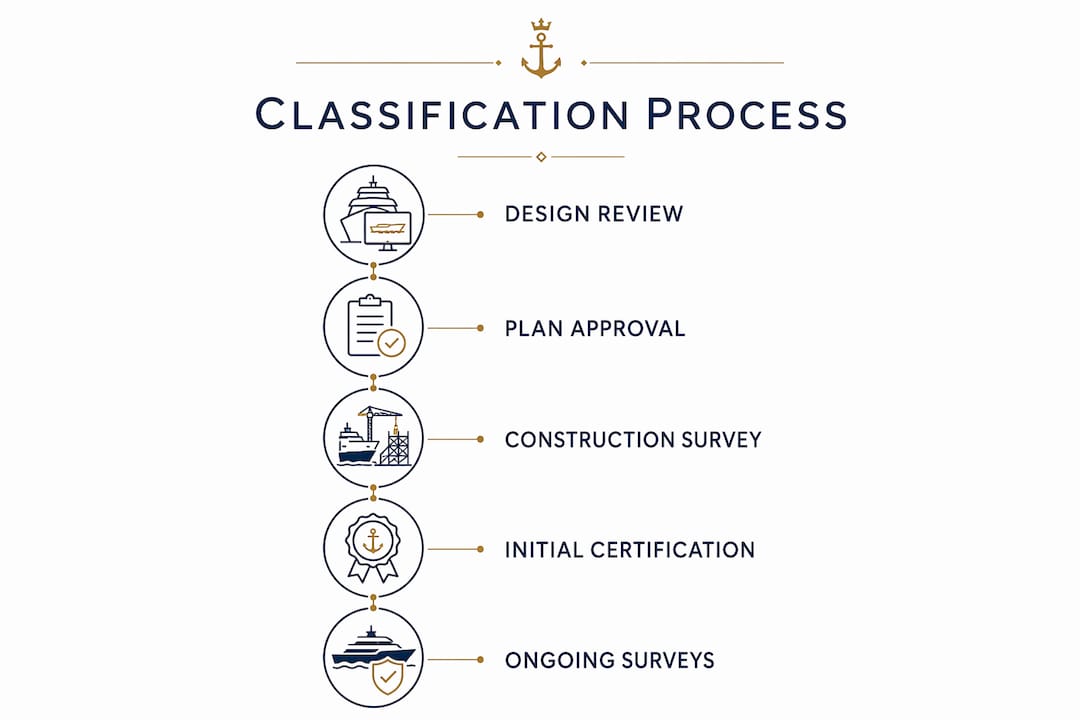
Once construction begins, a classification surveyor visits the yard at key milestones. These surveyors are not simply inspectors ticking boxes. They act as technical advisors, guiding builders and owners through rule interpretation and flagging potential issues before they become structural problems. Their role is collaborative, not adversarial.
After delivery, the work continues through a structured survey cycle:
- Annual surveys confirm the vessel remains in satisfactory condition and that no major changes have been made without approval.
- Intermediate surveys (typically at the 2.5-year mark) go deeper, examining machinery, safety systems, and structural integrity.
- Special periodic surveys occur every five years and represent the most thorough review, often requiring the vessel to be hauled out of the water.
Pro Tip: Schedule your annual survey well before your certificate expiry date. Surveyors are in high demand, and a missed window can trigger a suspension that grounds your vessel and voids your insurance.
Why does classification matter for insurance, flag states, and resale value?
Classification is the commercial passport that allows a yacht to operate internationally. A classed status is frequently cited as a critical factor in retaining secondary market value and obtaining insurance coverage. Insurers and port authorities treat a valid class certificate as proof that the vessel meets international safety standards. Without it, coverage becomes difficult to secure and often prohibitively expensive.
The relationship between classification societies and flag states is one of delegation, not replacement. Flag states delegate technical verification to classification societies through formal agreements, but the flag state retains full legal authority. A society can issue class certificates and sometimes statutory certificates on behalf of a flag state, but it cannot override the law. The legal and operational authority always stays with the flag administration.
For owners thinking about the charter market, classification is often non-negotiable. Charter brokers and their clients expect a classed vessel. Buyers in the secondary market pay a premium for one. The absence of class certification narrows your pool of potential charterers and buyers significantly.
“Classification is not just a safety standard. It is a commercial tool that acts as a passport enabling yachts to operate internationally and secure coverage from risk-averse insurers. Owners who treat it as a bureaucratic hurdle miss its real value as a market differentiator.”
What are the size thresholds and the 12-passenger rule?
Two thresholds define most of the classification conversation: the 24-meter length threshold and the 12-passenger rule. Both carry significant financial and operational consequences.
The 24-meter mark is where classification becomes a practical necessity for commercial and charter operations. Below that size, many yachts operate under simpler flag state rules. Above it, the expectation of formal classification is nearly universal in professional maritime circles. You can review the broader distinctions between vessel categories in this yacht vs superyacht breakdown to understand how size shapes every aspect of ownership.
The 12-passenger rule is where things get expensive fast. Yachts carrying 13 or more guests must comply with commercial passenger ship regulations, which are significantly more stringent than private yacht standards. This triggers full SOLAS compliance requirements, including additional fire suppression systems, life-saving appliances, and structural fire protection measures.
| Threshold | Regulatory impact |
|---|---|
| Under 24 meters | Simplified flag state rules, classification often optional |
| 24 meters and above | Classification expected as industry standard for charter and commercial ops |
| Up to 12 passengers | Private yacht or small commercial vessel regulations apply |
| 13 or more passengers | Full commercial passenger ship rules, including SOLAS Chapter II-2 |
Misunderstanding the 12-passenger threshold can lead to unexpected and expensive retrofits. A yacht designed to carry 12 guests comfortably may need a full structural overhaul to legally carry 13. That is not a paperwork change. It is a rebuild.
Pro Tip: If you are commissioning a new build and think you might ever want to carry more than 12 guests commercially, design for that capacity from day one. Retrofitting SOLAS-compliant fire protection and escape routes into a finished hull is one of the most expensive mistakes in superyacht ownership.
What are the ongoing owner responsibilities for maintaining class?
Classification is a lifelong commitment, not a one-time achievement. Ongoing surveys are necessary to maintain class certification, and missing a survey results in suspension. A suspended class certificate does not just create paperwork problems. It can void your insurance, bar you from certain ports, and make your vessel unsellable in the charter market.
Owners face a recurring set of obligations throughout the vessel’s life:
- Annual surveys must be completed within a defined window around the certificate anniversary date.
- Intermediate surveys require a more detailed inspection of machinery and safety systems at the midpoint of the five-year cycle.
- Special periodic surveys every five years demand the most thorough review, often including underwater inspections and machinery strip-downs.
- Condition of class notations may be issued when surveyors identify deficiencies, requiring corrective action within a set timeframe.
- Regulatory-driven upgrades can be imposed when international conventions change, requiring owners to retrofit systems regardless of the vessel’s age.
Classification requires ongoing financial investment for surveys and potential upgrades throughout the yacht’s life. Owners who budget only for the initial classification process are routinely surprised by the cost of a quinquennial special survey, which can run into six figures for a large superyacht. Proper yacht maintenance planning is the most effective way to avoid those surprises.
The safety equipment standards required to pass surveys also evolve. What satisfied a surveyor five years ago may not meet current requirements today. Staying ahead of those changes, rather than scrambling to meet them at survey time, is the mark of a well-managed vessel.
Key Takeaways
A yacht classification society is the independent technical authority that defines whether a vessel is safe, insurable, and commercially viable throughout its entire operational life.
| Point | Details |
|---|---|
| Definition of classification | An independent body sets and verifies design, construction, and maintenance standards for yachts. |
| 24-meter threshold | Classification becomes a practical industry requirement for yachts above 24 meters in charter and commercial use. |
| 12-passenger rule | Carrying 13 or more guests triggers full commercial passenger ship regulations under SOLAS. |
| Ongoing survey cycle | Annual, intermediate, and five-year special surveys are required to maintain a valid class certificate. |
| Commercial value | A classed vessel commands better insurance terms, stronger resale prices, and broader charter market access. |
Classification is a strategic asset, not just a compliance checkbox
I have seen owners approach classification the way they approach a tax filing: something to get through once and forget about. That mindset costs money and creates real operational risk. Classification done right is one of the most powerful tools a yacht owner has for protecting the value of a significant asset.
The owners who benefit most from classification are the ones who engage their chosen society during the design phase, not after the keel is laid. They treat the surveyor as a partner, not an auditor. They budget for the full survey cycle from day one. And they understand that the certificate on the wall is only as good as the vessel condition behind it.
What surprises most people is how much classification shapes the secondary market. A well-maintained classed vessel with a clean survey history sells faster and at a stronger price than an equivalent unclassed yacht. Buyers and brokers know exactly what they are getting. That transparency has real monetary value.
The 12-passenger rule is the single most misunderstood threshold in the industry. I have spoken with owners who discovered mid-build that their charter ambitions required a complete redesign of fire protection systems. That conversation is brutal. It is also entirely avoidable with the right advice at the right time.
Classification is becoming less optional and more expected across the board. Flag states are tightening their requirements. Insurers are asking harder questions. The charter market has essentially made class a baseline expectation for serious commercial operations. Owners who treat classification as a strategic investment rather than a compliance burden will always be better positioned.
— Jason
How Mazzamarine supports your classification readiness
Keeping a yacht survey-ready year-round takes more than good intentions. It takes a trusted team that knows exactly what surveyors look for and how to get your vessel there without last-minute scrambling.

Mazzamarine connects Florida yacht owners with an expert network covering everything from urgent mechanical repairs to complete maintenance packages built around classification survey schedules. Whether you need engine work, structural repairs, safety system upgrades, or a full marine mechanical systems overhaul before your next special survey, Mazzamarine has the right specialist for the job. Brothers Mino and Luigi built this network on the belief that every yacht owner deserves a trusted partner, not just a vendor. Reach out and let the team help you stay classed, covered, and ready to sail.
FAQ
What is a yacht classification society?
A yacht classification society is an independent, non-governmental technical organization that sets standards for yacht design, construction, and maintenance. Societies like Lloyd’s Register, DNV, and ABS verify compliance and issue class certificates used by insurers and flag states.
Is classification mandatory for all yachts?
Classification is not legally mandatory for all yachts, but it is a de facto requirement for superyachts above 24 meters and for most vessels operating commercially in the international charter market.
How does the 12-passenger rule affect classification?
Yachts carrying 13 or more paying guests must comply with full commercial passenger ship regulations under SOLAS, which are significantly more stringent and costly than private yacht standards.
What happens if a yacht misses a classification survey?
Missing a required survey results in suspension of the class certificate. A suspended certificate can void insurance coverage, restrict port access, and make the vessel ineligible for charter operations.
What is the difference between a classification society and a flag state?
A classification society provides independent technical verification, while the flag state holds legal authority. Flag states often delegate technical audits to classification societies but retain the power to issue and revoke statutory certificates.
Recommended
Text or Call 954-330-9653 Schedule Appointment
Mazza Marine Yacht Services & Refit

Fiberglass Upgrades and Damage Repair

Premium Yacht Paint/ Faux Teak

Fishing: Custom Rods, Reels,Tackle

Electrical, Electronics and Navigation

Paint, Hull and Gelcoat

Teak Decks, Wood Cabinets, Carpentry

Canvas, Enclosures and Upholstery

Mechanical, Repower and Running Gear

Plumbing, Bilge and Thru-Hulls

Welding and Custom Fabrication

Interior Refit And Past Work
Get your yacht value Estimate
"*" indicates required fields