
View Our Recent Work:

A yacht lien search is a formal review of all recorded debts, legal claims, and encumbrances attached to a vessel before you take ownership. Think of it as the maritime equivalent of a title search on a house. Skip it, and you could close on a beautiful boat only to discover the previous owner left behind an unpaid engine overhaul, a marina storage debt, or a preferred ship mortgage the lender never released. Those obligations can follow the vessel directly to you.
The search process splits into two distinct tracks depending on how the vessel is registered. Federally documented yachts, typically larger vessels used in commerce or crossing state lines, fall under the USCG National Vessel Documentation Center, which issues an Abstract of Title (form CG-1332) listing every recorded mortgage and lien claim. State-registered boats go through a separate system entirely, typically a state DMV, DNR, or equivalent titling agency. Searching only one system when a vessel has history in both leaves you exposed. The Coast Guard Port State Information Exchange (CGMIX) adds another layer for vessels with federal documentation, providing operational and compliance records beyond what the Abstract alone reveals.
Common lien types you may encounter include:
- Preferred ship mortgages recorded with the USCG
- Mechanic’s liens from unpaid repair yards or boatyards
- Marina liens for unpaid dockage, storage, or fuel
- Judgment liens from court rulings against the owner
- Tax liens filed by federal or state revenue agencies
- Maritime liens for crew wages, salvage, or necessaries, which arise automatically and may not appear in any public record
What a lien check actually reveals about a vessel
A thorough yacht ownership lien check surfaces more than just outstanding loans. The full picture includes ownership chain integrity, recorded encumbrances, and warning signs that suggest something deeper may be wrong.

Clouded titles are among the most common findings. A clean chain of ownership means every transfer from the original owner to the current seller appears in the record. When a gap exists, perhaps because a prior sale was never properly filed, the title becomes “clouded.” A clouded title can block you from documenting the vessel in your name and may signal a disputed ownership claim that no bill of sale can easily fix.
Hull Identification Number discrepancies are a serious red flag. Every boat manufactured after 1972 carries a 12-character HIN permanently affixed to the transom. HIN tampering or mismatches between the physical vessel and its paperwork can indicate fraud, theft, or an attempt to obscure the boat’s history. Always verify the HIN physically against every document in the file.
Beyond recorded liens, the search may also reveal:
- Unresolved preferred ship mortgages from prior financing
- Mechanic’s liens filed by yards that completed work but were never paid
- Marina storage or fuel accounts left open and unpaid
- Judgment liens attached to the owner personally and extended to the vessel
- Tax liens from the IRS or state revenue agencies
- Secret maritime liens for crew wages, salvage, or supplies that attach automatically and appear in no database
That last category deserves special attention. Maritime liens arise by operation of law the instant a qualifying service is rendered, with no filing required and no public notice given. A fuel supplier, a repair yard, a crew member owed wages, all of them may hold valid claims against the vessel right now, and none of those claims will show up in an Abstract of Title search.
How to conduct a yacht lien search step by step
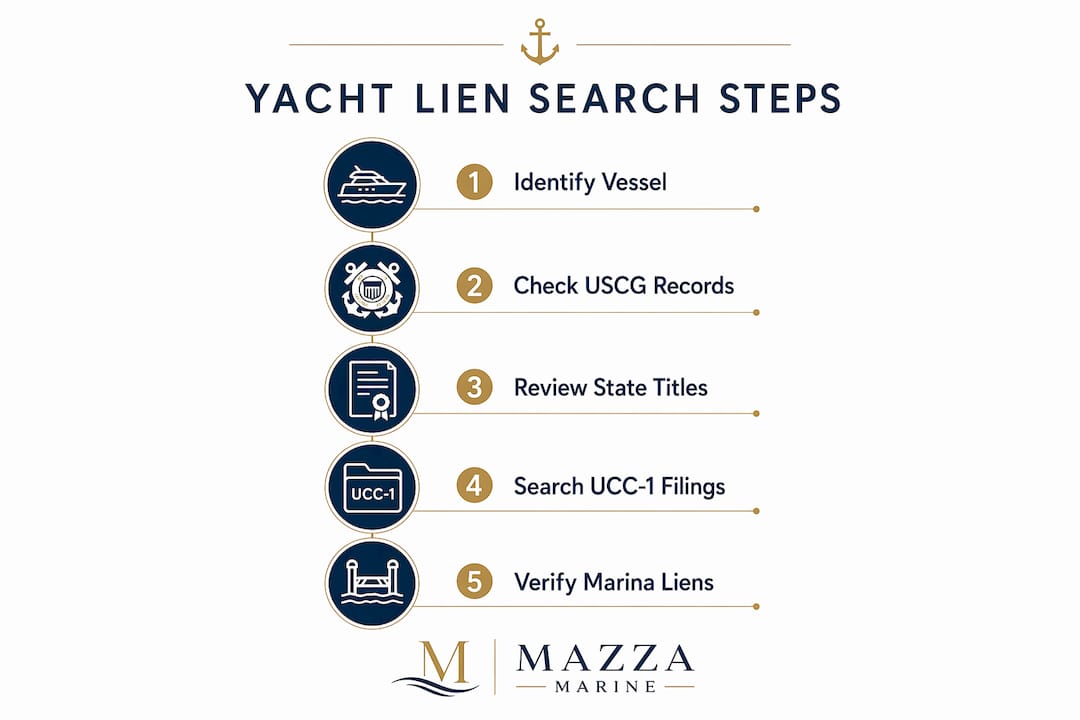
The recommended approach is a triple-layer check combining federal records, state records, and UCC filings. Here is how to work through each layer systematically.
-
Confirm the vessel’s documentation status. Ask the seller for the documentation number or check the USCG NVDC’s free online database. If the vessel is federally documented, you need the federal search. If it is state-registered only, skip to step three. Many vessels have history in both systems.
-
Request a USCG Abstract of Title. Any person may submit a request to the National Vessel Documentation Center for form CG-1332. As of 2026, a certified Abstract of Title costs $25, paid through Pay.gov. The Abstract lists every recorded owner, preferred ship mortgage, and lien claim since the vessel’s first federal documentation. It is the gold standard for federal records, but it covers only what was formally filed with the USCG.
-
Search the relevant state agency. In approximately 43 states that require boat titles, the state DMV, DNR, or titling agency holds the primary ownership record. Contact the agency using the vessel’s HIN or registration number to verify title status and check for any state-level liens. In the roughly seven states that do not require titles, liens may be recorded at the county level or may not be centrally recorded at all.
-
Check UCC-1 financing statements. Lenders who financed the vessel through a state-level security interest often file a UCC-1 form with the Secretary of State’s office. Searching UCC filings by the owner’s name can surface security interests that never made it into the USCG or state title records.
-
Search county court records. Judgment liens from civil lawsuits against the owner can attach to personal property including vessels. A quick search of the county clerk’s records where the vessel is registered or primarily kept can reveal these.
-
Contact the marina and any recent repair yards directly. Call the marina where the boat currently sits and ask whether the account is current. Reach out to any yard that has recently hauled or serviced the vessel and request written confirmation that all bills are settled. This step is the only practical way to surface unpaid service claims that exist as maritime liens but appear nowhere in official records.
-
Consider a professional lien search service for high-value purchases. Professional services combine multiple databases including USCG records, state title records, UCC filings, and sometimes county-level records into a single report. For higher-value purchases, the cost of a professional search is modest compared to the risk of missing a hidden claim. You can also review boat registry search methods across jurisdictions to understand which databases apply to your specific vessel.
Pro Tip: Run the lien search before you commission a marine survey, not after. If the title is clouded or a major lien surfaces, you will have saved the survey fee entirely. Timing the search early also gives you room to negotiate a price reduction or require the seller to clear encumbrances before closing.
How maritime lien priority can override a clean title
Maritime liens operate under a legal framework that surprises most first-time yacht buyers. Under admiralty law, a vessel is treated as a legal person, meaning debts owed for its operation attach directly to the ship itself, not just to whoever owns it at the time. Under 46 U.S.C. § 31342, any person providing necessaries to a vessel on the owner’s order holds a maritime lien and may bring a civil action in rem to enforce it, with no requirement to prove that credit was extended to the vessel.
The practical consequence is that these liens survive a change of ownership. You can buy a vessel with a clean Abstract of Title, pay full price, and still face a claim from a fuel supplier or repair yard that worked on the boat under the previous owner.
Maritime lien priority does not follow filing order. Certain claims, including crew wages, maritime tort claims, and salvage, rank ahead of recorded preferred ship mortgages regardless of when the mortgage was filed. Legal professionals stress that buyers who rely solely on the Abstract of Title are assessing only one layer of a more complex risk picture. A recorded mortgage may be subordinate to maritime claims that never appeared in any public record.
The hierarchy of claims, from highest to lowest priority, works as follows:
| Lien Type | Priority Rank | Notes |
|---|---|---|
| Court costs and arrest expenses | 1 (highest) | Paid first from any sale proceeds |
| Maritime tort liens | 2 | Personal injury, death, collision damage |
| Crew wages | 3 | Includes penalty wages for late payment |
| Salvage claims | 4 | Compensation for saving vessel from peril |
| Liens for necessaries | 5 | Fuel, repairs, provisions, operational supplies |
| Preferred ship mortgages | 6 | Recorded USCG mortgages rank below all maritime liens |
When a vessel is sold through a judicial sale ordered by a federal admiralty court, the sale extinguishes all prior liens, including those whose holders never appeared in the proceeding. The buyer at a judicial sale takes title free and clear. Getting there requires the U.S. Marshal to physically seize the vessel, public notice published in a local newspaper, and actual notice sent to every known interested party. It is the only guaranteed path to a completely clean title on a vessel with serious encumbrances, and it is expensive and slow.
For buyers, the takeaway is that the Abstract of Title is the gold standard for federal documentation records, but it does not and cannot capture maritime liens that arose without any filing. Understanding this distinction is what separates a careful buyer from one who gets an unwelcome call from an admiralty attorney six months after closing. Reviewing the yacht bill of sale process alongside your lien research helps you understand exactly which representations the seller is making at closing.
Common pitfalls when reading yacht lien search results
Misreading a lien search result is almost as dangerous as skipping the search entirely. Several patterns trip up buyers regularly, especially those purchasing their first vessel.
Assuming the Abstract of Title is complete. The USCG Abstract covers only what was formally recorded with the National Vessel Documentation Center. It excludes state-level mechanic’s liens, tax liens, and every maritime lien that arose without a filing. Treating it as a comprehensive clearance is the single most common mistake in the yacht title search process.
Confusing documented and state-registered records. A vessel that was federally documented for ten years and then allowed to lapse into state registration has history in both systems. Searching only the current system misses everything from the prior period. Experts consistently flag this as the critical challenge for buyers trying to piece together a complete ownership picture.
Overlooking foreign registry history. If a vessel spent years registered under a foreign flag before being imported to the United States, the USCG Abstract covers only the period under US documentation. Those earlier years are a blind spot. Contacting the foreign registry directly is the only way to fill that gap, and record quality varies widely by country.
Here is a practical checklist of red flags and precautionary steps to work through before closing:
- Physical HIN does not match documentation, registration, or bill of sale
- Signs of grinding, re-stamping, or alteration around the HIN plate
- Gaps in the ownership chain with no recorded bill of sale
- Seller cannot produce the original title document
- Marina account is not current or the seller is evasive about recent service history
- Recent major work with no receipts or written confirmation of payment
- Vessel has foreign registry history with no corresponding records
- Multiple liens listed with no releases on file
Pro Tip: Ask the seller for a written statement confirming all marina fees, fuel, storage, and recent repair bills are paid in full. Then verify it independently by calling the marina and the yard yourself. Sellers are not always aware of secondary liens filed against them, so this is not about distrust. It is about documenting past work and verifying the paper trail before money changes hands.
When a search reveals a recorded lien, the cleanest resolution is requiring the seller to satisfy it before closing. The lienholder issues a written release, and the USCG or state agency updates the record. For disputed or stale encumbrances that no party will voluntarily release, an admiralty attorney can advise on whether a judicial sale is warranted or whether a negotiated payoff makes more sense given the vessel’s value.
Buyers who are new to the process often benefit from working with a professional who knows both the federal and state systems. The first-time buyer mistakes that cost people the most money almost always trace back to a lien or title issue that a proper search would have caught early.
Ready to protect your investment? Mazzamarine can help
Buying a yacht in Florida is one of the most rewarding decisions a boating enthusiast can make. Getting the due diligence right beforehand is what keeps it that way. Mazzamarine’s network of Florida yacht experts, built by brothers Mino and Luigi from a lifetime of passion for the sea, covers every aspect of ownership from pre-purchase guidance to complete maintenance packages that keep your vessel in peak condition long after the ink dries.
Whether you need help understanding what a lien search revealed, coordinating repairs to clear a mechanic’s lien, or simply want a trusted partner for the full ownership journey, Mazzamarine is the one-stop resource Florida yacht owners rely on. Reach out today and let’s make sure your next vessel comes with smooth sailing from day one.
Key Takeaways
A yacht lien search requires a triple-layer check combining a USCG Abstract of Title, state title records, and UCC-1 filings, because no single database captures every type of claim that can legally attach to a vessel.
| Point | Details |
|---|---|
| Two registration systems | USCG-documented vessels use the National Vessel Documentation Center; state-registered boats require a separate state agency search. |
| Certified Abstract costs — | A certified USCG Abstract of Title (form CG-1332) costs $25 as of 2026, paid through Pay.gov |
| Maritime liens are secret | Liens for crew wages, repairs, and salvage attach automatically by law with no filing, and will not appear in any official database. |
| Lien priority beats mortgages | Crew wages, tort claims, and salvage rank above recorded preferred ship mortgages in admiralty court distribution. |
| Search early, not at closing | Running the lien search before commissioning a marine survey saves money and creates time to resolve issues before purchase. |
Recommended
Text or Call 954-330-9653 Schedule Appointment
Mazza Marine Yacht Services & Refit

Fiberglass Upgrades and Damage Repair

Premium Yacht Paint/ Faux Teak

Fishing: Custom Rods, Reels,Tackle

Electrical, Electronics and Navigation

Paint, Hull and Gelcoat

Teak Decks, Wood Cabinets, Carpentry

Canvas, Enclosures and Upholstery

Mechanical, Repower and Running Gear

Plumbing, Bilge and Thru-Hulls

Welding and Custom Fabrication

Interior Refit And Past Work
Get your yacht value Estimate
"*" indicates required fields