
View Our Recent Work:

Custom welding is defined as the fabrication of one-of-a-kind metal components by precisely cutting, forming, and joining raw materials to meet specifications that no off-the-shelf part can satisfy. For boat owners in Florida, that definition carries real weight. Whether you’re reinforcing a corroded railing on a sportfish, fabricating a new bracket for a helm pod, or repairing a structural frame after a hard season on the water, custom metal fabrication is often the only path to a part that actually fits, holds, and lasts. This guide walks you through how the process works, which techniques matter most for marine metals, and what to look for when you need a skilled welder for your vessel.
What is custom welding and how does it differ from standard fabrication?
Custom welding is the process of building metal parts from scratch or replicating damaged components to exact, non-standard dimensions. Standard fabrication produces identical parts in volume. Custom welding produces one part, or a small batch, built specifically around your project’s requirements. That distinction matters enormously on a boat, where hull geometry, mounting angles, and corrosion exposure vary from vessel to vessel.
The term you’ll hear professionals use interchangeably is custom metal fabrication. It covers the full scope of cutting, shaping, and welding raw stock into finished components. On marine projects, this often means working with aluminum, 316-grade stainless steel, or bronze, each of which behaves differently under heat and saltwater stress. A welder who specializes in marine work understands those material demands before the first arc is struck.
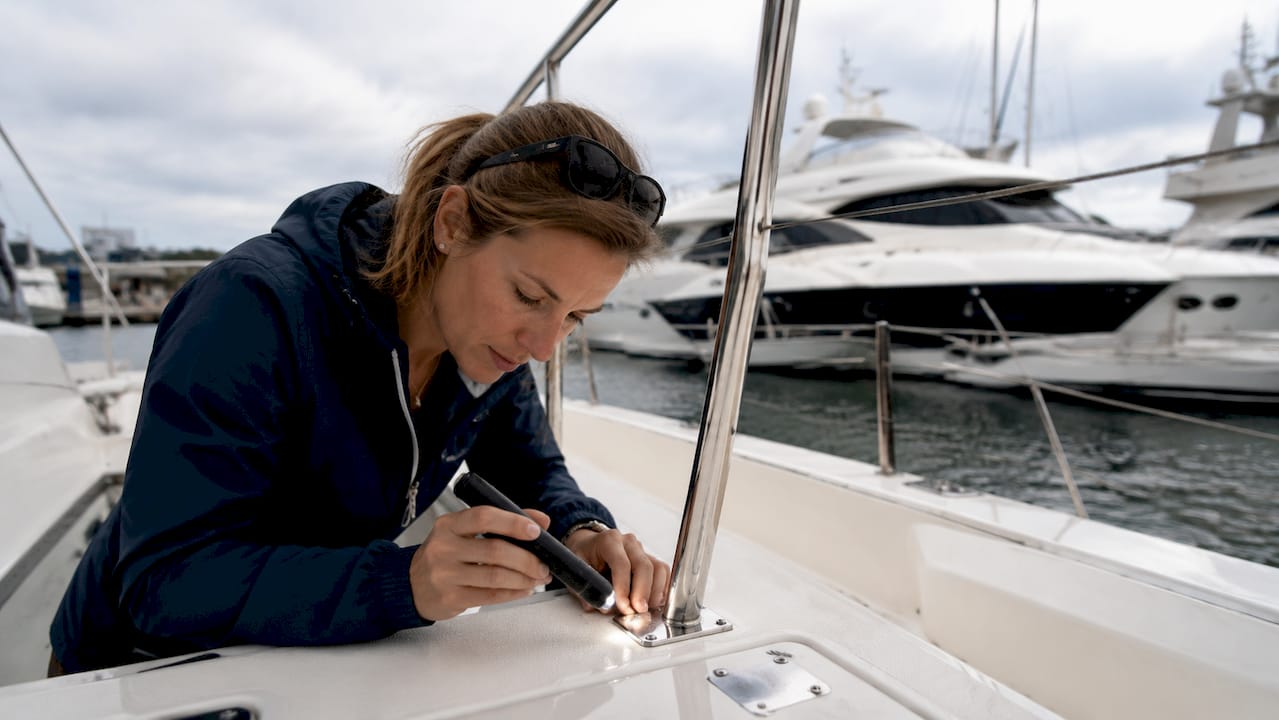
Many boat owners assume custom fabrication is reserved for shipyards and large industrial operations. That assumption is wrong. One-off repairs and modifications on personal vessels and residential docks require the same level of custom fabrication as any commercial job. The scale is smaller; the precision required is identical.
How does the custom welding process work?
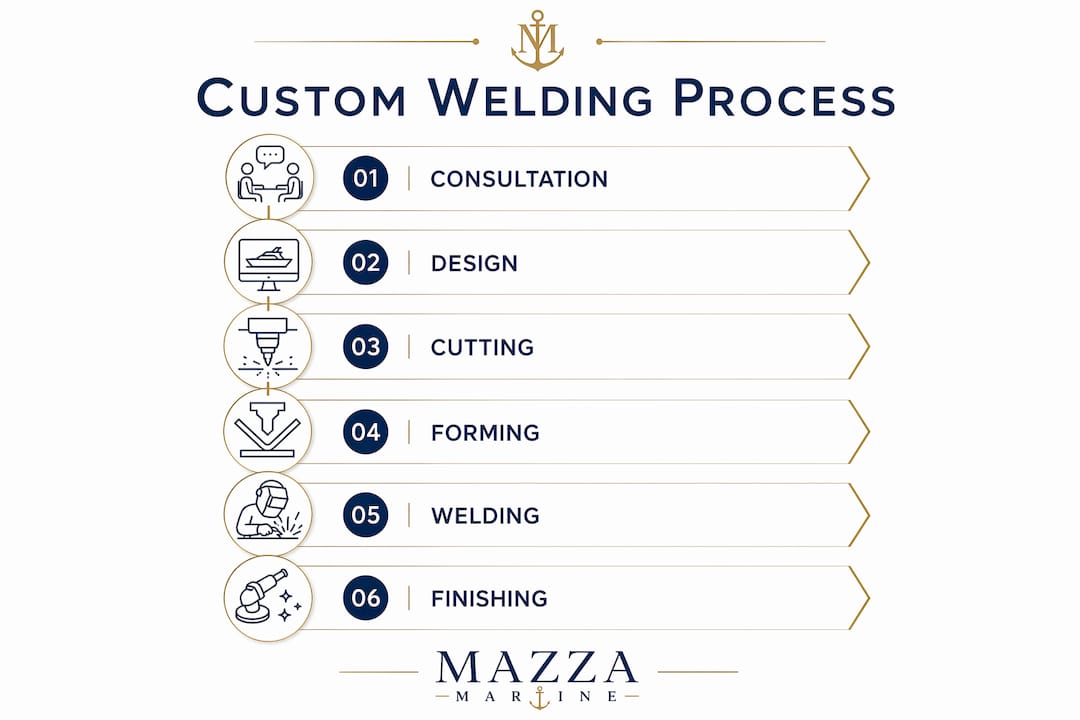
The custom welding process follows three distinct stages: cutting, forming, and welding assembly. Each stage builds on the last, and skipping steps is how projects fail.
-
Consultation and specification. Before any metal is touched, a skilled fabricator needs to understand exactly what you need. That means discussing the part’s function, the loads it will bear, the environment it will live in, and the metals involved. For marine repairs, this stage often includes an on-site inspection at the dock.
-
Cutting. Raw stock, whether plate, tube, or bar, is cut to rough dimensions using plasma cutters, angle grinders, or band saws depending on material thickness and required precision.
-
Forming. Cut pieces are bent, rolled, or pressed into shape. On a boat, this might mean bending stainless tubing to match the curve of an existing railing or pressing aluminum plate to follow a hull contour.
-
Welding assembly. The formed pieces are joined using the technique best suited to the metal and the structural demands of the finished part. Tack welds hold everything in position first; full welds follow once alignment is confirmed.
-
Finishing and inspection. Welds are ground, polished, or treated depending on the application. Marine parts often receive passivation or coating to resist saltwater corrosion.
Pro Tip: Bring physical samples, photos, or original blueprints to your first consultation. Fabricators who replicate damaged parts accurately rely on reference material, and a clear reference cuts both time and cost.
The consultation stage is where most clients underinvest. Arriving with a vague description of what broke produces a vague result. Arriving with the broken part, a photo of it in context, and a clear explanation of the load it carries produces a component that fits and performs from day one.
What are the key benefits of custom welding for marine equipment?
The core advantage of custom welding over off-the-shelf replacement parts is fit. A part built to your exact dimensions eliminates the shimming, grinding, and improvised mounting that generic parts require. That precision translates directly into structural integrity and long-term durability.
Here is what boat owners consistently gain from purpose-built welded components:
- Reduced maintenance cycles. Custom welded components are built to eliminate future modifications and frequent repairs, which means fewer haul-outs and less time at the dock.
- Material-matched corrosion resistance. A fabricator selects the alloy grade that suits your specific saltwater exposure, UV load, and galvanic environment. Generic hardware rarely offers that specificity.
- Structural integrity you can verify. A skilled welder produces joints whose visual quality reflects their structural soundness. Clean, consistent bead profiles indicate proper fusion and penetration.
- Long-term cost savings. The initial cost of custom fabrication is higher than buying a standard part. Over a five-year ownership horizon, the math often reverses because you stop paying for repeated replacements and labor.
- Flexibility for unique configurations. Older vessels, custom builds, and heavily modified sportfish boats frequently have no catalog equivalent for their hardware. Custom fabrication is the only option, not just the best one.
“Weld quality relates directly to durability and safety. The appearance of a weld is not cosmetic. It is a direct indicator of the structural integrity beneath it.” — Alfonso’s Welding
That insight from professional fabricators captures something boat owners often miss. A beautiful weld on a railing stanchion or a thru-hull fitting is not vanity work. It is evidence that the joint was executed correctly and will hold under the dynamic loads a vessel experiences underway.
What welding techniques are used in custom marine fabrication?
Professionals select welding techniques based on the metal type, joint geometry, and strength requirements of each application. For marine work, three methods dominate.
| Technique | Best for | Marine application |
|---|---|---|
| TIG (GTAW) | Aluminum, stainless steel, thin-gauge metals | Railings, helm pods, fuel fittings, decorative trim |
| MIG (GMAW) | Mild steel, thicker aluminum, faster production | Structural frames, engine mounts, heavy brackets |
| Stick (SMAW) | Heavy-duty repairs, outdoor or field conditions | Hull reinforcements, dock hardware, emergency repairs |
TIG, MIG, and stick welding each serve a distinct purpose, and experienced marine fabricators know which to reach for without hesitation. TIG welding produces the cleanest, most precise joints and is the standard choice for 316 stainless and marine-grade aluminum. The process is slower and demands more skill, but the results are visually and structurally superior for exposed hardware.
MIG welding trades some precision for speed and is well-suited to structural work where appearance is secondary to strength. Stick welding remains the go-to for field repairs at the dock, where portability and tolerance for imperfect surface conditions matter more than bead aesthetics.
Pro Tip: When evaluating a welder for aluminum work on your vessel, ask to see previous TIG welds on marine-grade aluminum specifically. Aluminum is unforgiving under heat, and technique errors that are invisible on steel become structural failures on a boat.
What to look for when choosing a custom welding provider
Choosing the right fabricator for your boat is not simply a matter of finding the lowest quote. The wrong welder on a structural marine component creates a safety risk, not just a cosmetic problem.
- Verify experience with marine metals. Ask specifically about their history with 316 stainless, 5052 or 6061 aluminum, and bronze. These alloys behave differently from structural steel, and a fabricator without marine experience will treat them the same way, which is a mistake.
- Confirm mobile or on-site capability. On-site welding at docks or marinas eliminates the need to move heavy components and dramatically reduces your vessel’s downtime. For urgent repairs, this is non-negotiable.
- Request documentation. Ask for weld procedure specifications, material certifications, or any relevant compliance documentation. Reputable fabricators maintain records and welcome the question.
- Ask about their consultation process. A fabricator who asks detailed questions about your project before quoting is one who understands the work. One who quotes immediately without asking questions is one who will improvise later.
- Review previous marine work. Photos of completed yacht railings, thru-hull installations, or structural repairs tell you more than any certification. Ask for examples that match the complexity of your project.
Pro Tip: Engaging a welder early in the design or repair phase, before a failure occurs, is the single most cost-effective decision a boat owner can make. Custom welding functions as preventative maintenance when applied proactively.
How is custom welding applied in marine projects?
The range of custom welding applications on a typical yacht or sportfish is broader than most owners realize until they start looking closely at their vessel.
- Structural frame and hull reinforcement. Corroded or cracked frames are rebuilt to original specification or improved geometry using marine-grade plate and TIG or MIG welding.
- Railing and stanchion fabrication. Custom railings match the exact geometry of your deck layout, including non-standard angles and heights that catalog parts cannot accommodate.
- Bracket and mount fabrication. Electronics mounts, outrigger bases, rod holders, and engine component brackets are frequently custom-built to fit specific equipment on specific vessels.
- Thru-hull fittings and sea cocks. These components carry significant structural and safety responsibility. Custom fabrication to exact hull thickness and angle is the correct approach.
- Emergency dock-side repairs. Mobile welders perform structural repairs directly at the marina, getting vessels back on the water without a haul-out or transport.
- Integration with broader refit work. Custom welding rarely happens in isolation. It connects naturally with hull and gelcoat maintenance, interior carpentry, and electronics upgrades as part of a full vessel refit.
The integration point is worth emphasizing. A railing replacement that requires welding also exposes the deck surface beneath it, which may need gelcoat repair. A structural frame repair may reveal corroded thru-hulls nearby. Experienced marine service providers coordinate these overlapping scopes so nothing falls through the gaps.
Key takeaways
Custom welding produces purpose-built metal components that fit precisely, perform reliably, and outlast generic alternatives, making it the correct choice for structural marine repairs and personal boat modifications.
| Point | Details |
|---|---|
| Three-stage process | Custom fabrication follows cutting, forming, and welding assembly in sequence. |
| Technique selection matters | TIG suits aluminum and stainless; MIG handles structural steel; stick works for field repairs. |
| Durability over time | Purpose-built components eliminate repeated repairs and reduce long-term maintenance costs. |
| Early welder involvement | Engaging a fabricator before failure occurs prevents costly structural problems. |
| Mobile welding saves time | On-site fabrication at the dock eliminates transport and minimizes vessel downtime. |
Why I think most boat owners call a welder too late
I’ve seen this pattern more times than I can count. A boat owner notices a hairline crack in a stanchion base or a railing that wobbles slightly at the fitting. They live with it for a season, maybe two, because it doesn’t look serious. Then one rough crossing later, the fitting tears out of the deck and takes a section of fiberglass with it. What started as a two-hour welding job becomes a structural repair that touches the hull, the deck core, and the gelcoat.
The uncomfortable truth about custom welding for marine use is that most people treat it as a reactive service. Something breaks; they call a welder. But the real value of a skilled fabricator is preventative. A welder who inspects your vessel’s metal components during a refit can identify fatigue, corrosion pitting, and stress cracks before they become failures. That inspection costs almost nothing relative to the emergency repair it prevents.
I also want to push back on the idea that custom welding is a luxury reserved for large yachts or commercial vessels. A 30-foot center console with corroded rod holder bases or a cracked engine mount bracket has exactly the same need for precise custom fabrication as a 70-foot sportfish. The scale differs; the standard of work should not.
If you’re planning any modification or repair that touches metal on your vessel, bring a welder into the conversation at the planning stage. The craftsmanship that goes into a well-executed TIG weld on marine aluminum is genuinely impressive, and the peace of mind that comes from knowing that component was built correctly for your specific boat is worth every dollar.
— Jason
Ready to explore custom welding services for your vessel?
If this article has you thinking about metal components on your boat that need attention, that instinct is worth following. Mazzamarine connects Florida yacht owners with experienced fabricators who specialize in marine-grade welding, thru-hull work, and structural repairs across a full range of vessel types.

Whether you’re dealing with corroded railings, a cracked bracket, or planning a full sportfish upgrade, Mazzamarine’s network covers the full scope of marine fabrication and repair. Start by reviewing the signs you need yacht repairs to understand where your vessel stands before your next season on the water. From custom welding to marine welding for yachts, Mazzamarine’s Florida partners are ready to help you protect your investment and keep your vessel performing at its best.
FAQ
What is custom welding in simple terms?
Custom welding is the process of fabricating metal parts to exact, non-standard specifications by cutting, shaping, and joining raw materials. It produces components that fit a specific application precisely, rather than relying on catalog parts.
What metals are most commonly used in marine custom welding?
Marine fabricators most commonly work with 316-grade stainless steel, 5052 and 6061 aluminum alloys, and bronze. These metals are selected for their corrosion resistance in saltwater environments.
How long does a custom welding project take for a boat repair?
Timeline depends on part complexity and material availability, but straightforward repairs such as railing sections or bracket fabrication are often completed within one to three days. On-site mobile welding at the dock can reduce turnaround significantly.
Is custom welding more expensive than buying replacement parts?
The upfront cost is typically higher than a generic replacement. Over time, purpose-built components that eliminate repeated repairs and modifications deliver better value, particularly for marine applications where saltwater accelerates wear on ill-fitting hardware.
How do I find a qualified custom welder for my boat in Florida?
Look for fabricators with documented experience in marine metals, specifically TIG welding on aluminum and stainless steel, and confirm they offer mobile or on-site service at marinas. Mazzamarine connects Florida yacht owners with vetted marine welding specialists across the state.
Recommended
Text or Call 954-330-9653 Schedule Appointment
Mazza Marine Yacht Services & Refit

Fiberglass Upgrades and Damage Repair

Premium Yacht Paint/ Faux Teak

Fishing: Custom Rods, Reels,Tackle

Electrical, Electronics and Navigation

Paint, Hull and Gelcoat

Teak Decks, Wood Cabinets, Carpentry

Canvas, Enclosures and Upholstery

Mechanical, Repower and Running Gear

Plumbing, Bilge and Thru-Hulls

Welding and Custom Fabrication

Interior Refit And Past Work
Get your yacht value Estimate
"*" indicates required fields