
View Our Recent Work:

Your boat’s engine is working in one of the harshest environments on earth. Salt, heat, moisture, and constant vibration combine to accelerate wear in ways that simply don’t happen to a car engine sitting on dry pavement. That’s exactly why regular engine servicing is not optional for serious boat and yacht owners. It’s the difference between a vessel that performs confidently season after season and one that leaves you stranded offshore with a six-figure repair bill. This guide breaks down what’s really at stake when you skip service, what the right schedules look like, and how to build a maintenance habit that protects your investment for the long haul.
Table of Contents
- Key Takeaways
- Why regular engine servicing protects every critical system
- Servicing schedules: how often to service your engine
- Preventing common engine failures before they strand you
- Safety and operational benefits of consistent service
- My honest take on engine maintenance discipline
- Let Mazzamarine keep your engine running at its best
- FAQ
Key Takeaways
| Point | Details |
|---|---|
| Marine conditions accelerate wear | Salt, heat, and moisture degrade engine components faster than land vehicle use. |
| Dual service intervals matter | Track both engine hours and calendar time to avoid missing critical service windows. |
| Early detection prevents major repairs | Routine checks on filters, impellers, and hoses catch failures before they escalate. |
| Safety depends on consistent service | Engine-room inspections reduce hazards from fuel leaks, electrical faults, and overheating. |
| A maintenance log is your best tool | Logging every service task by date and hours protects vessel value and simplifies scheduling. |
Why regular engine servicing protects every critical system
A marine engine is a collection of interdependent systems, and each one requires routine attention to stay healthy. Scheduled oil and filter changes protect lubrication quality, prevent metal-to-metal contact, and keep internal temperatures stable over many seasons. Skip them long enough, and the oil breaks down into a sludge that accelerates wear on bearings, pistons, and camshafts at a rate most owners don’t realize until the damage is already done.
Cooling systems are equally unforgiving. A blocked heat exchanger or a failed raw-water pump goes unnoticed until the engine overheats mid-passage. Corrosion in saltwater environments can silently degrade cooling passages and electrical contacts long before any warning light comes on. Regular inspection of battery connections, heat exchangers, and sacrificial anodes is the only reliable way to catch this degradation early.
The fuel delivery system deserves its own attention. Replacing water-separating filters and inspecting hoses regularly prevents fuel starvation, a leading cause of hard starting and sudden power loss offshore. Ethanol-blended fuels are particularly problematic for marine applications because they absorb moisture from the surrounding air, degrading faster than the fuel in your car ever would.
Here’s a quick reference for the systems that regular servicing protects:
- Lubrication: Oil and filter changes prevent sludge buildup and metal wear
- Cooling: Thermostat checks, heat exchanger flushes, and raw-water pump inspections maintain safe operating temps
- Fuel delivery: Water-separator filter changes and hose inspections prevent fuel starvation and injector damage
- Ignition: Spark plug inspection and replacement keep combustion clean and efficient
- Corrosion resistance: Anode replacement, battery terminal cleaning, and bilge inspections protect structural integrity
- Drive systems: Gear oil changes and drive lubrication on outboards and sterndrives prevent gearcase failure
Pro Tip: For inboard diesel owners, pay close attention to your heat exchanger zincs. They’re easy to overlook but corrode faster than hull anodes and can cause expensive cooling failures if left unchecked.
Servicing schedules: how often to service your engine
One of the most common mistakes boat owners make is treating engine servicing like a calendar-only event. Marine engines require a dual interval approach. You track both engine hours and elapsed calendar time, and whichever threshold arrives first triggers your next service.

For most outboard engines, service is recommended every 100 hours or annually, whichever comes first. This matters because a boat that spends the season on a mooring with the engine running occasionally can still accumulate enough calendar time for fluids to break down, seals to dry out, and fuel to go stale. Hours alone don’t capture the full picture.
A practical seasonal framework looks like this:
- Pre-season service: Change engine oil and filter, inspect cooling system, replace fuel filters, check belts and hoses, test battery and charging system, inspect anodes
- Mid-season check: Visual inspection of hoses and connections, check oil level and color, inspect impeller if hours are approaching the service threshold
- End-of-season or storage prep: Full oil change, flush cooling system with fresh water, stabilize fuel, fog the engine cylinders, grease all fittings, check gear oil
- After every outing: Quick visual check of the bilge, look for unusual exhaust color or smell, check oil dipstick if the engine ran hard
Tracking overlapping service tasks by both hours and calendar time is one of the biggest practical challenges in marine maintenance, especially for diesel owners with multi-interval schedules. Missing even one task in the chain reduces the protection you get from all the others.
Pro Tip: Keep a small waterproof notebook or use a dedicated boat maintenance app to log every service entry by date and engine hours. When you go to sell, that log alone can add real perceived value to your vessel.
Preventing common engine failures before they strand you
The most expensive repairs are almost always the ones that had visible warning signs weeks earlier. Understanding what to look for, and what causes these failure modes, is where the true benefits of engine maintenance reveal themselves.
Impeller failures
The raw-water pump impeller is a small rubber component that pushes cooling water through the engine. Marine impeller failures are most often caused by reduced water flow, heat, salt contamination, and improper servicing, not random wear. The encouraging part is that early warning signs appear before full failure. If you notice higher-than-normal operating temperatures or reduced water flow from the exhaust, that impeller needs attention immediately.
Replacing an impeller proactively costs a fraction of what a seized engine costs after an overheating event.
Fuel system restrictions
Fuel problems from stale fuel, water contamination, and poor filtration are frequent and entirely preventable. Ethanol-blended fuel left in a tank over a storage period absorbs moisture, forms phase separation, and can clog injectors or carburetors when you start up in the spring. Replacing the fuel water separator filter at every service, using a quality stabilizer during storage, and starting each season with fresh fuel eliminates most of this category of failure entirely.
What to watch for between service appointments
| Warning Sign | Likely Cause | Recommended Action |
|---|---|---|
| Hard starting | Stale fuel or weak spark plugs | Check fuel system and inspect plugs |
| Power loss under load | Fuel restriction or fouled injectors | Replace filters and inspect delivery system |
| Overheating gauge | Impeller failure or blocked cooling | Stop immediately, check water flow |
| Excessive smoke | Oil burning or rich fuel mixture | Inspect oil consumption and fuel system |
| Unusual engine noise | Lubrication breakdown or bearing wear | Check oil level and quality, seek inspection |
Skipping maintenance leads to gradual oil breakdown, corrosion damage, overheating, and expensive repairs. The failure progression is almost always gradual, which means you have windows to catch problems early. Regular servicing keeps those windows open.
Safety and operational benefits of consistent service
The importance of engine service goes well beyond performance. A poorly maintained engine room is a genuine safety hazard. Fuel vapors from weeping hose connections, corroded electrical terminals that arc, and overheated components all represent risks that a routine inspection catches long before they become serious.
Engine-room inspections following ABYC safety practices reduce the risk of sparks, electrical hazards, and allow early detection of leaks and corrosion. An ABYC Master Technician will always cover positive battery terminals, disable shore power, and remove ignition keys before beginning any inspection. These aren’t just professional habits. They’re the difference between a routine service visit and a dangerous incident.
Here are the core operational benefits that consistent servicing delivers:
- Dependability offshore: A well-serviced engine doesn’t strand you three miles out in a building sea
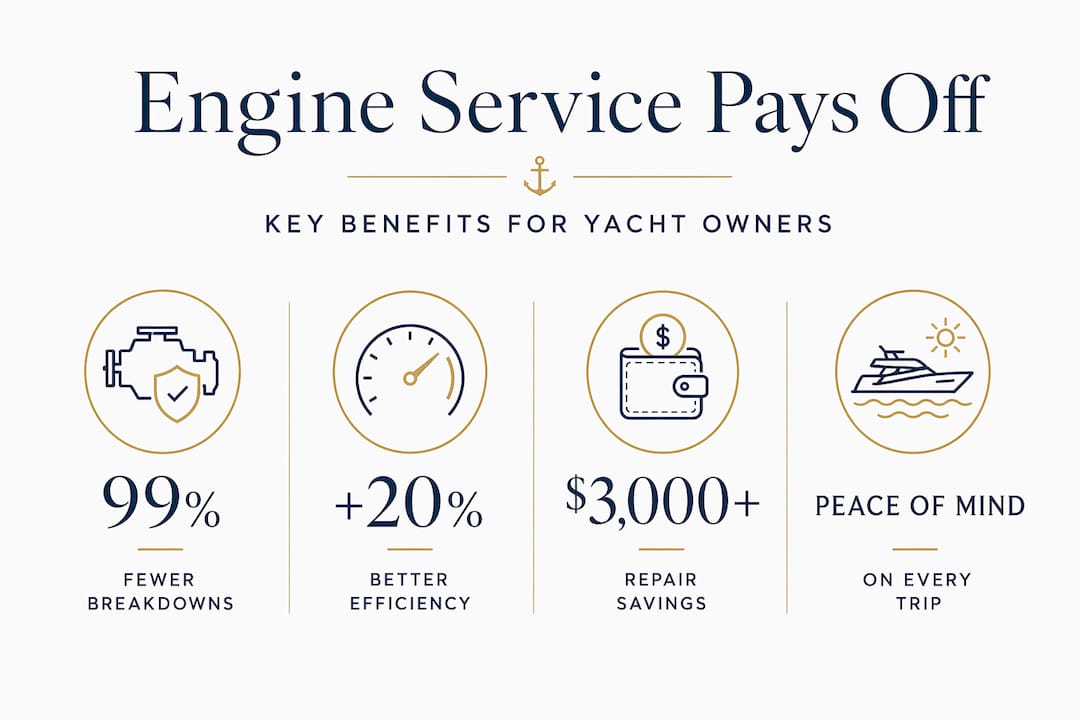
- Better fuel economy: Clean fuel systems and fresh oil reduce internal friction, which directly improves consumption
- Stable performance: Correctly timed ignition and clean injectors deliver smooth, predictable power across the RPM range
- Longer engine life: Every service interval you honor extends the mechanical life of your engine, protecting a component that often costs tens of thousands of dollars to replace
“Marine safety and reliability start with proactive maintenance and safety-first engine-room inspections.” ABYC-certified technician guidance
For Florida owners who run their boats year-round, maintaining sportfish boat fuel efficiency through consistent engine care also adds up to real savings over a season. The engine servicing advantages compound over time in a way that reactive repairs simply never can.
My honest take on engine maintenance discipline
I’ve watched boat owners spend extraordinary amounts of money on custom finishes, new electronics, and premium gear, only to run an engine six months past its service date without a second thought. And I understand it. Maintenance is invisible when it’s working. You only feel the absence of it when something goes wrong.
What I’ve learned from years working alongside Florida yacht owners is that the owners who experience the fewest breakdowns and the lowest long-term repair costs are not the ones with the newest boats. They’re the ones with the most consistent habits. A simple maintenance log, a service schedule tied to both hours and the calendar, and a trusted technician who knows their vessel well. That’s the whole formula.
The challenge I hear most often is tracking overlapping service tasks across multiple systems. It feels complicated, and it is, until you build a rhythm around it. Once that rhythm exists, a smarter maintenance schedule becomes second nature rather than a burden.
My honest advice: don’t wait for a symptom to prompt action. Treat your service schedule the way a commercial captain treats theirs. By the time something feels wrong on the water, the repair is already more expensive than the service would have been.
— Jason
Let Mazzamarine keep your engine running at its best

At Mazzamarine, Mino and Luigi have built a network of Florida’s most trusted marine experts precisely because boat ownership shouldn’t feel like a guessing game. Whether you need a full engine inspection, a seasonal maintenance package, or help diagnosing a problem before it becomes a crisis, the Mazzamarine team handles it all with the care and expertise your vessel deserves.
Start with the signs you need yacht repairs guide if you’re already noticing something off, or explore the marine mechanical systems guide for a broader look at everything that keeps your yacht running reliably. You can also reference the engine troubleshooting guide to diagnose common issues before your next service visit. Reach out to Mazzamarine today and build a maintenance relationship that lasts for the life of your boat.
FAQ
Why is regular engine servicing important for boats?
Marine engines operate in salt, heat, and moisture that accelerate component wear far faster than road vehicles experience. Regular servicing protects lubrication, cooling, fuel delivery, and corrosion resistance, preventing breakdowns and expensive repairs.
How often should you service a boat engine?
Most outboard engines require service every 100 hours or annually, whichever comes first. Inboard diesel engines have multi-interval schedules that require tracking both hours and calendar time for full protection.
What happens if you skip boat engine maintenance?
Skipping scheduled service leads to gradual oil breakdown, corrosion damage, overheating, and ultimately expensive repairs or being stranded offshore. Failure progression is gradual, which is why prevention always costs less than the repair.
What are the early warning signs of engine trouble on a boat?
Hard starting, loss of power under load, higher-than-normal operating temperatures, unusual exhaust smoke, and strange noises are all signs that your engine needs attention before the next scheduled service.
Does regular servicing improve fuel efficiency on a yacht?
Yes. Clean fuel systems, fresh oil, and properly functioning ignition components reduce internal friction and combustion inefficiency. Consistent engine maintenance benefits include measurably better fuel economy across a full season of use.
Recommended
Text or Call 954-330-9653 Schedule Appointment
Mazza Marine Yacht Services & Refit

Fiberglass Upgrades and Damage Repair

Premium Yacht Paint/ Faux Teak

Fishing: Custom Rods, Reels,Tackle

Electrical, Electronics and Navigation

Paint, Hull and Gelcoat

Teak Decks, Wood Cabinets, Carpentry

Canvas, Enclosures and Upholstery

Mechanical, Repower and Running Gear

Plumbing, Bilge and Thru-Hulls

Welding and Custom Fabrication

Interior Refit And Past Work
Get your yacht value Estimate
"*" indicates required fields