
View Our Recent Work:

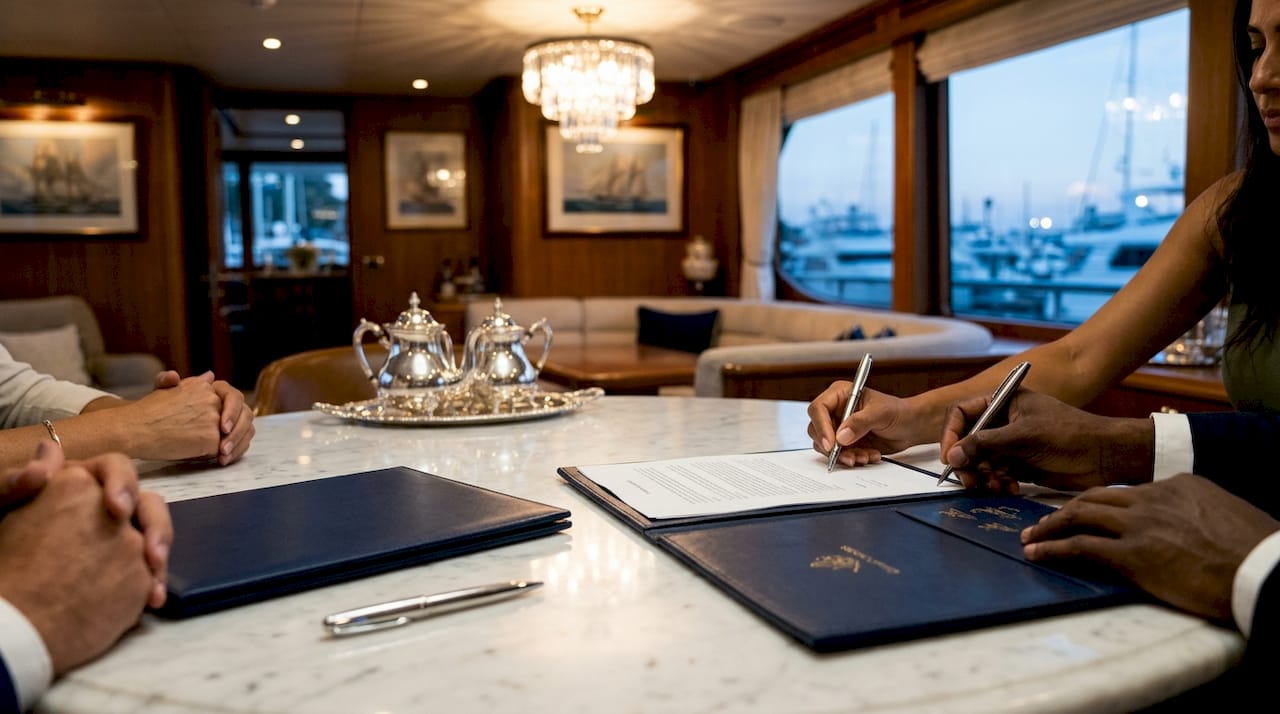
A yacht bill of sale is the legal document that officially transfers ownership of a vessel from seller to buyer, serving as the primary proof of that transaction. Without it, neither party has a clear record of the sale, and registration or title transfer becomes nearly impossible. The U.S. Coast Guard, through its National Vessel Documentation Center (NVDC), sets specific standards for what this document must contain, particularly for federally documented vessels. Whether you are buying your first sportfish or selling a classic cruiser, understanding the legal requirements for a yacht sale protects your investment from day one.
What is a yacht bill of sale and what must it include?
A yacht bill of sale is a legally binding record of the sale and transfer of a vessel, equivalent in function to a deed for real property. The industry standard term is “bill of sale,” though you will also see it called a vessel sales agreement or yacht sales agreement in private transactions. Both terms refer to the same document, and both carry the same legal weight.
The document must capture specific details to be enforceable. Missing even one field can cause a registration application to be rejected outright. A complete bill of sale includes:
- Vessel identification: The official vessel number, Hull Identification Number (HIN), vessel name, make, model, year, and length
- Buyer and seller information: Full legal names and mailing addresses of both parties, exactly as they appear on government-issued ID
- Transaction details: The agreed sale price and the exact date of the transaction
- Equipment itemization: A description of any outboard motor with its serial number, trailer with its VIN, and any electronics or gear included in the sale
- Warranty of title: A statement from the seller affirming lien-free ownership and the legal right to sell the vessel
- Signatures: Seller signature, and in most cases buyer signature, on every copy
Pro Tip: Print at least three signed originals: one for the buyer, one for the seller, and one for the registration authority. Photocopies are routinely rejected.
The warranty of title clause deserves special attention. It is the seller’s formal guarantee that no bank, lender, or creditor holds a claim against the vessel. A buyer who skips this clause risks inheriting a lien they never agreed to pay.
How does a yacht bill of sale fit into federal and state documentation?
The answer depends on whether your vessel carries federal documentation or a state title. These are two separate systems, and the bill of sale plays a different role in each.
Federal documentation through the U.S. Coast Guard
Federally documented vessels, typically those 26 feet or longer used in commerce or crossing state lines, are registered with the NVDC rather than a state DMV. For these vessels, the bill of sale is the primary ownership transfer instrument instead of a traditional state title certificate. The U.S. Coast Guard requires Form CG-1340 or an equivalent document that includes the vessel number, HIN, legal names of both parties, percentage of ownership being transferred, and a notarized seller signature.
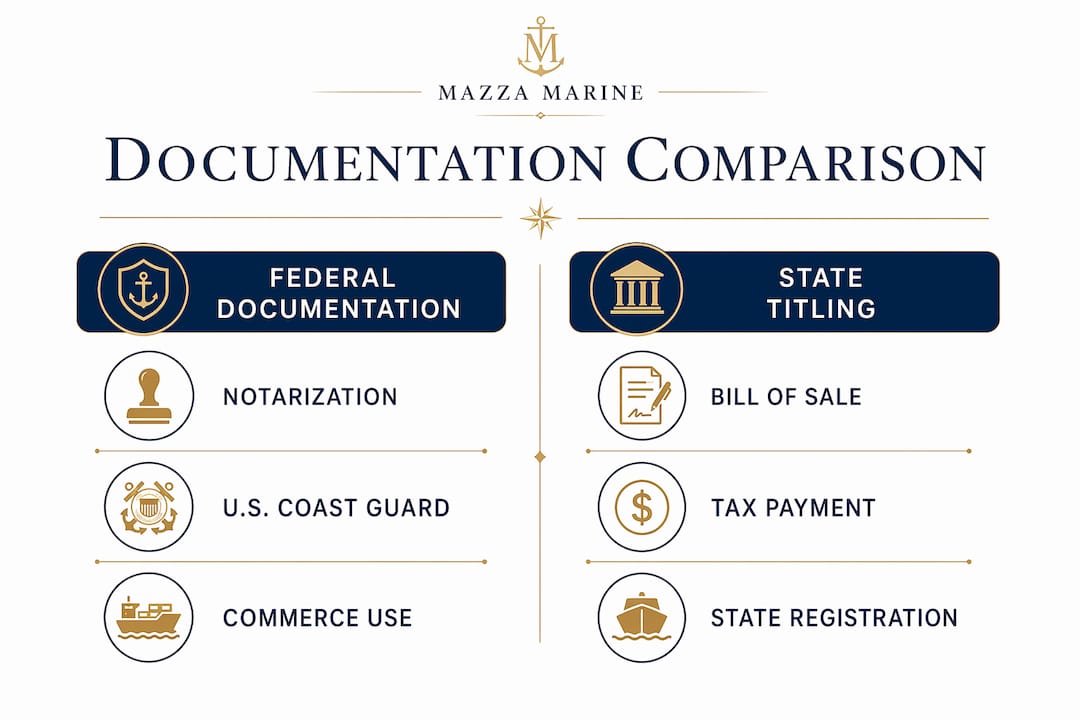
Notarization is non-negotiable for federally documented vessels. Without notarization, the NVDC rejects the ownership transfer application and returns the paperwork. That rejection adds weeks to the process and can complicate financing or insurance coverage in the interim.
State titling and registration
| Vessel type | Documentation system | Bill of sale role | Notarization required |
|---|---|---|---|
| Federally documented (26 ft+) | U.S. Coast Guard / NVDC | Primary ownership instrument | Yes, mandatory |
| State-titled vessel | State DMV or marine agency | Supporting document with signed title | Varies by state |
| Undocumented small craft | State registration only | Primary proof of sale | Varies by state |
For state-titled vessels, most states require the bill of sale along with the signed title and proof of tax payment for registration. Submission deadlines typically fall within 15–30 days of the sale date. Missing that window triggers fines in most states, so timing matters.
Pro Tip: Check your specific state’s marine agency website before closing the deal. Florida, for example, processes vessel titles through the Department of Highway Safety and Motor Vehicles, and their checklist differs from states like California or Texas.
Understanding yacht documentation in Florida is especially relevant for Gulf Coast and Atlantic buyers, where federal documentation is common among larger cruising and sportfishing vessels.
What are common pitfalls and red flags in a yacht bill of sale?
The bill of sale looks simple on the surface. In practice, it is where most yacht transactions go wrong.
The most serious red flag is a seller who refuses to include a warranty of title. Legal professionals emphasize reviewing the warranty of title carefully to avoid acquiring a vessel with undisclosed liens or ownership disputes. A seller who balks at this clause may have a lender, marina, or creditor with a claim on the boat. Walk away or demand a lien search before signing.
A vague condition statement like “sold in current condition” does not carry the same legal protection as an explicit “as-is” disclaimer. A bill of sale that clearly states an “as-is” condition protects the seller from implied warranties and future liability claims. Buyers, in turn, should treat an “as-is” clause as a signal to commission a professional survey before closing.
Other common pitfalls include:
- Missing signatures on copies: Failure to include seller signatures on every copy of the bill of sale is a leading cause of registration rejection. Every original must be fully executed.
- Incomplete equipment lists: Leaving the motor or trailer off the bill of sale creates a separate ownership dispute for those items. List everything with its serial or VIN number.
- Wrong legal names: Using a nickname or abbreviated business name instead of the full legal name on record causes mismatches with title databases.
- No lien search: A title warranty from the seller is valuable, but an independent lien search through the NVDC or a marine title company confirms it independently.
Reviewing a Florida yacht sales guide before you sign gives you a practical checklist tailored to the state’s specific requirements.
How to properly draft and use a yacht bill of sale
A well-drafted bill of sale follows a clear sequence. Rushing this process is the single most common mistake in private yacht transactions.
- Gather vessel records first. Pull the current NVDC abstract of title or state title certificate before drafting anything. Confirm the seller’s name matches the record exactly.
- Use a complete yacht bill of sale template. A blank template from the NVDC or a maritime attorney covers all required fields. Generic real estate or vehicle forms miss vessel-specific requirements like the HIN and official number.
- Itemize every component of the sale. List the hull, motor with serial number, trailer with VIN, electronics, and any included gear separately. Vague descriptions like “all equipment onboard” create disputes later.
- Include an explicit condition statement. Decide whether the sale is “as-is” or includes any seller representations about condition. State it clearly in writing.
- Get the document notarized. For federally documented vessels, notarization is mandatory. For state-titled vessels, it adds legal weight even when not required.
- Sign every copy. Both parties should sign all originals. Missing signatures on any copy is the most common reason registration applications are rejected.
- Submit promptly. File with the NVDC or your state marine agency within the required window, typically 15–30 days, along with tax payment documentation.
Pro Tip: After closing, keep your original signed bill of sale in a waterproof document pouch aboard the vessel. Coast Guard boarding officers and marina operators may ask for proof of ownership.
For sellers, the process of selling your yacht in Florida involves additional steps beyond the bill of sale, including canceling existing documentation and settling any outstanding marina fees before transfer.
Key Takeaways
A valid yacht bill of sale must include the HIN, full legal names, sale price, equipment itemization, a warranty of title, and notarized signatures to satisfy both federal and state requirements.
| Point | Details |
|---|---|
| Federal documentation standard | U.S. Coast Guard Form CG-1340 requires notarized seller signature and full vessel identification. |
| Warranty of title is non-negotiable | Sellers must affirm lien-free ownership; buyers should independently verify with a lien search. |
| Notarization determines validity | Without notarization, the NVDC rejects federally documented vessel transfer applications. |
| State deadlines are strict | Most states require bill of sale submission within 15–30 days of sale to avoid fines. |
| Sign every copy | Missing seller signatures on any original is the leading cause of registration rejection. |
What I’ve learned from watching yacht deals go sideways
Watching yacht transactions fall apart over paperwork is genuinely painful, especially when the vessel itself is in perfect condition. The bill of sale is treated as an afterthought in too many private sales. Buyers are excited, sellers are ready to move on, and everyone assumes the document is just a formality. It is not.
The deals that go wrong almost always share one trait: someone downloaded a generic vehicle bill of sale template and filled in the vessel name. That document will not satisfy the NVDC. It will not protect the buyer if a lien surfaces six months later. And it will not hold up if the seller’s name does not match the title record exactly.
My honest advice is this: spend the time upfront. Order an abstract of title from the NVDC before you negotiate price. Use a vessel-specific template, or better yet, have a maritime attorney review the document for transactions above $50,000. The cost of a one-hour legal review is trivial compared to the cost of inheriting someone else’s debt on a $300,000 boat.
The vehicle retrieval logistics side of a yacht purchase, getting the vessel from its current location to your home port, also deserves planning before the ink dries. Too many buyers close the deal and then realize they have no transport plan.
— Jason
Mazzamarine is here after the paperwork is done
Once the bill of sale is signed and the vessel is yours, the real work of ownership begins. Mazzamarine’s network of Florida yacht experts covers everything from urgent repairs to complete maintenance packages, interior refits, engine work, and custom upgrades. Mino and Luigi built Mazzamarine on a genuine passion for the sea, and that shows in every vendor relationship and every recommendation they make.
New owners often discover deferred maintenance only after taking possession. Mazzamarine’s yacht repair guide for Florida owners walks you through the warning signs to check immediately after a purchase. Whether you need a quick mechanical inspection or a full refit, Mazzamarine connects you with the right Florida specialists. Reach out today and start your ownership on solid footing.
FAQ
What is a yacht bill of sale used for?
A yacht bill of sale documents the legal transfer of vessel ownership from seller to buyer and serves as proof of the transaction for registration, titling, and tax purposes.
Is notarization required on a yacht bill of sale?
Notarization is mandatory for federally documented vessels. Without it, the NVDC rejects the ownership transfer application and returns all paperwork.
What is the difference between a bill of sale and a yacht title?
A state title certificate proves registered ownership at the state level, while a bill of sale documents the sale transaction itself. For federally documented vessels, the bill of sale replaces the state title as the primary ownership instrument.
How long do I have to file a yacht bill of sale after purchase?
Most states require submission within 15–30 days of the sale date. Filing late typically results in fines, so check your state’s specific deadline before closing.
What happens if the bill of sale is incomplete?
An incomplete bill of sale, missing signatures, wrong legal names, or absent vessel details, causes the registration or title application to be rejected, delaying ownership transfer and potentially affecting insurance coverage.
Recommended
Text or Call 954-330-9653 Schedule Appointment
Mazza Marine Yacht Services & Refit

Fiberglass Upgrades and Damage Repair

Premium Yacht Paint/ Faux Teak

Fishing: Custom Rods, Reels,Tackle

Electrical, Electronics and Navigation

Paint, Hull and Gelcoat

Teak Decks, Wood Cabinets, Carpentry

Canvas, Enclosures and Upholstery

Mechanical, Repower and Running Gear

Plumbing, Bilge and Thru-Hulls

Welding and Custom Fabrication

Interior Refit And Past Work
Get your yacht value Estimate
"*" indicates required fields