
View Our Recent Work:

Overview: Yacht escrow is a neutral, contract-driven arrangement where a qualified third party holds purchase funds until every agreed condition is met — protecting both buyer and seller from the moment a deposit is wired to the moment title transfers. Before you move a dollar, confirm in writing exactly who holds the deposit, under what conditions it releases, and which account it sits in. The International Yacht Brokers Association (IYBA) and Florida’s Yacht and Ship Brokers’ Act, Chapter 326, together set the legal and professional framework that governs every Florida yacht closing.
Table of Contents
- How does the yacht escrow process work, step by step?
- Who can legally hold escrow funds in Florida?
- What do escrow fees typically cost, and how long does closing take?
- Common escrow red flags and how to protect yourself
- What documents will you sign or see during yacht escrow?
- How do you choose a trustworthy escrow agent in Florida?
- Florida legal notes every yacht owner should know
- Key Takeaways
- What most owners get wrong about escrow
- Mazzamarine helps Florida owners close with confidence
- Authoritative sources and further reading
How does the yacht escrow process work, step by step?
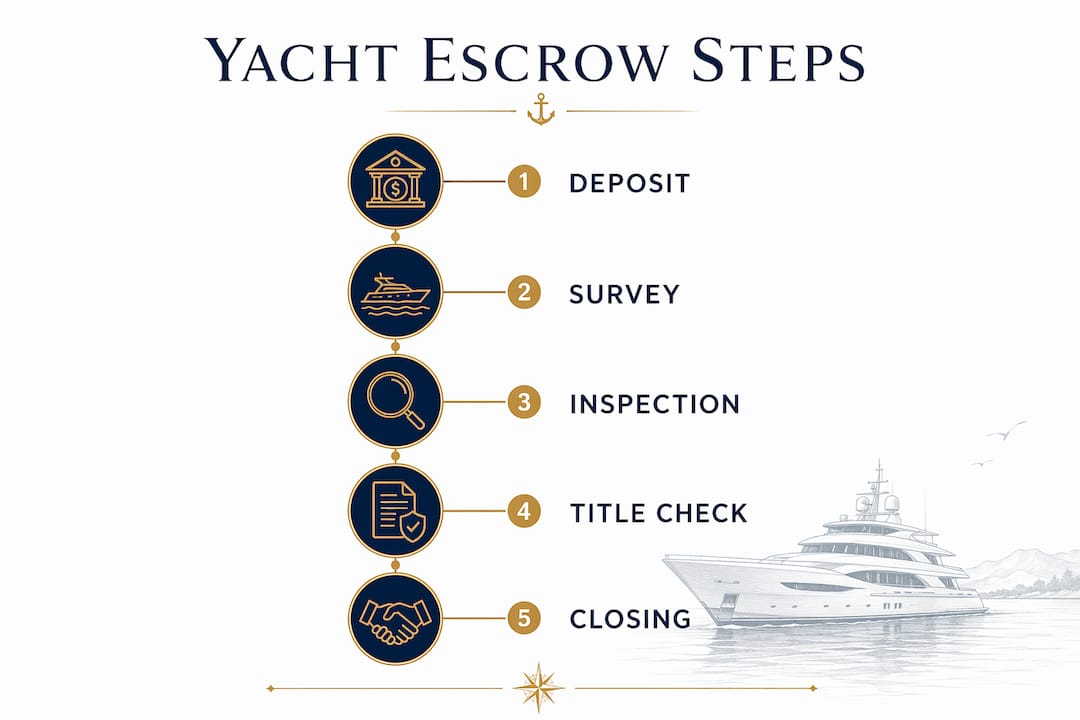
The purchase agreement triggers everything. Once buyer and seller sign, the buyer wires a deposit — typically a sum reflecting common industry practice — into a dedicated escrow account. From that moment, a clock starts.
- Offer and deposit: Buyer submits offer; seller accepts; deposit is due.
- Escrow account deposit: Florida rule 61B-60.006 requires brokers to place funds into a segregated trust account within three working days of receipt.
- Survey and sea trial: Buyer engages a certified marine surveyor (SAMS or NAMS accredited). This window is commonly within a week or two after deposit.
- Financing and insurance contingencies: Buyer secures a loan commitment and an insurance binder confirming the vessel is insurable.
- Title and lien search: An independent title search confirms no outstanding liens or encumbrances. Allow about one to two weeks.
- Final walk-through and delivery: Buyer inspects the vessel one last time before closing.
- Disbursement and closing statement: Escrow agent issues an itemized closing statement and releases funds per written instructions.
Pro Tip: The purchase agreement will name a specific date after which the deposit becomes non-refundable if the buyer has not exercised a survey contingency. Mark that date in red. Once it passes, your leverage to renegotiate on survey findings drops sharply.
| Milestone | Typical Day Range | Action Owner |
|---|---|---|
| Deposit wired to escrow | — | Buyer |
| Survey and sea trial | within a week or two | Buyer (schedules surveyor) |
| Title and lien search | — | Escrow agent / attorney |
| Financing commitment | about one to two weeks | Buyer |
| Closing and disbursement | — | Both parties + escrow agent |
Who can legally hold escrow funds in Florida?
Not just anyone can hold your deposit. Permitted escrow holders in a Florida yacht transaction fall into three categories: a licensed yacht broker maintaining a segregated trust account, a licensed Florida attorney holding funds in a client trust account, or an independent title and escrow company with marine closing experience.
The IYBA is clear on the fiduciary standard: an escrow agent’s duty is to follow the written escrow instructions exactly, without favoring buyer or seller. That neutrality is the whole point. An agent who starts “interpreting” ambiguous instructions in one party’s favor has stepped outside their legal role.
- Licensed broker trust accounts: Governed by Chapter 326 and rule 61B-60.006; funds must be segregated from operating accounts.
- Attorney escrow: Governed by Florida Bar rules; often preferred for complex or high-value transactions.
- Title/escrow companies: Useful when the vessel carries a USCG Certificate of Documentation and a formal title search is needed.
Florida’s Section 326.005 mandates that funds be deposited in a Florida financial institution and that an itemized closing statement accompany every title transfer. That requirement applies regardless of who holds the escrow.
What do escrow fees typically cost, and how long does closing take?
Escrow fees are generally reasonable relative to the vessel’s sale price, and who pays is almost always negotiable — the purchase agreement should spell it out.
| Cost Item | Typical Range | Usual Payer |
|---|---|---|
| Escrow / closing fees vary and may be a flat fee or a percentage of the price | Negotiated (often split) | |
| Title / lien search | — | Buyer |
| Marine survey costs typically depend on vessel size and complexity | Buyer | |
| Documentation and transfer fees vary depending on jurisdiction and vessel type | Seller or shared | |
| Attorney fees vary widely based on scope and complexity | Negotiated |
A clean, cash transaction with no title issues can often close within a few weeks. Adding financing or other complexities can extend the timeline to several weeks or months. Budget for the longer scenario and you will never be caught off guard.
Common escrow red flags and how to protect yourself
Most escrow failures trace back to two root causes: unclear release conditions in the written instructions, or improper handling of the trust account itself. Both are avoidable.
Red flags to watch for:
- Escrow holder refuses to provide written instructions before accepting funds.
- Requests for payment via wire to a personal account rather than a named trust account.
- Broker commingles escrow funds with operating money — a statutory violation and, when intentional, a felony under Chapter 326.
- No independent lien search is offered or performed.
- Closing statement is provided only after funds have already been released.
Protective steps:
- Get escrow instructions in writing before wiring any funds.
- Insist on an independent title and lien search, even when the seller says the title is “clean.”
- Verify the bank account name and number by phone with the institution directly — not via email.
- Require the itemized closing statement for your review before authorizing disbursement.
Florida treats intentional commingling of escrow funds as a third-degree felony under the Yacht and Ship Brokers’ Act. That is not a technicality — it is a criminal exposure that should make any broker think twice about sloppy account practices.
What documents will you sign or see during yacht escrow?
The paperwork at closing is more manageable than it looks, but every document has a job. Knowing what each one does lets you review rather than just sign.
| Document | Prepared By | Why It Matters |
|---|---|---|
| Purchase and Sale Agreement | Broker / attorney | Sets all terms, contingencies, and deposit conditions |
| Escrow Instructions | Escrow agent | Governs fund release; must be in writing |
| Bill of Sale | Seller (often broker-assisted) | Transfers ownership; required for registration |
| USCG Certificate of Documentation or State Title | USCG / state agency | Proves clear title; buyer retains original |
| Lien Release(s) | Lienholder(s) | Confirms no outstanding claims against the vessel |
| Insurance Binder | Buyer’s insurer | Required before most lenders release financing |
| Survey Report | Certified marine surveyor | Documents condition; basis for renegotiation |
| Closing Statement | Escrow agent / attorney | Itemizes all debits and credits; retain your copy |
Keep originals of the bill of sale, title or documentation certificate, and closing statement. Some states require notarized signatures on the bill of sale; Florida does not mandate notarization for vessel transfers, but lenders often do for their own records.
How do you choose a trustworthy escrow agent in Florida?
Start with licensed brokers who maintain segregated trust accounts, or independent attorneys and title companies with a track record of yacht closings. Credentials matter, but so does the conversation you have before you hand over a deposit.
Questions to ask any escrow candidate:
- Can you show me your trust account procedures and the name of the financial institution?
- How do you handle a disputed release instruction when buyer and seller disagree?
- Are your trust accounts FDIC-insured?
- Can you provide a sample closing statement from a recent transaction?
- Do you carry errors and omissions insurance?
Credentials and red flags:
- Florida broker license (verifiable through DBPR) with no disciplinary history.
- Proof of a separate, named trust account — not a general operating account.
- Willingness to provide written escrow instructions before accepting funds. Refusal is a hard stop.
- References from recent yacht closings, not just general real estate transactions.
Pro Tip: Ask for the bank confirmation details in writing and call the bank directly to verify the account name matches the escrow holder’s business name. Wire fraud in marine transactions is real, and a two-minute phone call is the simplest defense.
For a broader look at how Florida yacht brokerage works and what brokers are legally required to do, that guide covers the commission and fiduciary landscape in detail.
Florida legal notes every yacht owner should know
Florida’s rules are specific, and ignorance of them does not protect you. Here is what Chapter 326 and rule 61B-60.006 actually require:
- Brokers must deposit transaction funds into a trust account at a Florida financial institution promptly following receipt.
- Trust accounts must be kept completely separate from operating funds — no exceptions.
- Separate records for each transaction are required; the broker cannot pool multiple clients’ deposits into one undifferentiated account.
- An itemized closing statement is mandatory at the time of title transfer.
- Intentional failure to comply — including deliberate commingling — can constitute a third-degree felony under Chapter 326.
If you suspect a broker has mishandled escrow funds, the Florida Department of Business and Professional Regulation (DBPR) is the reporting authority. You can file a complaint through the DBPR’s Division of Florida Condominiums, Timeshares, and Mobile Homes, which oversees yacht and ship broker licensing. For title disputes or lien complications, consult a Florida maritime attorney before taking any other action.
This article is general information, not legal advice. Confirm current rules with the DBPR or a qualified Florida maritime attorney for your specific situation.
Key Takeaways
Florida yacht escrow requires written instructions, a segregated trust account, and a licensed escrow holder — skipping any one of those three creates real legal and financial exposure for both buyer and seller.
| Point | Details |
|---|---|
| Written instructions are non-negotiable | Get escrow instructions in writing before wiring any funds, without exception. |
| Florida’s three-day rule | Brokers must deposit funds into a segregated trust account within three working days under rule 61B-60.006. |
| Commingling is a felony | Intentional mixing of escrow and operating funds is a criminal offense under Chapter 326. |
| Time to close | Cash deals can close in 21–30 days; financing or title issues push this to 45–90 days. |
| Mazzamarine’s role | Mazzamarine helps Florida owners coordinate surveys, prepare documentation, and connect with vetted escrow professionals. |
What most owners get wrong about escrow
The conventional wisdom says escrow is just a formality — a holding pen for money while the paperwork catches up. That framing is exactly what gets owners into trouble. Escrow is a legal instrument with specific trigger conditions, and the written instructions are the mechanism that controls everything. A vague phrase like “funds release upon buyer satisfaction” has ended more than a few Florida closings in a dispute, because satisfaction is not a legal standard.
The other thing people underestimate is the survey contingency window. Buyers often treat the survey as a pass/fail test, but it is actually a negotiating tool. A skilled buyer uses survey findings to renegotiate price or request repairs before the non-refundable date arrives. Sellers who understand this prepare their vessels properly beforehand — and that preparation, more than any marketing, is what keeps a closing on schedule.
Mazzamarine helps Florida owners close with confidence
Mazzamarine is not a neutral escrow holder, and we are transparent about that. What we are is the team Florida yacht owners call when they need the vessel side of a closing handled properly — so the escrow side can proceed without surprises.

When a survey turns up deferred maintenance, Mazzamarine’s network of Florida specialists can schedule yacht repairs quickly, keeping your closing timeline intact. We coordinate pre-sale condition work, verify service histories, connect sellers with vetted maritime attorneys and escrow professionals, and help owners get their vessels sale-ready before the first showing. Whether you are selling a sportfish, a cruiser, or a custom refit project, the Mazzamarine team knows the Florida market and the vendors who move fast. Contact us today to talk through what your vessel needs before closing day.
Authoritative sources and further reading
- Chapter 326, Florida Statutes — Yacht and Ship Brokers’ Act (2024)
- Section 326.005 — Escrow Depository and Closing Transactions (2023)
- Florida Administrative Rule 61B-60.006 — Escrow Trust Depository
- IYBA — Money Matters: Escrow Agents and Deposits
- YachtWay Knowledge Center — How to Close on a Yacht Purchase
- YachtWorld — Buying from a Yacht Broker: Commissions, Escrow, Taxes, and More
For transactions involving cross-border financing, foreign-flagged vessels, or unresolved liens, consult a Florida maritime attorney before proceeding. The statutes above are the controlling authority — any broker or agent who contradicts them is the one to question.
Recommended
Text or Call 954-330-9653 Schedule Appointment
Mazza Marine Yacht Services & Refit

Fiberglass Upgrades and Damage Repair

Premium Yacht Paint/ Faux Teak

Fishing: Custom Rods, Reels,Tackle

Electrical, Electronics and Navigation

Paint, Hull and Gelcoat

Teak Decks, Wood Cabinets, Carpentry

Canvas, Enclosures and Upholstery

Mechanical, Repower and Running Gear

Plumbing, Bilge and Thru-Hulls

Welding and Custom Fabrication

Interior Refit And Past Work
Get your yacht value Estimate
"*" indicates required fields