
View Our Recent Work:

A cosmetic interior refresh typically runs a range from about twenty thousand to eighty thousand dollars, a full interior rebuild lands between $150,000 and over $1 million, and a mid-life refit on a larger yacht often falls in the $150,000 to $600,000 range. The number that matters most isn’t any of these bands. It’s the rule behind them: define your scope in writing, itemize every trade, then add project management and contingency before you sign anything. Skip that step, and even a modest refresh can drift into the next price tier.
TL;DR:
- The scope details, material choices, and project management quality heavily influence yacht refit costs, often more than yacht size alone.
- Hidden issues like rotted subdecking or corroded wiring can transform a cosmetic update into a structural repair, significantly raising expenses.
- Itemized bids with precise specifications and contingency planning of 5 to 15 percent help prevent budget overruns and allow fair comparison between yard quotes.
- A full interior refit on a 30-50 foot yacht generally costs between $150,000 and $600,000, depending on systems touched and scope complexity.
- Projects managed entirely in-house with a single project manager, like Mazzamarine, reduce subcontractor delays and facilitate more accurate, fixed-cost estimates.
Table of Contents
- How Much Does a Yacht Interior Refit Cost by Size and Scope?
- What Drives Yacht Refit Costs the Most?
- What Do Individual Refit Trades Actually Cost?
- How Do You Build an Itemized Refit Budget?
- How Long Does a Yacht Interior Refit Take?
- What Controls Actually Prevent a Refit From Going Over Budget?
- Who’s Behind This Guide (and Why Mazzamarine Knows This Territory)
- An Honest Take on Yacht Refit Budgeting
- Get a Firm, Itemized Refit Estimate From Mazzamarine
- Sources
- FAQ
How Much Does a Yacht Interior Refit Cost by Size and Scope?
Ask three different yards for a “full interior refit” quote on the same boat and you’ll likely get three wildly different numbers. That’s not because someone is padding the bid. It’s because “full interior” means something different to every yard until you nail down the scope.
Here’s how the ranges typically shake out once you separate cosmetic work from structural interior rebuilds.
| Yacht Size | Cosmetic Refresh | Full Interior Refit | Mid-Life Refit |
|---|---|---|---|
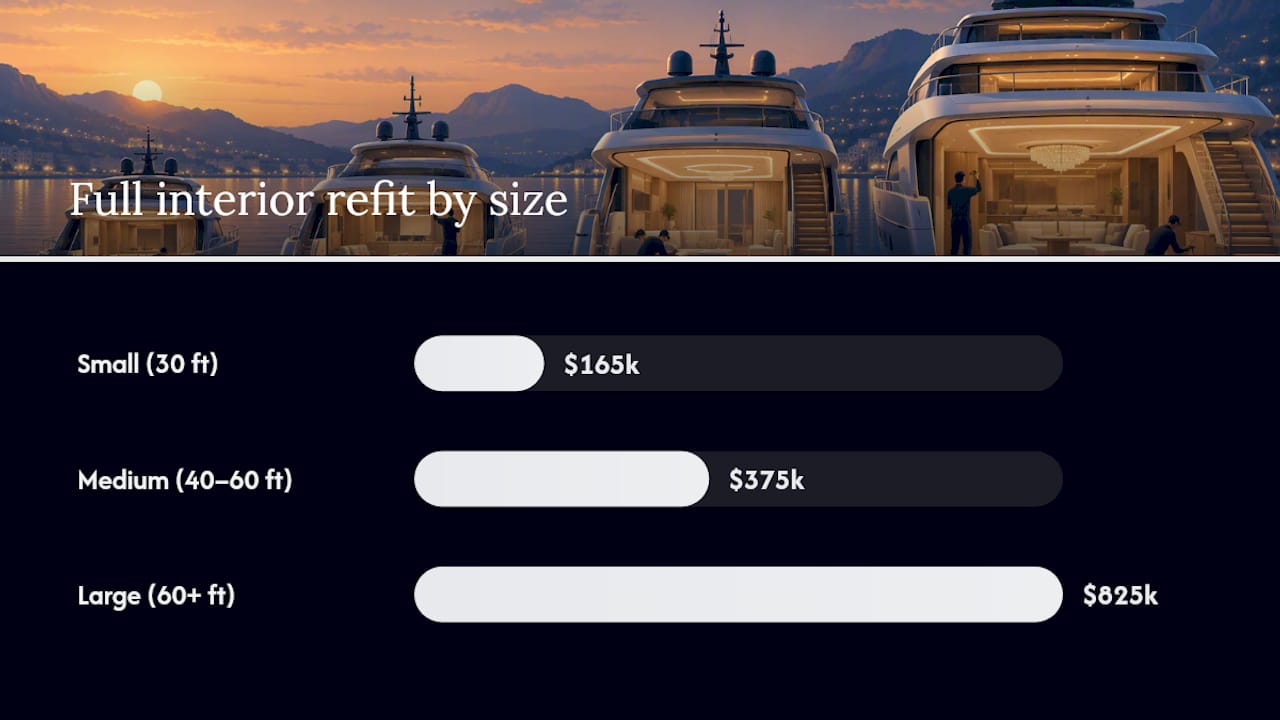
| Small (30–) ft | $20,000–$80,000 | a range roughly between eighty thousand and a quarter million dollars | a range typically seen between sixty thousand and under two hundred thousand dollars |
| Medium (40–60 ft) | a range generally spanning forty thousand to about one hundred thousand dollars | $150,000–$600,000 | a range often between one hundred twenty thousand and four hundred thousand dollars |
| Large (60 ft+) | ranges commonly seen between eighty thousand and over two hundred thousand dollars | $150,000–$1,500,000+ | ranges typically starting around three hundred thousand to a million or more |
For most 30 to 60 foot yachts, a complete refurbishment commonly ranges from $50,000 to $1,500,000 or more, with the wide spread coming down almost entirely to how many systems get touched alongside the interior. On larger yachts, the math shifts to a per-meter framework: mid-life refits on bigger boats often run EUR 10,000 to 30,000 per metre, though that figure depends far more on scope and condition than the length of the hull.
A handful of warning signs push a project into the next cost band fast. Rotted subdecking discovered under old teak, corroded wiring behind cabinetry, or an outdated air handling system all turn a “cosmetic” job into a structural one. If your surveyor flags moisture intrusion or your yard finds soft spots during strip-out, budget for the next tier up before you’re surprised by it.
What Drives Yacht Refit Costs the Most?
Owners tend to assume size sets the price. It’s a factor, sure, but the variables you actually control matter more.
- Scope clarity. A refit brief that says “update the salon” invites design drift; one that specifies exact materials, finishes, and fixtures keeps every bid comparable.
- Access and hidden conditions. Tight engine room clearances, buried plumbing runs, and what’s behind the walls once demo starts routinely add cost nobody priced upfront.
- Materials and finish level. Marine-grade vinyl and solid teak joinery sit at opposite ends of the same line item, and the gap between them can be five figures on a single cabin.
- Labor and yard rates. Florida yard rates vary by region and season, and subcontractor coordination adds friction (and cost) when trades aren’t managed under one roof.
- Schedule pressure. Rushing a timeline means paying rush freight on long-lead items like custom cushions or imported stone countertops.
Pro Tip: Lock your finish schedule (fabric, wood species, hardware finish) before you send drawings to more than one yard. Changing your mind mid-tender is the single fastest way to make three bids incomparable.
What Do Individual Refit Trades Actually Cost?
Headline ranges are useful for planning, but tenders live and die on line items. Here’s what owners typically see when a yard breaks a refit brief into trades.
| Trade | Typical Range | What’s Included |
|---|---|---|
| Upholstery & soft goods | $18,000–$50,000+ | Cushions, settees, headliners, window treatments |
| Joinery & cabinetry | $30,000–$200,000+ | Teak cabinetry, paneling, custom millwork |
| Flooring | $10,000–$60,000 | Teak decking, carpet, vinyl plank, marble inlay |
| Lighting | $8,000–$40,000 | LED retrofits, dimming systems, accent fixtures |
| AV & electronics | $15,000–$100,000+ | Entertainment systems, wiring, control panels |
Marine upholstery for luxury yachts commonly starts around $18,000 and can exceed $50,000, with premium per-linear-foot work often priced at several hundred dollars. That range shifts dramatically based on one decision: leather versus a high-quality marine-grade fabric. Retaining your existing furniture layout and specifying standard marine fabrics instead of bespoke leather or rare textiles is one of the more effective ways to control this line item without sacrificing the finished look.
A few things to know before you tender, including options like marine ceramic coating for boats to protect surfaces and extend finish life:
- Upholstery, flooring, and joinery are usually the most variable line items because material choice swings price so widely.
- Electronics and AV packages are often closer to fixed-price once the equipment list is finalized, since the hardware cost is set.
- Lighting retrofits tend to price predictably per fixture, making them one of the easier trades to nail down early.
How Do You Build an Itemized Refit Budget?
An itemized brief is the difference between three yards quoting the same job and three yards quoting three different jobs. Here’s the sequence that works:
- Break the boat into zones. Saloon, cabins, galley, and helm each get their own line items rather than one lump “interior” number.
- Specify materials by name. “Teak cabinetry, satin finish” beats “wood cabinetry” every time a yard prices it.
- Add design and project management fees. Design and PM fees commonly run 12 to 18% of total refit cost, and that fee regularly pays for itself by catching design drift before it becomes a change order.
- Build in contingency. Plan for 5 to 15% on well-defined projects, and lean toward the higher end on an older yacht where hidden defects are more likely.
- Send identical specs to every yard. Same materials, same lead-time assumptions, same finish standard, every time.
- Set variation control rules upfront. Require written approval above a set dollar threshold before any change order proceeds.
Pro Tip: A single specification document with itemized trades and identical material callouts lets you compare yard quotes line by line, an approach that commonly reduces final cost by 20 to 30% compared with loosely specified, owner-managed refits.
How Long Does a Yacht Interior Refit Take?
A cosmetic refresh usually holds a yacht for 2 to 6 weeks. A full interior refit commonly runs 3 to 9 months, and a mid-life refit on a larger yacht can stretch past a year once mechanical and system work gets layered in.
- Compressing a full refit timeline by half often adds a direct labor premium and forces overtime crews.
- Rushed schedules push material orders into expedited freight, which can add thousands to a single joinery package.
- Budget separately for dockage, cranage, covered storage, and material transport. These logistics costs get overlooked until the invoice arrives.
What Controls Actually Prevent a Refit From Going Over Budget?
Most overruns don’t come from bad luck. They come from decisions made without a system to catch them.
- An independent project manager or a strong owner representative reduces design drift and catches mispriced tenders before they’re signed.
- Weekly committed-cost reporting keeps you looking at the running total instead of finding out at the end.
- Setting a dollar threshold for change-order approval stops small “while we’re in there” additions from stacking up unnoticed.
- Ordering long-lead items (custom fabric, imported stone, specialty hardware) early, with verified supplier lead times, avoids the rush-freight tax.
Pro Tip: Refits typically move through six distinct phases from planning to sea trial. Ask any yard you’re considering to walk you through where your project sits in that sequence before you sign.
Who’s Behind This Guide (and Why Mazzamarine Knows This Territory)
This guide draws on published refit-cost data and project management practices used across the Florida yacht service industry, cross-checked against real trade pricing. Mazzamarine brings its own perspective: an in-house team spanning joinery, upholstery, electronics, and paint, run under one project manager instead of a chain of subcontractors. That structure is exactly the kind of setup this guide recommends owners look for.
An Honest Take on Yacht Refit Budgeting
Most refit advice tells owners to “get multiple quotes” and calls it a day. That advice is incomplete, and it’s part of why so many refits run over. Three quotes on three different scopes aren’t three options. They’re three unrelated numbers pretending to be comparable.
The real lever isn’t shopping harder. It’s specifying harder, before a single yard sees your project. An itemized brief with named materials, a locked finish schedule, and a defined PM fee turns “get me some quotes” into an actual apples-to-apples comparison. That’s the unglamorous part of refit planning nobody wants to spend a weekend on, and it’s exactly the part that saves the most money.
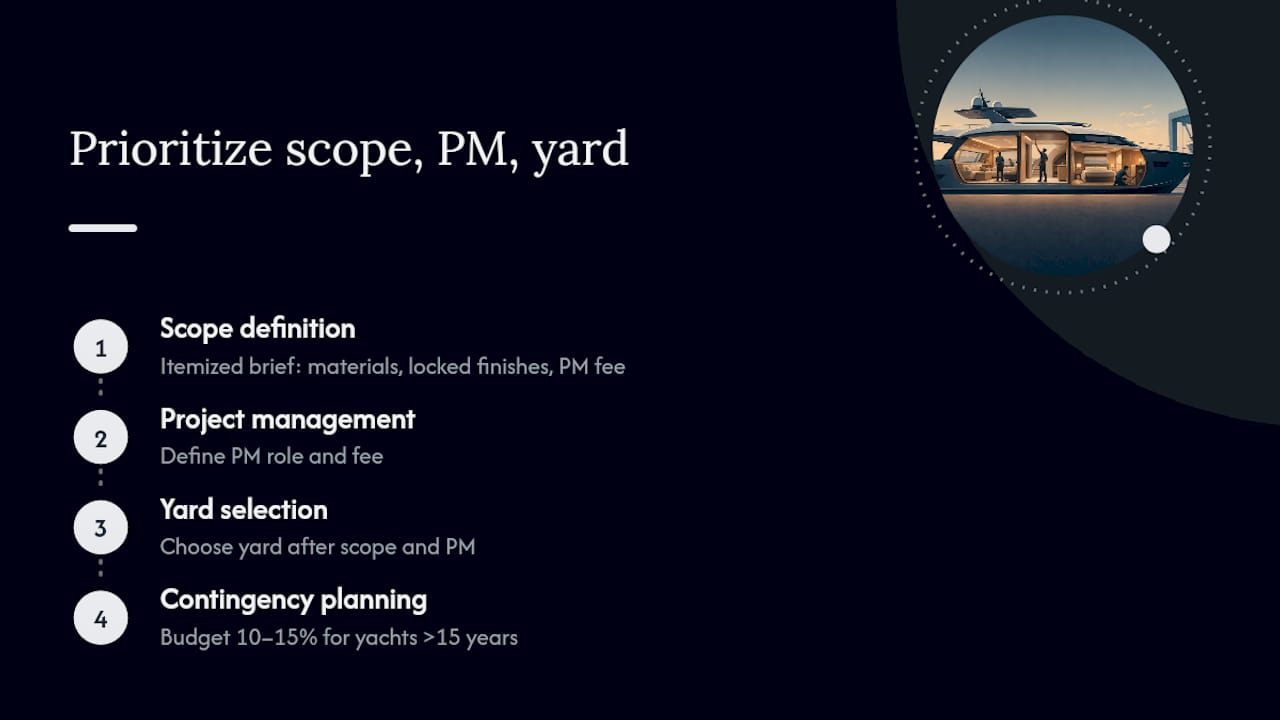
I’d also push back on how owners think about contingency. Most treat it as an insurance line they hope never to touch. Treat it instead as an expected cost on any yacht over 15 years old, because strip-out almost always finds something. The owners who budget 10 to 15% and never need it aren’t wasting money. They’re the ones who didn’t get an unpleasant surprise in month four.
Prioritize scope definition first, project management second, and yard selection third. In that order, not reversed.
— Jason
Get a Firm, Itemized Refit Estimate From Mazzamarine
Some refit providers do all work in-house and under a single project manager, helping to keep joinery crews, upholstery teams, and electronics technicians coordinated and avoid subcontractor delays.
That structure directly addresses the biggest risk this guide covers: subcontractor coordination gaps that turn a tight schedule into a missed one. Whether your project centers on teak joinery and cabinetry, fresh upholstery and soft goods, an electronics and navigation upgrade, or a paint and gelcoat refresh alongside the interior work, one project manager keeps every trade on the same page and the same timeline.
To get a tailored estimate, send Mazzamarine your yacht’s length overall, current photos of the spaces you want touched, and a short scope brief covering what you want changed and what stays. From there, reach out through the main contact page to start the itemized estimate process and see examples of past refit work.
Sources
For deeper cost breakdowns, consult the Yatco refit cost overview and the Nicholson Yachts refit roadmap before finalizing your tender brief.
- Marine Upholstery Pricing Guide | Seafarer Stitch
- Yacht refit costs explained: Real refit budgets, timelines & hidden expenses | Yachttrading
- Yacht interior design and project management guidance | House of Nuances
FAQ
How much does a yacht interior refit cost?
Costs typically span $20,000 for a cosmetic refresh to over $1 million for a full interior rebuild on a larger yacht, with mid-range full refits for 30 to 50 foot yachts commonly falling in the $150,000 to $600,000 band. The exact figure depends heavily on yacht size, current condition, and material choices.
What percentage should I budget for project management fees?
Design and project management fees typically run 12 to 18% of the total refit cost. That fee is usually money well spent, since it enforces like-for-like tendering and catches design drift before it turns into an expensive change order.
How much contingency should I set aside for a yacht refit?
Most well-defined refit projects call for 5 to 15% contingency, while older yachts or projects with structural exposure should lean toward the higher end of that range or beyond. Hidden defects found during strip-out are typically the largest source of unplanned spend on any refit.
How long does a full interior refit take?
A full interior refit commonly takes 3 to 9 months, while a mid-life refit on a larger yacht can run past a year once mechanical and system upgrades are included. Compressing that timeline usually adds direct labor premiums and rush-freight costs on custom materials.
Does Mazzamarine provide itemized refit estimates?
Yes. Mazzamarine builds estimates from your yacht’s length, current photos, and a written scope brief, using in-house teams across joinery, upholstery, and electronics under one project manager. Current pricing and project details are available by contacting Mazzamarine directly.
Recommended
Text or Call 954-330-9653 Schedule Appointment
Mazza Marine Yacht Services & Refit

Fiberglass Upgrades and Damage Repair

Premium Yacht Paint/ Faux Teak

Fishing: Custom Rods, Reels,Tackle

Electrical, Electronics and Navigation

Paint, Hull and Gelcoat

Teak Decks, Wood Cabinets, Carpentry

Canvas, Enclosures and Upholstery

Mechanical, Repower and Running Gear

Plumbing, Bilge and Thru-Hulls

Welding and Custom Fabrication

Interior Refit And Past Work
Get your yacht value Estimate
"*" indicates required fields