
View Our Recent Work:

Plan on roughly 8-12% of your yacht’s value every year for upkeep, with most owners and managers treating 10% as the working number. A 60-foot yacht valued around $600,000 lands somewhere near $48,000 to $72,000 annually. Your actual number moves with the vessel’s age, how hard you run her, whether you carry crew, and where she sits in the water.
TL;DR:
- Maintenance costs typically range from 8% to 12% of a yacht’s value annually, with older or high-usage vessels closer to 12%.
- Major expense categories include haul-outs, bottom paint, engine service, electronics, and berthing fees, which often surpass maintenance costs.
- Maintenance packages vary: fixed monthly fees, hourly rates, or hybrids, but owners should confirm coverage scope and parts billing methods upfront.
- Maintaining a separate refit reserve on top of annual maintenance funding helps avoid last-minute financing of major overhauls.
- Contract clauses that define service scope, check frequency, spending limits, and billing transparency prevent budget overruns and disputes.
Table of Contents
- What Drives Yacht Maintenance Package Costs?
- What Does a Yacht Maintenance Package Cost by Size?
- How Are Maintenance Packages Structured and Priced?
- Reserves, Refits, and Long-Term Budgeting
- Contract and Operational Controls: An Expert Checklist
- Cost-Reduction Tactics That Actually Move the Number
- A Quick Story on Why Contract Details Matter
- How Mazzamarine Builds Maintenance Packages That Actually Hold Their Budget
- Sources
What Drives Yacht Maintenance Package Costs?
Every maintenance package is really a stack of separate cost lines, and the mix matters more than the total. Haul-outs and anti-fouling usually happen once or twice a year and can run several thousand dollars depending on hull size and bottom condition. Hull and gelcoat work, exterior paint touch-ups, and zinc replacement follow close behind, especially in Florida’s warm, corrosive saltwater.
Engine and mechanical service scales with hours run, not calendar time, and twin-engine boats effectively double parts and labor compared to a single-engine setup. Generators, bow thrusters, and watermakers each carry their own service cycles, often overlooked until one fails at the worst possible moment.
Recurring cost lines that make up a typical maintenance package:
- Haul-out, bottom paint, and anti-fouling
- Engine, generator, and mechanical servicing
- Electronics, navigation, and electrical systems
- HVAC, plumbing, and bilge system upkeep
- Safety equipment inspection and certification
- Interior soft goods, canvas, and upholstery
- Marina dockage and berthing fees
Industry data consistently shows crew, berthing, and fuel as the largest ongoing operating lines once you own the boat, with maintenance sitting right alongside them. A charter yacht run hard six days a week will chew through consumables and wear items far faster than a private boat that goes out twice a month.
What Does a Yacht Maintenance Package Cost by Size?
The percentage rule only becomes useful once you attach it to a real hull length and value. Here’s how the 8-12% guidance translates into planning numbers across common size bands, using conservative examples pulled from published cost data.
To build your own number, take your yacht’s current market value, not the original purchase price, and multiply by 10% as a starting point. Older vessels or high-usage boats should budget closer to the 12% end of that range.
How Are Maintenance Packages Structured and Priced?
Providers typically price maintenance three ways: a flat monthly or seasonal fee covering defined preventive work, an hourly rate with parts billed separately, or a hybrid that blends a base retainer with pass-through costs for parts and specialty labor. Fixed packages give you budget certainty but need a tight scope definition. Hourly-plus-pass-through models offer flexibility but can drift if nobody’s watching the invoices.
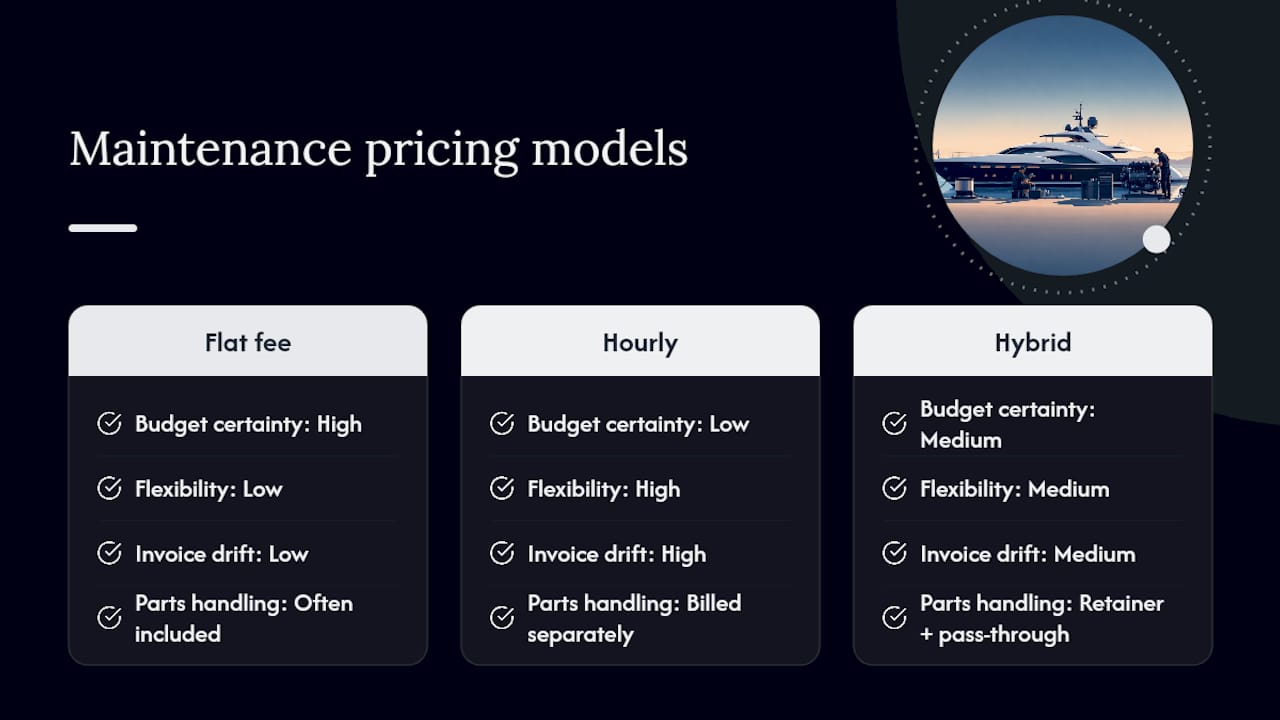
Before signing anything, check whether the package covers preventive maintenance only or corrective repairs too, whether haul-out is included or billed separately, and how often you’ll receive written reports.
Pro Tip: Ask every provider whether parts are billed at cost, cost-plus, or a fixed markup. Vendor markup transparency is the single biggest hidden-cost lever in a maintenance contract, and most owners never ask.
A full maintenance package that bundles these categories under one provider tends to reduce coordination friction versus juggling separate vendors for each system.

Reserves, Refits, and Long-Term Budgeting
Treat your annual maintenance line and your refit reserve as two different accounts, because they serve two different jobs. Maintenance covers the routine keeping-the-boat-running work; the reserve covers the bigger, less frequent projects like teak deck replacement, major electronics overhauls, or engine rebuilds that tend to land on a five to ten year cycle.
- Fund maintenance monthly from your 8-12% baseline number
- Set aside a separate refit reserve, often calculated as an additional percentage layered on top
- Track engine hours, completed checklists, and monthly financial summaries as standard documentation
- Review the reserve annually against upcoming refit timing, not just current spend
Owners who skip the second account almost always end up financing a major refit out of cash flow, at the worst possible moment.
Contract and Operational Controls: An Expert Checklist
A maintenance package is only as good as the paperwork behind it. Every agreement you sign should nail down these points before work starts:
- Explicit scope of services covering every system, not vague language like “general upkeep”
- Defined check frequency for haul-outs, engine service, and safety inspections
- Monthly financial summaries itemizing labor, parts, and pass-through costs
- Completed maintenance checklists logging engine hours and key system readings
- Spending authorization thresholds, so routine work under a set dollar amount proceeds automatically while anything above it requires your sign-off
- Vendor billing transparency, confirming whether third-party invoices pass through at cost or carry a markup
A public maintenance agreement filed with the SEC shows exactly this structure in practice: monthly oversight, an upfront expense allowance for emergencies, and a capped short-term fee arrangement. That’s the kind of concrete language worth borrowing when you draft your own terms.
This single clause stops more billing disputes than any other line in the contract.*
Cost-Reduction Tactics That Actually Move the Number
Bundling systems under one long-term contract and scheduling major work off-season typically deliver the biggest savings, since yards discount labor when demand drops. Building a relationship with one trusted vendor beats shopping every job separately. Never cut preventive maintenance to save money; a skipped $400 impeller check can turn into a $15,000 engine repair within a season.
- Bundle systems into one annual contract
- Schedule non-urgent work in off-peak months
- Negotiate parts procurement directly where possible
- Build a long-term relationship with one primary vendor
A Quick Story on Why Contract Details Matter
A client once avoided a five-figure surprise simply because their contract capped routine authorization at $500. When a “routine” fuel filter job crept toward $3,000, the yard had to call first. That single clause, not luck, saved the budget.
— Jason
How Mazzamarine Builds Maintenance Packages That Actually Hold Their Budget
Mazzamarine replaces the guesswork of juggling five separate vendors with one accountable point of contact for every system on your yacht, backed by transparent monthly reporting so you always know where the money went. As Florida-based specialists handling everything from engine and mechanical work to electronics, canvas, and custom fabrication, Mino and Luigi’s team builds packages around your actual usage pattern rather than a generic template.

Every package spells out scope, authorization thresholds, and billing transparency before work begins, so nothing lands on your invoice as a surprise. If you’re weighing a fixed package against pay-as-you-go repairs, or want to see how marine repair services fit into your current budget, reach out to Mazzamarine for a tailored estimate based on your yacht’s size, age, and use.
Sources
- Yacht Maintenance Costs by Size: Complete 2026 Budget Guide
- Hiring boat management services: contract terms for vessel care
- Yacht maintenance agreement (SEC filing excerpt)
Recommended
Text or Call 954-330-9653 Schedule Appointment
Mazza Marine Yacht Services & Refit

Fiberglass Upgrades and Damage Repair

Premium Yacht Paint/ Faux Teak

Fishing: Custom Rods, Reels,Tackle

Electrical, Electronics and Navigation

Paint, Hull and Gelcoat

Teak Decks, Wood Cabinets, Carpentry

Canvas, Enclosures and Upholstery

Mechanical, Repower and Running Gear

Plumbing, Bilge and Thru-Hulls

Welding and Custom Fabrication

Interior Refit And Past Work
Get your yacht value Estimate
"*" indicates required fields