
View Our Recent Work:

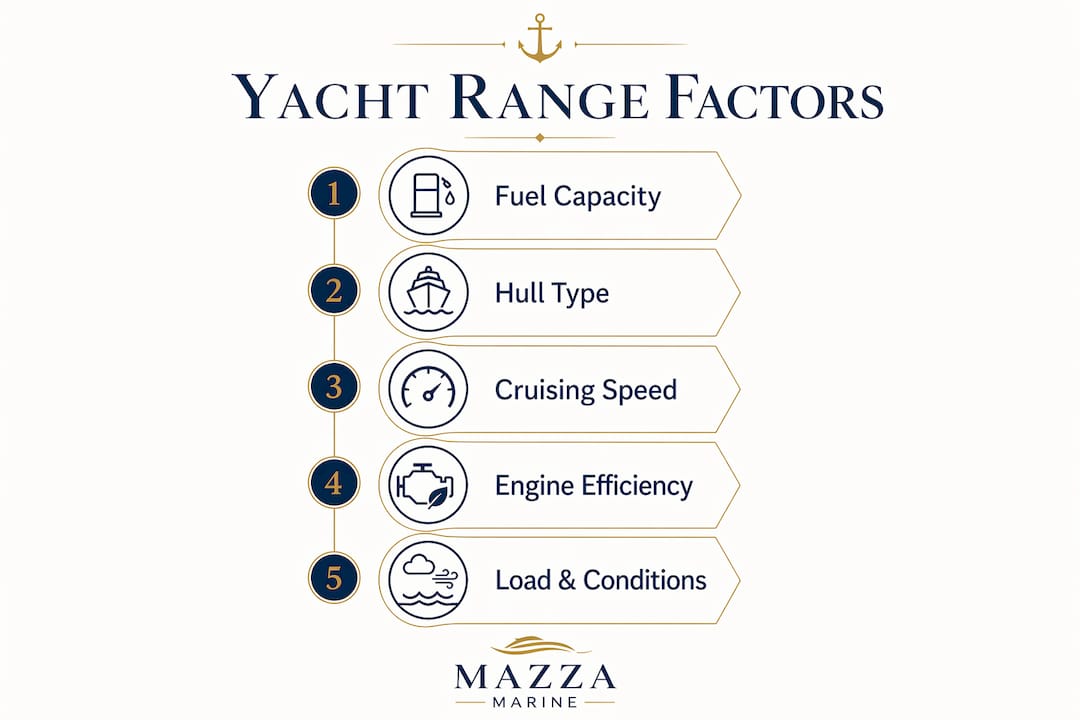
Yacht range capacity is defined as the maximum distance a vessel can travel on a single tank of fuel without stopping to refuel. In the industry, this is more precisely called cruising range or endurance capacity, and it sits at the center of every serious trip planning conversation. Whether you’re evaluating a 40-foot express cruiser or a 100-foot superyacht, understanding yacht range explained in real terms, not just brochure numbers, is the difference between a confident passage and an anxious one. Fuel capacity, engine efficiency, cruising speed, and environmental conditions all shape this number in ways that most buyers never fully appreciate before signing on the dotted line.
What is a yacht range capacity and why does it matter?
Yacht range capacity is the total nautical miles a vessel can cover before its fuel tanks run dry, calculated under a specific set of conditions. The industry standard term is cruising range, and it is expressed in nautical miles (NM). This figure matters enormously for trip planning because it determines whether you can reach your destination without an unplanned fuel stop, which at sea can mean the difference between a relaxing passage and a genuine emergency.
For buyers, understanding yacht cruising range is equally critical. A yacht with a short range may be perfect for day trips around Biscayne Bay but completely unsuitable for a Bahamas crossing or a run up the Florida coast to the Keys. Range shapes how you use the boat, where you can take it, and ultimately how much you enjoy owning it.
The core formula is straightforward: divide total usable fuel by fuel consumption rate at a given speed, then multiply by that speed. The result is your theoretical range. The word theoretical is doing a lot of work in that sentence, as you will see shortly.
How yacht size and fuel capacity shape cruising range
The most direct driver of how far a yacht can travel is how much fuel it carries. Larger hulls carry more fuel, but they also burn more of it. The relationship is not linear, which is where things get interesting.
Fuel capacity by size varies dramatically across the spectrum:
- A 30–40 foot yacht typically carries 100–500 gallons of diesel.
- Mid-size yachts in the 50–70 foot range commonly hold 1,000–3,000 gallons.
- Mega yachts over 200 feet carry 30,000–100,000+ gallons.
That scale in tank size translates directly into passage-making ability. Yachts under 30 meters typically achieve 1,000–3,000 NM of range, while superyachts over 70 meters regularly exceed 6,000 NM. A 6,000 NM range means crossing the Atlantic with fuel to spare.
The table below puts the relationship between yacht size, typical fuel capacity, and expected cruising range into perspective:
| Yacht length | Typical fuel capacity | Expected cruising range |
|---|---|---|
| 30–40 ft | 100–500 gallons | 300–800 NM |
| 50–70 ft | 1,000–3,000 gallons | 1,000–2,500 NM |
| 80–100 ft | 3,000–8,000 gallons | 2,500–4,000 NM |
| 100–150 ft | 8,000–20,000 gallons | 4,000–5,500 NM |
| 200 ft+ | 30,000–100,000+ gallons | 5,500–6,000+ NM |
Hull design and propulsion type also play a significant role. A displacement hull, like those found on trawler-style yachts, moves through the water rather than over it. That design burns far less fuel per mile than a planing hull at speed. Hull design and propulsion efficiency can shift range figures by hundreds of nautical miles on the same tank of fuel.
Pro Tip: When comparing two yachts of similar length, check the hull type before comparing range figures. A 60-foot trawler and a 60-foot sportfish can have wildly different ranges even with identical tank sizes.
How does cruising speed affect maximum yacht distance?
Speed is the variable most owners underestimate when thinking about yacht endurance capacity. Fuel burn does not increase in a straight line as you push the throttle forward. It increases exponentially above the optimal cruising speed.
Fuel consumption rises sharply above the efficiency sweet spot, which for most motor yachts sits at 10–12 knots. That means pushing a 65-foot yacht from 10 knots to 18 knots might cut your range by 40% or more, not 20%. The physics of water resistance are unforgiving.
Here is what that looks like in practice:
- At 10 knots, a mid-size motor yacht might burn 15 gallons per hour and achieve 2,200 NM of range.
- At 15 knots, the same yacht may burn 35 gallons per hour, dropping range to under 1,200 NM.
- At 20 knots, fuel burn can exceed 60 gallons per hour, cutting range below 700 NM.
The lesson is clear: cruising faster than optimal speed drastically limits how far you can travel. For long passages, disciplined throttle management is one of the most powerful tools you have.
Engine type matters too. Twin diesel inboards running at displacement speeds are far more economical than high-performance gasoline engines pushed hard. Volvo Penta IPS drives and Caterpillar marine diesels, for example, are engineered with efficiency curves that reward steady, moderate speeds. Knowing your engine’s sweet spot before departure is not optional. It is the foundation of any serious passage plan.
Pro Tip: Before any offshore run, plot your fuel burn at two speeds: your comfortable cruising speed and 2 knots slower. The range difference will often surprise you, and that slower option may be the one that gets you home safely.
Real-world vs. brochure yacht range: why the numbers never match
Brochure range figures represent theoretical maximums measured under ideal, controlled conditions. Real-world performance consistently falls short, and by a meaningful margin. Practical planning should use about 80% of the manufacturer’s stated range as your working number.
The gap is well-documented. A 19–26% drop in real range compared to manufacturer claims has been observed in 70-foot yachts under typical operating conditions. The Sunseeker 70 is a concrete example: its claimed range is 3,500 NM, but real-world range with air conditioning running drops to approximately 2,580 NM. That is a 920 NM difference. On a long passage, that gap can strand you.
Several factors drive this performance shortfall:
- Hotel loads. Air conditioning, refrigeration, entertainment systems, and lighting all draw power from generators that burn fuel. On a warm Florida summer passage, the AC alone can add 10–15% to total fuel consumption.
- Sea state and currents. A 2-knot adverse current or a 4-foot head sea forces the engines to work harder, burning more fuel for the same speed over ground.
- Mandatory fuel reserves. Safety reserves of 10–15% of total tank capacity must remain untouched. That fuel is not available for passage-making. It exists to get you to safety if conditions change.
- Tank design and sediment. Fuel quantity in tanks is not fully usable due to tank geometry and sediment accumulation at the bottom. The last gallons in a tank are often inaccessible without risking engine damage.
“The most common mistake I see from new owners is treating the manufacturer’s range figure as a planning number. It is a marketing number. Your planning number is 80% of that, minus your reserve, adjusted for conditions.”
The practical takeaway: if a yacht’s brochure says 2,000 NM, plan for 1,400–1,600 NM of usable range under real conditions. Build your fuel stops around that number, not the glossy figure in the sales packet.
Additional factors that quietly limit yacht endurance capacity
Beyond fuel volume and speed, several less-discussed variables chip away at your effective range. Experienced captains account for all of them before departure.
- Auxiliary power consumption. Generators, HVAC systems, and hydraulics draw from the same fuel supply as the main engines. On a fully crewed yacht with guests running the AC around the clock, generator load can consume the equivalent of an extra 5–8% of total fuel capacity on a 24-hour passage.
- Vessel weight and load. Every extra pound aboard increases resistance. A yacht loaded with provisions, water, gear, and guests for a two-week cruise weighs significantly more than the same vessel on a test run. Heavier displacement means higher fuel burn per mile.
- Hull condition and fouling. A clean, freshly painted bottom slides through the water efficiently. A hull with six months of barnacle growth creates measurable drag. Regular engine maintenance and hull care directly protect your range figures.
- Weather and sea conditions. Wind direction and strength, wave height, and swell period all affect how hard the engines work. A beam sea can increase fuel consumption by 10–20% compared to flat water.
- Engine condition and service history. Worn injectors, dirty fuel filters, and fouled heat exchangers all reduce combustion efficiency. A well-serviced engine burns less fuel for the same output. Regular engine servicing is not just about reliability. It is a direct investment in your range capacity.
The cumulative effect of these factors is significant. A yacht that looks capable of a 1,800 NM passage on paper may realistically deliver 1,200–1,400 NM when all variables are stacked against you. Planning conservatively is not timid. It is professional seamanship.
Key Takeaways
Yacht range capacity is the cruising distance achievable on a full tank, and real-world performance consistently runs 20–25% below manufacturer claims when hotel loads, reserves, and sea conditions are factored in.
| Point | Details |
|---|---|
| Cruising range definition | Range capacity is the nautical miles a yacht covers on one tank, expressed as cruising range. |
| Size and fuel volume | Yachts under 30 meters achieve 1,000–3,000 NM; superyachts over 70 meters exceed 6,000 NM. |
| Speed kills range | Exceeding the 10–12 knot efficiency sweet spot can cut range by 40% or more. |
| Brochure vs. reality | Plan on 80% of the manufacturer’s stated range to account for real-world conditions. |
| Maintenance protects range | Engine condition, hull cleanliness, and fuel system health directly affect fuel efficiency and distance. |
Why I always tell buyers to run their own sea trial before trusting any range figure
I have sat across from a lot of excited buyers who have memorized the range spec from a builder’s brochure the way a kid memorizes a baseball card. The number feels real because it is printed in a glossy document by a reputable manufacturer. But that number was measured at a specific speed, in calm water, with no guests aboard, no AC running, and a freshly serviced engine. It is the best-case scenario, not your scenario.
The most useful thing I have seen owners do is run a proper sea trial with a full fuel load, typical crew weight, and the AC on. Log the actual burn rate over two hours at your intended cruising speed. That number is your real planning figure. It will almost always be lower than the brochure, and knowing it before you commit to a passage is worth more than any spec sheet.
I also think the industry undersells the role of maintenance in range performance. A yacht with clean injectors, a fresh bottom paint job, and properly tuned engines will consistently outperform a neglected sister ship with identical specs. The owners who get the most out of their vessels are the ones who treat peak mechanical reliability as a year-round discipline, not a pre-trip checklist item.
One more thing: always carry more fuel than you think you need. The sea has a way of making your best plans feel optimistic.
— Jason
How Mazzamarine helps you get the most from every passage
A yacht that runs at peak efficiency is a yacht that goes farther, costs less to operate, and keeps you and your crew safer at sea. At Mazzamarine, Mino and Luigi’s team of Florida yacht experts handles everything that directly affects your range and reliability: engine and mechanical servicing, fuel system inspections, hull work, and complete marine repair services for owners who want their vessel performing at its best before every voyage. Whether you are planning a Bahamas crossing or a run down the Florida Keys, the Mazzamarine network gives you the confidence that your boat is ready for the distance. Reach out today and let’s make sure your next passage goes exactly as planned.
FAQ
What is the average cruising range for a motor yacht?
Most motor yachts in the 50–70 foot range achieve 1,000–2,500 NM under real-world conditions. Actual range depends on fuel capacity, cruising speed, and onboard loads.
How do I calculate my yacht’s practical range?
Divide your usable fuel (total capacity minus the 10–15% safety reserve) by your engine’s fuel burn rate at cruising speed, then multiply by that speed. Use 80% of the result as your conservative planning figure.
Why is my yacht’s actual range lower than the manufacturer claims?
Brochure range figures are measured under ideal conditions without hotel loads, adverse currents, or passenger weight. Real-world range typically runs 19–26% below the stated figure.
What speed gives the best fuel efficiency on a motor yacht?
Best efficiency sits at 10–12 knots for most motor yachts. Pushing beyond that speed increases fuel burn exponentially and significantly reduces your total range.
Does engine maintenance affect how far a yacht can travel?
Yes, directly. Worn injectors, dirty filters, and fouled heat exchangers reduce combustion efficiency and increase fuel consumption per mile. A well-serviced engine can meaningfully extend your effective cruising range on every passage.
Recommended
Text or Call 954-330-9653 Schedule Appointment
Mazza Marine Yacht Services & Refit

Fiberglass Upgrades and Damage Repair

Premium Yacht Paint/ Faux Teak

Fishing: Custom Rods, Reels,Tackle

Electrical, Electronics and Navigation

Paint, Hull and Gelcoat

Teak Decks, Wood Cabinets, Carpentry

Canvas, Enclosures and Upholstery

Mechanical, Repower and Running Gear

Plumbing, Bilge and Thru-Hulls

Welding and Custom Fabrication

Interior Refit And Past Work
Get your yacht value Estimate
"*" indicates required fields