
View Our Recent Work:

Yacht sea keeping ability is defined as a vessel’s capacity to maintain safe, controlled motion and structural integrity across a range of sea states. Naval architects call this “seakeeping,” and it covers everything from how much a hull pitches in head seas to the vertical accelerations your guests feel at the dining table. The NORDFORSK 1987 criteria set the benchmark comfort limits still used today, including vertical acceleration RMS values of 0.15–0.20g for passenger vessels. Understanding these numbers is not just academic. They determine whether your yacht is genuinely capable of the passages you plan, or whether it will leave your crew exhausted and your guests miserable before you clear the inlet.
What motions and forces define yacht sea keeping ability?
A yacht moving through waves experiences six degrees of freedom. Three are translational: surge (fore and aft), sway (side to side), and heave (up and down). Three are rotational: roll, pitch, and yaw. Of these six, roll and pitch cause the most discomfort and structural stress on a yacht.
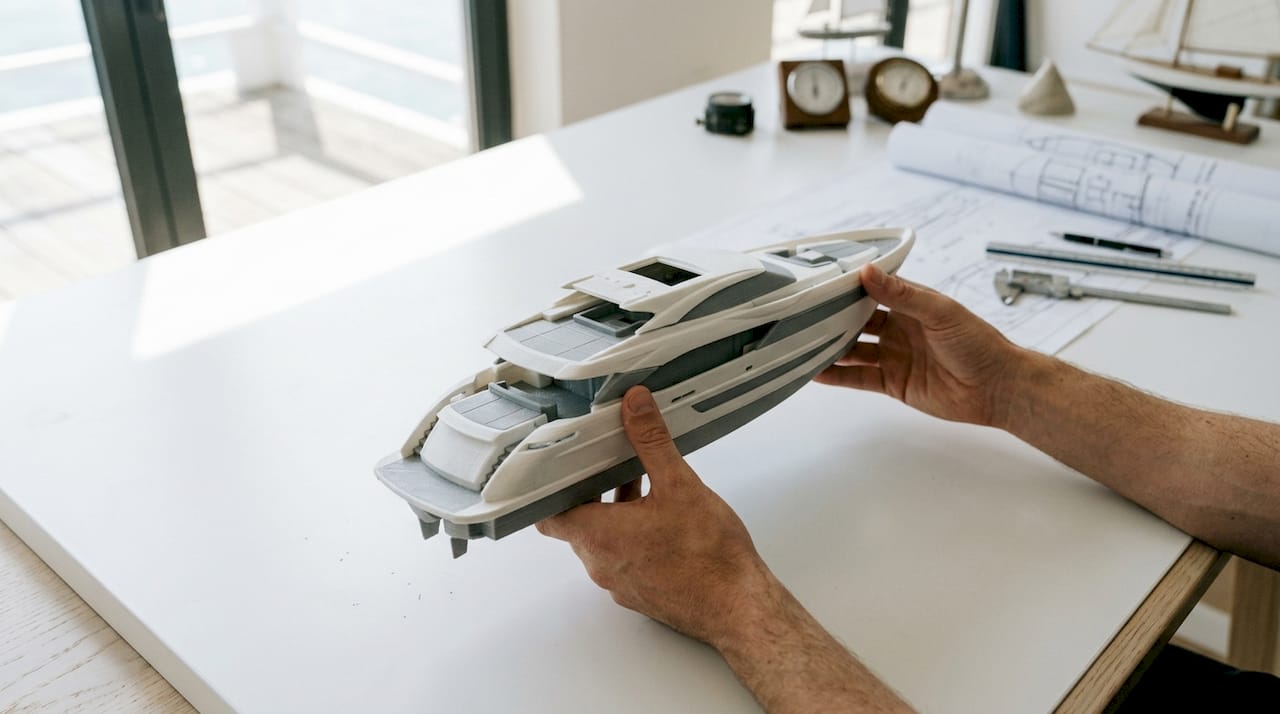
Roll is the most dangerous motion in terms of passenger safety. Resonant roll angles can reach 30–45 degrees under synchronous wave excitation, which means a wave period matching the yacht’s natural roll period creates a feedback loop that amplifies motion dramatically. Roll natural periods typically fall between 10 and 28 seconds depending on hull form and loading. That range overlaps with common ocean swell periods, which is why roll management is central to any serious seakeeping discussion.
Pitch drives the other major comfort problem: slamming. When a bow rises over a wave and drops hard into the trough, the impact loads on the hull can be severe. Naval architects use Response Amplitude Operators, known as RAOs, to predict how a specific hull will respond to a given wave frequency. Think of an RAO as a transfer function: feed in the wave energy spectrum, and the RAO tells you the expected motion amplitude at each frequency. This tool lets designers tune a hull before it is ever built.
- Heave and pitch drive slamming probability and vertical acceleration at the bow
- Roll creates the greatest risk of seasickness and loss of footing
- Surge and sway contribute to fatigue in long passages but rarely dominate comfort complaints
- Yaw affects steering load and autopilot performance in following seas
Pro Tip: If you experience chronic seasickness on a specific yacht, ask your naval architect to pull the RAO curves for roll and pitch. A peak at a common swell period tells you exactly where the problem lives.
How does hull design influence sea keeping performance?
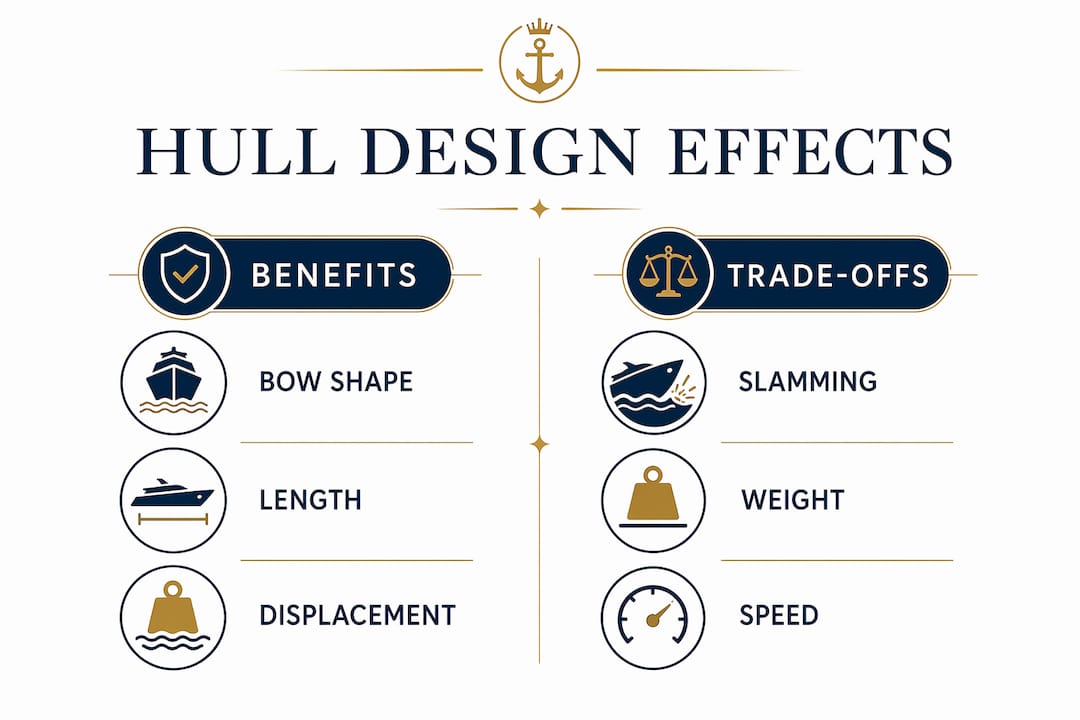
Hull form is the single greatest determinant of how a yacht behaves in waves. Every design choice, from bow shape to displacement, creates trade-offs between speed, comfort, and structural durability.
Bow shape and slamming
Hull flare at the bow increases slamming probability. Flared sections generate significantly higher impact pressures in head seas compared to V-shaped sections. A deep-V bow cuts through waves rather than riding over them, reducing slam loads at the cost of some buoyancy reserve. The X-bow and inverted bow designs, popularized in offshore supply vessels and now appearing on expedition yachts, take this further by eliminating the traditional flared entry entirely. The result is a smoother ride in head seas but a wetter deck in following conditions.
Displacement vs. planing hulls
Displacement hulls move through the water rather than over it. Greater displacement lowers relative acceleration for a given wave energy input, which is why a 120-foot displacement motoryacht rides more smoothly than a 45-foot planing sportfish in the same sea state. Planing hulls trade that comfort for speed. At cruise, a planing hull skips across wave tops, which feels exhilarating in calm water and punishing in a chop.
Hull length and weight distribution
Length matters more than most owners realize. A longer waterline means the hull spans more wave crests simultaneously, reducing the pitch angle for a given wave height. Fuller forward waterplane areas increase the pitch restoring moment and shorten the natural pitch period, which can shift resonance into higher sea states where you are less likely to operate. Weight distribution affects both roll and pitch periods. Heavy engines and fuel tanks placed low and centered reduce GM sensitivity to loading changes.
| Hull characteristic | Sea keeping benefit | Trade-off |
|---|---|---|
| Deep-V bow sections | Reduces slamming impact pressure | Less buoyancy reserve forward |
| Inverted/X-bow | Smooth head-sea ride, less pitching | Wetter deck in following seas |
| High displacement | Lower accelerations in waves | Slower top speed |
| Long waterline | Reduced pitch amplitude | Larger overall footprint |
| Low center of gravity | Improved roll stability | May stiffen roll, increasing accelerations |
Pro Tip: When evaluating a yacht for offshore passages, ask the broker or builder for the pitch natural period. If it falls between 6 and 10 seconds, it overlaps with typical North Atlantic and Gulf Stream swell. That overlap is a comfort red flag.
What standards and criteria measure yacht sea keeping ability?
The industry does not leave seakeeping to guesswork. Specific numeric limits guide both designers and operators.
The NORDFORSK 1987 criteria remain the most widely referenced comfort standard for passenger vessels. They set vertical acceleration RMS limits at 0.15–0.20g and lateral acceleration RMS at 0.07g. Slam probability must stay below 0.01 per minute in moderate seas. Exceeding these limits does not mean the yacht sinks. It means crew fatigue accelerates, passengers become ill, and structural fatigue accumulates faster than the design intended.
Speed polar diagrams translate these limits into operational guidance. A polar diagram maps the maximum safe speed at each heading relative to the wave direction. Masters reduce speed by 30–60% below calm-water speed to keep motions within criteria limits in heavy weather. Yacht owners who understand their vessel’s polar diagram make better real-time decisions about when to slow down, alter course, or seek shelter.
The IMO has updated dynamic stability requirements through MSC.1/Circ.1627, which introduced second-generation intact stability criteria. These rules address wave-induced dynamic failure modes that older static stability calculations missed entirely.
“Second-generation intact stability criteria regulate dynamic failure modes such as parametric roll, surf-riding, and broaching. These are not theoretical risks. They are documented causes of vessel loss, and the new rules exist because static stability alone does not prevent them.”
Parametric roll deserves special attention for yacht owners. It occurs when a vessel’s roll restoring moment changes cyclically as wave crests and troughs pass along the hull. Container ships have capsized from parametric roll. Yachts with fine bows and full sterns are particularly susceptible in following or quartering seas. Knowing your hull’s vulnerability is part of responsible ownership.
How can yacht owners improve sea keeping through operations and equipment?
Improving how a yacht handles in waves does not always require a refit. Operational choices deliver significant results immediately.
-
Use your speed polar diagram. Every yacht with a seakeeping analysis has one. If yours does not, commission one. Speed and heading decisions informed by polar diagrams and RAO predictions keep motion criteria within safe limits. Slowing from 18 knots to 10 knots in a beam sea can cut roll amplitude by more than half.
-
Understand your stabilizer type before you rely on it. Active fin stabilizers provide up to 95% roll reduction underway but lose effectiveness at anchor or at low speeds. Gyroscopic stabilizers work well at anchor and at slow speeds but add significant weight high above the waterline, which raises the center of gravity and can reduce overall stability. Neither system is universally superior. The right choice depends on how and where you use the yacht.
-
Adjust heading before adjusting speed. In confused seas, a 20-degree course change often reduces motion more than a 3-knot speed reduction. Quartering seas at 135 degrees off the bow typically produce the worst combined pitch and roll. Moving to a 150-degree or 120-degree angle can break the resonance pattern.
-
Load the yacht consistently. Fuel, water, and stores affect both the natural roll period and the GM. A yacht that rides beautifully at full fuel load may roll uncomfortably when half-empty because the natural period has shifted. Knowing your yacht’s maintenance schedule and loading plan together is part of managing sea handling.
-
Match your route to your hull. A planing sportfish built for Florida day runs is not the right tool for a winter Atlantic crossing. Customizing a yacht for its intended routes, whether through hull modifications, stabilizer additions, or weight redistribution, produces far better results than fighting the wrong hull in the wrong sea state.
Pro Tip: Before any offshore passage, run your intended route through a weather routing service that outputs significant wave height by heading. Cross-reference that with your yacht’s polar diagram. The overlap tells you exactly where your comfort and safety margins live.
What yacht stability factors affect sea keeping beyond hull design?
Stability and seakeeping are related but distinct. A yacht can be statically stable and still deliver a miserable, dangerous ride.
Metacentric height, known as GM, controls the initial roll restoring force. Higher GM reduces rolling amplitude but increases the speed of the roll, which raises the accelerations passengers experience. A very stiff yacht with a high GM snaps back upright quickly. That snap creates high lateral accelerations that are actually harder on the body than slower, deeper rolls.
Free surface effects from partially filled tanks reduce effective GM. A fuel tank that is 50% full creates a liquid free surface that shifts with the vessel’s motion, reducing stability dynamically. This effect compounds in rough weather when tanks are being consumed unevenly. Keeping tanks either full or near-empty during offshore passages is a practical way to manage this.
- Center of gravity (VCG): Lower is better for stability, but adding heavy equipment high up (like gyro stabilizers or radar arches) raises VCG and reduces GM
- Ballast placement: Fixed ballast low in the keel provides passive roll resistance without the weight penalty of active systems
- Tank management: Symmetric fuel and water consumption preserves trim and reduces free surface effect
- Added topside weight: Every piece of equipment added above the waterline shifts the center of gravity upward and changes the natural roll period
Seaworthiness ensures legal compliance and basic safety. It does not guarantee a comfortable or safe ride in all sea states without matching the design to the intended route and conditions. That distinction matters enormously when planning passages beyond protected waters.
Key Takeaways
A yacht’s sea keeping performance is determined by hull form, natural motion periods, stability parameters, and operational decisions, not by size or price alone.
| Point | Details |
|---|---|
| NORDFORSK 1987 limits | Vertical acceleration RMS must stay at 0.15–0.20g; lateral at 0.07g for passenger comfort. |
| Roll resonance risk | Natural roll periods of 10–28 seconds overlap with ocean swells, amplifying motion to dangerous angles. |
| Hull form trade-offs | Deep-V and inverted bows reduce slamming; high displacement lowers accelerations in waves. |
| Stabilizer selection | Fin stabilizers cut roll up to 95% underway; gyros work at anchor but raise the center of gravity. |
| Operational control | Speed polar diagrams and heading adjustments keep motions within safe limits without hardware changes. |
What I’ve learned after years of watching owners get this wrong
Yacht owners consistently confuse seaworthiness with sea keeping ability. A vessel can hold a valid stability certificate and still make its crew violently ill in a 6-foot chop. I have seen it happen on expensive, well-maintained yachts whose owners had never looked at a polar diagram in their lives.
The second mistake is treating stabilizers as a complete solution. Gyro stabilizers are genuinely impressive at the dock and in slow-speed anchorage conditions. But owners who install them without accounting for the weight penalty and the resulting change in GM are trading one problem for another. I have spoken with captains who noticed their yacht felt “stiffer” after a gyro installation and could not explain why. The answer is almost always a raised center of gravity reducing the natural roll period and increasing snap-back accelerations.
The third mistake is buying a hull for its top speed and then planning offshore passages in it. A planing hull that does 32 knots in flat water is not a comfortable passage-maker in 8-foot seas. The physics do not bend for the price tag. Matching hull design to intended use, and understanding the 2026 safety standards that govern offshore operations, is the most valuable thing an owner can do before writing a check.
Sea keeping is not a feature you buy. It is a characteristic you understand, plan for, and manage every time you leave the dock.
— Jason
Mazzamarine’s approach to sea keeping and yacht performance
Mazzamarine works with Florida yacht owners who take performance seriously. Whether you are evaluating a refit that affects hull weight distribution, adding stabilization systems, or addressing mechanical issues that compromise your vessel’s motion control, the Mazzamarine network brings together specialists who understand how every modification affects how your yacht handles at sea.
From hull and mechanical repairs that restore structural integrity to full refit projects that reshape how a yacht performs offshore, Mazzamarine connects you with Florida’s most experienced yacht professionals. Mino and Luigi built this network on a genuine passion for the sea and a commitment to getting the details right. If your yacht is not riding the way it should, that conversation starts with a call.
FAQ
What is yacht sea keeping ability?
Yacht sea keeping ability is the measure of how well a vessel maintains controlled, safe motion in waves. It covers accelerations, roll and pitch amplitudes, slamming probability, and structural response across different sea states.
What are the NORDFORSK 1987 comfort criteria?
The NORDFORSK 1987 criteria set vertical acceleration RMS limits at 0.15–0.20g and lateral acceleration RMS at 0.07g for passenger vessels. These limits define the threshold between acceptable comfort and conditions that cause fatigue and seasickness.
Do fin stabilizers work at anchor?
Active fin stabilizers require vessel speed to generate lift and lose effectiveness at anchor or very low speeds. Gyroscopic stabilizers are the preferred choice for roll reduction at anchor, though they add weight above the waterline.
How does hull length improve sea handling?
A longer waterline allows the hull to span more wave crests simultaneously, which reduces pitch angle for a given wave height. Longer hulls also tend to have lower natural pitch frequencies, keeping resonance out of common swell ranges.
What is a speed polar diagram for yachts?
A speed polar diagram maps the maximum safe speed at each heading relative to wave direction. Captains use it to make real-time decisions about course and speed adjustments that keep motions within comfort and safety limits.
Recommended
Text or Call 954-330-9653 Schedule Appointment
Mazza Marine Yacht Services & Refit

Fiberglass Upgrades and Damage Repair

Premium Yacht Paint/ Faux Teak

Fishing: Custom Rods, Reels,Tackle

Electrical, Electronics and Navigation

Paint, Hull and Gelcoat

Teak Decks, Wood Cabinets, Carpentry

Canvas, Enclosures and Upholstery

Mechanical, Repower and Running Gear

Plumbing, Bilge and Thru-Hulls

Welding and Custom Fabrication

Interior Refit And Past Work
Get your yacht value Estimate
"*" indicates required fields