
View Our Recent Work:

Overview: A yacht sea trial is the on-water performance test that verifies a vessel’s advertised condition before you commit to closing. Think of it as a technical audit, not a pleasure cruise. With a survey contingency written into your purchase agreement, the trial’s findings become your contractual lever to renegotiate price, demand repairs, or walk away entirely. Most trials run for one to a few hours; large motor yachts with complex systems can take much longer. Mazzamarine’s Florida network of marine surveyors, engine specialists, and certified captains supports buyers through every step of that process.
Key things a sea trial reveals that a dockside inspection cannot:
- Cold-start behavior and time to oil pressure
- Vibration signatures at multiple RPM bands
- Generator performance under realistic load
- Autopilot tracking and electronics accuracy
- Bilge condition and cooling-system stability under sustained WOT
Stat to know: Industry guidance sets the maximum acceptable air-intake temperature delta at a level above ambient that indicates sufficient cool air intake. Exceed that threshold and the engine is starving for cool air, a sign of poor ventilation or a blocked intake.
Table of Contents
- Where does the sea trial fit in the U.S. purchase timeline?
- Who should attend a sea trial and what does each person do?
- What exactly should you test? A sea trial checklist
- How to conduct a sea trial: the day-of runbook
- How do you turn sea trial findings into contract actions?
- What are the red flags that should stop a purchase?
- How should you document results for negotiation?
- Safety and insurance considerations for U.S. sea trials
- Key Takeaways
- What Florida sea trials taught me
- Mazzamarine supports your sea trial from prep to post-purchase repairs
- Useful sources for U.S. yacht buyers
Where does the sea trial fit in the U.S. purchase timeline?
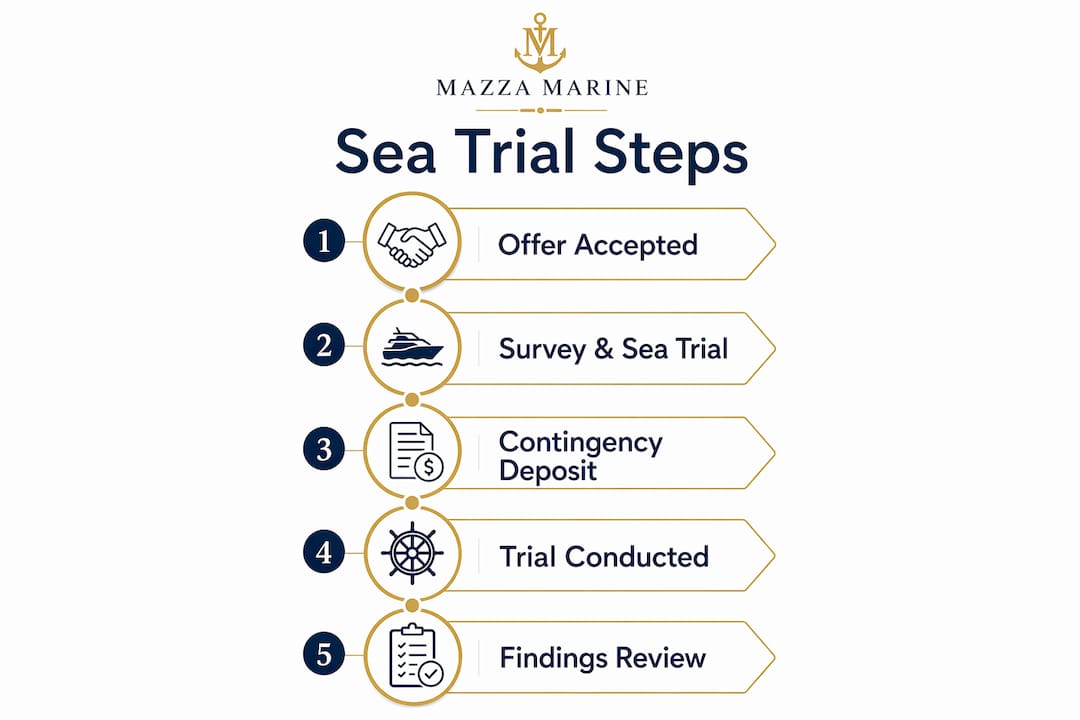
The standard U.S. sequence runs: accepted offer → purchase agreement with a survey-and-sea-trial contingency → deposit held in escrow → coordinated marine survey and sea trial → closing conditional on acceptable findings. The sea trial and haul-out survey are almost always scheduled together to minimize the seller’s disruption and reduce your travel costs. Scheduling both on the same day is common practice in Florida and the broader U.S. market.
Timing also matters for lenders and insurers. Most U.S. marine lenders require a current survey dated within a few months of closing, and underwriters often flag vessels with unresolved sea-trial deficiencies. Scheduling the trial early in the contingency window gives you time to get repair estimates before the deadline.
Cost and duration expectations:
| Vessel type | Typical trial duration | Who typically pays |
|---|---|---|
| Small cruiser | 1.5–3 hours | Negotiable; often buyer |
| Mid-size motor yacht (medium length range) | 1.5–3 hours | Negotiable; often buyer |
| Large motor yacht (longer vessels) | Half day or more | Negotiable; often split |
Fuel costs, captain fees, and surveyor time are all negotiable line items in the purchase agreement. Get them in writing before the trial date.
Who should attend a sea trial and what does each person do?
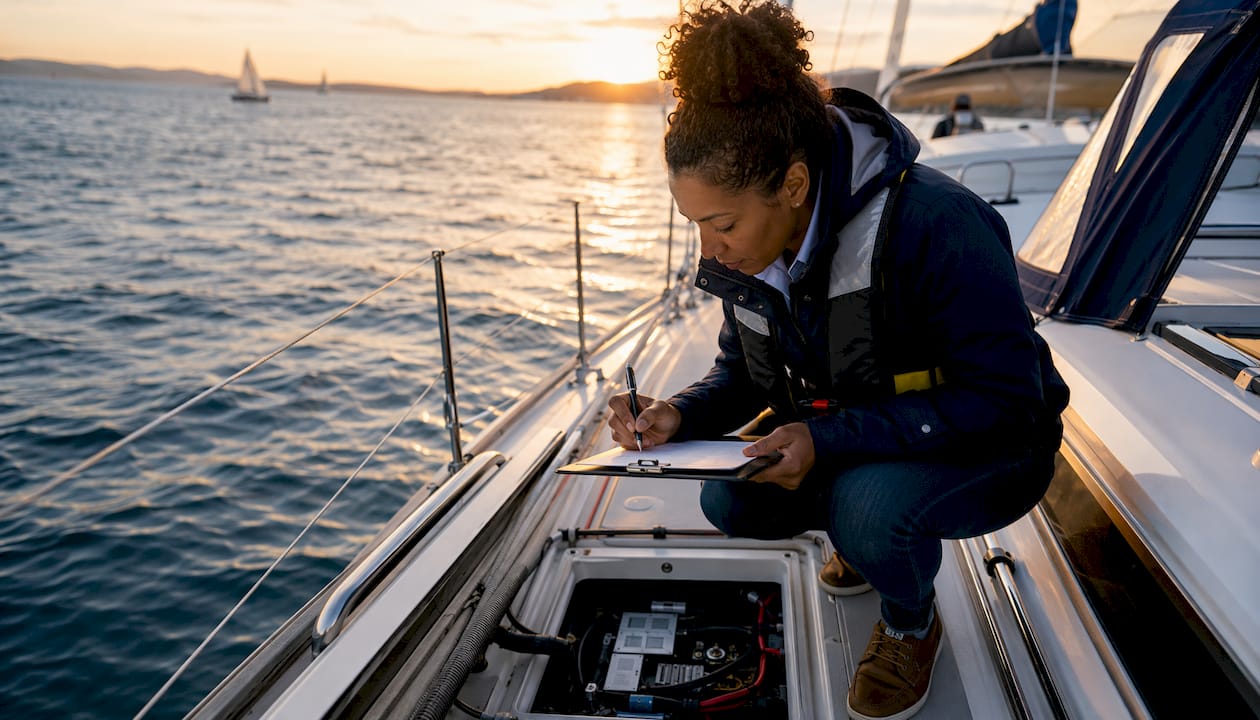
Showing up with the right people is half the battle. A buyer who arrives alone, without a surveyor or qualified captain, is essentially handing the seller a free pass on every mechanical deficiency.
| Attendee | Primary responsibilities | Key output |
|---|---|---|
| Independent marine surveyor | Observe all systems, log measurements, note defects | Signed sea-trial report |
| Qualified captain/skipper | Control throttles and maneuvers safely | Operational observations |
| Buyer/principal | Ask questions, review instruments, take notes | Acceptance or rejection decision |
| Broker (if used) | Facilitate communication, document agreed items | Written summary to both parties |
| Engine specialist | Deep-dive on mechanical anomalies when warranted | Repair scope and cost estimate |
The seller or seller’s representative should also be present for liability and insurance reasons. If the vessel is damaged during the trial, clear documentation of who was aboard and who controlled the helm matters enormously for insurance claims.
What exactly should you test? A sea trial checklist
This is where the yacht testing process separates informed buyers from expensive mistakes. Focus on measurable metrics, not cabin finishes.
Engine and propulsion
- Cold start: Note smoke color, time to oil pressure, and any rough idle. A warm start hides problems a cold start reveals.
- RPM progression: Step up in 500 RPM increments, recording fuel flow and speed at each band.
- WOT (wide-open throttle): Confirm the engine reaches its rated RPM range and hold it under observation for at least 5–10 minutes while monitoring temperatures.
- Exhaust smoke: White smoke after warm-up suggests coolant intrusion; black smoke points to over-fueling or restricted airflow; blue smoke indicates oil burning.
- Transmission: Shift smoothness in forward and reverse, engagement timing, and any clunking.
Cooling and air intake
Coolant temperature should stabilize and hold steady under sustained load. Air-intake delta is the metric most buyers miss: the air entering the engine should not exceed ambient outside temperature by more than 16–17 °C. A higher delta signals restricted ventilation and chronic heat stress on the engine.
Generator
Load the generator to a high level of its rated capacity by running HVAC, refrigeration, and house loads simultaneously. A start-and-idle test tells you almost nothing about real-world reliability.
Vibration and shaft alignment
Place your hand on the engine mounts, shaft log, and hull near the struts at cruise RPM. Excessive vibration at specific RPM bands often points to a bent shaft, worn cutlass bearings, or a damaged propeller. Note the RPM band where vibration peaks.
Navigation and electronics
Boot the chartplotter, radar, and GPS cold. Confirm the autopilot holds a steady course without hunting. Check instrument consistency: does the GPS speed match the knotmeter?
Measurement log template:
| Metric | Target / normal range | Recorded value |
|---|---|---|
| Cruise RPM / speed | Per manufacturer spec | |
| WOT RPM | Per manufacturer spec | |
| Fuel flow at cruise | Per manufacturer spec | |
| Oil pressure (warm idle) | Per manufacturer spec | |
| Coolant temp (sustained WOT) | Per manufacturer spec | |
| Air-intake delta | within the recommended range above ambient temperature | |
| Generator voltage under load | 120V (60 Hz) | |
| Vibration notes | None perceptible at cruise |
Pro Tip: Request ECM (Engine Control Module) RPM-band hour data before the trial. ECM data exposes heavy high-RPM usage patterns that a paper log or seller’s verbal history can easily mask.
How to conduct a sea trial: the day-of runbook
Preparation the night before is as important as the trial itself. Confirm the surveyor’s availability, verify the vessel will have full fuel (document the level), and ask the seller explicitly not to pre-warm the engines.
Day-of safety checklist before cast-off:
- Lifejackets counted and accessible for all aboard
- Fire extinguishers checked and tagged
- VHF radio tested on working channel
- Emergency procedures briefed to all attendees
- Fuel quantity recorded and photographed
Trial sequence:
- Dock checks: inspect bilge, engine room, and all through-hulls before starting engines.
- Cold start: observe and record immediately.
- Thruster and berthing tests at the dock.
- Idle and displacement-speed run: check steering response and cooling at low load.
- Incremental RPM runs in 500 RPM steps, logging fuel burn and speed at each.
- Cruise-speed sustained run: hold for 20–30 minutes, monitoring all temperatures.
- WOT run: hold for 5–10 minutes when sea conditions allow; record all metrics.
- Maneuver tests: hard turns to port and starboard, backing down, beam-sea heading.
- Generator and house-load stress test at approximately 80% capacity.
- Return to dock: note any change in handling, smoke, or instrument readings.
Pro Tip: If the day offers only dead-calm water, note that limitation in the log and negotiate a follow-up run in modest chop. Calm water rarely reveals stabilizer performance or hull behavior at sea.
For buyers interested in how professional crewing affects vessel handling during maneuver tests, observing a qualified captain work through the sequence is genuinely instructive.
How do you turn sea trial findings into contract actions?
A sea trial’s findings are only as powerful as the contract language behind them. Frame deficiencies clearly before you make any demand.
- Minor deficiencies (worn belts, a faulty bilge pump switch, a single instrument glitch): request seller repair with receipts before closing, or accept a modest price credit.
- Material deficiencies (inability to reach rated RPM, overheating under load, shaft vibration): demand independent repair estimates, then negotiate a price reduction or an escrowed repair holdback.
- Deal-breakers (coolant intrusion, structural delamination, persistent smoke at WOT): exercise the survey-and-sea-trial contingency and cancel. Review the bill of sale process to confirm your deposit recovery rights.
Pro Tip: Always attach the surveyor’s signed sea-trial log to any contingency claim. A documented, witnessed measurement carries far more weight in renegotiation than a buyer’s verbal complaint.
What are the red flags that should stop a purchase?
Some findings are negotiable. Others are not.
- Persistent smoke beyond the first 60 seconds of cold start: white smoke after warm-up is a serious warning sign of coolant intrusion, especially when paired with a milky oil dipstick.
- Overheating under sustained load: if coolant temp climbs and does not stabilize, the cooling system has a real problem.
- Inability to reach rated WOT RPM: points to propeller damage, fouled bottom, or internal engine wear.
- Excessive vibration at cruise RPM: bent shaft or damaged prop until proven otherwise.
- Autopilot that cannot hold course: a navigation system failure that affects safety and resale value.
- Bilge contamination or persistent leaks: oil sheens, raw water intrusion, or fuel odors in the bilge are immediate concerns.
- Maintenance records that do not match observed wear: mismatched ECM hours and logbook entries suggest selective record-keeping.
When multiple red flags appear together, bring in a specialist before making any repair demands. An engine repower or structural repair changes the economics of the deal entirely.
How should you document results for negotiation?
Documentation is what converts observations into leverage. A verbal “the engine ran hot” claim goes nowhere without a timestamped log and a surveyor’s signature.
- Measurement log: capture RPM, speed, fuel flow, oil pressure, coolant temp, intake-air delta, vibration notes, and generator load at each test phase. Include time stamps.
- Photos and video: engine room cold-start, exhaust plume at start and WOT, instrument panel screenshots, bilge condition, and hull run-off from astern.
- Surveyor’s signed report: must include ECM/RPM-band hours, generator load test results, and a written statement of all observed defects.
- Chain of evidence: share the complete log with the broker and seller via dated email immediately after the trial. Keep original files. Review the yacht condition report standards to confirm your documentation meets lender and insurer expectations.
Safety and insurance considerations for U.S. sea trials
Before anyone boards, confirm who is insured. The seller’s Protection and Indemnity (P&I) policy typically covers the vessel during a trial, but it may not extend to guests or a buyer operating the helm. Request written proof of coverage before the trial date.
Pre-cast-off insurance and safety checklist:
- Confirm seller’s P&I policy covers trial participants and the trial route.
- Clarify whether the buyer’s own marine insurance requires notification before boarding a vessel under survey.
- Never operate in conditions that exceed the vessel’s rated sea state or the captain’s comfort level.
- Understand that a buyer who takes the helm assumes operational liability; most buyers wisely leave throttle control to the captain.
- Lenders and insurers may require a current survey (often within 90–180 days) as a condition of financing or coverage; a failed sea trial can delay or void underwriting approval.
- Older electrical systems flagged during the trial often trigger hull insurance alerts; address these before binding coverage.
This article is general information for educational purposes. Confirm current insurance requirements, legal obligations, and survey standards with a licensed marine surveyor, maritime attorney, or your insurer before proceeding.
Key Takeaways
A yacht sea trial is a technical audit that must be documented, witnessed by an independent surveyor, and tied directly to your purchase contingency to carry contractual weight.
| Point | Details |
|---|---|
| Treat it as a technical audit | Focus on measurable engine, cooling, vibration, and generator metrics, not cabin finishes. |
| Insist on a cold start and surveyor | A warm start hides defects; only a signed surveyor report creates enforceable negotiation leverage. |
| Record specific measurements | Log RPM bands, fuel flow, coolant temp, and air-intake delta (target ≤16–17 °C above ambient). |
| Load-test the generator | Test at a high capacity load with HVAC and refrigeration running, not just a start-and-idle. |
| Mazzamarine supports the full process | From pre-trial engine checks to post-trial repairs and escrow-ready work orders in Florida. |
What Florida sea trials taught me
The most common mistake I see Florida buyers make is treating the sea trial as a formality after falling in love with a boat at the dock. By the time they’re underway, they’re mentally decorating the salon instead of watching the temperature gauges.
Florida’s heat load is genuinely punishing on generators. A generator that passes a cool-morning start test in February can fail spectacularly on a July afternoon with the air conditioning running. That seasonal gap is why Mazzamarine always recommends a full load test, not a courtesy idle. Salt-accelerated corrosion is the other Florida-specific trap: ECM hour discrepancies between the logbook and the actual module data are more common here than buyers expect, particularly on vessels that have changed hands multiple times in South Florida’s active brokerage market.
The best seasonal window for a realistic Florida sea trial is October through April, when sea states in the Atlantic and Gulf are more varied and temperatures are manageable. Hurricane season (June through November) brings its own complications: choppy conditions can actually be useful for hull and stabilizer testing, but scheduling around weather windows requires flexibility. When a trial surfaces engine, electrical, or structural concerns, bring in a specialist before you negotiate, not after. A repair estimate from a credentialed professional carries far more weight than a buyer’s guess.
Mazzamarine supports your sea trial from prep to post-purchase repairs
When a sea trial reveals mechanical issues, the clock on your contingency window starts immediately. Mazzamarine’s Florida network covers the full range of post-trial needs: engine and generator stress testing, ECM data pulls, refrigeration and HVAC load verification, electrical diagnostics, and certified repair work orders formatted for escrow holdbacks. If the trial uncovers something serious, the Florida yacht repair guide is a practical starting point for understanding repair scope and cost before you make a demand.
Mazzamarine also coordinates pre-trial preparation, including engine checks, marine mechanical systems reviews, and full maintenance assessments so the vessel you’re evaluating is tested fairly, not artificially warmed up or masked. Contact Mazzamarine to request a pre-trial checklist or to schedule a technical sea-trial support team for your next Florida purchase.
Useful sources for U.S. yacht buyers
These resources offer vetted guidance on sea-trial standards, survey requirements, and measurement norms:
- YATCO Sea Trial Guide: Practical overview of what to expect on the water, including system checks and buyer responsibilities.
- YATCO Sea Trial Tips: Measurement-focused guidance including the air-intake delta standard and generator load protocol.
- Yachtlista Sea Trial Checklist: Structured checklist covering cold-start protocol, ECM data requests, and weather planning.
- YachtWorld Sea Trial Research: Contractual context for using sea-trial findings in price renegotiation and contingency claims.
- YATCO Blog: What to Expect: Buyer-facing narrative on the trial’s role in the purchase process and post-trial decision options.
Always use an independent marine surveyor whose signed sea-trial log is attached to any contingency claim. That document is your primary evidence in any renegotiation or contract dispute.
Recommended
Text or Call 954-330-9653 Schedule Appointment
Mazza Marine Yacht Services & Refit

Fiberglass Upgrades and Damage Repair

Premium Yacht Paint/ Faux Teak

Fishing: Custom Rods, Reels,Tackle

Electrical, Electronics and Navigation

Paint, Hull and Gelcoat

Teak Decks, Wood Cabinets, Carpentry

Canvas, Enclosures and Upholstery

Mechanical, Repower and Running Gear

Plumbing, Bilge and Thru-Hulls

Welding and Custom Fabrication

Interior Refit And Past Work
Get your yacht value Estimate
"*" indicates required fields